WASHINGTON (AP) — Russia has released an American military veteran who spent more than four years in prison on disputed charges under abusive conditions and was said to be gravely ill and at risk of dying, a group advocating for him said Tuesday.
Robert Gilman was on his way to a U.S. military hospital in Texas, where he will be medically and psychologically assessed and treated, said Eric Lebson, chief strategy officer of Global Reach, a group that’s been working to free him and other American detainees abroad. Gilman’s family has flown to Texas to be with him, including his mother, who was in Russia attempting to see him at a hospital.
Gilman, a 32-year-old teacher detained since 2022, was initially handed a 3 1/2-year sentence when he was convicted of beating a police officer after being taken off a train for causing a disturbance. He later was convicted of attacking a prison inspector during a cell check, beating an investigator and assaulting a guard, and he was sentenced in October 2024 to eight years and one month. His sentence was extended last year to 10 years after he was found guilty of assaulting prison guards.
Gilman's sister, Lexie Hudson, credited President Donald Trump and U.S. Sen. Ed Markey of Massachusetts with bringing about the former Marine's release.
“There is no other reason that Robert is alive today other than that President Trump heard about the case and took action,” said Hudson, who thanked Markey “for leading our advocacy efforts in Congress.”
“The Russians treated my brother so badly," Hudson said. "They hurt him for no reason, other than that he was both an American and a Marine. What did they get out of this? Why did they do this to such a wonderful person?”
The State Department said that Gilman, who had been determined recently to have been wrongfully detained, was released on humanitarian grounds and “was not part of an exchange, and no other concessions were provided.”
“This as a welcome step that we hope leads to the release of Americans unjustly held in Russia, such as wrongful detainee Stephen Hubbard,” it said.
Before Gilman was flown out of Russia, he had been in “a dissociative stupor” for 47 days due to the abuse he has suffered in prison, Lebson said. Gilman had been moved from a prison to a civilian hospital, where he was hooked up to a feeding tube and handcuffed to a bed.
Hospital reports conveyed Gilman’s condition “as dire and life-threatening,” pushing the U.S. government into action and leading to “a unilateral humanitarian release” by Russian officials, Lebson said.
Markey had called on Russia and the U.S. to work together to get the Massachusetts resident released. Gilman was among at least eight Americans who remained in Russian custody after a series of high-profile prisoner exchanges with the U.S. in recent years.
Markey blamed Russia for Gilman's poor health, saying his return to the U.S. was long overdue.
“It is a tragedy that it took Robert’s near-death condition for his case to receive the attention that it required for his release to be negotiated," Markey said. "Throughout his detention, Robert was subjected to physical torture, forced medication, and provocations by Russian authorities. There is no doubt that his treatment by Russian authorities is the reason Robert is in this precarious state today.”
The Associated Press was making efforts to get comment from Russian officials on Gilman's release.

FILE - American and Russian flags are pictured on stage before President Donald Trump and Russia's President Vladimir Putin participate in a joint press conference at Joint Base Elmendorf-Richardson, Alaska, Aug. 15, 2025. (AP Photo/Jae C. Hong, File)

FILE - U.S. and Russian national flags wave on the wind at Moscow's Vnukovo airport, Russia, April 11, 2017. (AP Photo/ Ivan Sekretarev, File)

FILE - U.S. and Russian national flags wave on the wind at Moscow's Vnukovo airport, Russia, April 11, 2017. (AP Photo/ Ivan Sekretarev, File)
Primary elections are taking place in six U.S. states on Tuesday — Alabama, Connecticut, Minnesota, South Carolina, Vermont and Wisconsin.
Minnesota voters will settle a moderate-versus-progressive Democratic U.S. Senate primary between centrist U.S. Rep. Angie Craig and progressive Lt. Gov. Peggy Flanagan. In the race for governor, Mike Lindell, known as the MyPillow Guy, leads a crowded Republican primary with President Donald Trump’s endorsement, while Sen. Amy Klobuchar faces minimal opposition for the Democratic nomination.
The Democratic primary for Wisconsin governor is another high-profile clash between the party’s establishment and progressive wings, as democratic socialist Francesca Hong tries to rise above establishment candidate David Crowley. In a Republican primary for U.S. House, Trump-backed candidate Michael Alfonso, the 26-year-old son-in-law of U.S. Transportation Secretary Sean Duffy, is seeking to win Duffy’s former district.
And Republicans in South Carolina are casting ballots in a special primary election to replace the late U.S. Sen. Lindsey Graham on the state’s general election ballot. The crowded race has attracted top party members, including two congressmen and a former governor — but Trump has endorsed Graham’s sister, Sen. Darline Graham, a political unknown appointed to serve out the final months of her late brother's current term.
Here's the latest:
Linda Biles believes Hong’s politics will frighten voters like her — a Republican in a largely rural area who votes Democratic because she dislikes Trump and politicians who back him.
“I think just the word ‘socialism’ is turning off Republicans,” said Biles, a 71-year-old retired home economics teacher, after casting her ballot in the western Wisconsin town of Hudson. “It scares them away.”
Crowley, she said, was an obvious choice: “He’s got more of a chance of beating Tiffany,” she said.
Michele Tafoya is seeking the Republican nomination for U.S. Senate.
She strode into a suburban Minneapolis church with a phalanx of reporters and photographers watching. She checked in with poll workers, filled out her ballot and fed it into the counter.
“How are you?” she asked the top election official on site.
“I’ll be glad when you’re done,” the stressed-out official responded with a laugh.
In the parking lot out front, she argued that this will be the year voters end a 20-year losing streak for Republicans running statewide in Minnesota. Voters, she said, are fed up after widespread reports of fraud in public assistance programs.
“Minnesotans are ready. We’ve had a crisis of leadership here,” Tafoya said. “We’ve seen what career politicians have done in this state. They’ve brought us to a place of national embarrassment, and this state is ready for change.”
Asked if she would have handled anything differently about the sprint of a special Senate primary, Graham said she had no regrets.
“I don’t think I could have done anything any differently,” Graham told reporters outside the Lexington church where she and her family voted. “It was my priority to be in Washington as your representative, working hard, and I got back here just as soon as I possibly could.”
With the Senate staying in session until early Saturday morning, Graham — as South Carolina’s interim senator — was in Washington for votes during much of the campaign.
Anticipating a runoff to follow Tuesday’s crowded GOP Senate primary, Graham told reporters that she would “get out and work really hard to earn” voters in the ensuing two-week period.
Democratic Sen. Amy Klobuchar has had a successful career in Washington, but she’d prefer to head back home to Minnesota. She’s the leading candidate for governor in the state’s Democratic primary.
She’s not alone. Four senators ran for governor this year, underscoring how sharply the balance of political ambition has shifted away from Washington.
Although the Senate was once seen as the capstone of a long political career or a premier perch for launching presidential bids, it has become increasingly stagnant and dysfunctional.
Sens. Marsha Blackburn of Tennessee and Tommy Tuberville of Alabama both won Republican gubernatorial primaries this year.
But Colorado Democratic Sen. Michael Bennet wasn’t as fortunate. He lost to state Attorney General Phil Weiser.
Bronin was a sophomore at Yale University when Larson was elected to the U.S. House in 1998.
Now he’s standing in the way of Larson getting a 15th term representing Connecticut. The two face off in another contest that pits the party’s old guard against a younger generation.
Bronin, 46, is the former mayor of Hartford. He’s a lawyer, former Rhodes scholar and U.S. Navy Reserve officer.
Larson is 78. While he has been popular in his central Connecticut district throughout his time in office, concerns about his health arose when he suffered a partial seizure during a speech on the House floor last year.
In a flip of the usual script for primary challengers, Bronin can lay claim to be the establishment candidate. He won the Democratic state party’s endorsement at a nominating convention earlier this year.
The interim senator and her 17-year-old daughter Nicole Nordone voted midday Tuesday at a Lexington County church.
“It was a hard choice,” Nicole said jokingly to her father, as they walked out of the voting area so that Darline Graham could speak with reporters.
After she fed her ballot into a reader machine, Graham told poll workers that she typically votes at another location. Many polling sites have been changed for Tuesday’s special election due to several factors, including classes beginning this week at many schools typically used for voting.
South Carolinians who are 17 years old but will be 18 before the general election can vote in primaries.
Michael Alfonso has leaned into his endorsement from Trump in the five-way Republican primary for Wisconsin’s 7th Congressional District.
The 26-year-old Alfonso has faced blowback from some Republican leaders in the district who question whether he is too young and inexperienced for the job.
Alfonso is counting on Trump’s endorsement carrying the day in the deeply red district.
Duffy held the congressional seat from 2011 until 2019, when he resigned mid-term. He returned to politics last year when Trump tapped him to serve as transportation secretary. Alfonso is married to Duffy’s daughter, Evita Duffy.
After losing a top Senate advocate when the South Carolina Republican suddenly died, Trump has angled to play a role in picking his replacement, too.
Trump heralded the selection of Darline Graham as “a fabulous tribute” to serve as her brother’s interim replacement. And he urged her to run in the special primary, endorsing Graham before she’d made her candidacy official.
In forging a relationship with Darline Graham, Trump could be angling to develop another ally to help steer his agenda through the Senate.
So far, Darline Graham has been doing just that. Repeatedly stressing to voters her intent to support Trump’s policy positions, she often references in particular her co-sponsorship of a voting bill that’s become a key priority for the president.
Trump relied on Lindsey Graham in the Senate and has endorsed Darline Graham to replace him.
She had already been known as Lindsey Graham’s sister and lifelong supporter, but since her brother’s death a month ago, Darline Graham has been thrust into the political spotlight.
A day after the late senator’s sudden death was announced, South Carolina Gov. Henry McMaster named Darline Graham to serve the remaining months on his current term, which expires in January. She was sworn in the next day and took his spot on powerful committees, including Judiciary.
Days later, Darline Graham was among the candidates jumping into a special GOP primary to replace her late brother on November ballots. She’s appeared at various stump events and one debate, although Senate business kept her off the campaign trail as other hopefuls traversed the state.
U.S. Rep. Angie Craig has support from the party’s establishment, while Lt. Gov. Peggy Flanagan is backed by prominent figures on the left including Sen. Bernie Sanders.
The primary will again take the temperature of Democratic voters a week after progressive Abdul El-Sayed won a bitter and divisive primary in Michigan that fired up the left and fueled anxiety among party leaders that Democrats will alienate moderate swing voters.
Craig says her record of winning repeatedly in a battleground House district will ensure the seat stays in Democratic hands. Flanagan says Craig hasn’t stood firm enough against President Donald Trump and wealthy donors.
Wisconsin voter Jesse Heer said Hong understands “what it’s like to live here and have to afford to live here.”
Heer, a 32-year-old business owner from Madison, said Hong’s focus on affordability issues was the top reason he voted for her. And he’s not buying the argument from other Democrats, including Hong’s more moderate challenger, Milwaukee County Executive David Crowley, that she will have a harder time winning in the general election.
“I think she’s a good candidate,” Heer said. “I think a lot of people agree.”
Hong voter Kelly McClurg, 40, of Sun Prairie, says Hong has shown “she’ll be able to push back more” on issues that Democrats care about, like affordability.
McClurg said if fellow Democrats believe in her, and don’t assume she can’t beat Republican Tom Tiffany, “she can win.”
Wisconsin voters who cast their ballots Tuesday for the gubernatorial candidate favored by more mainstream Democrats say they are confident the party will unite even if the progressive challenger wins.
David Zimmerman, a 79-year-old retired industrial engineering professor, voted for Milwaukee County Executive David Crowley. Crowley is endorsed by Gov. Tony Evers and is seen as the pick of more moderate Democrats.
Zimmerman says he worries “a lot” about progressive candidate Francesca Hong’s ability to defeat Republican Tom Tiffany in November.
“I think she’s going to have trouble winning,” Zimmerman said.
But both Zimmerman and fellow Crowley voter Julie Martinson, 69, predict Democrats will come together even if Hong wins. They said they would vote for her in November.
“There’s no reason we can’t galvanize around her and get her in there,” Martinson said.
No Connecticut governor has served three consecutive terms in modern times. Former Republican Gov. John G. Rowland was elected to a third consecutive term in November 2002 but he resigned in 2004 amid a corruption scandal.
In Tuesday’s Democratic primary, Lamont, 72, takes on state Rep. Josh Elliott, 41, who is running left of the current governor.
One of two Democratic governors who attended President Donald Trump’s inauguration, Lamont has carefully chosen which issues to criticize the Republican president on. That tactic has prompted complaints from more liberal Democrats in Connecticut.
This post has been updated to correct the ages of Lamont and Elliott. Lamont is 72, not 71. Elliott is 41, not 42.
The state is holding special primaries in four congressional districts after it won permission from the U.S. Supreme Court to change its congressional maps. The state tossed out the results of May primaries and scheduled the Tuesday special primaries using the new map.
Turnout for party primaries is typically low. It was 23% in the May primary and 10.7% for the June runoff. It is expected to be particularly low in a special late-summer primary, when people are unaccustomed to voting.
Six Republicans are seeking the GOP nomination in the redrawn 2nd Congressional District. The winner will challenge Democratic Rep. Shomari Figures in November.
Republican candidates and party officials have been trying to promote the special primary and get voters to the polls. The primaries will be decided without a runoff.
Polling places opened across the state at 7 a.m. EDT, and voters have until 7 p.m. to cast their ballots.
It’s only been two months since South Carolina voters made their picks in the primary elections in June. But Graham’s sudden death last month set into motion a special primary to pick a Republican replacement for the general election ballot in November.
Candidates have only had a matter of weeks to campaign.
There were three days of early voting last week, and Tuesday’s special election also coincides with the first day of school in some areas, so polling places have changed for many who typically are assigned to vote at schools for summertime primaries.
The topsy turvy race pits democratic socialist Francesca Hong against the governor’s endorsed candidate David Crowley.
Hong has ridden a wave of support from liberals to bolster her insurgent campaign. Crowley had quit the race but got back in — with Democratic Gov. Tony Evers’ endorsement.
Crowley rejoined the race after Lt. Gov. Sara Rodriguez dropped out last month amid a campaign finance scandal.
Former Lt. Gov. Mandela Barnes had the highest name recognition after a 2022 U.S. Senate run, but he also dropped out less than two weeks before the primary amid questions about inappropriate behavior.
In the Republican primary for governor, U.S. Rep. Tom Tiffany has Trump’s endorsement and faces nominal opposition.
Progressive candidates for governor in Wisconsin and U.S. Senate in Minnesota are increasing the pressure on a Democratic establishment that has spent the year on its heels.
Today’s primaries come a week after Abdul El-Sayed narrowly defeated Rep. Haley Stevens in Michigan’s divisive and costly U.S. Senate primary. El-Sayed’s victory has energized the left while stoking fears among Democratic Party leaders that the shift to the left, particularly in battleground states like Michigan and Wisconsin, will make it more difficult to win in November.

Minnesota Lt. Gov. Peggy Flanagan, a Democratic candidate for U.S. Senate, greets supporters during a campaign event at the Leech Lake Band of Ojibwe Twin Cities Office in Minneapolis, Saturday, Aug. 8, 2026. (AP Photo/Ellen Schmidt)
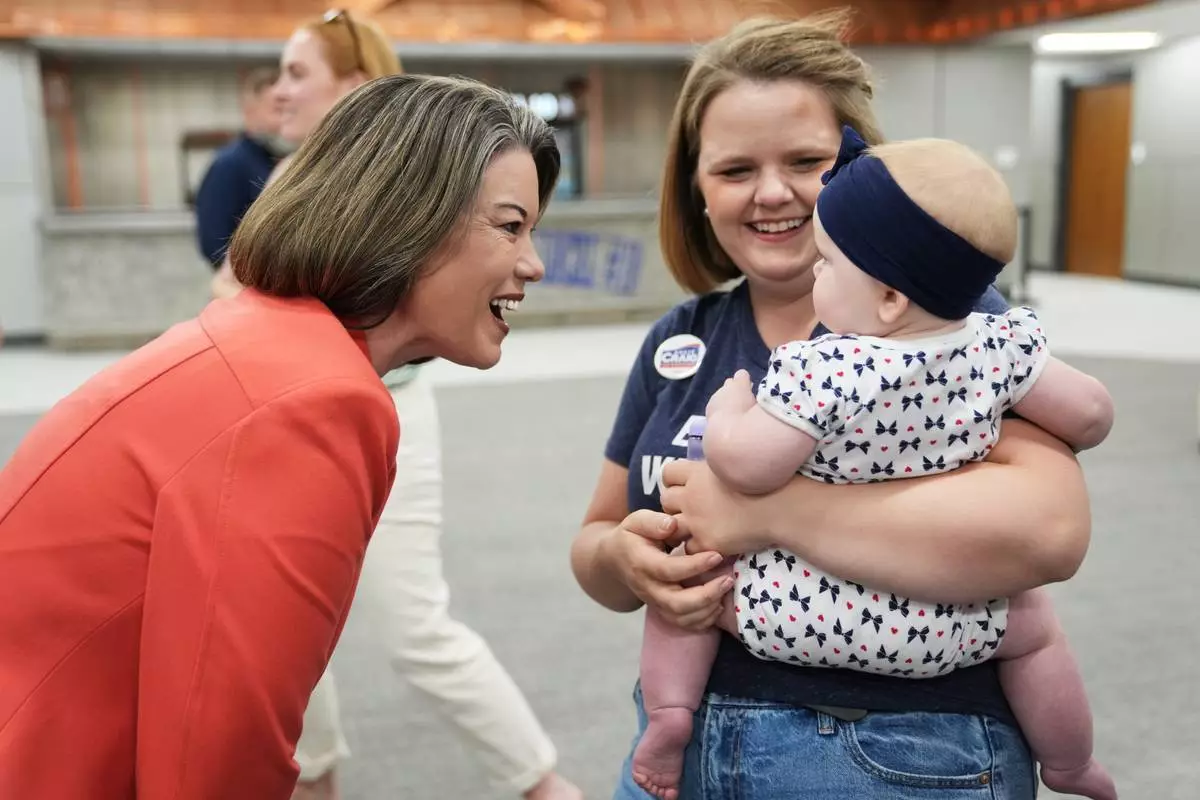
U.S. Rep. Angie Craig, D-Minn., candidate for U.S Senate, greets Merci Wolff and her daughter during a canvassing event at SMART Sheet Metal Workers Local #10 headquarters, Monday, Aug. 10, 2026, in St. Paul, Minn. (AP Photo/Ellen Schmidt)

Campaign signs for Michael Alfonso, a candidate for U.S. House in Wisconsin's 7th congressional district, line the entrance to an event, Tuesday, Aug. 4, 2026, in New Richmond, Wis. (AP Photo/Ellen Schmidt)

David Crowley, right, Democratic candidate for Wisconsin governor talks with CJ Arthur, left, owner of WordHaven BookHouse during a campaign stop with Wisconsin Gov. Tony Ever, center, Friday, Aug. 7, 2026, in Sheboygan, Wis. (AP Photo/Kayla Wolf)