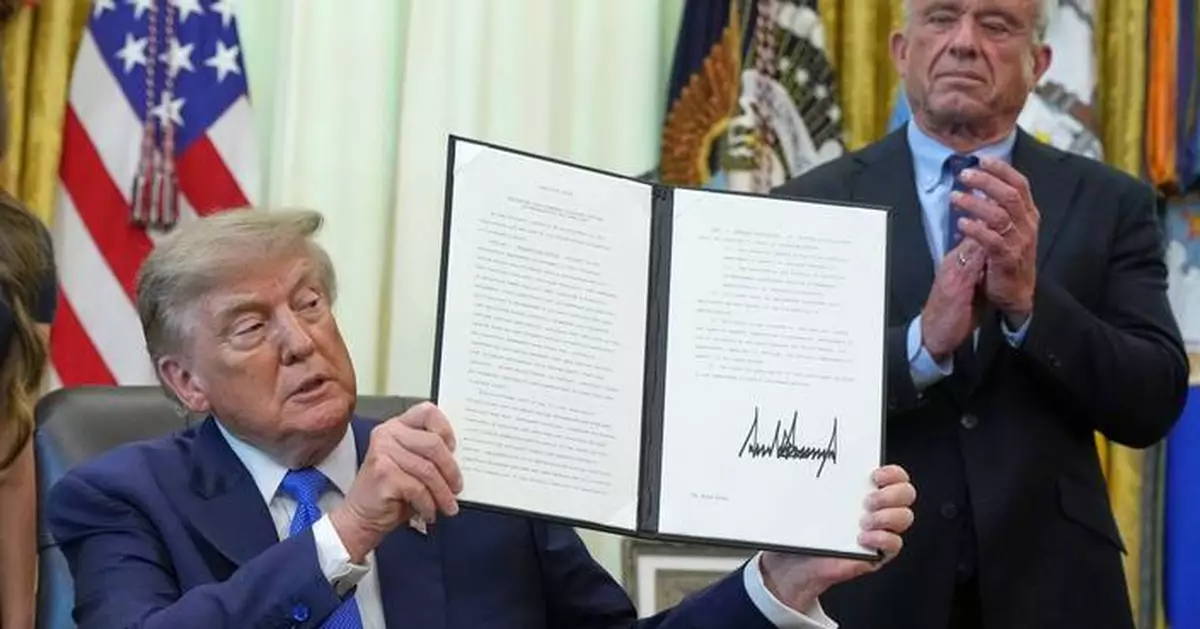
While issuing an executive order on Monday aimed at getting states to revise childhood vaccine recommendations, President Donald Trump and others in his administration repeated several false claims about those vaccines, as well as their relationship to autism.
The order recommends separating the measles, mumps and rubella (MMR) vaccine into three separate single-disease shots and administering childhood vaccines at separate appointments whenever possible.
But many public health experts expressed concern about the recommendations, saying that spacing out the shots could increase the risk that children would become infected with a vaccine-preventable disease before returning for another visit. They noted that childhood vaccines and how they should be given have been rigorously studied around the world for decades, and continue to prove to be safe and effective at protecting children.
Here's a closer look at the facts.
TRUMP: “In many cases, we were requiring 72 jabs for our beautiful, healthy, lovely, delicate little children."
THE FACTS: That's misleading. In 2025, the government's childhood vaccination schedule recommended routine protection against 18 diseases. How many separate injections that added up to between birth and age 18 varied. It depended on things like the brand used, the availability of combination shots and the child's starting age. But unless you counted once-a-year flu vaccines (which some kids can get as a nasal spray) or COVID-19 shots, the number of injections was closer to three dozen.
Those shots have been proven to protect children from preventable and sometimes devastating diseases. Even so, vaccines were never “required,” as families could opt out. States do require children to get certain vaccines before enrolling in school, but the state lists of school shots were narrower than the federal vaccine schedule, and many states offer different types of exemptions.
The Trump administration in January cut the national vaccine recommendations to injections against 11 diseases, with additional vaccines now separately categorized for at-risk children or as available through “shared decision-making” with a doctor. This drops the total number of injections to about 23 if children receive only the recommended-for-all vaccinations on the administration's new schedule.
TRUMP: “You have the MMR, we want it in three separate vaccinations given at separate times. Together there could be a possibility they are quite lethal and separately, it looks like they are not at all lethal but just very effective."
THE FACTS: This is false. Doctors say, and years of real-world evidence prove, that the current combination MMR vaccine is both safe and effective at protecting children from illness. Common side effects are mild and include a sore arm from the shot, fever, mild rash and temporary pain and stiffness in the joints. Doctors point out that separate vaccines for measles, mumps and rubella are not available in the United States.
“I’m concerned about an unintended consequence of people under vaccinating because of fear that giving a single dose of the MMR is going to put their child at risk when there’s no evidence to suggest that’s the case,” said Dr. Aaron Milstone, pediatric director of infection prevention at Johns Hopkins Health System and a fellow with the American Academy of Pediatrics. “There are many, many, many years of scientific data highlighting the safety of vaccines in children.”
TRUMP: “Large amounts of vaccine, large amounts of like vats of vaccine are currently pumped into your child’s body.”
THE FACTS: This is false. Dr. Molly O’Shea, a Michigan pediatrician, said amounts vary slightly by vaccine, but doctors give less than 0.5 milliliters per vaccine -- usually 0.1 to 0.3 milliliters per vaccine. By comparison, a teaspoon is about 5 milliliters.
“It’s a teeny amount,” she said. “So there are no vats.”
Trump also said during the executive order signing: "I've seen proof of it. Where they have a vaccination that looks like the size of a bottle of soda poured into a little child’s body.” A typical plastic bottle of soda contains 500 milliliters, or about 2,500 times more than a typical vaccine.
TRUMP: “There's nothing that we lose with this. The worst thing that would happen would be nothing happens. We're not going to lose anything.”
THE FACTS: Public health experts have raised concerns that spacing out shots as Trump suggests can lead to an increased risk that children become infected with a vaccine-preventable disease before returning for another visit. Doctors say, and real world evidence proves, that vaccinations save millions of lives.
“Vaccines are among the most thoroughly studied, effective tools we have to protect children from serious vaccine-preventable diseases," said Dr. Willie Underwood, president of the American Medical Association. “Altering a proven vaccination schedule without credible evidence risks weakening public confidence and putting children’s health at risk.”
Dr. Andrew Racine, president of the American Academy of Pediatrics, said that “delaying or skipping shots is risky, especially as measles continues to spread and children go back to school.”
Measles was declared eliminated in the U.S. in 2000, but rates are now climbing as vaccination rates decline. The number of cases this year has already surpassed the record-breaking tally for all of 2025, which was the worst year for measles in more than three decades.
HEALTH SECRETARY ROBERT F. KENNEDY JR.: “In 1970, the biggest epidemiological study at that time in history was performed. And the university scientists from across this country looked at all the 8-year-olds in Wisconsin, about 900,000 children, and they were looking for autism. And they knew what autism looked like. And they came back with an incidental rate of .8 per 10,000. So less than one in 10,000. The rate according to CDC today in this country is one in every 31 children."
THE FACTS: It’s true that in the 20th century, only 1 in 10,000 children were diagnosed with autism —- the diagnosis was rare and given only to kids with severe problems communicating or socializing and those with unusual, repetitive behaviors. But the term became shorthand for a group of milder, related conditions known as ″autism spectrum disorders,” and the number of kids labeled as having some form of autism began to balloon.
Health officials have largely attributed growing autism numbers to better recognition of cases, through wide screening and better diagnosis. In April 2025, the CDC said the diagnosis rate was 1 in 31 children.
During the executive order signing, Kennedy and Trump suggested that childhood vaccines may play a role in causing autism. But studies by the CDC and others have ruled that out. A fraudulent single study that claimed a link between the measles, mumps and rubella vaccine was later retracted by the journal that published it.
There are no blood or biologic tests for autism; it is diagnosed by making judgments about a child’s behavior. Research has looked at a variety of other possible explanations, including genetics, the age of the father, the weight of the mother and chemicals in the environment.
“No environmental factor has been better-studied as a potential cause of autism than vaccines,” said Dr. Alycia Halladay, chief science officer at the Autism Science Foundation. “That includes vaccine ingredients as well as the body’s response to the vaccines. All this research has determined that there is no link between autism and vaccines. This is consistent across multiple studies, repeated in different countries around the world, including those mentioned in today’s press conference.”
Last year, Kennedy promised to conduct exhaustive studies to identify any environmental factors that may cause the developmental disorder. He said on Monday that his department will deliver research findings “as soon as they are ready.”
AP Medical Writer Lauran Neergaard contributed to this report.
Find AP Fact Checks here: https://apnews.com/APFactCheck.
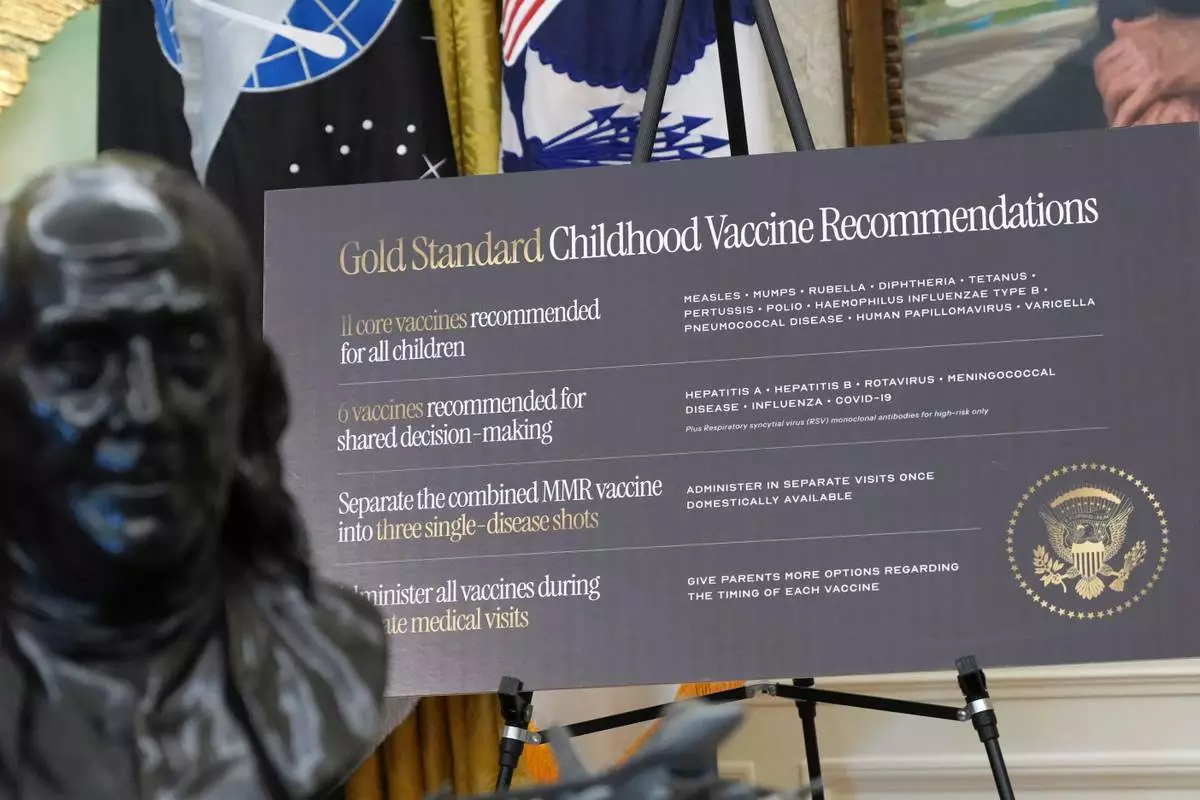
A sign about childhood vaccines is pictured as President Donald Trump speaks during a meeting to sign an executive order, Monday, Aug. 10, 2026, in the Oval Office of the White House in Washington. (AP Photo/Jacquelyn Martin)
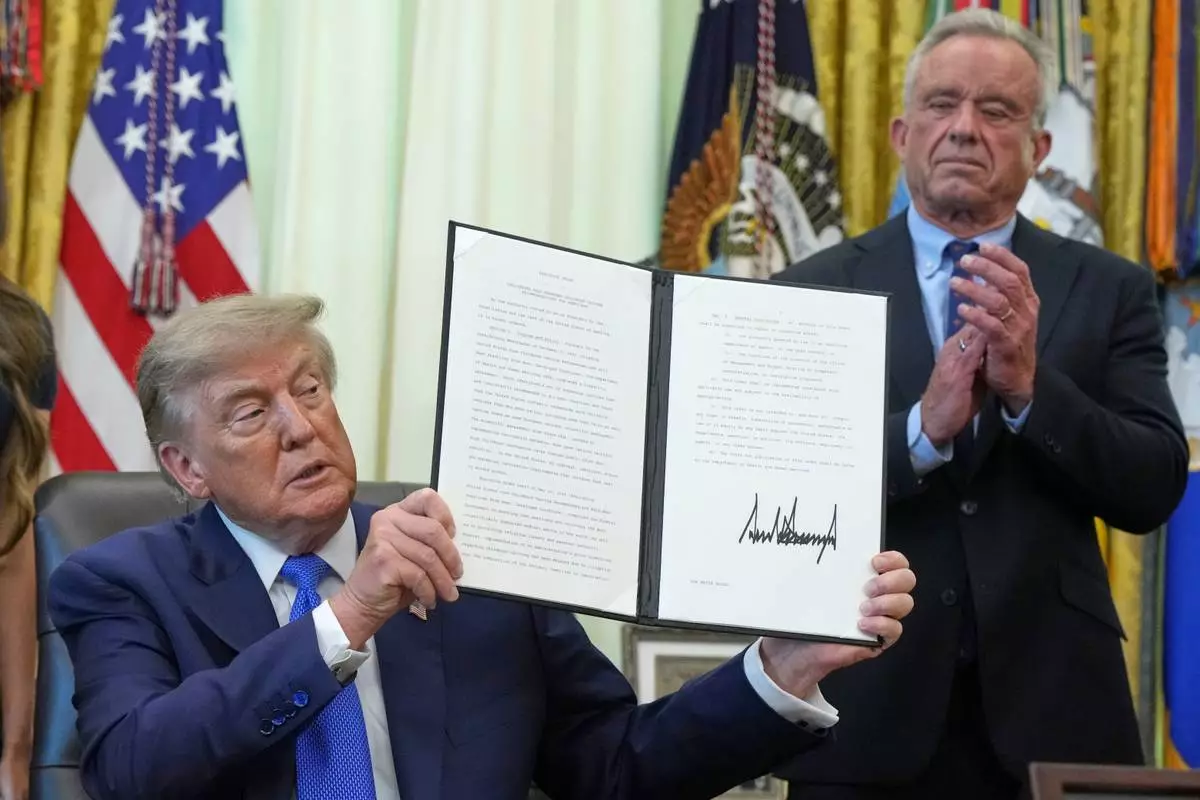
President Donald Trump holds a signed executive order about vaccines as Health and Human Services Secretary Robert F. Kennedy Jr. looks on, Monday, Aug. 10, 2026, in the Oval Office of the White House in Washington. (AP Photo/Jacquelyn Martin)
Primary elections are taking place in six U.S. states on Tuesday — Alabama, Connecticut, Minnesota, South Carolina, Vermont and Wisconsin.
Minnesota voters will settle a moderate-versus-progressive Democratic U.S. Senate primary between centrist U.S. Rep. Angie Craig and progressive Lt. Gov. Peggy Flanagan. In the race for governor, Mike Lindell, known as the MyPillow Guy, leads a crowded Republican primary with President Donald Trump’s endorsement, while Sen. Amy Klobuchar faces minimal opposition for the Democratic nomination.
The Democratic primary for Wisconsin governor is another high-profile clash between the party’s establishment and progressive wings, as democratic socialist Francesca Hong tries to rise above establishment candidate David Crowley. In a Republican primary for U.S. House, Trump-backed candidate Michael Alfonso, the 26-year-old son-in-law of U.S. Transportation Secretary Sean Duffy, is seeking to win Duffy’s former district.
And Republicans in South Carolina are casting ballots in a special primary election to replace the late U.S. Sen. Lindsey Graham on the state’s general election ballot. The crowded race has attracted top party members, including two congressmen and a former governor — but Trump has endorsed Graham’s sister, Sen. Darline Graham, a political unknown appointed to serve out the final months of her late brother's current term.
Here's the latest:
Frank Bohn said an interaction with Sen. Darline Graham in a parking lot was part of what tilted the scales in her favor in terms of his vote in South Carolina’s special Senate primary, when he cast his vote early last week in Horry County.
“She’s not a politician, but she was kin to probably one of the greatest senators ever,” Bohn said, reflecting on his impression of the political newcomer and the service of her brother, the late
Sen. Lindsey Graham. “Being not a politician, and just being able to follow the path of her brother … she could do no harm.”
Susan Bohn said her husband’s recollection helped make up her mind to vote for Darline Graham, too.
“I was going to vote for somebody else, but I changed my mind,” said Susan Bohn, who had been considering U.S. Rep. Ralph Norman.
Debra Dowd said she was deciding between two candidates in the South Carolina Senate primary, U.S. Rep. Russell Fry and Sen. Darline Graham, but ended up going with the latter in part because she admired the late Sen. Lindsey Graham’s service.
“I just think her brother did a wonderful job for all the time he’s been in the Senate, so I went for her,” Dowd said after casting her ballot for the late senator’s sister in Conway during early voting last week.
It wasn’t all about Lindsey Graham’s service, though. Dowd said she considered President Donald Trump’s endorsement of Darline Graham, as well as her performance earlier this month, in which the candidate voiced strong support for the president’s agenda.
“Watching the debate, I liked her answers,” Dowd said. “Her debate performance was really good.”
The longtime South Carolina Republican lawmaker had been seeking a fifth term when he died suddenly a month ago, and the campaign to pick a new GOP nominee has been a whirlwind.
State law sets out the timeline that officials must follow for a special election when a seat becomes vacant. Candidates had about two weeks to file for the contest, then two weeks to campaign.
Graham’s sister was swiftly appointed to serve out the remaining months of his current term. In a move that surprised many political watchers in the state, Darline Graham also launched a primary bid, something she said came at the urging of President Donald Trump, with whom her late brother had been closely aligned.
Preliminary medical findings note Lindsey Graham died from an aortic tear.
After casting his ballot during early voting in Conway last week, George Mitford said he picked U.S. Rep. Russell Fry in the special Senate GOP primary because he favored the two-term congressman’s experience over current Sen. Darline Graham, appointed last month to serve the rest of her late brother’s current term.
“I just thought he’d probably had more experience in this than she would have had,” Mitford said, adding that he had supported Sen. Lindsey Graham’s tenure in the Senate.
“I’m a conservative and a Republican, and I just think he was the best choice,” said Mitford, who lives in Fry’s district along South Carolina’s northern coastal area.
The Democratic primary features a race between economist Amanda Janoo and Aly Richards, a former child advocacy organization CEO.
Richards, 40, grew up in Newbury, Vermont, and has received endorsements from former Vermont governors Howard Dean and Madeleine Kunin. She previously worked for former Gov. Peter Shumlin and on former President Barack Obama’s 2008 campaign.
Janoo, 38, was born on a farm in Strafford, Vermont. She began her career working with the United Nations and international development organizations.
Scott, who has served five terms and is one term away from becoming the state’s longest-serving governor, is running unopposed.
Vermont is one of two states, along with neighboring New Hampshire, that hold a gubernatorial election every two years.
Republicans redrew Alabama’s 2nd Congressional District after the U.S. Supreme Court severely weakened the Voting Rights Act earlier this year.
The redraw added a Republican-leaning seat to the state’s congressional map by shifting the boundaries of one represented by a Black Democrat.
The seat is now held by Democratic Rep. Shomari Figures, who was unopposed in his primary and has said he plans to aggressively defend the seat.
Six Republicans are competing in the special congressional primary for the chance to challenge Figures in November.
The Democratic Congressional Campaign Committee has placed Figures on its list of “frontline” candidates for extra support in what they consider the most pivotal districts. The National Republican Congressional Committee has similarly put the district on its list of targets for 2026.
In the Wisconsin governor’s race, software engineer Cody Chandler said he didn’t worry about electability when he cast his ballot for Hong.
“In the past I’d think about who could win,” said Chandler. “But this time I’m voting for who I want to win.”
He’s thrilled by Hong and the progressive movement around her.
“She’s probably the most exciting candidate I’ve seen,” said Chandler, 35, who voted in the town of Hudson. He sees himself as a progressive, someone inspired a decade ago by Sen. Bernie Sanders, and volunteered for Hong’s campaign.
“She seems to be like a real working-class person. Sure, she stumbles over her words sometimes — but so do I,” he said, laughing. “She feels like one of us.”
Linda Biles believes Hong’s politics will frighten voters like her — a Republican in a largely rural area who votes Democratic because she dislikes Trump and politicians who back him.
“I think just the word ‘socialism’ is turning off Republicans,” said Biles, a 71-year-old retired home economics teacher, after casting her ballot in the western Wisconsin town of Hudson. “It scares them away.”
Crowley, she said, was an obvious choice: “He’s got more of a chance of beating Tiffany,” she said.
Michele Tafoya is seeking the Republican nomination for U.S. Senate.
She strode into a suburban Minneapolis church with a phalanx of reporters and photographers watching. She checked in with poll workers, filled out her ballot and fed it into the counter.
“How are you?” she asked the top election official on site.
“I’ll be glad when you’re done,” the stressed-out official responded with a laugh.
In the parking lot out front, she argued that this will be the year voters end a 20-year losing streak for Republicans running statewide in Minnesota. Voters, she said, are fed up after widespread reports of fraud in public assistance programs.
“Minnesotans are ready. We’ve had a crisis of leadership here,” Tafoya said. “We’ve seen what career politicians have done in this state. They’ve brought us to a place of national embarrassment, and this state is ready for change.”
Asked if she would have handled anything differently about the sprint of a special Senate primary, Graham said she had no regrets.
“I don’t think I could have done anything any differently,” Graham told reporters outside the Lexington church where she and her family voted. “It was my priority to be in Washington as your representative, working hard, and I got back here just as soon as I possibly could.”
With the Senate staying in session until early Saturday morning, Graham — as South Carolina’s interim senator — was in Washington for votes during much of the campaign.
Anticipating a runoff to follow Tuesday’s crowded GOP Senate primary, Graham told reporters that she would “get out and work really hard to earn” voters in the ensuing two-week period.
Democratic Sen. Amy Klobuchar has had a successful career in Washington, but she’d prefer to head back home to Minnesota. She’s the leading candidate for governor in the state’s Democratic primary.
She’s not alone. Four senators ran for governor this year, underscoring how sharply the balance of political ambition has shifted away from Washington.
Although the Senate was once seen as the capstone of a long political career or a premier perch for launching presidential bids, it has become increasingly stagnant and dysfunctional.
Sens. Marsha Blackburn of Tennessee and Tommy Tuberville of Alabama both won Republican gubernatorial primaries this year.
But Colorado Democratic Sen. Michael Bennet wasn’t as fortunate. He lost to state Attorney General Phil Weiser.
Bronin was a sophomore at Yale University when Larson was elected to the U.S. House in 1998.
Now he’s standing in the way of Larson getting a 15th term representing Connecticut. The two face off in another contest that pits the party’s old guard against a younger generation.
Bronin, 46, is the former mayor of Hartford. He’s a lawyer, former Rhodes scholar and U.S. Navy Reserve officer.
Larson is 78. While he has been popular in his central Connecticut district throughout his time in office, concerns about his health arose when he suffered a partial seizure during a speech on the House floor last year.
In a flip of the usual script for primary challengers, Bronin can lay claim to be the establishment candidate. He won the Democratic state party’s endorsement at a nominating convention earlier this year.
The interim senator and her 17-year-old daughter Nicole Nordone voted midday Tuesday at a Lexington County church.
“It was a hard choice,” Nicole said jokingly to her father, as they walked out of the voting area so that Darline Graham could speak with reporters.
After she fed her ballot into a reader machine, Graham told poll workers that she typically votes at another location. Many polling sites have been changed for Tuesday’s special election due to several factors, including classes beginning this week at many schools typically used for voting.
South Carolinians who are 17 years old but will be 18 before the general election can vote in primaries.
Michael Alfonso has leaned into his endorsement from Trump in the five-way Republican primary for Wisconsin’s 7th Congressional District.
The 26-year-old Alfonso has faced blowback from some Republican leaders in the district who question whether he is too young and inexperienced for the job.
Alfonso is counting on Trump’s endorsement carrying the day in the deeply red district.
Duffy held the congressional seat from 2011 until 2019, when he resigned mid-term. He returned to politics last year when Trump tapped him to serve as transportation secretary. Alfonso is married to Duffy’s daughter, Evita Duffy.
After losing a top Senate advocate when the South Carolina Republican suddenly died, Trump has angled to play a role in picking his replacement, too.
Trump heralded the selection of Darline Graham as “a fabulous tribute” to serve as her brother’s interim replacement. And he urged her to run in the special primary, endorsing Graham before she’d made her candidacy official.
In forging a relationship with Darline Graham, Trump could be angling to develop another ally to help steer his agenda through the Senate.
So far, Darline Graham has been doing just that. Repeatedly stressing to voters her intent to support Trump’s policy positions, she often references in particular her co-sponsorship of a voting bill that’s become a key priority for the president.
Trump relied on Lindsey Graham in the Senate and has endorsed Darline Graham to replace him.
She had already been known as Lindsey Graham’s sister and lifelong supporter, but since her brother’s death a month ago, Darline Graham has been thrust into the political spotlight.
A day after the late senator’s sudden death was announced, South Carolina Gov. Henry McMaster named Darline Graham to serve the remaining months on his current term, which expires in January. She was sworn in the next day and took his spot on powerful committees, including Judiciary.
Days later, Darline Graham was among the candidates jumping into a special GOP primary to replace her late brother on November ballots. She’s appeared at various stump events and one debate, although Senate business kept her off the campaign trail as other hopefuls traversed the state.
U.S. Rep. Angie Craig has support from the party’s establishment, while Lt. Gov. Peggy Flanagan is backed by prominent figures on the left including Sen. Bernie Sanders.
The primary will again take the temperature of Democratic voters a week after progressive Abdul El-Sayed won a bitter and divisive primary in Michigan that fired up the left and fueled anxiety among party leaders that Democrats will alienate moderate swing voters.
Craig says her record of winning repeatedly in a battleground House district will ensure the seat stays in Democratic hands. Flanagan says Craig hasn’t stood firm enough against President Donald Trump and wealthy donors.
Wisconsin voter Jesse Heer said Hong understands “what it’s like to live here and have to afford to live here.”
Heer, a 32-year-old business owner from Madison, said Hong’s focus on affordability issues was the top reason he voted for her. And he’s not buying the argument from other Democrats, including Hong’s more moderate challenger, Milwaukee County Executive David Crowley, that she will have a harder time winning in the general election.
“I think she’s a good candidate,” Heer said. “I think a lot of people agree.”
Hong voter Kelly McClurg, 40, of Sun Prairie, says Hong has shown “she’ll be able to push back more” on issues that Democrats care about, like affordability.
McClurg said if fellow Democrats believe in her, and don’t assume she can’t beat Republican Tom Tiffany, “she can win.”
Wisconsin voters who cast their ballots Tuesday for the gubernatorial candidate favored by more mainstream Democrats say they are confident the party will unite even if the progressive challenger wins.
David Zimmerman, a 79-year-old retired industrial engineering professor, voted for Milwaukee County Executive David Crowley. Crowley is endorsed by Gov. Tony Evers and is seen as the pick of more moderate Democrats.
Zimmerman says he worries “a lot” about progressive candidate Francesca Hong’s ability to defeat Republican Tom Tiffany in November.
“I think she’s going to have trouble winning,” Zimmerman said.
But both Zimmerman and fellow Crowley voter Julie Martinson, 69, predict Democrats will come together even if Hong wins. They said they would vote for her in November.
“There’s no reason we can’t galvanize around her and get her in there,” Martinson said.
No Connecticut governor has served three consecutive terms in modern times. Former Republican Gov. John G. Rowland was elected to a third consecutive term in November 2002 but he resigned in 2004 amid a corruption scandal.
In Tuesday’s Democratic primary, Lamont, 72, takes on state Rep. Josh Elliott, 41, who is running left of the current governor.
One of two Democratic governors who attended President Donald Trump’s inauguration, Lamont has carefully chosen which issues to criticize the Republican president on. That tactic has prompted complaints from more liberal Democrats in Connecticut.
This post has been updated to correct the ages of Lamont and Elliott. Lamont is 72, not 71. Elliott is 41, not 42.
The state is holding special primaries in four congressional districts after it won permission from the U.S. Supreme Court to change its congressional maps. The state tossed out the results of May primaries and scheduled the Tuesday special primaries using the new map.
Turnout for party primaries is typically low. It was 23% in the May primary and 10.7% for the June runoff. It is expected to be particularly low in a special late-summer primary, when people are unaccustomed to voting.
Six Republicans are seeking the GOP nomination in the redrawn 2nd Congressional District. The winner will challenge Democratic Rep. Shomari Figures in November.
Republican candidates and party officials have been trying to promote the special primary and get voters to the polls. The primaries will be decided without a runoff.
Polling places opened across the state at 7 a.m. EDT, and voters have until 7 p.m. to cast their ballots.
It’s only been two months since South Carolina voters made their picks in the primary elections in June. But Graham’s sudden death last month set into motion a special primary to pick a Republican replacement for the general election ballot in November.
Candidates have only had a matter of weeks to campaign.
There were three days of early voting last week, and Tuesday’s special election also coincides with the first day of school in some areas, so polling places have changed for many who typically are assigned to vote at schools for summertime primaries.
The topsy turvy race pits democratic socialist Francesca Hong against the governor’s endorsed candidate David Crowley.
Hong has ridden a wave of support from liberals to bolster her insurgent campaign. Crowley had quit the race but got back in — with Democratic Gov. Tony Evers’ endorsement.
Crowley rejoined the race after Lt. Gov. Sara Rodriguez dropped out last month amid a campaign finance scandal.
Former Lt. Gov. Mandela Barnes had the highest name recognition after a 2022 U.S. Senate run, but he also dropped out less than two weeks before the primary amid questions about inappropriate behavior.
In the Republican primary for governor, U.S. Rep. Tom Tiffany has Trump’s endorsement and faces nominal opposition.
Progressive candidates for governor in Wisconsin and U.S. Senate in Minnesota are increasing the pressure on a Democratic establishment that has spent the year on its heels.
Today’s primaries come a week after Abdul El-Sayed narrowly defeated Rep. Haley Stevens in Michigan’s divisive and costly U.S. Senate primary. El-Sayed’s victory has energized the left while stoking fears among Democratic Party leaders that the shift to the left, particularly in battleground states like Michigan and Wisconsin, will make it more difficult to win in November.
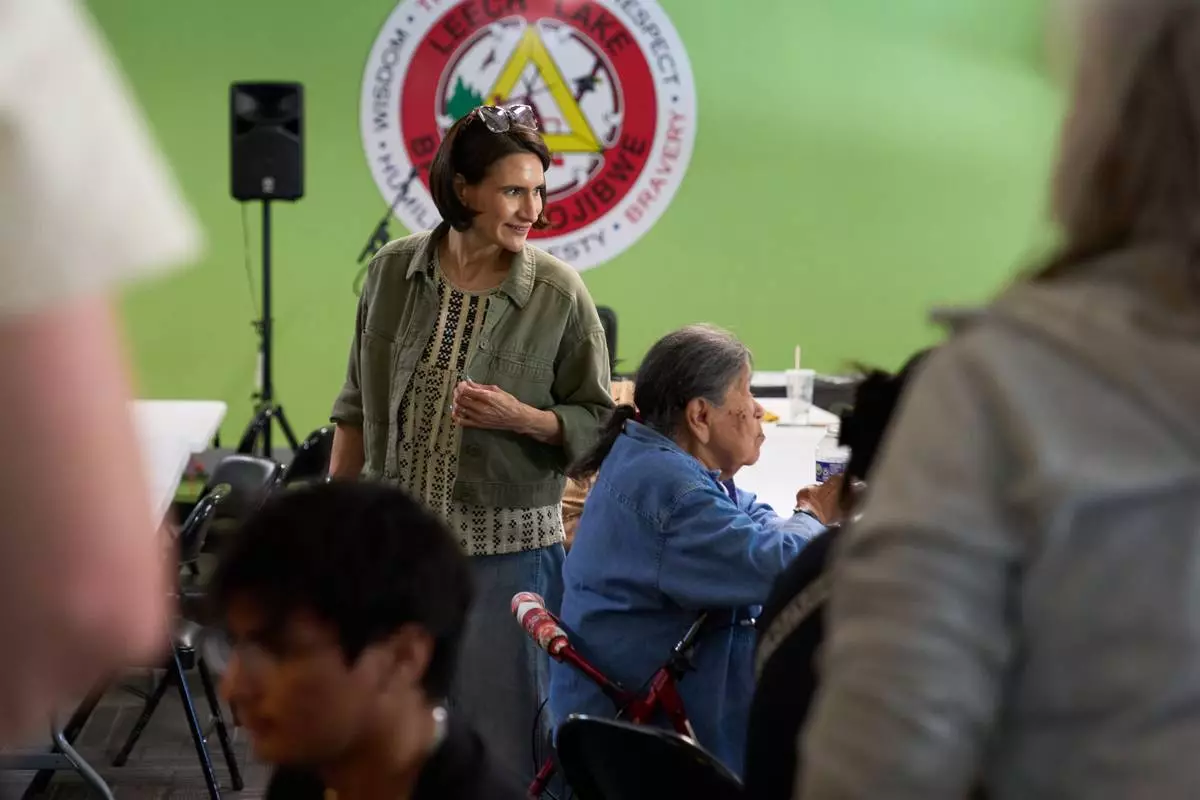
Minnesota Lt. Gov. Peggy Flanagan, a Democratic candidate for U.S. Senate, greets supporters during a campaign event at the Leech Lake Band of Ojibwe Twin Cities Office in Minneapolis, Saturday, Aug. 8, 2026. (AP Photo/Ellen Schmidt)
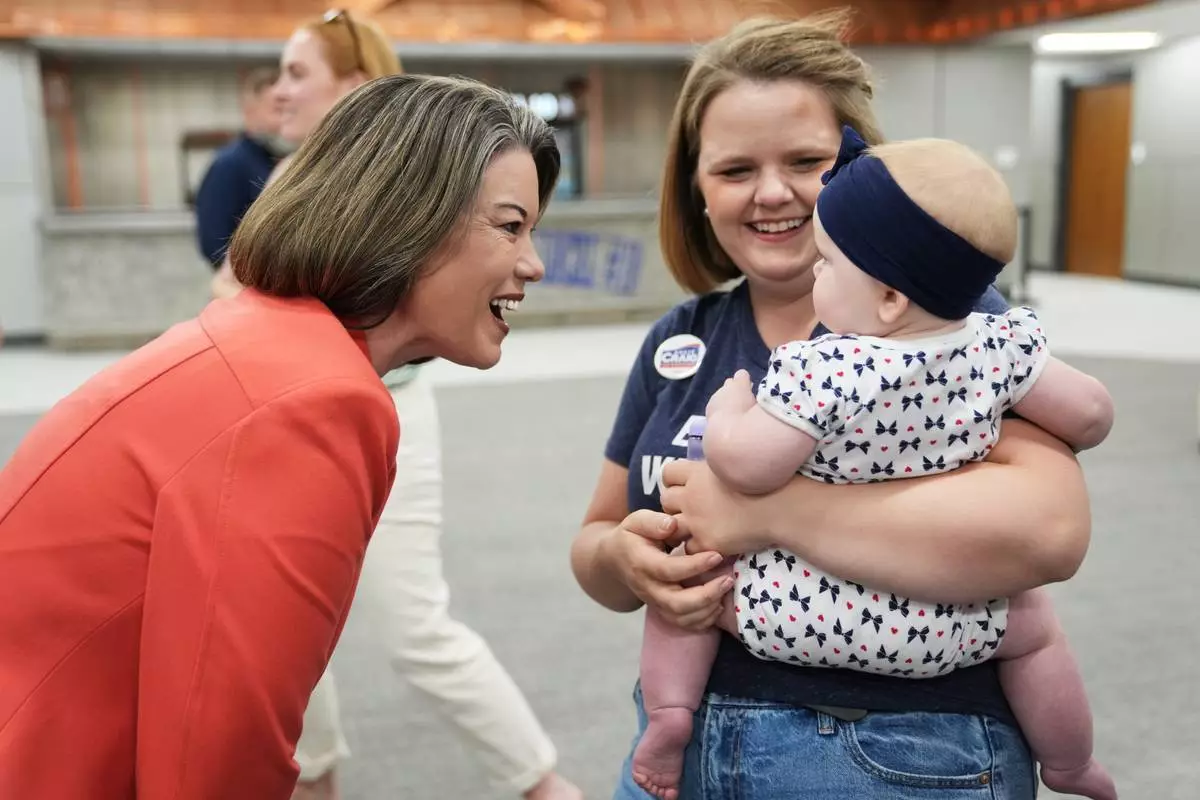
U.S. Rep. Angie Craig, D-Minn., candidate for U.S Senate, greets Merci Wolff and her daughter during a canvassing event at SMART Sheet Metal Workers Local #10 headquarters, Monday, Aug. 10, 2026, in St. Paul, Minn. (AP Photo/Ellen Schmidt)
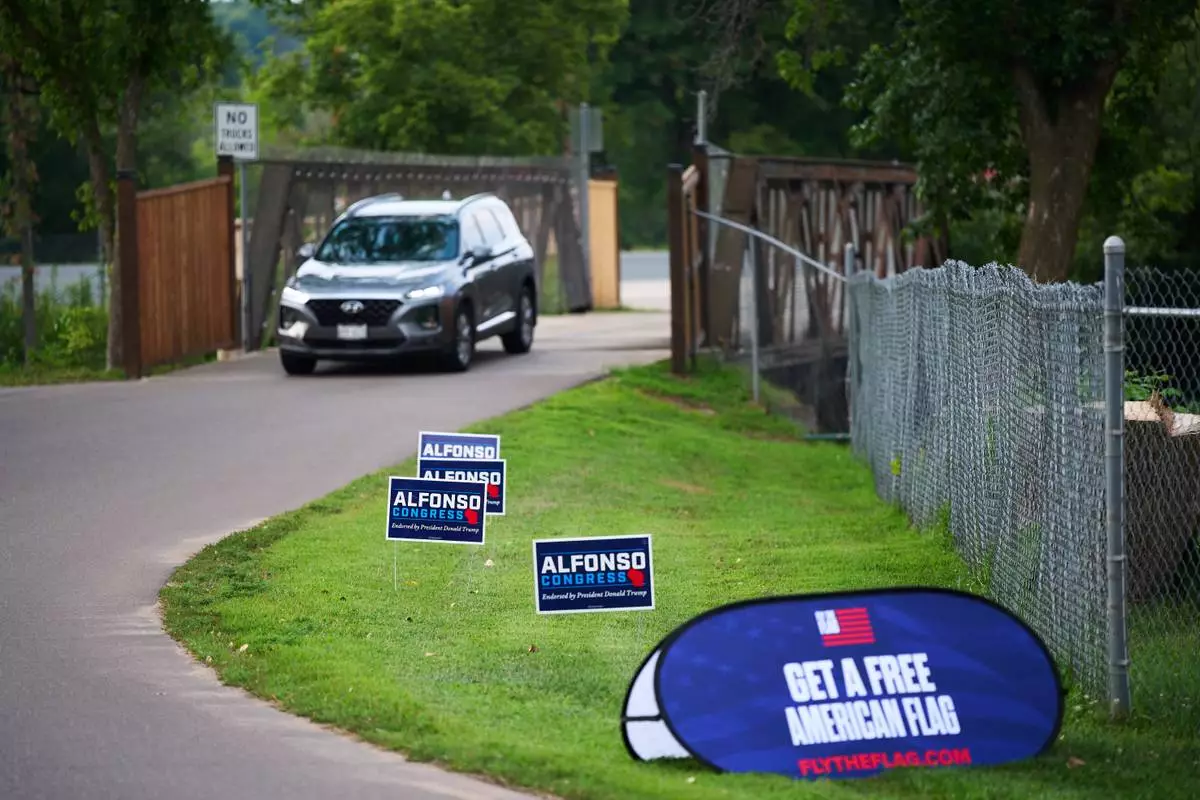
Campaign signs for Michael Alfonso, a candidate for U.S. House in Wisconsin's 7th congressional district, line the entrance to an event, Tuesday, Aug. 4, 2026, in New Richmond, Wis. (AP Photo/Ellen Schmidt)
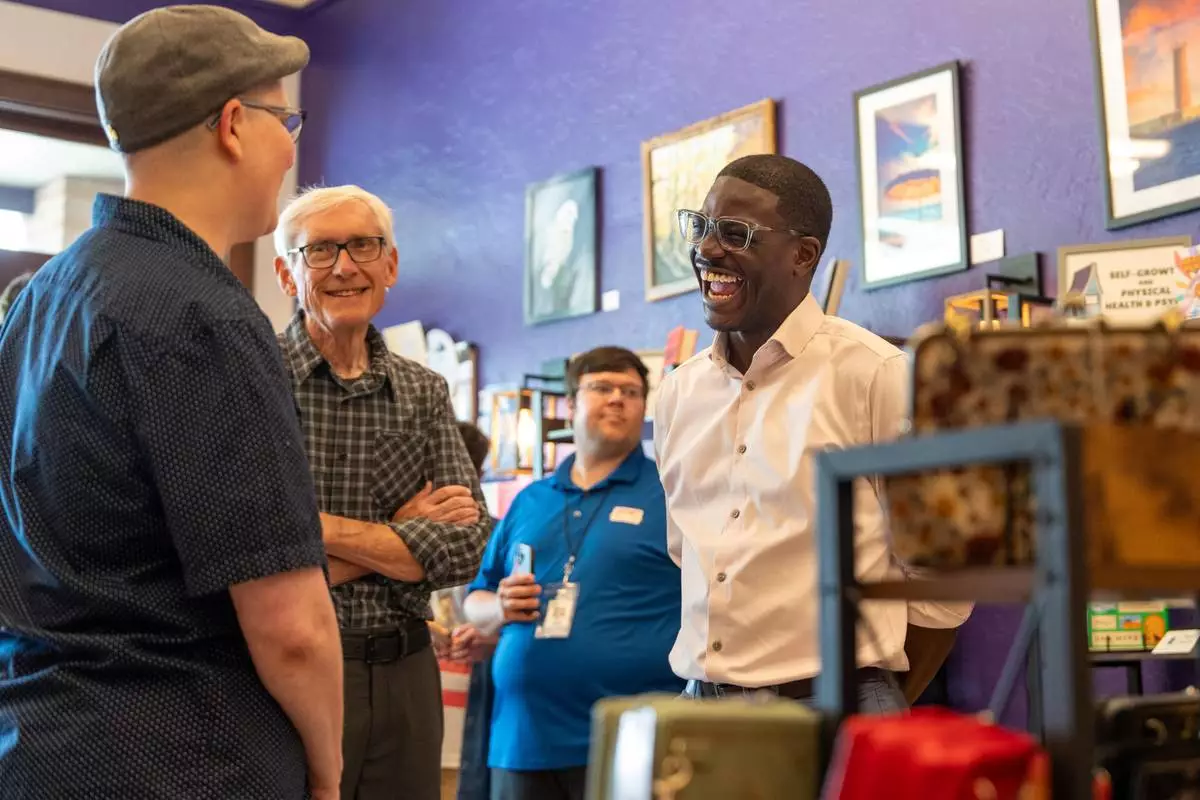
David Crowley, right, Democratic candidate for Wisconsin governor talks with CJ Arthur, left, owner of WordHaven BookHouse during a campaign stop with Wisconsin Gov. Tony Ever, center, Friday, Aug. 7, 2026, in Sheboygan, Wis. (AP Photo/Kayla Wolf)