BAIDOA, Somalia (AP) — After nearly two weeks on the road with her five children, Luul Mohamed finally arrived in the southwestern Somali city of Baidoa with no food and little sense of what would happen next.
Drought conditions had forced Mohamed and her family to leave Saakoow, a town in the Middle Jubba region more than 300 kilometers (186 miles) away. They moved from village to village before arriving in Baidoa, now a major hub for people fleeing drought, insecurity and food shortages, on Aug. 3.
“We are very hungry and in a desperate situation,” Mohamed said. “We have nothing to eat and can only place our hope in God, as He is the one who sustains us through this ordeal that culminated in our trip.”
The family's journey is one example of a deepening humanitarian emergency in Somalia, where years of drought, conflict and economic pressures are pushing more families from rural communities into displacement camps as hunger rises and humanitarian funding shrinks.
About 2 million people are facing emergency levels of food insecurity, more than double the number recorded last year, according to Plan International, which has provided assistance to more than 200,000 people in Somalia this year. The humanitarian group and Somalia’s Disaster Management Agency are calling for increased international assistance, with concern that the crisis could be compounded by another climate shock later this year.
The U.N. Food and Agriculture Organization has projected a greater than 90% probability of El Nino conditions developing from mid-2026 and intensifying during Somalia’s October-to-December rainy season, bringing the severe risk of flooding.
Somalia is highly vulnerable to extreme weather and has experienced repeated cycles of prolonged drought followed by destructive flooding. The shocks have eroded livelihoods, displaced communities, contributed to disease outbreaks and worsened food insecurity.
In Baidoa, hundreds of thousands of people fleeing prolonged drought have gathered in sprawling displacement settlements on the outskirts of the city.
One of them, Habiba Adan, fled her settlement in Awdiinle in the Bay region after four consecutive years of drought destroyed crops and killed livestock. She eventually moved to Baidoa with her two older daughters and now lives in a displacement camp.
Adan would like to return home, but she said continuing drought and failed harvests there have left families with little prospect of rebuilding their lives.
“The drought we are experiencing has stretched for four consecutive years, and this year, most crops have again been decimated,” Adan said. “Farmers were only able to harvest enough to sow their fields for the next season, leaving our future bleak. Here in these camps, we lack food and essential support. We have no food, water, or money, and we sit idly.”
According to Plan International, the city is hosting about 1.6 million people, nearly half of them displaced. It says one in five families lacks reliable access to water, among the most immediate challenges facing displaced families. They are increasingly forced to buy trucked water at steep prices that many simply cannot afford.
Reena Ghelani, the global CEO of Plan International, visited Baidoa last week, meeting drought-displaced families and visiting a malnutrition ward in the Bay region.
Ghelani said many of the families she met had tried to remain in their communities through successive years of drought, leaving only when their resources were exhausted.
Many fled “after waiting and waiting year after year of drought and just surviving,” Ghelani said. “And now they say there’s nothing left. They have no water. They have no stocks. The animals have died. There is literally nothing left anymore.”
She said rising prices are placing additional pressure on families already struggling to find enough food.
Data released in May by the Integrated Food Security Phase Classification, a global hunger monitoring system, showed that about half of children under 5 in Somalia were facing acute malnutrition.
Plan International, citing Save the Children, said the number of children receiving treatment for the most dangerous form of malnutrition in Baidoa had nearly tripled over six months.
Dr. Omar Abdikarin, a nutritionist in Baidoa, said patients are arriving for treatment from the Bay as well as the neighboring Bakool and Gedo regions.
“Malnutrition is prevalent in this region, and the majority of patients treated at this hospital suffer from malnourishment,” Abdikarin said.
The health risks extend beyond malnutrition. Ghelani said she encountered children affected by outbreaks of diphtheria, measles, malaria, cholera and acute diarrhea.
The prospect of heavy rainfall later this year presents a new threat to communities facing multiple crises. Intense rainfall and flooding could wash away homes and farmland, contaminate drinking water and force families to move again. Aid agencies warn that the expected El Nino conditions will compound the crisis for countless families before they have had time to recover from prolonged drought conditions.
For families arriving in Baidoa such as Mohamed's, the most urgent question is where to find clean water and food.
Mohamed said her husband had left for farms on the outskirts of the city, in search of work or something for their children to eat. A day after arriving in the city, she was still waiting to find out whether her husband would return with good news.
For more on Africa and development: https://apnews.com/hub/africa-pulse
The Associated Press receives financial support for global health and development coverage in Africa from the Gates Foundation. The AP is solely responsible for all content. Find AP’s standards for working with philanthropies, a list of supporters and funded coverage areas at AP.org.
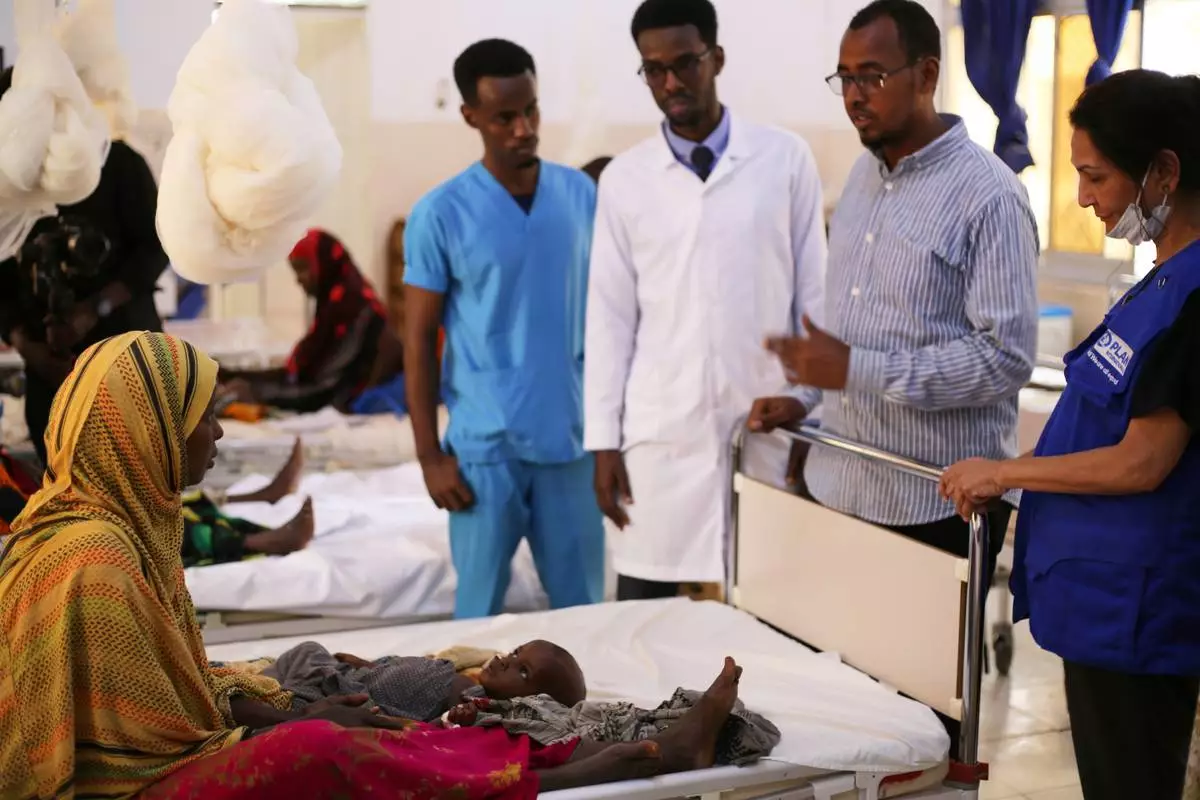
Health workers talk to a woman with her malnourished baby at Bay Hospital in Baidoa, Somalia, Tuesday, Aug. 4, 2026. (AP Photo/Mohamed Sheikh Nor)