LONDON, Aug. 13, 2026 /PRNewswire/ -- Colebrook Bosson Saunders (CBS) recently launched its 2026 Sustainability Report, detailing progress against its 2030 sustainability targets spanning carbon reduction, circular design, material transparency, packaging, supplier engagement and community impact.
The report, the company's second annual, tracks performance against its 14 sustainability targets across three pillars: environmental stewardship, human health and well-being, and leading credentials and transparency.
Carbon reduction
CBS cut its total carbon emissions by 8.06% against its FY2023 baseline in the year to May 2025 (FY2025). Scope 1 and 2 emissions, which cover CBS's own operations, dropped 87.8% over the same period following a shift to renewable energy procurement, bringing electricity emissions to zero on a market basis.
Scope 3 emissions, those generated across the company's supply chain, which account for more than 99% of its total carbon footprint, fell 7.47% against the FY2023 baseline and 26% in a single year (FY2025). The reductions came largely from increased use of recycled content in products and lower embodied carbon across key top-selling products.
CBS has mapped the carbon footprint of 100% of its top-selling products, representing 80% of net sales in the year to May 2025, meeting that part of its 2026 target ahead of schedule. Coverage across the broader portfolio reached 97%, up from 74% the prior year. Flo and Flo Modular, two of CBS's best-selling monitor arms, each cut their lifecycle carbon footprint by 33% against the FY2023 baseline. Ollin followed with a 19% reduction in its product carbon footprint against the FY2023 baseline.
Circular design and packaging
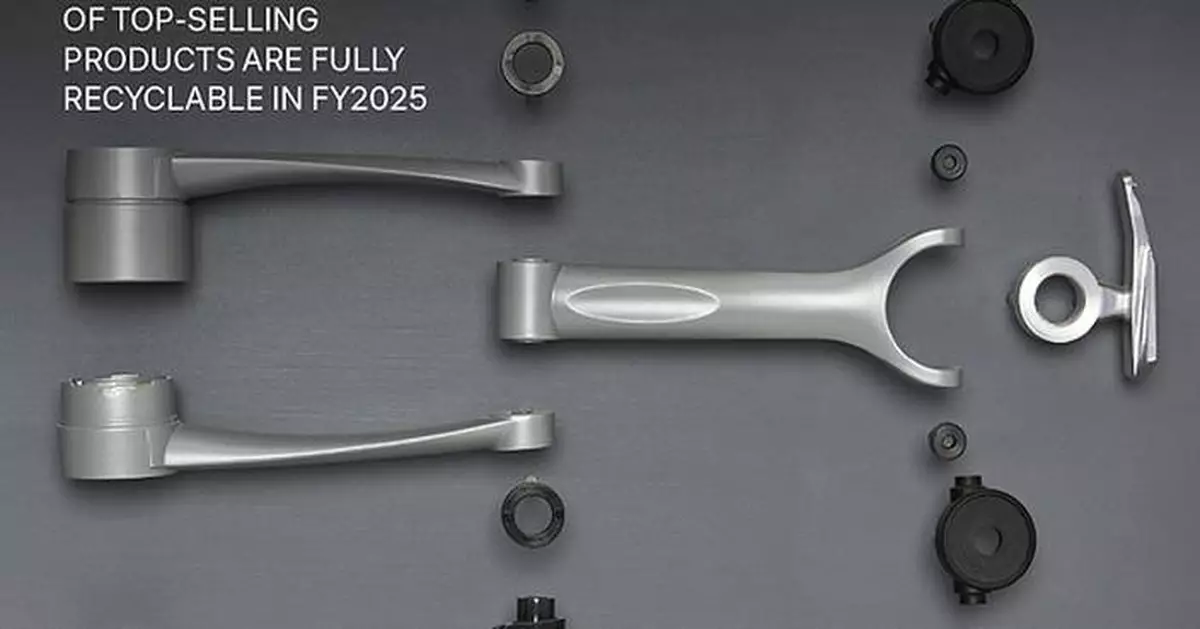
As part of its mission to design out waste and keep materials in use for longer, CBS's top-selling products are made with recyclable materials, some by design from the outset, others through an active phase-out of harder-to-recycle plastics. By net sales, 98% of the broader portfolio was made with recyclable materials in FY2025. Among the changes, the company replaced harder-to-recycle plastics with polypropylene across key lines. The widely recyclable alternative makes products easier to disassemble and recover at end of life.
The company also partnered with refurbishment firms in the U.K., Asia, Australia and the Middle East to collect, refurbish and recirculate used products to support more sustainable end-of-life pathways and circular reuse.
Circularity extends beyond the product itself and into how it reaches the customer. Since introducing bulk packaging in 2022, CBS has expanded the format across multiple product lines. Bulk packaging options for the Flo Monitor Arm, which consolidate 10 units per pack, reduce packaging volume by 40.4% per unit. In the year to May 2025, 99.8% of products were delivered in plastic-free packaging using recyclable and biodegradable paper-based materials, based on net sales.
Sustainability credentials and material transparency
In 2026, CBS was awarded a Diamond climate strategy rating by Greenly, the carbon accounting platform's highest recognition, ranking CBS among the top 1% of more than 3,500 organisations it has assessed.
The company holds ISO 14001 and SCS Indoor Advantage Gold certification, verifying its products meet stringent indoor air quality standards. CBS aligns with science-based emissions targets as part of the MillerKnoll collective, which holds a Gold Medal from EcoVadis, placing it in the top 5% of companies assessed globally for environmental performance.
CBS strengthened material transparency across its portfolio, with verified material ingredient labels supporting sustainable building standards, covering 94.4% of products by net sales. PFAS elimination remains a significant challenge across the manufacturing sector, but CBS has made a firm commitment to phase them out through ongoing material development. All products launched since March 2025 are free from intentionally added PFAS, excluding electronic parts. Remaining legacy material and product inventory is being responsibly phased out throughout 2026 and 2027.
Human health and well-being
CBS hosted more than 70 ergonomic education events in the year to May 2025, reaching 3,000 professionals across 14 countries. Associate participation in the company's annual Day of Purpose volunteering initiative rose to 85% from 75% the prior year.
"We believe high-performing, beautifully designed products and genuine sustainability progress are not mutually exclusive," said Andy Humphreys, managing director. "This year's report shows that when the whole business pulls in the same direction, the progress is real."
CBS was founded in London in 1990 and designs, manufactures and distributes ergonomic workplace products worldwide. It is an independent brand within the MillerKnoll collective.
The 2026 Sustainability Report is available at CBS's website. The company will continue working towards its 2030 targets across all three pillars of its sustainability framework.
For media enquiries: sustainability@cbsproducts.co.uk
Media Contact:
Cecil Huang
Senior Marketing Manager – APAC, Middle East & Africa
cecil.huang@cbsproducts.co.uk
** This press release is distributed by PR Newswire through automated distribution system, for which the client assumes full responsibility. **

Colebrook Bosson Saunders Launches 2026 Sustainability Report, Highlighting Measurable Progress Towards 2030 Targets