As of Monday, the Guangzhou-Shenzhen-Hong Kong Express Rail Link had transported a cumulative total of 20.054 million cross-border passengers this year, reaching the 20-million-passenger milestone 11 days earlier than last year, according to the latest statistics from Shenzhen railway department.
Breakdown figures showed that the number of passengers traveling from the Chinese mainland to the Hong Kong Special Administrative Region (HKSAR) came in at 10.327 million, and the number of passengers traveling from the HKSAR to the Chinese mainland stood at 9.727 million, with a vigorous two-way flow of passengers.
"We're planning to take the kid to Disneyland during the summer vacation, and also visit Victoria Harbour -- the one the kid has read about in her schoolbooks," said Ms Wang, a tourist from southwest China's Sichuan Province.
"Since we're coming by the high-speed rail, it's quick and convenient," said Wang's daughter.
"We are going back to my hometown Xiamen for a trip of about six days. We will visit Gulangyu Island and some other places, as my children have never been there," said Mr. Che from the HKSAR.
Data showed that the cross-border passenger flow reaches peak at weekends. This year, the peak number of days with daily passenger flow exceeding 100,000 has reached 63, four days more than the same period of last year.
"Since the start of the summer travel season, the passenger flow on the Guangzhou-Shenzhen-Hong Kong High-Speed Express Rail Link has continued to rise, with a total of 3.817 million passenger trips transported, averaging 93,000 per day. On August 8, in particular, the number of passenger trips reached 136,000, setting a new record for the highest single-day passenger flow during the period," said Wei Liangyi, duty chief of the Shenzhen North Railway Station. According to statistics from the Shenzhen General Station of Exit and Entry Frontier Inspection, as of 18:00 on Thursday, the number of people entering and leaving the country through Shenzhen ports this year had reached 182 million, including 5.2025 million foreign people.
"We are going [to travel in] China in Guangzhou, Guilin, Dali, Lijiang, Shangri-La. It's easy to take high-speed railway," said a tourist from France.
"Since the beginning of this year, the West Kowloon Border Inspection Station has handled over 1.07 million foreign passenger trips, an increase of 34.7 percent compared to the same period last year. In particular, nearly 300,000 foreign tourists have entered the country under visa-free policies, an increase of about 78 percent compared to the same period last year," said Wu Yanwen, a staff member with West Kowloon Border Inspection Station.
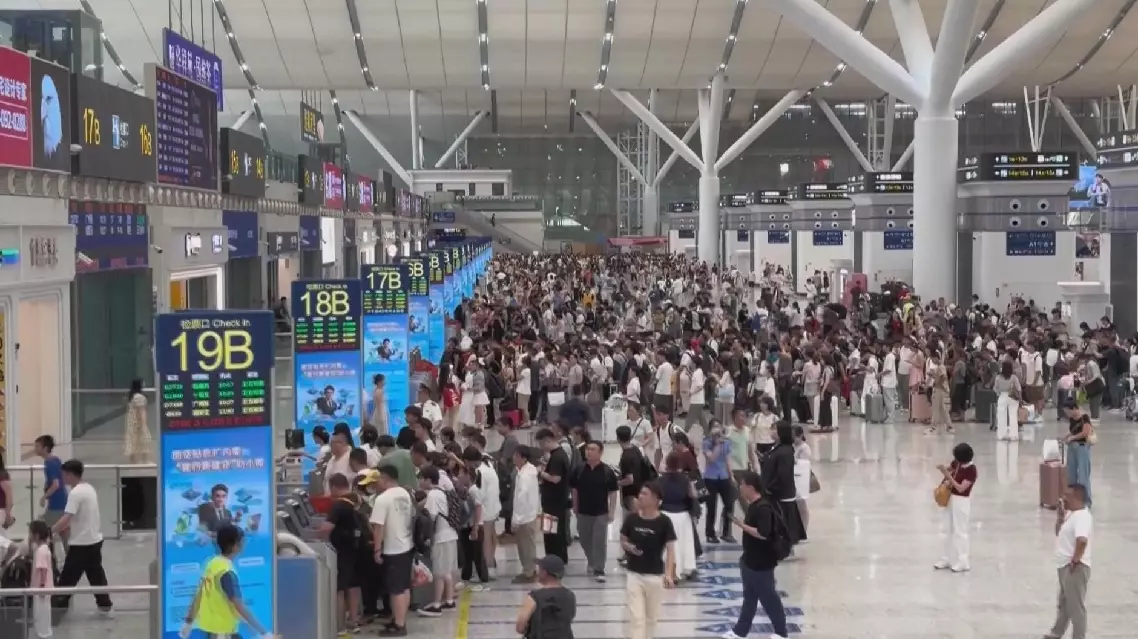
Cross-border passenger trips on Guangzhou-Shenzhen-Hong Kong high-speed rail top 20 million this year