Stanley “Skip” Bertman, who turned LSU's baseball program into a national powerhouse that won five national championships in the span of a decade, died at age 88 early Friday morning.
The former LSU coach and athletic director passed away in a Baton Rouge hospital, LSU spokesman Michael Bonnette said.
The LSU Tigers, now synonymous with college baseball's elite and known for fielding numerous Major League Baseball prospects, had never won a national title when Bertman, a native of Miami, took over the program in 1983.
The College Baseball Hall of Famer's legacy now includes the current Alex Box Stadium, which opened in 2009, holds about 11,000 and routinely is filled to capacity. The field in the stadium was named for Bertman in 2013. The Tigers also have won three national championships under two of Bertman's successors, most recently in 2025.
Since 2013, the College Baseball Foundation's annual award for the nation's top coach has been named the Skip Bertman Coach of the Year Award. Bertman won it six times between 1986 and 2000.
Bertman coached a total of 18 seasons, retiring in 2001 with a record of 870-330-3 and 11 College World Series appearances. He then served as Athletic Director until 2008 and Athletic Director Emeritus after that, continuing to live in Baton Rouge, support the university and attend LSU events for the rest of his life.
Bertman coached the Tigers to their first five NCAA College World Series championships in 1991, ’93, ’96, ’97, ’00. His tenure as coach also included seven Southeastern Conference championships. His NCAA Tournament winning percentage of .754 is the highest in the history of the event.
Bertman also was head coach of the 1996 U.S. Olympic team, which at that time included only amateur players and won a bronze medal in Atlanta.
Bertman played baseball at Miami before going into coaching, starting at the high school level in Miami Beach. His final job before taking over at LSU was as an assistant at Miami under then coach Ron Fraser.
Bertman was preceded in death by his wife, Sandy, and daughter, Lisa.
Funeral arrangements were pending Friday.
AP college sports: https://apnews.com/hub/college-sports
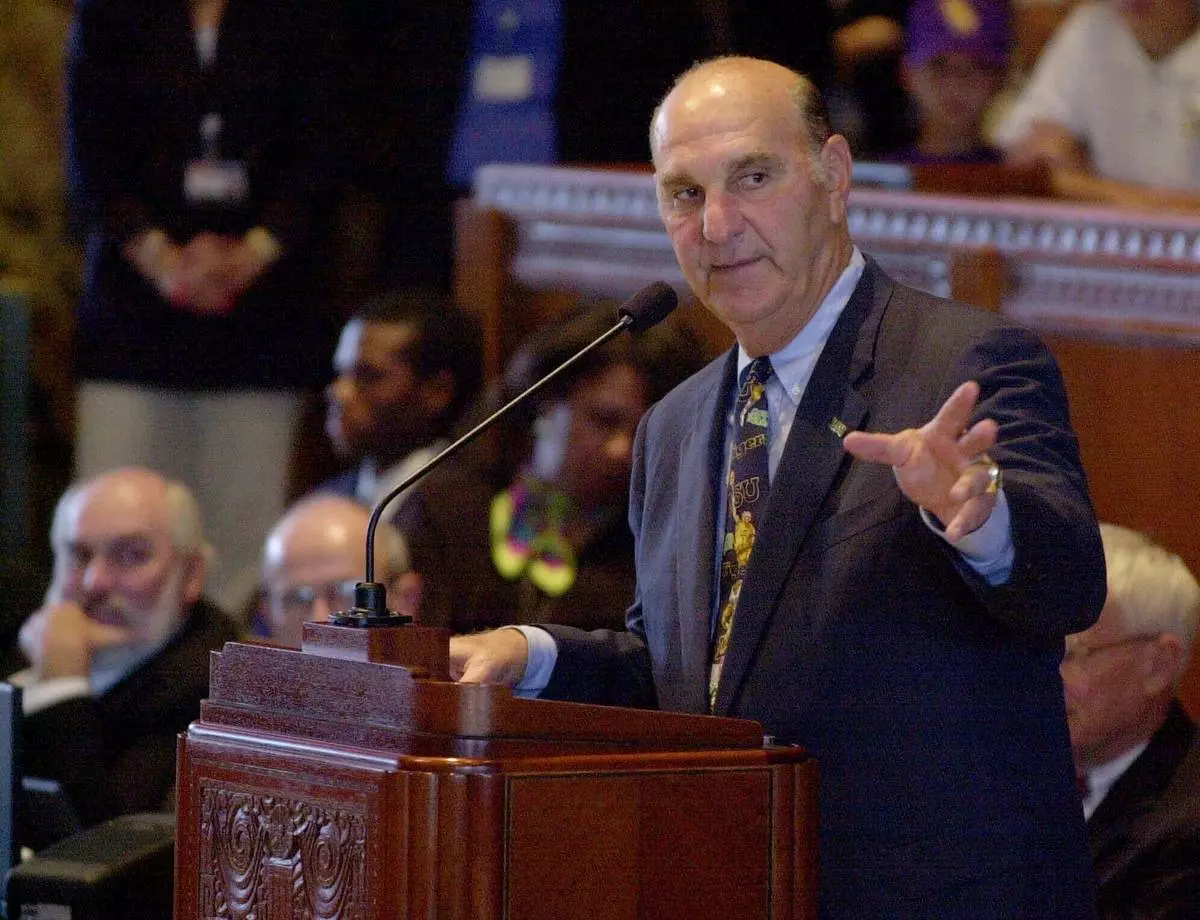
FILE - Louisiana State baseball coach Skip Bertman addresses the state House of Representatives at the Capitol in Baton Rogue, La., June 21, 2000. (AP Photo/Bill Haber, file)
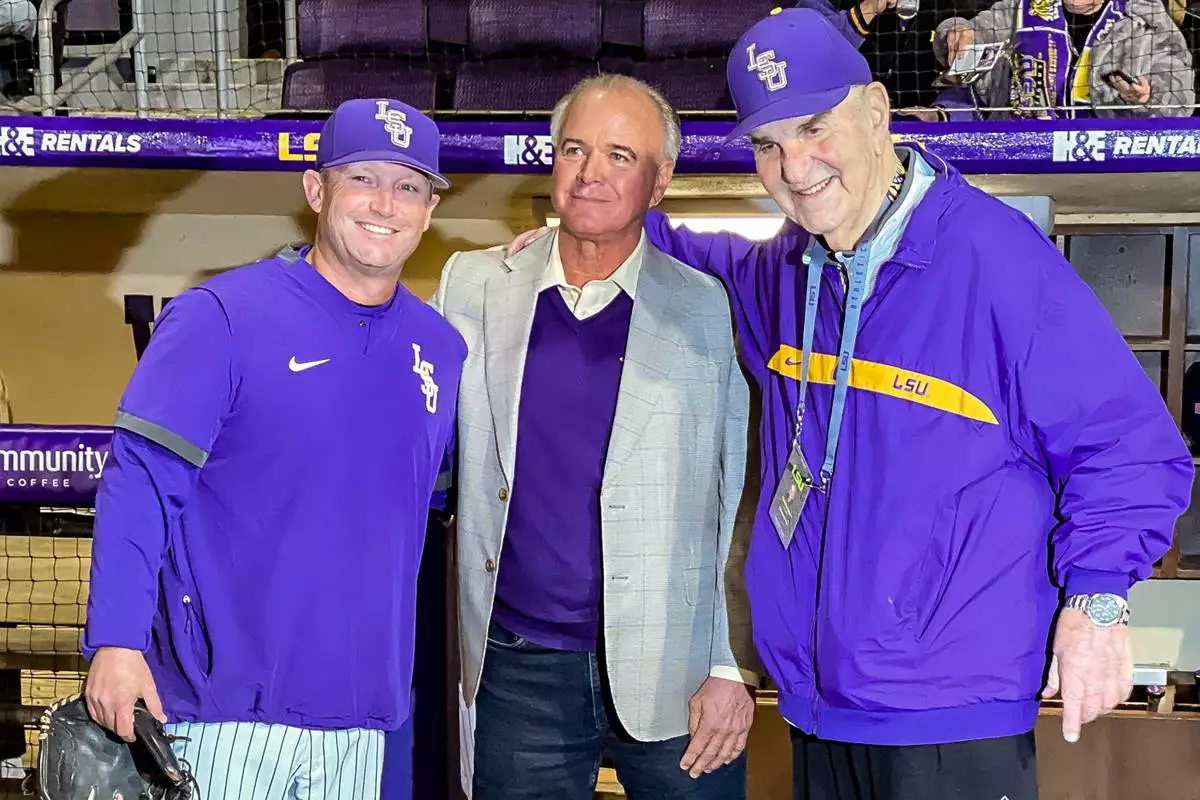
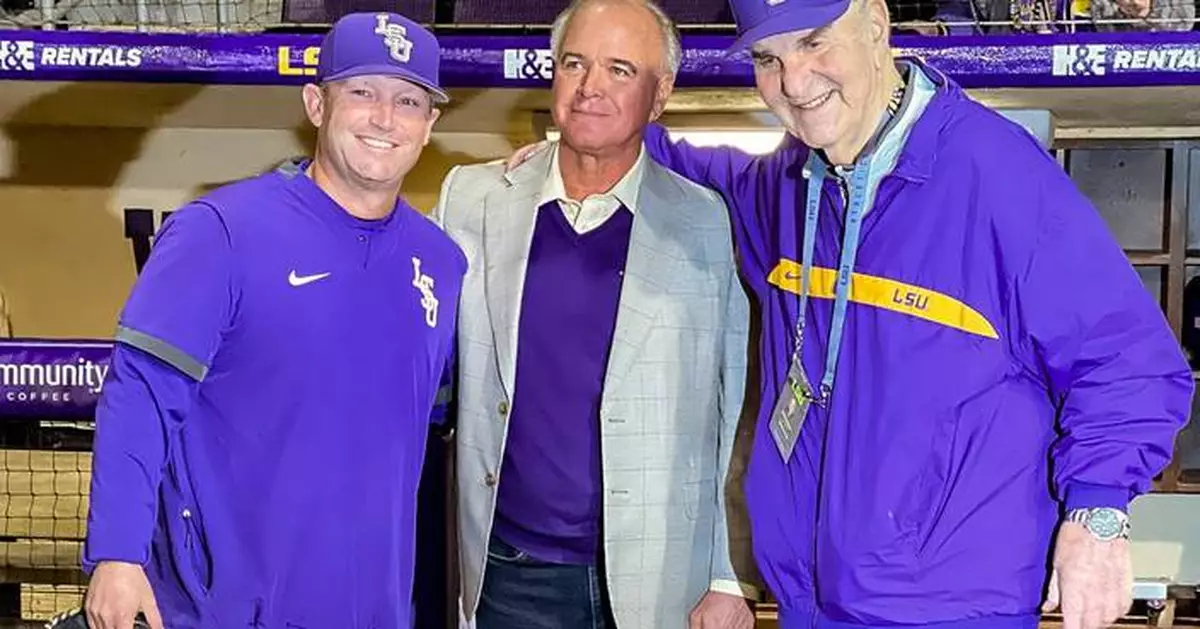
FILE - LSU head coach Jay Johnson, left, smiles with retired head coach Paul Mainieri, and head coach Skip Bertman before an NCAA baseball game against Maine on Feb. 18, 2022, in Baton Rouge, (AP Photo/Matthew Hinton, File)
ARLINGTON, Iowa (AP) — Farmer Tim Burrack had concerns about the Republican nominee for Iowa governor — and he wasn't the only one.
The conservative voter from northeast Iowa said he didn't know Zach Lahn before the political newcomer “came out of nowhere" with a surprise GOP primary win over the candidate endorsed by President Donald Trump. So when Lahn came to his farm last week, Burrack questioned him on his approach to agriculture.
“I hit him pretty hard,” said Burrack, who was considering whether to vote for Lahn in November or not vote at all.
It wasn't the first skeptical audience for the self-described “change candidate” in the state led by Republicans.
Lahn won the June primary even though an “entire establishment was set up against me,” he said. He criticizes politicians in both parties, accusing them of being bought by corporate interests. His bid for governor will test how an anti-establishment conservative fares with a general electorate — and with traditional Republicans — a decade after Trump’s own brand of populism reshaped the GOP.
While Iowa Republicans have an electoral advantage, Lahn entered the general election with a lower public profile than his Democratic opponent, state Auditor Rob Sand. Democrats see an opportunity to win this cycle in once-competitive Iowa, where high costs, health clinic closures, manufacturing job losses and a struggling agricultural economy weigh on voters.
Lahn talks about bringing a “different message” to Iowans who aren't satisfied with the trajectory of Iowa's small towns, public education or cancer rates, even after years of Republican control of state government. But only three months before Election Day, Lahn acknowledged he needs to keep getting out in front of people to address their questions and concerns.
“I think, for the most part, a lot of people just have never heard my message,” Lahn said after the event at Burrack's farm in Arlington. “The more we’ve met with people, the more they understand where our priorities lie, the more they say, ‘We are with you.’”
Some of Lahn's ideas challenge the Republican Party's status quo. Among them is his approach to agriculture and embrace of the “Make America Healthy Again” movement, which has prompted questions in the state that's among the nation's top producers of corn, soybeans, red meat and ethanol. Lahn promotes regenerative farming; emphasizes a link between high nitrate-loaded water and cancer; and questions the safety of agrochemicals.
Before Lahn took the stage in Arlington to talk agriculture, farmer Lance Lillibridge, a former president of the Iowa Corn Growers Association, told the couple hundred Iowans there that the goal was to “get the air clear."
In front of a huge American flag and sandwiched between two freshly washed John Deere tractors, Lahn said, “We farm a bit weird” on his own Iowa acres, growing oats, alfalfa and einkorn along with corn and beans.
But he told the crowd he wants to fund farmers’ efforts to diversify their operations, not force Iowans to farm like him. He said targeting “big ag” means filing antitrust lawsuits against corporate conglomerates that sell seed and fertilizer and taxing out-of-state investors consolidating Iowa acres, not stepping on family farms. He wants to see more incentives to improve water quality but wouldn’t try to outright ban agrochemicals.
Burrack, like Lahn, says that they won’t agree on everything. But after talking with Lahn, he called himself a supporter.
At another stop, a few dozen faces crowded at the back of a coffee shop in Hampton, Iowa, just after the lunch rush. Many of them were familiar with each other but less so with the candidate they came to see. Among them were Jay and Sally Van Wert, retired farmer and teacher, who said Lahn seemed like a nice guy, but they didn't know much else.
Several Iowans attending some of Lahn's first publicly advertised events since the primary said they only knew what they’ve seen in advertisements from Sand's campaign. The ads call Lahn a “part-time Iowan" and reference dozens of occasions where Lahn piloted his private plane to and from Kansas since launching his campaign.
“Is he going all the time to Kansas?” asked Larry Streicher, 84, a Republican farmer in the front row in Arlington. “We don’t know anything about him.”
Lahn said he left Iowa for college like so many others but wanted to come home, amplifying a nostalgia for Iowa culture and heritage that resonated with voters, not unlike Trump's “Make America Great Again” message.
He left Iowa again to start a private school funded by the Koch family, which opened in Kansas in 2018. He co-founded the school with his now-wife, Annie, who had been married to Chase Koch, son of conservative billionaire Charles Koch.
Lahn told the crowds he and Annie moved into their Belle Plaine, Iowa, homestead in 2023 after finishing renovations. Lahn bought the farm that had been in his family for a century but sold it after his great-grandmother died.
Douglas Puffett, a farmer from Strawberry Point and member of his county’s GOP central committee, said Lahn's story is like so many other Iowans’ and his vision for Iowa is driven by what drew him back.
“That’s how you inspire the next generation,” said the 40-year-old, who appreciates that Lahn, also 40, is young and has young kids.
Lahn has explained that trips to Kansas are due to his blended family, which includes children from his and Annie’s previous marriages. He doesn't comment on whether he would travel or use taxpayer resources to do so if elected governor, saying it would not impact his ability to govern.
Puffett, who attended Lahn’s Arlington event, thinks 10 years of Republican trifecta have given Sand an opening to appeal to people who might be unhappy with the “Republican establishment,” he said, but Lahn “stacks up really nice” with his calls for reform.
“I think it’s time to kind of roll over the leadership of the Republican Party here in Iowa," he said.
Gov. Kim Reynolds’ decision to not seek a third term gave Republicans their first wide-open primary since 2010, and five candidates were on the ballot. Lahn overtook U.S. Rep. Randy Feenstra by less than a percentage point, or about 1,650 more votes.
Lahn told crowds that he only met Reynolds after the primary, a signal of his distance from Iowa politics. Speaking at the state party’s fundraiser in July, he joked about all the donors who “haven’t been returning my calls” all being in one room.
Since his primary win, Lahn has met with party leaders and Iowa's prominent industry groups. His campaign spent the summer ramping up fundraising, staff and organizing infrastructure.
State Rep. Bobby Kaufmann, who is the majority leader of House Republicans, said there may be some differences of opinion or “curiosities, not concerns" about Lahn's positions, but added that's always the case.
Kaufmann met Lahn earlier this year, voted for him in June and said there's been a “full embrace” of the nominee. He said Lahn is not a traditional candidate, but that's what makes his campaign energizing for Republicans who are “constantly craving new leadership."
“I think it began back in 2016 with President Trump,” Kaufmann said. “Republicans don’t rest on our laurels."
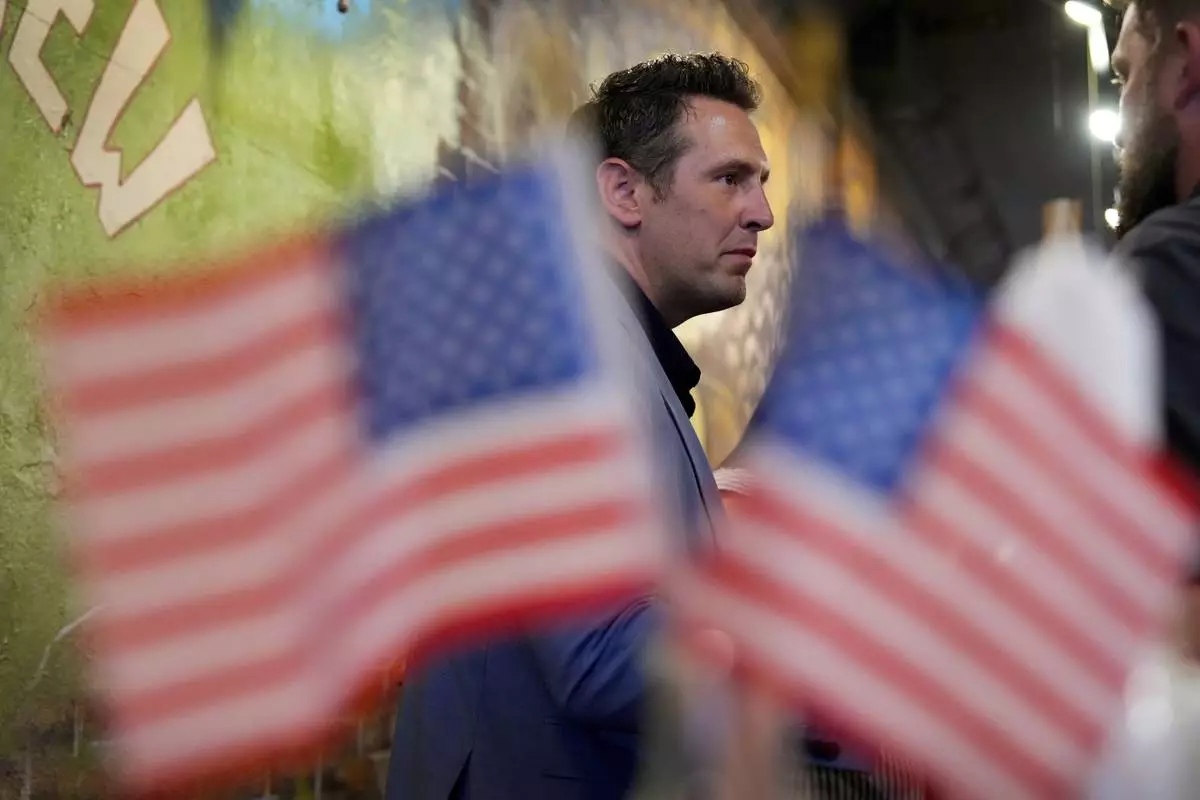
Zach Lahn, Republican candidate for Iowa governor, speaks to local residents during a meet and greet, Tuesday, Aug. 4, 2026, in Hampton, Iowa. (AP Photo/Charlie Neibergall)