TORONTO (AP) — Six-time All-Star Vladimir Guerrero Jr. was evaluated for a possible concussion after leaving the Toronto Blue Jays' 3-1 victory over the Yankees on Friday night following a collision with New York rookie shortstop George Lombard Jr. on a chaotic play at third base.
With Guerrero at first and Nathan Lukes at second in the sixth inning and the Blue Jays trailing 1-0, George Springer hit a bouncer to third baseman Ryan McMahon, who stepped on the bag to force out Lukes for the second out.
McMahon threw to first in a bid to retire Springer, but New York first baseman Luis García Jr. couldn’t scoop the throw, losing his glove in the process. Guerrero broke for third and García threw toward Lombard, who was trying to get to the bag. The throw got away as Lombard tried to leap over the sliding Guerrero, and his left knee and thigh struck Guerrero’s head.
Guerrero’s helmet was dislodged. He got up and ran home to score the tying run, but looked dazed after crossing the plate.
Manager John Schneider said Guerrero had “a little bit of a headache” after the collision.
“Kind of precautionary right now,” Schneider said of the decision to remove Guerrero. “We'll see how he is tomorrow.”
Charles McAdoo took over at first base in the top of the seventh.
Guerrero is batting .263 with seven homers and 46 RBIs.
McMahon and García were both charged with throwing errors.
“Just didn't work out, man,” McMahon said of the play. “Obviously led to a couple of runs for them and that hurts.”
See AP’s full MLB coverage here

Toronto Blue Jays Vladimir Guerrero Jr. (27) grimaces as he crosses the plate after scoring following a throwing error by New York Yankees first baseman Luis García Jr. (26) during the first inning of a baseball game in Toronto, Friday, Aug. 14, 2026. (Chris Young/The Canadian Press via AP)
STARBASE, Texas (AP) — SpaceX launched Starship toward orbit Friday in its boldest test yet: a 22-hour flight that aimed to capture the entire rocket in a move meant to accelerate moon and Mars travel.
But Elon Musk’s company had to lower its expectations when the first part of the double catch flopped.
The first-stage booster malfunctioned and instead of returning to its Texas pad several minutes after liftoff, it ended up in the Gulf of Mexico after an automatic abort. Despite the setback, the bullet-shaped spacecraft continued toward orbit. It will steer toward the pad Saturday for a similar grab, barring further trouble.
It’s the first time that the spacecraft will try to return to the pad from orbit, to be plucked in midair by mechanical arms secured to the launch tower.
The original goal was to retrieve every single piece of the rocket for the purpose of future recycling, something yet to be achieved anywhere in the world. Musk sees this leading to the kind of fast and consistent launch rates necessary for building moon bases and sending people to Mars.
Once in orbit, Starship will deliver 26 of the company’s most advanced Starlink satellites. The plan is for Starship to complete 15 laps around the world at an altitude of around 170 miles (275 kilometers) before heading back to the launch site for Saturday’s grand finale.
SpaceX had already made three booster grabs at the company’s sprawling Starbase near the U.S.-Mexico border. This was the first attempt to capture the upgraded version that stretches 236 feet (72 meters) — the production model for moon and Mars expeditions. It will also be the first time the company attempts to catch the spacecraft, which spans 171 feet (52 meters). Together, they form the world’s biggest and most powerful rocket — an astounding 407 feet (124 meters) in height.
The spacecraft portion of the 14 previous Starships ended up in the ocean, either by design at flight’s end or by accident in a stream of flaming wreckage. During the first full-scale test flight in 2023, multiple engines failed to ignite and the tumbling rocket’s self-destruct system was activated.
The last test, in September, was the first to reach orbit, but SpaceX did not try to recover any of the rocket stages.
SpaceX plans to start launching Starships from Florida within a few months and from Louisiana in a few years. Scaled-up infrastructure, combined with full rocket reusability, is “how you go from zero launches to 10 to 100 to 1,000 to 10,000 to 100,000,” SpaceX’s Kiko Dontchev, vice president of launch, said at a NASA tech summit last week at Florida’s Kennedy Space Center.
SpaceX’s smaller Falcon rockets will continue to fly from Cape Canaveral, carrying astronauts to the International Space Station for NASA and from California carrying Starlinks. Satellites also will keep hitching Falcon rides for now. Musk wants Starships to eventually replace Falcons.
Falcon rockets “are still not fully reusable. We still throw that second stage away every single flight. Starship, we’re going to catch both the first stage and second stage,” Dontchev said.
NASA is paying SpaceX billions of dollars to land Artemis astronauts on the moon with Starships. Jeff Bezos’ Blue Origin is the other major player. NASA expects to decide a year before the Artemis IV lunar landing — the first by astronauts in more than half a century — whether to get the moonwalkers to the surface with Musk’s Starship or Bezos’ Blue Moon.
During next summer’s Artemis III mission, astronauts will practice docking their capsule with a Blue Moon and then a Starship in orbit around Earth. That will set the stage for an Artemis moon touchdown as early as 2028.
The Associated Press’ health and science coverage receives financial support from the AP Fund for Journalism and private foundations. AP is solely responsible for all content. Find AP’s standards for working with philanthropies, a list of supporters and funded coverage areas at AP.org.
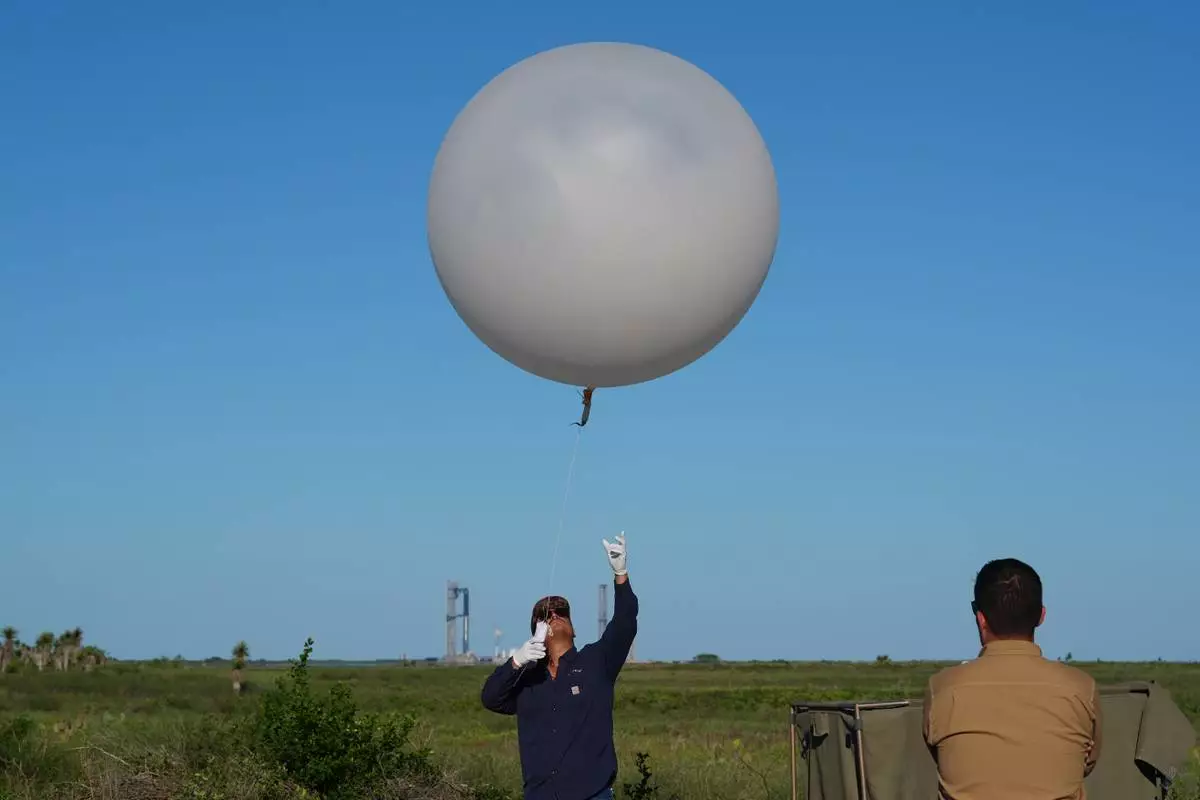
A weather balloon is released ahead of SpaceX's Starship test flight from Starbase in Texas, Nov. 13, 2026. (AP Photo/Eric Gay)
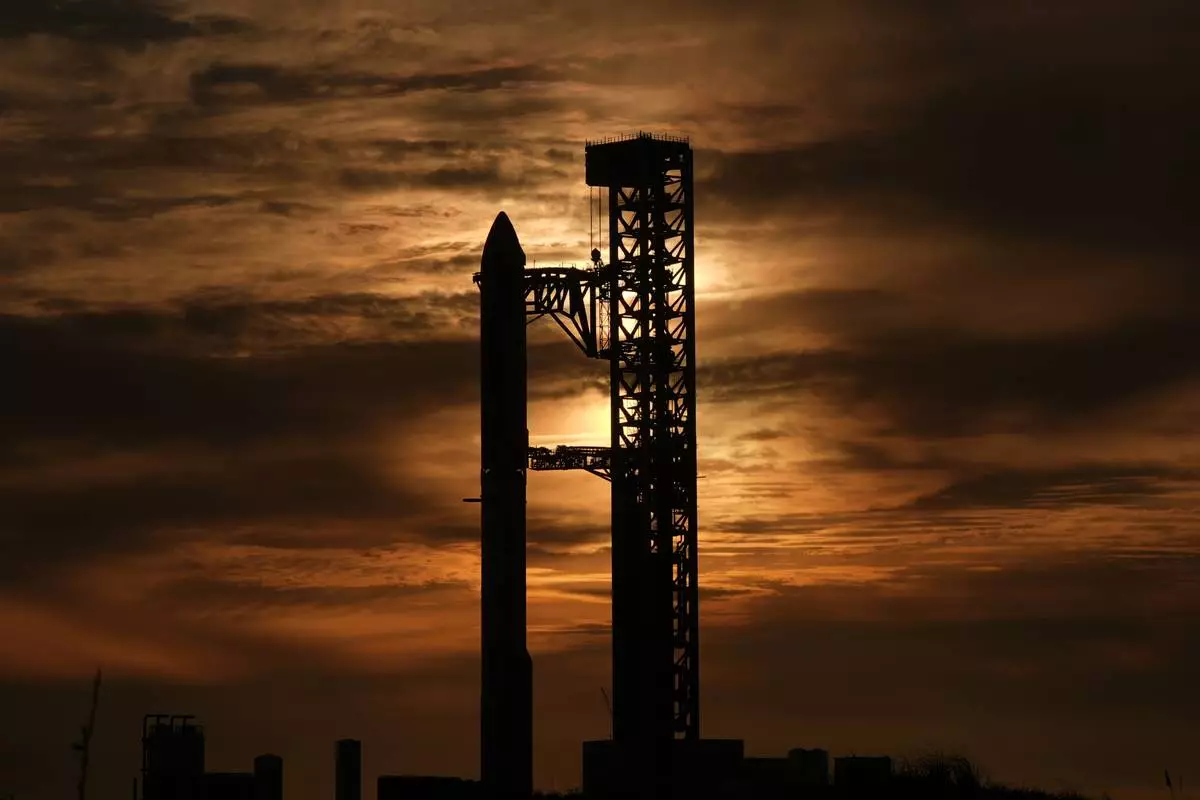
SpaceX's mega rocket Starship is stacked and prepared for a test flight from Starbase, Texas, Thursday, Nov. 12, 2026. (AP Photo/Eric Gay)
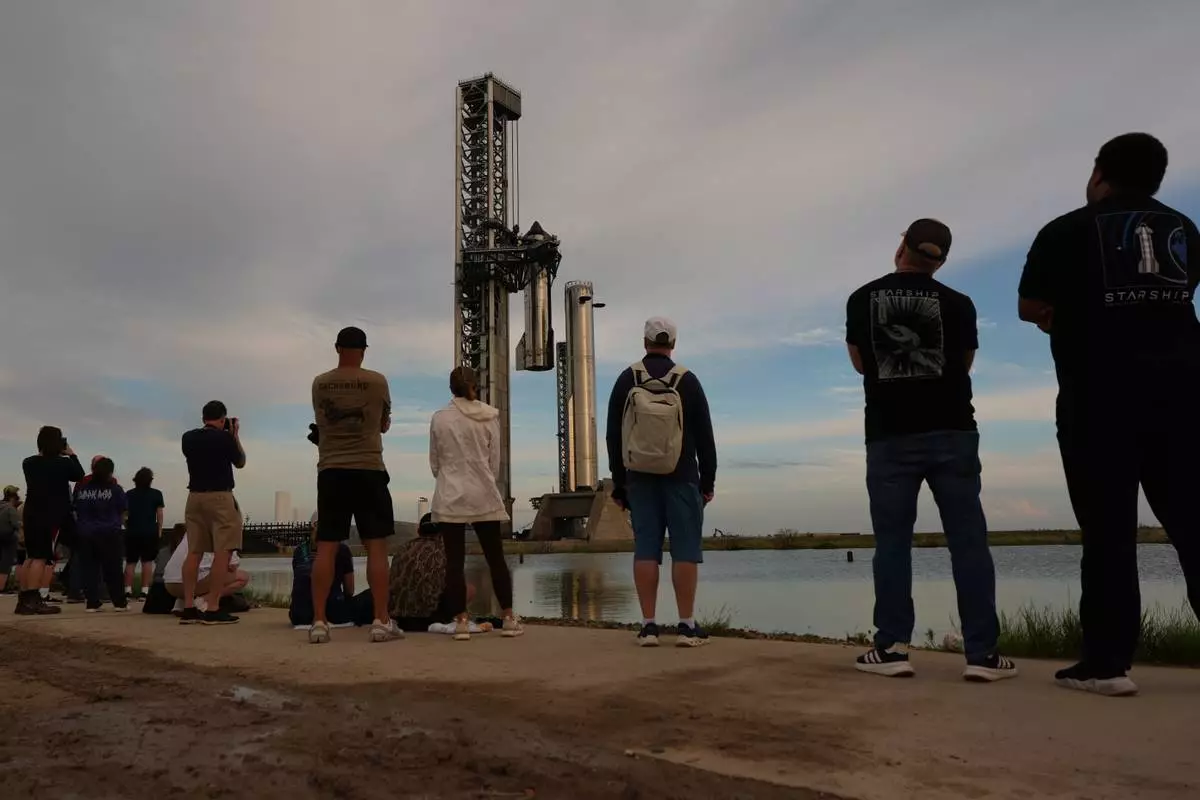
People gather to watch as SpaceX's mega rocket Starship, getting stacked and prepared for a test flight from Starbase, Texas, Thursday, Nov. 12, 2026. (AP Photo/Eric Gay)
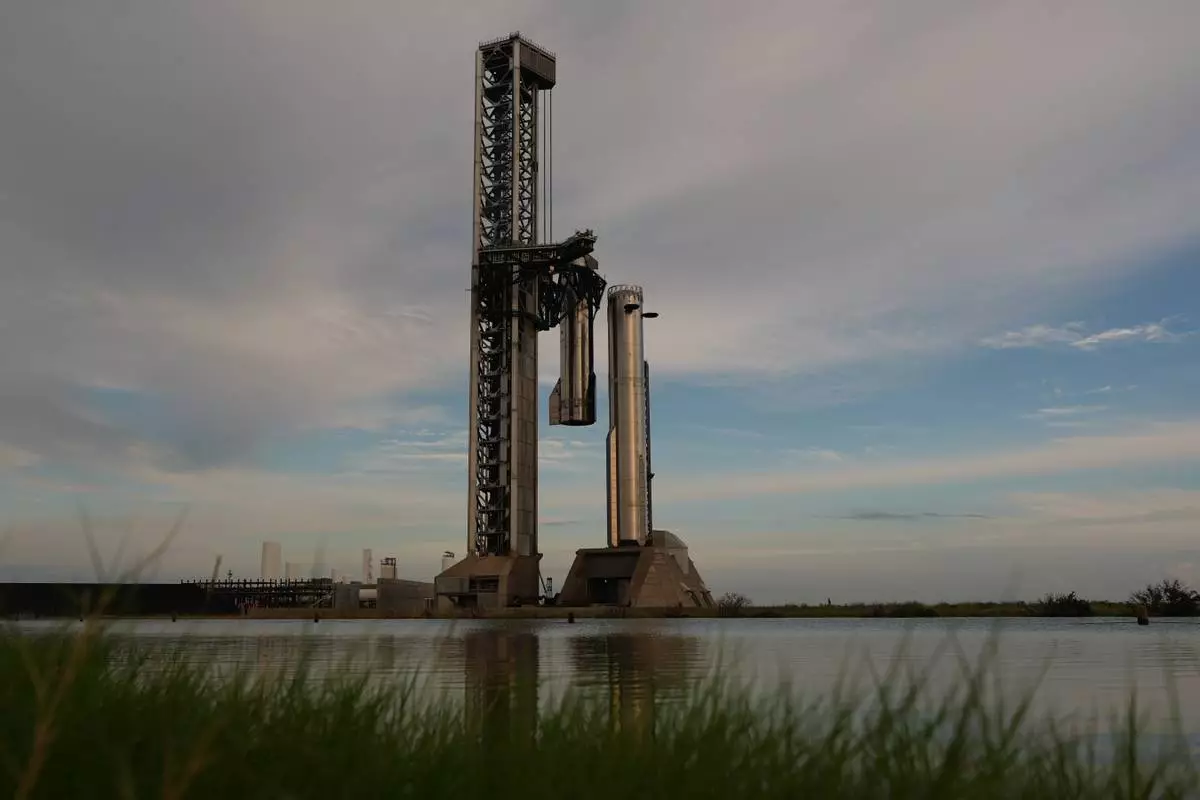
SpaceX's mega rocket Starship is stacked and prepared for a test flight from Starbase, Texas, Thursday, Nov. 12, 2026. (AP Photo/Eric Gay)
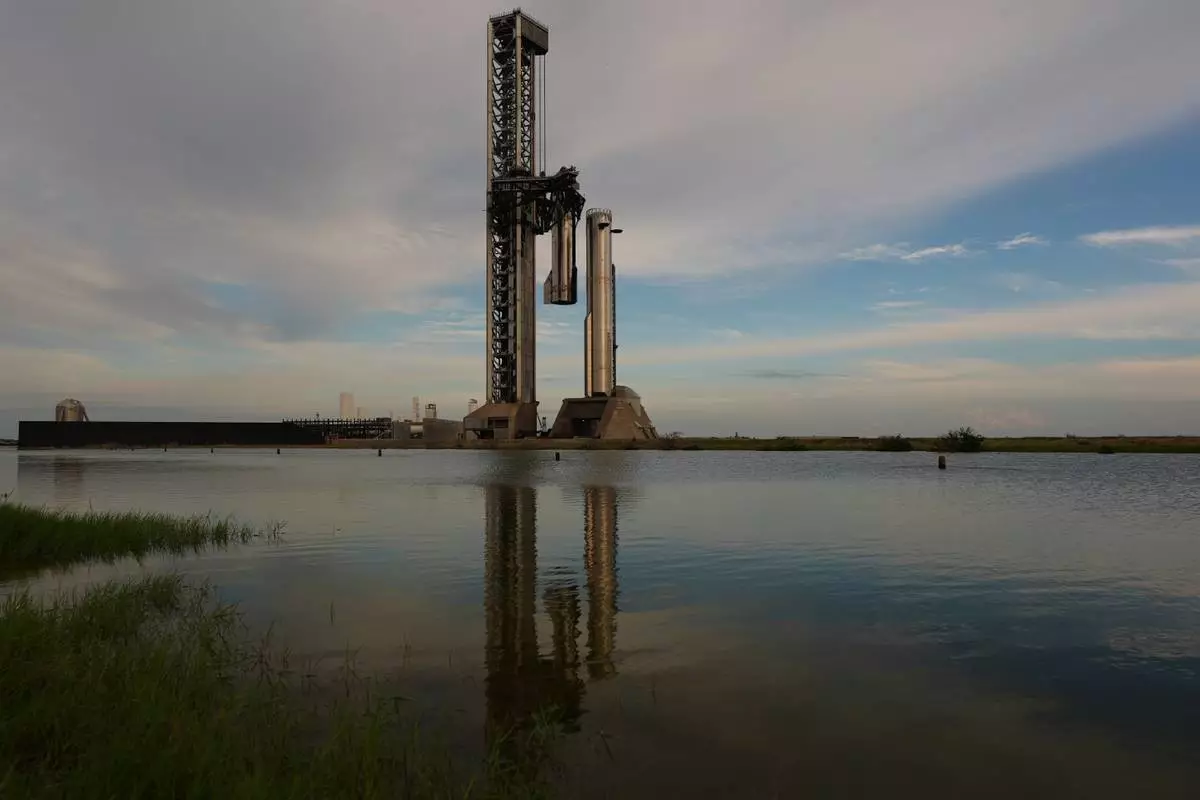
SpaceX's mega rocket Starship is stacked and prepared for a test flight from Starbase, Texas, Thursday, Nov. 12, 2026. (AP Photo/Eric Gay)
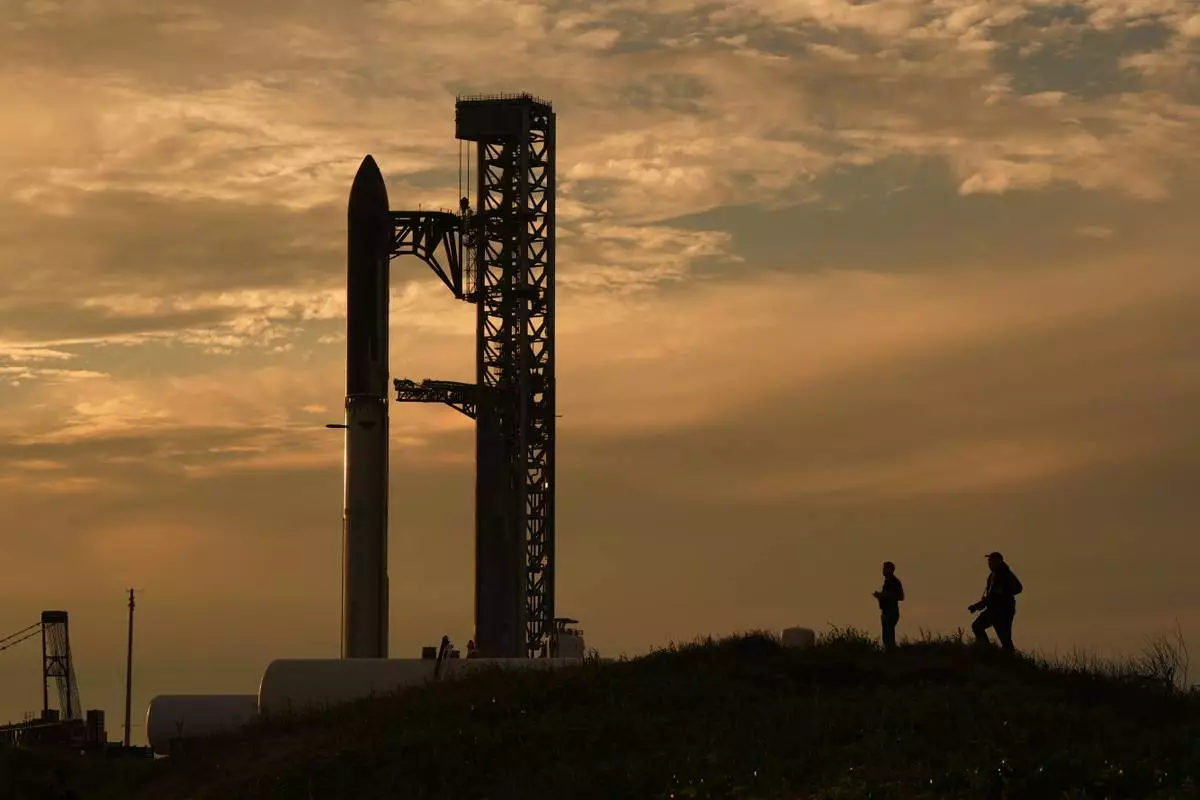
SpaceX's mega rocket Starship is stacked and prepared for a test flight from Starbase, Texas, Thursday, Nov. 12, 2026. (AP Photo/Eric Gay)