China's railway system handled 2.8 billion passenger trips in the first seven months this year, up 4.1 percent year on year and marking a record high for the period, China Railway said on Saturday.
The growing passenger trips were driven by increased transport capacity with ever increased high-speed railway networks, and new route sections and stations on lines that connect central China's Shiyan City and northwestern city of Xi'an as well as Lanxi and Jiande in the eastern Zhejiang Province going into operation.
From January to July, China's railways operated an average of 11,462 passenger trains daily, an increase of 571 trains or 5.2 percent year‑on‑year.
Booming inbound tourism also contributed to the increased travels. From January to July, the country's railways handled nearly 15 million passenger trips by foreign visitors, up 32.5 percent year on year.

China's railway handles 2.8 bln passenger trips in Jan-July
U.S. stocks recovered on Thursday as falling Treasury yields provided relief to equity markets, helping technology and semiconductor shares stabilize amid debt-financing worries.
The Dow Jones Industrial Average rose 556.21 points, or 1.08 percent, to 52,177.69. The S and P 500 added 25.12 points, or 0.33 percent, to 7,744.06. The Nasdaq Composite Index increased by 20.16 points, or 0.08 percent, to 26,713.03.
Eight of the 11 primary S and P 500 sectors ended in the green, with health and materials leading the gainers by going up 1.84 percent and 1.71 percent, respectively. Meanwhile, energy and technology led the laggards by losing 1.55 percent and 0.54 percent, respectively.
Market sentiment found footing as benchmark borrowing costs retreated, allowing heavily pressured tech equities to pare steep losses.
In the AI infrastructure sector, cloud compute provider CoreWeave gained nearly 6 percent, reversing a portion of Wednesday's more than 15 percent drop triggered by concerns over excessive debt accumulation to finance its hardware expansion. Memory manufacturer Micron Technology also recovered most of its intraday decline, closing 1.87 percent higher.
Concerns across the AI ecosystem were compounded by a CNBC report that Anthropic's quarterly revenue reached 16.8 billion U.S. dollars in the third quarter. While representing massive growth, the pace raised questions among some market participants about whether revenue expansion remains swift enough to sustain lofty valuations across underlying chipmakers.
Despite the broader equity recovery, inflation pressures remained pronounced. The U.S. Bureau of Labor Statistics reported Thursday that the producer price index (PPI) for final demand jumped 1.3 percent in September, lifting the annualized wholesale rate to 6.3 percent, its fastest pace since 2022.
The sharp acceleration followed Wednesday's hotter-than-expected consumer price index (CPI) reading, further complicating the Federal Reserve's policy trajectory as officials weigh persistent price spikes ahead of their upcoming interest rate decision.
"Today's PPI report, after Wednesday's CPI, confirms inflation is getting worse as energy prices stay high," said David Russell, global head of market strategy at TradeStation. "Election or no election, prices are rising and the Fed might be forced to act."
According to CME FedWatch, traders now see a 29 percent likelihood the Federal Reserve will raise interest rates at its meeting in two weeks, and an 88 percent likelihood the central bank will lift rates at least a quarter-percentage point at its December meeting.
Broader market gains were underpinned by defensive and consumer-oriented sectors outside of technology. Walmart advanced 1.47 percent, after Deutsche Bank upgraded the stock to "buy" from "hold," citing a positive outlook for 2027. The bank expects incremental margins to improve and noted current inflation levels could help the company attract consumers.
Nike jumped more than 5 percent, leading consumer discretionary gainers. Apple, which on Wednesday joined Nvidia as the only companies ever to close with a market capitalization above 5 trillion dollars, ended 0.28 percent lower.
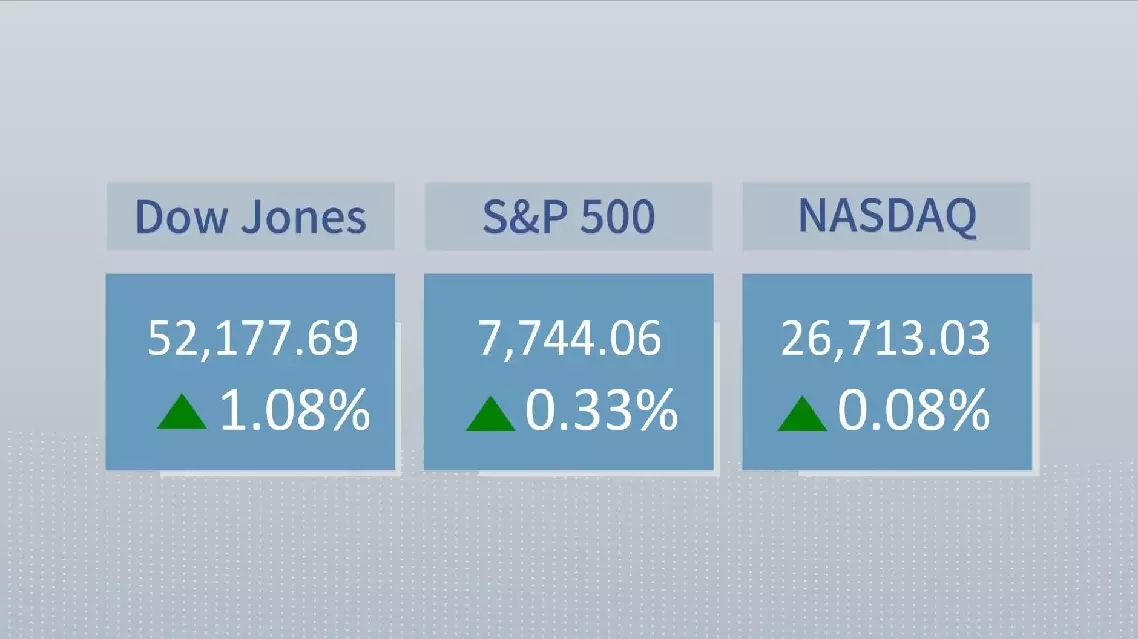
U.S. stocks recover as sliding Treasury yields offset hot inflation data