Skip to Content Facebook Feature Image

Obesity drugs show early promise against the hormonal disorder PMOS, giving a suffering family hope

ENT

Obesity drugs show early promise against the hormonal disorder PMOS, giving a suffering family hope
ENT

ENT

Obesity drugs show early promise against the hormonal disorder PMOS, giving a suffering family hope

2026-08-15 21:11 Last Updated At:21:21

Charlotte Touzalin was still a young teenager when she began struggling with weight gain, abnormal periods and unwanted facial hair — the same puzzling symptoms that plagued her mom for decades and that no doctor could piece together.

“I’d go home and I’d cry,” said Touzalin, an 18-year-old college student from Colorado. “I didn’t understand why all this weight was coming back or why my friends didn’t have to shave their faces and I had to.”

More Images
Anne Schultz and her daughter, Charlotte Touzalin, go on a walk Friday, July 10, 2026 in Elizabeth, Colo. (AP Photo/Brittany Peterson)

Anne Schultz and her daughter, Charlotte Touzalin, go on a walk Friday, July 10, 2026 in Elizabeth, Colo. (AP Photo/Brittany Peterson)

GLP-1 medication used in the polyendocrine metabolic ovarian syndrome trial Friday, July 10, 2026 in Aurora, Colo. (AP Photo/Brittany Peterson)

GLP-1 medication used in the polyendocrine metabolic ovarian syndrome trial Friday, July 10, 2026 in Aurora, Colo. (AP Photo/Brittany Peterson)

Dr. Melanie Cree explains medical results to Noelani Schulmeister in a study using GLP-1 medication to treat PMOS Friday, July 10, 2026 in Aurora, Colo. (AP Photo/Brittany Peterson)

Dr. Melanie Cree explains medical results to Noelani Schulmeister in a study using GLP-1 medication to treat PMOS Friday, July 10, 2026 in Aurora, Colo. (AP Photo/Brittany Peterson)

Charlotte Touzalin holds a photo of herself, provided by Bre Blake Photography, showing her before participating in a PMOS study, in Elizabeth, Colo., on Friday, July 10, 2026. (AP Photo/Brittany Peterson, Bre Blake Photography)

Charlotte Touzalin holds a photo of herself, provided by Bre Blake Photography, showing her before participating in a PMOS study, in Elizabeth, Colo., on Friday, July 10, 2026. (AP Photo/Brittany Peterson, Bre Blake Photography)

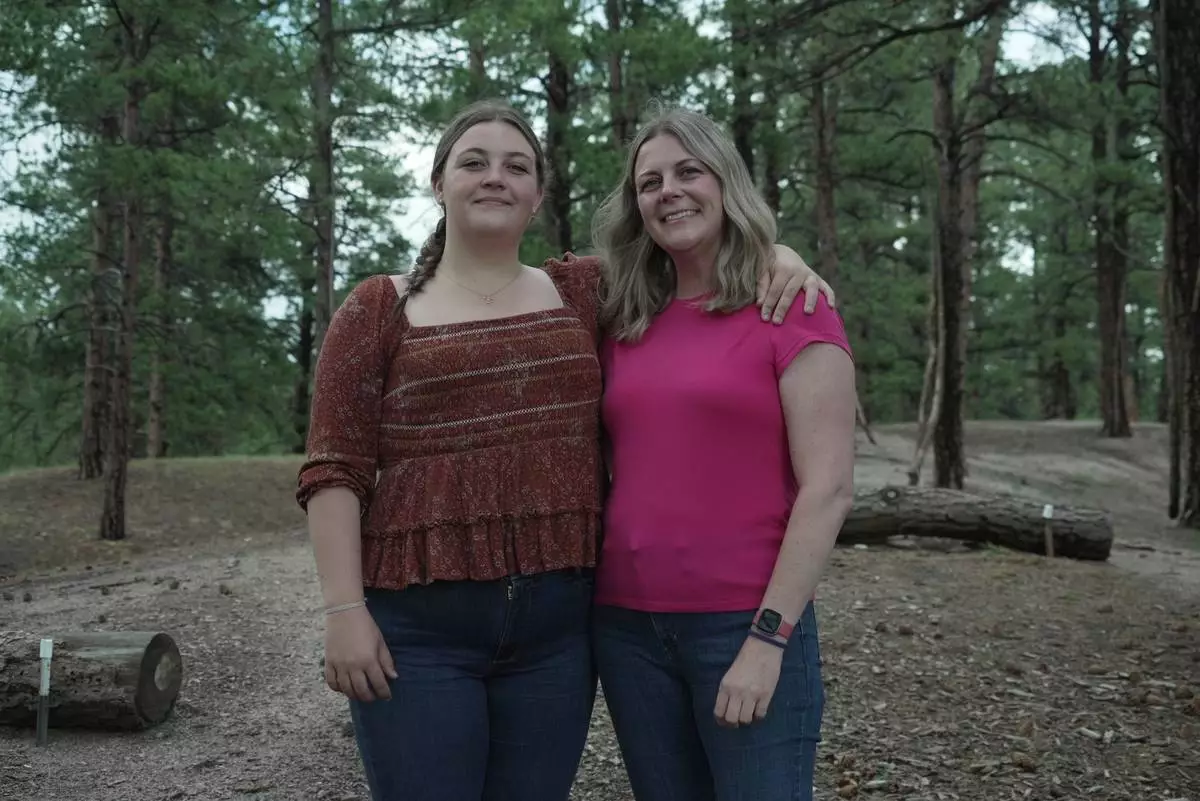
Charlotte Touzalin stands with her mother, Anne Schultz, Friday, July 10, 2026 in Elizabeth, Colo. (AP Photo/Brittany Peterson)

Charlotte Touzalin stands with her mother, Anne Schultz, Friday, July 10, 2026 in Elizabeth, Colo. (AP Photo/Brittany Peterson)

Touzalin and her mom, Anne Schultz, were finally diagnosed with polyendocrine metabolic ovarian syndrome, a hormonal condition affecting 1 in 8 women worldwide. But unlike her mom, Touzalin is beginning young adulthood with new hope after taking part in a study testing blockbuster GLP-1 drugs as a treatment.

A small but growing body of research shows that these obesity medications may also work for the disorder known as PMOS — not only by promoting weight loss but also by improving insulin resistance, hormone balance and ovulation. These things are key to the disease, which used to be called polycystic ovary syndrome but was renamed earlier this year to shift the focus away from ovaries and cysts.

“We need to do a better job taking care of it,” said Dr. Melanie Cree, who has led three studies testing GLP-1 drugs for PMOS including the one Touzalin joined. “We are finding them incredibly effective and really exciting for improving symptoms in women with this condition.”

Touzalin and her mom's long, frustrating journey with PMOS is common.

Diagnosis often takes years because symptoms overlap with other conditions, vary widely and may be dismissed by doctors. The disorder tends to run in families, and many but not all women affected carry excess weight. But there’s no known cause or specific treatment, just symptom management such as taking birth control pills to regulate periods and keeping weight in check with diet and exercise.

Two hormones are key drivers of PMOS: insulin, which acts like a key to let blood sugar into cells, and testosterone, which among other things helps maintain sexual desire, bone density and muscle mass.

Most women with PMOS, regardless of their body size, have insulin resistance, which means this hormone doesn't work as well as it should, said Cree, PMOS clinic director at Children’s Hospital Colorado. In many women, the high insulin can go directly to the ovaries, spurring them to make more testosterone and leading to problems like skipped periods, severe acne and even beard growth.

Schultz, 43, didn’t even know the condition existed when she first began having irregular periods and bloating around age 18. In addition to struggling with the same symptoms as her daughter, she had problems with her ovaries and numerous miscarriages, which are more common with PMOS.

Schultz received various diagnoses before learning she had PMOS around the same time as her daughter, who faced a similar medical runaround.

Schultz recalled talking about Touzalin's symptoms with a pediatrician who was seeing her for what they thought was primarily an issue with binge eating and ADHD.

Schultz told the doctor: “There's gotta be something else going on here.”

Touzalin said she felt “heard for the first time” when a nurse practitioner began piecing things together a few years ago. Cree definitively diagnosed her last year.

“It was like a godsend,” said Schultz, tearing up. “We finally had an answer and some kind of a path for her.”

In Cree’s study, Touzalin gave herself shots of semaglutide weekly for 10 months. The abnormal hair growth slowed and her periods normalized. For the first time, she felt full after eating and stopped gaining weight constantly.

“I became a happier version of myself,” she said. “I felt like a normal person.”

Touzalin’s results weren’t unique. Early data from the study, published in June in the journal Fertility and Sterility, said eight of 11 participants completing the trial lost at least 10% of their body weight. The median weight loss among them was about 42 pounds; the median drop in testosterone was 52%. Six women had more periods and four of them went to monthly periods.

In all three of Cree’s studies, women on GLP-1s lost more weight than those in control groups, and levels of testosterone, blood sugar and insulin dropped. While the study involving Touzalin looks at semaglutide shots, the other studies examined semaglutide pills in one and exenatide shots in the other.

Other studies globally have shown similarly positive results. Although the studies are small, some researchers say GLP-1s are already showing promising potential for targeting metabolic issues in PMOS. Others say the evidence remains uncertain, and more studies are underway.

As research continues, more and more doctors are prescribing the drugs “off label” for PMOS and seeing improvements in their patients. But insurance coverage is often a problem because the drugs are not approved to treat the condition.

“I use these medicines a great deal,” said Dr. Rana Malek, an endocrinologist with the University of Maryland Medical System.

Among patients with insulin resistance, she said she usually uses them to help with weight loss.

Doctors stress that results vary. GLP-1s don’t work for everyone and can have side effects, like nausea and constipation. If people stop taking them, weight can return.

Still, they can help a lot of PMOS patients, Malek said, and it’s frustrating that many can’t get them because of insurance issues. Not only are they unapproved for PMOS, some insurers don’t cover them for weight loss.

Touzalin recently ran into this barrier herself. After finishing her study participation, she no longer gets free GLP-1s and had to go off them in June.

Schultz is determined to get her back on them. She’s fighting with her insurer and has a backup plan to get medications through a drug company program. She’d also like to try GLP-1s for her own PMOS, but said her daughter comes first.

Touzalin hopes for a day when any PMOS patient can get the treatment if she needs it.

“It’s something that could help a lot of other people,” she said.

AP video journalist Brittany Peterson in Denver contributed to this story.

The Associated Press Health and Science Department receives support from the Howard Hughes Medical Institute’s Department of Science Education and the Robert Wood Johnson Foundation. The AP is solely responsible for all content.

Anne Schultz and her daughter, Charlotte Touzalin, go on a walk Friday, July 10, 2026 in Elizabeth, Colo. (AP Photo/Brittany Peterson)

Anne Schultz and her daughter, Charlotte Touzalin, go on a walk Friday, July 10, 2026 in Elizabeth, Colo. (AP Photo/Brittany Peterson)

GLP-1 medication used in the polyendocrine metabolic ovarian syndrome trial Friday, July 10, 2026 in Aurora, Colo. (AP Photo/Brittany Peterson)

GLP-1 medication used in the polyendocrine metabolic ovarian syndrome trial Friday, July 10, 2026 in Aurora, Colo. (AP Photo/Brittany Peterson)

Dr. Melanie Cree explains medical results to Noelani Schulmeister in a study using GLP-1 medication to treat PMOS Friday, July 10, 2026 in Aurora, Colo. (AP Photo/Brittany Peterson)

Dr. Melanie Cree explains medical results to Noelani Schulmeister in a study using GLP-1 medication to treat PMOS Friday, July 10, 2026 in Aurora, Colo. (AP Photo/Brittany Peterson)

Charlotte Touzalin holds a photo of herself, provided by Bre Blake Photography, showing her before participating in a PMOS study, in Elizabeth, Colo., on Friday, July 10, 2026. (AP Photo/Brittany Peterson, Bre Blake Photography)
Charlotte Touzalin holds a photo of herself, provided by Bre Blake Photography, showing her before participating in a PMOS study, in Elizabeth, Colo., on Friday, July 10, 2026. (AP Photo/Brittany Peterson, Bre Blake Photography)

Charlotte Touzalin stands with her mother, Anne Schultz, Friday, July 10, 2026 in Elizabeth, Colo. (AP Photo/Brittany Peterson)


Charlotte Touzalin stands with her mother, Anne Schultz, Friday, July 10, 2026 in Elizabeth, Colo. (AP Photo/Brittany Peterson)

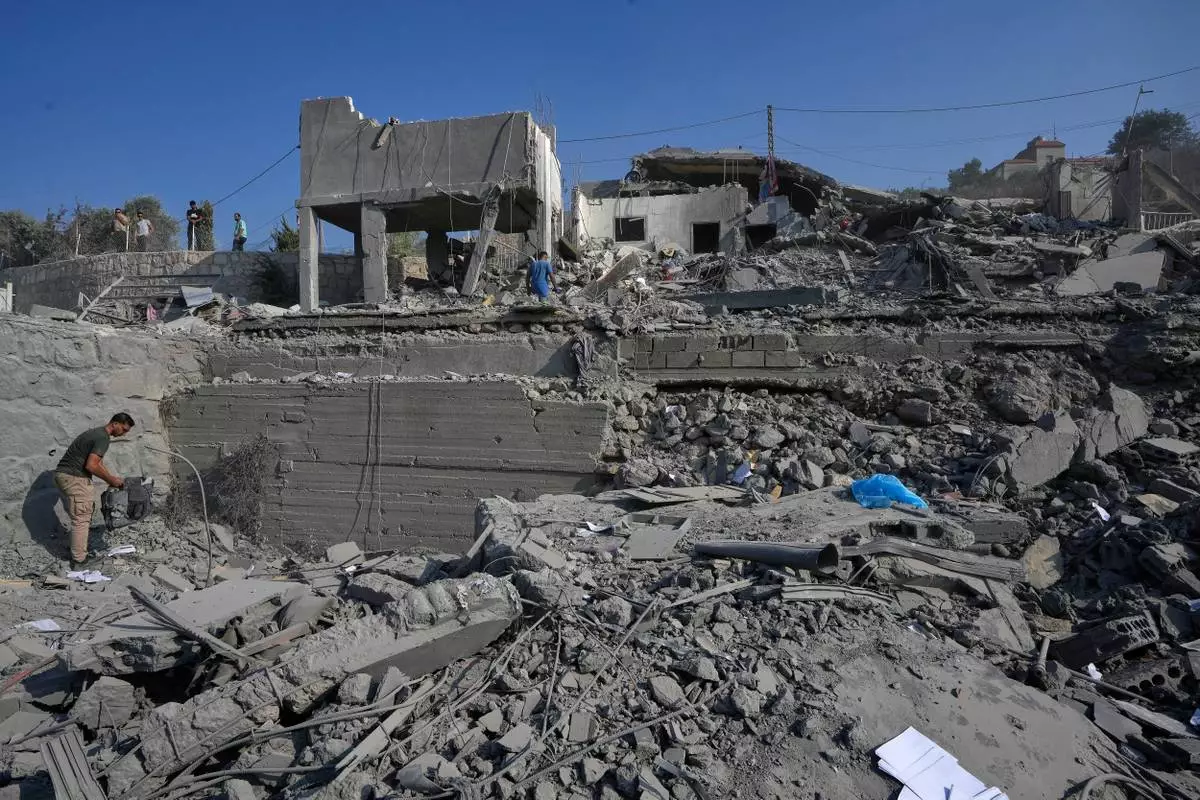
BEIRUT (AP) — Israeli airstrikes on southern Lebanon killed at least 11 people Saturday, in the deadliest attacks since a precarious truce between Israel and Hezbollah went into effect on June 20.

Lebanon's Health Ministry and state news agency said one of the airstrikes that targeted a home on the edge of the village of Ansar killed seven people, including three children, and wounded two. The second, on the village of Deir al-Zahrani, killed four and wounded 17.

Israel and the Lebanese government announced a “framework agreement” on June 26, laying out a plan for Israeli forces to withdraw from southern Lebanon, in exchange for the disarmament of the Iran-backed Hezbollah militant group. It also envisions steps toward an eventual peace agreement between the two countries — which technically remain in a state of war nearly 80 years after Israel’s establishment.

Hezbollah has refused direct talks and wasn’t party to the deal.

Saturday's strikes are the deadliest since the truce went into effect two months ago. On July 6, four people were killed in strikes on the town of Nabatiyeh Fawqa.

On June 19, a day before the truce went into effect, Israeli strikes on Lebanon killed 83 and wounded 141, according to the health ministry.

Lebanese Prime Minister Nawaf Salam criticized Israel's airstrikes on southern Lebanon, saying they intimidate “residents in their homes" and undermine efforts to stabilize the situation in the south.

“The seven martyrs of the Israeli airstrike on the town of Ansar are not military infrastructure and the children and women killed were not military targets,” Salam said in comments posted on X. He added that it is the job of the Lebanese state to deal with any military infrastructure in the country.

“Israel must halt this escalation,” Salam said. He added that the security of the Lebanese people and their right to life on their land “are not subject to negotiation or bargaining.”

President Joseph Aoun said in comments released by his office that the strikes are “a clear message to the negotiation track and to the American efforts aimed at implementing this agreement.”

Intense Israeli airstrikes early Saturday also hit the strategic Ali Taher hill, which overlooks parts of the southern city of Nabatiyeh and main roads leading to it, NNA reported. Despite the truce, Israel’s military has continued its almost daily attacks on the area, which is north of the Litani River and has been a de facto boundary in Lebanon, with large areas to the south under Israeli military control.

The Israeli military said in a statement that it struck Hezbollah infrastructure in the areas of Ali Taher and Ansar in response to an action against Israeli soldiers in the area. The military added that it will not allow the Hezbollah to harm Israeli civilians or soldiers “and will continue to operate to remove threats.”

A Hezbollah official did not immediately respond when asked for comment on whether they carried out any attacks on Israeli forces in southern Lebanon.

Hebzollah later called on the Lebanese state to find ways to halt “this aggression” rather than going after U.S.-sponsored direct talks with Israel as it will be giving “free gifts for the enemy despite the crimes and aggression it is carrying out.”

“The American side is a partner of the Israeli enemy in its crimes and massacres,” Hezbollah added in the statement. The group said that Israel must clearly understand that “its acts of aggression, violations and attempts to impose a fait accompli cannot continue” and they will be met with an appropriate response by Hezbollah.

Earlier this month, two Israeli soldiers were killed in an explosion in southern Lebanon, the first Israeli deaths since the shaky truce. Hezbollah did not comment on the blast.

Lebanon and Israel have held seven rounds of talks; the most recent took place in Rome earlier this month.

The Iran-backed Hezbollah has refused to disarm and accuses the Lebanese government of making too many concessions without guaranteeing an Israeli withdrawal.

The latest Israel-Hezbollah war erupted on March 2, when Hezbollah fired rockets across the border two days after the U.S. and Israel launched their attacks on Iran. More than 4,000 people have been killed by Israeli strikes in Lebanon since then, including hundreds of civilians. About 40 soldiers and three civilians — including a military contractor — have been killed on the Israeli side.

Associated Press writer Sam Mednick contributed to this report from Tel Aviv, Israel.

People and rescue workers gather on a destroyed house that was hit by an Israeli airstrike in Deir al-Zahrani village, southern Lebanon, Saturday, Aug. 15, 2026. (AP Photo/Mohammed Zaatari)

People and rescue workers gather on a destroyed house that was hit by an Israeli airstrike in Deir al-Zahrani village, southern Lebanon, Saturday, Aug. 15, 2026. (AP Photo/Mohammed Zaatari)

Rescue workers carry a plastic bag, containing the body of a person who was killed at a house that was hit by an Israeli airstrike in Deir al-Zahrani village, southern Lebanon, Saturday, Aug. 15, 2026. (AP Photo/Mohammed Zaatari)

Rescue workers carry a plastic bag, containing the body of a person who was killed at a house that was hit by an Israeli airstrike in Deir al-Zahrani village, southern Lebanon, Saturday, Aug. 15, 2026. (AP Photo/Mohammed Zaatari)

People check a destroyed home that was hit by an Israeli airstrike in Ansar village, southern Lebanon, Saturday, Aug. 15, 2026. (AP Photo/Mohammed Zaatari)

People check a destroyed home that was hit by an Israeli airstrike in Ansar village, southern Lebanon, Saturday, Aug. 15, 2026. (AP Photo/Mohammed Zaatari)

A man checks his damaged bedroom near the site where an Israeli airstrike hit and destroyed a house in Ansar village, southern Lebanon, Saturday, Aug. 15, 2026. (AP Photo/Mohammed Zaatari)

A man checks his damaged bedroom near the site where an Israeli airstrike hit and destroyed a house in Ansar village, southern Lebanon, Saturday, Aug. 15, 2026. (AP Photo/Mohammed Zaatari)

A man reacts on the rubble of a destroyed home that was hit by an Israeli airstrike in Ansar village, southern Lebanon, Saturday, Aug. 15, 2026. (AP Photo/Mohammed Zaatari)

A man reacts on the rubble of a destroyed home that was hit by an Israeli airstrike in Ansar village, southern Lebanon, Saturday, Aug. 15, 2026. (AP Photo/Mohammed Zaatari)

A rescue worker, left, searches for victims under the rubble of a home that was hit by an Israeli airstrike in Ansar village, southern Lebanon, Saturday, Aug. 15, 2026. (AP Photo/Mohammed Zaatari)

A rescue worker, left, searches for victims under the rubble of a home that was hit by an Israeli airstrike in Ansar village, southern Lebanon, Saturday, Aug. 15, 2026. (AP Photo/Mohammed Zaatari)

Recommended Articles