A teenage boy and four adults were killed Friday in shootings that prompted a wide search for the fleeing gunman, whose body was ultimately found in a wooded area alongside one of his victims, authorities said. A teenage girl survived and was in stable condition, police said.
Chad Hickman, 39, was found dead after a wide search in Missaukee County, police said. Police released the ages and genders of the victims on Saturday but did not specify whether they were related to each other or the suspect.
Officers responded Friday morning to reports of a shooting at a home about 170 miles (270 kilometers) northwest of Detroit, where they found the bodies of a 16-year-old boy, a 45-year-old man and 40-year-old woman, and a 13-year-old girl in critical condition, Michigan State Police said.
Authorities say Hickman fled that scene, leading to a large-scale search. Police found the body of a 53-year-old man at a second home, and then a 29-year-old woman, dead alongside Hickman, in the woods. All the victims died of gunshot wounds, police said.
“This situation is heartbreaking for the community and challenging for the investigators involved,” Lt. Ashley Miller said in a Friday statement. Miller said Saturday the investigation is ongoing.
Hickman was convicted in 2024 of misdemeanor fourth-degree child abuse, according to court records. He was sentenced to one year in jail. In the same case, the court dismissed felony assault and criminal sexual conduct charges.
Gov. Gretchen Whitmer said Friday she was monitoring the situation. “My thoughts are with the victims, their families, and the Missaukee community,” she said.
—
Associated Press journalist Hallie Golden contributed from Seattle. GaNun is a corps member for The Associated Press/Report for America Statehouse News Initiative. Report for America is a nonprofit national service program that places journalists in local newsrooms to report on undercovered issues.

This undated poster provided by The Michigan State Police (MSP) Seventh District, shows suspect Chad Hickman, who was the suspect in the killing of 5 people and found dead on Friday, Aug.14, 2026. (The Michigan State Police, Seventh District via AP)
NEW YORK (AP) — Bedbugs are sometimes called the vampires of the insect world — hiding during the day and coming out at night to feast on human blood. Generations of children have been told: “Sleep tight. Don’t let the bedbugs bite.”
Well, bad news: Bedbug infestations are increasing. This is the time of year when they tend to be at their worst. And some scientists think the reviled pests might be capable of spreading an antibiotic-resistant infection called MRSA.
For centuries, the bugs have horrified homeowners and occasionally panicked the public. That happened in New York City in 2018, when at least a half dozen city buses were taken out of service after reports of bedbugs crawling on seats. It happened again in Paris in 2023, when reports of bedbugs at a movie theater, on trains and on buses popped up in the lead-up to the 2024 Olympics.
“They certainly are out there,” said Christopher Hayes, a North Carolina State University assistant professor who has been bitten by bedbugs more than 50 times in the course of research. “And if you're unaware, if you're not on top of your game, it's easy to bring them into your home."
Bedbugs are reddish-brown bloodsuckers about the size of an apple seed. Some researchers estimate they date back to the time of the dinosaurs, but they are best known for their unfortunate ability to live with — and prey on — humans.
They can hide in narrow crevices in furniture and lurk in clothes, linens and mattresses. They are hard to see but can be detected through the small dark excrement stains they leave.
The pests can be year-round problems but they have traditionally thrived in the summer. They tend to emerge at night, crawling onto people and using a beaklike body part to pierce human skin and suck blood for several minutes.
The bite itself is painless. Some people develop itchy red welts a day or so later, but others have no reaction.
That's a problem, because people unaware that they are repeatedly being bitten can quickly find themselves victims of an infestation.
One of the more gruesome stories about bedbugs and human health was detailed in a 2020 medical journal case report from France.
It told of a 70-year-old man who lived by himself in an apartment and fainted on the street one day. He was brought to a hospital emergency department in a Paris suburb where he was diagnosed with dementia — and with anemia caused by a longstanding loss of blood.
He also had bedbugs feeding on his neck, head and shoulder. An investigation of his apartment detected thousands of them in his bed and on the floor, walls and curtains of his home.
Some good news about bedbugs is there hasn't been clear evidence that they have spread diseases from one person to another. The bugs' digestion and anatomy seem to prevent germs from being passed on efficiently, said Chow-Yang Lee, an entomologist at the University of California at Riverside.
But University of South Dakota researchers in 2023 published the results of an experiment — using blood capsules with an artificial skin — that demonstrated bedbugs could acquire MRSA during one feeding and spread it during a later one.
Follow-up research is needed to really prove bedbugs actually are spreading MRSA to people, said one of the study's authors, Jose Pietri, who is now at Purdue University. But “it changes the perspective of what bedbugs do, in terms of public health,” Pietri said.
Bedbug populations in developed countries were decimated after World War II due to the widespread use of the pesticide DDT. The U.S. Environmental Protection Agency banned the pesticide for most uses in 1972, citing evidence that it was harming animals and was a potential risk to people.
Bedbugs had already started to develop resistance to DDT by then, and they have only been getting stronger and more common, said Lee, noting that insecticide resistance has driven a continued resurgence in bedbugs in recent decades.
Exactly how much more common isn't clear. Pest control companies generate annual rankings of U.S. cities with the worst bedbug problems. (Orkin currently ranks Chicago at No. 1, while Terminix says Philadelphia has the biggest problem.) But those lists are based on how many calls each company receives in a year, not a rigorous survey.
Many bedbug infestations happen in low-income or public housing, which may not hire the big companies that compile those rankings, Lee said in an email.
The best thing you can do is never get them in the first place, experts say. That means not bringing them into your home.
Travelers can pick them up in hotel rooms. So before you unpack for your stay, check the room for signs of bedbugs by pulling back the covers and bedsheets to look for bugs or fecal spots.
Do not place luggage on beds or on the floor near beds, and consider placing your bags in a light-colored trash bag or even in the bathtub. When you get home, open the luggage outside and take laundry right to the washing machine and dryer.
Sometimes, bedbugs enter homes by hitching a ride on secondhand furniture or other products. Visually inspect those items and treat them before you take them into your home, Hayes advised. Some experts advise vacuuming, steaming or heating furniture, and quarantining it in a garage or storage unit for a few days before bringing it inside the house.
If it's clothes, wash them and put them through the dryer for an hour. Shoes or other items? Consider putting them in a freezer for a week “to make sure that everything in there that could be alive is taken care of,” Hayes said.
The U.S. Environmental Protection Agency offers do-it-yourself guidance for getting rid of the pests, but it's labor-intensive, involving sealing hiding spaces and treating infested items.
It also contains many warnings of what not to do.
"You can't just blast random chemicals and expect it's going to work because there's a fairly high likelihood that they'll be resistant to some of the first-line insecticides,” Pietri said.
It makes sense to hire professional exterminators who are experienced in getting rid of bedbugs, Pietri and other experts said. But it can cost hundreds or even thousands of dollars.
Insecticides are not the only option.
Silica dust treatments, for example, absorb the bedbug’s body moisture, killing them.
Sustained dry heating works wonders, killing eggs as well as adult bedbugs. But it has to be at least 122 degrees (50 degrees Celsius) and can damage furniture, paintings and other personal possessions, so it must be done by professionals.
“I think the biggest piece of advice is just people shouldn't panic,” Hayes said. “They just need to take action. If you think you have bedbugs, don't wait to deal with it.”
The Associated Press Health and Science Department receives support from the Howard Hughes Medical Institute’s Department of Science Education and the Robert Wood Johnson Foundation. The AP is solely responsible for all content.
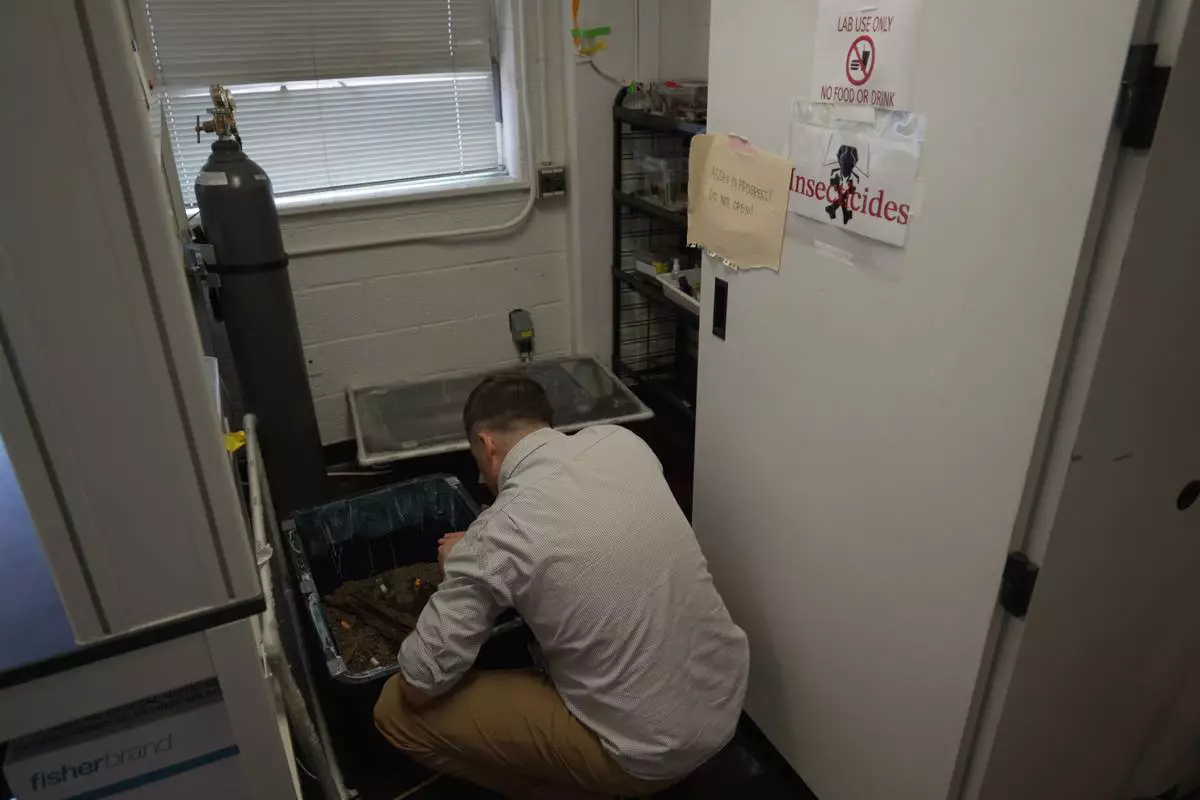
Assistant Professor Christopher Hayes checks a container filled with ants on the floor of his Structural Pest Research Lab at North Carolina State University in Raleigh, N.C., on Monday, Aug. 3, 2026. (AP Photo/Allen G. Breed)

Bedbugs crawl around in Petri dishes in Christopher Hayes's Structural Pest Research Lab at North Carolina State University in Raleigh, N.C., on Monday, Aug. 3, 2026. (AP Photo/Allen G. Breed)

Assistant Professor Christopher Hayes uses a probe to turn over anaesthetized bedbugs in his Structural Pest Research Lab at North Carolina State University in Raleigh, N.C., on Monday, Aug. 3, 2026. (AP Photo/Allen G. Breed)
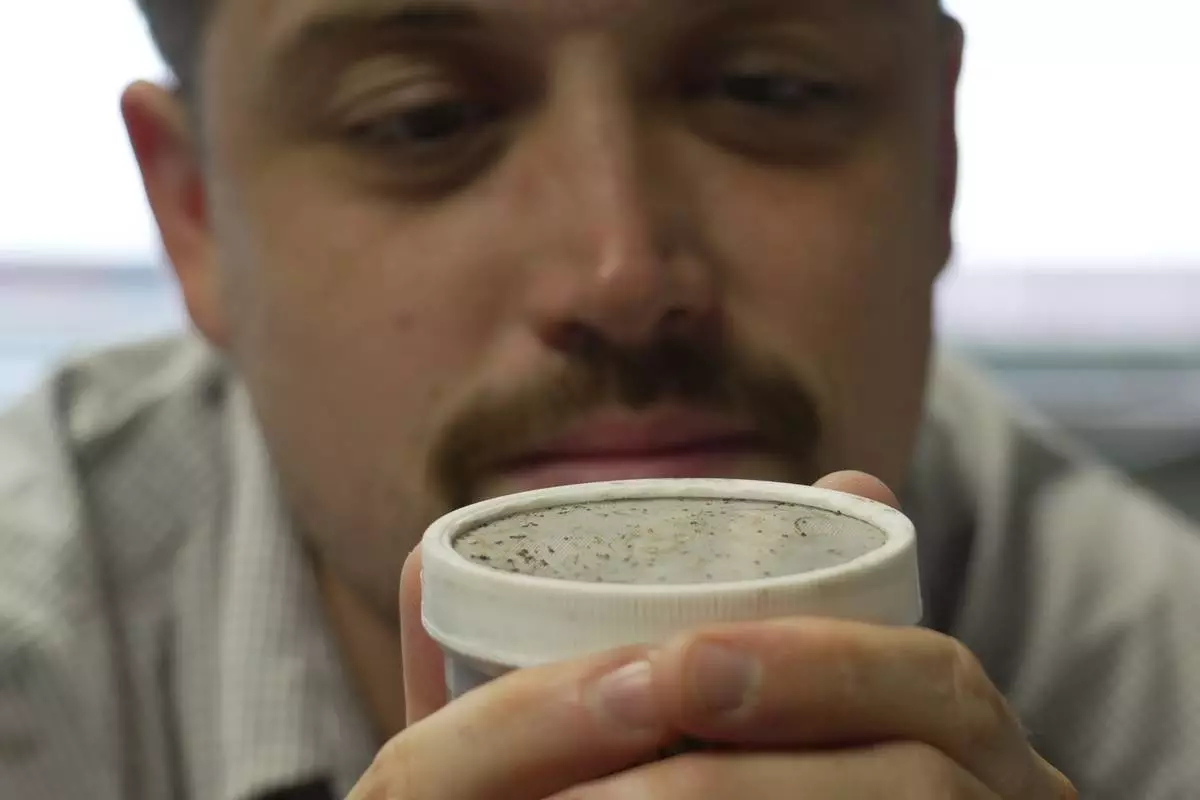
The mouth parts of hungry bedbugs protrude from a vented jar lid as Assistant Professor Christopher Hayes breathes across it in his office at North Carolina State University in Raleigh, N.C., on Monday, Aug. 3, 2026. (AP Photo/Allen G. Breed)
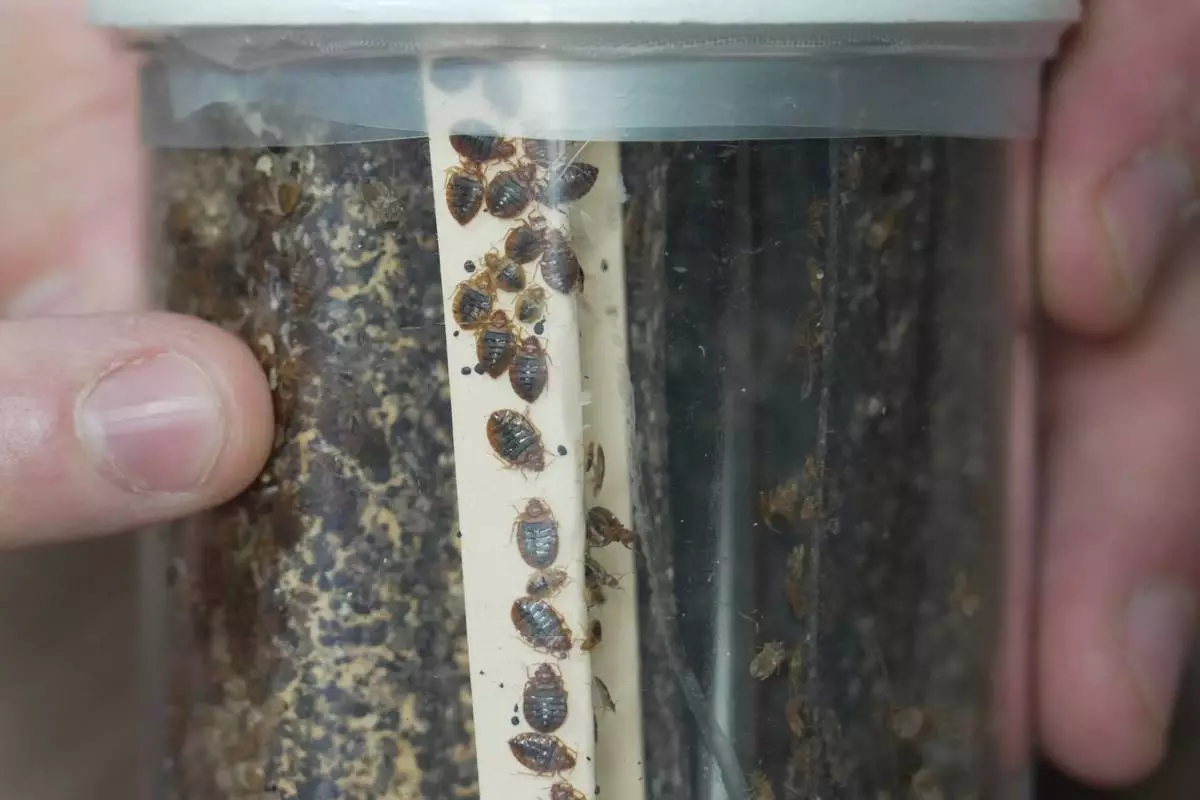
Assistant Professor Christopher Hayes uses the heat of his finger to stimulate a colony of bedbugs in his office at North Carolina State University in Raleigh, N.C., on Monday, Aug. 3, 2026. (AP Photo/Allen G. Breed)