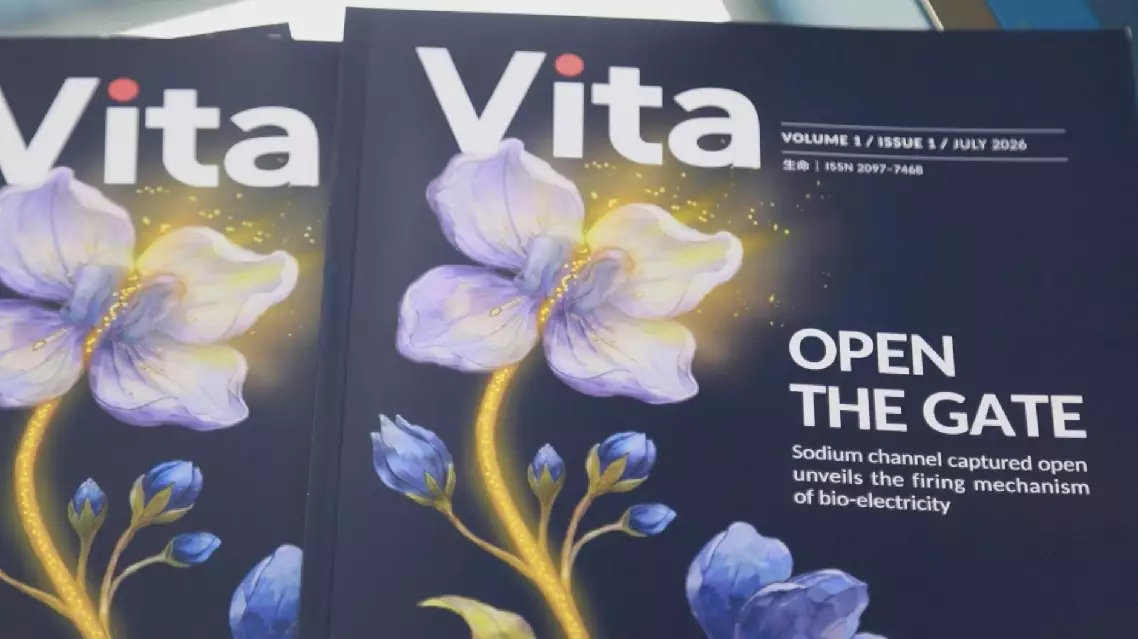
The first print edition of the Chinese-led international academic journal Vita has been released, with the goal of becoming a premier publication in China's life sciences sector.
Jointly established by member universities and institutions of the Alliance of Open Life Science, the Vita series runs on a "main journal plus sub‑journals" model and adopts an open-access policy, making its content freely available globally while charging no publication fees to authors.
Alliance members have pledged to recognize Vita and its sub-journals as equivalent to top-tier international counterparts and sub‑journals in research evaluation, incentivizing Chinese research teams to publish major original findings in the journal.
Li Dangsheng, Vita co-editor-in-chief and chief scientific officer at Shanghai Academy of Natural Sciences, said journals should put into practice the principle of "serving science and serving scientists," and earn recognition from researchers through rigorous, fair and impartial services.
"The alliance now comprises nearly 40 top-tier universities and scientific research institutions in the fields of life sciences and biomedicine. Vita serves as the alliance's flagship journal, while its sub-journals are developed as key public-service offerings of the alliance, dedicated to serving science and scientists," said Li.
High-level scientific journals reflect national scientific competitiveness and cultural influence.
While China has seen rapid growth in its scientific publications in recent years, with increasing total citations and impact factors, according to a report on China's sci-tech journal development in 2025, most of the country's leading research papers are still published abroad, and the country has yet to produce a globally recognized top-tier journal.
"China attaches exceptional importance to journal development. As China has gradually grown into the world's top contributor in terms of published scientific papers, it is of critical significance to secure the right to speak in scientific research by having independent publication carriers, namely the platforms where papers are released, the entities that host them, and the databases that store them — this constitutes a core form of discourse power," said Shi Yigong, Vita co-editor-in-chief and also president of Westlake University.
The Alliance of Open Life Science was jointly initiated by 15 leading universities and research institutions from the Chinese mainland, Hong Kong, and Macao, and officially established in Hong Kong on Aug 12, 2025. Now comprising 39 members, the alliance prioritizes developing high-quality scientific journals and open international research data platforms.
China-led journal Vita aims for world-class status in life sciences