An article by Xi Jinping, general secretary of the Communist Party of China (CPC) Central Committee, on enhancing disaster prevention, mitigation and relief capabilities was published on Sunday.
The article by Xi, also Chinese president and chairman of the Central Military Commission, was published in this year's 16th issue of the Qiushi Journal, a flagship magazine of the CPC Central Committee.
China has a vast territory, complex geography and diverse climate, making it prone to frequent natural disasters, the article says. Since the 18th CPC National Congress, the CPC Central Committee has led officials and the public in overcoming a series of major natural disasters, minimizing casualties and property losses to the greatest extent possible, with achievements widely recognized by the international community.
According to the article, to ensure effective disaster prevention, mitigation and relief work, it is a must to uphold the Party's overall leadership, put people and their lives first, respect the laws of nature, prioritize prevention, pursue reform and innovation, take a systematic approach, and promote public participation.
China's disaster prevention, mitigation and relief work currently faces many new situations and challenges, the article says, stressing the need to fully recognize the utmost importance of such work, build on strengths, address weaknesses, and continuously improve the country's capabilities and competence to respond to natural disasters. Such efforts can help effectively safeguard people's lives and property, maintain social stability, and ensure steady and sustained progress in Chinese modernization.
The article calls for a more prevention-focused approach to disaster management, incorporating safety and resilience requirements into territorial spatial planning and various construction plans, and appropriately raising the disaster-resilience standards for key infrastructure in major cities and disaster-prone areas.
It is important to strengthen the response to major and catastrophic disasters, the article says, highlighting the need to conduct in-depth assessments of such disaster risks, continuously improve emergency response plans, and make early warnings more timely, accurate and accessible.
The article underscores efforts to strengthen support from science and technology and the rule of law, promote technological and industrial innovation in emergency management, and deepen international exchanges and cooperation in science and technology for disaster prevention, mitigation and relief.
Efforts should be made to consolidate the foundation of disaster prevention, mitigation and relief at the primary level, strengthen primary-level emergency rescue capabilities, and bolster support for the construction of emergency facilities and ensure supplies and equipment, according to the article.
The article notes that disaster prevention, mitigation and relief work requires clearly defined responsibilities, a tight chain of accountability, and concerted efforts.
To do a good job in disaster prevention, mitigation and relief, it is important to establish and practice a correct understanding of what it means to perform well, and firmly correct tendencies such as prioritizing development over safety and disaster relief over prevention, the article says.
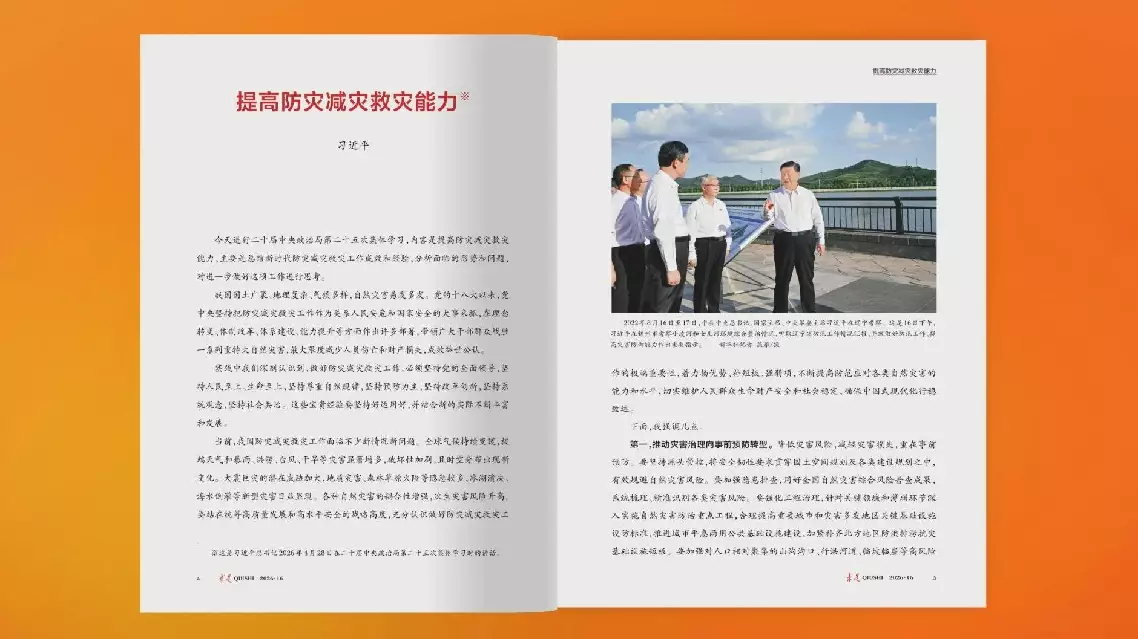
Xi's article on enhancing disaster management capabilities published