Japan's economy grew at an annualized real rate of 1.1 percent in the second quarter of 2026, falling well short of market expectations, government data showed Monday.
On a quarter-on-quarter basis, inflation-adjusted GDP rose 0.3 percent in the April-June period, the first full quarter reflecting the impact of the Middle East conflict, which has driven up energy costs for both businesses and households, according to the Cabinet Office's preliminary report. Private consumption, which accounts for more than half of economic output, edged down 0.02 percent from the previous quarter, marking the first decline in eight quarters.
Business investment in equipment fell 1.2 percent from the previous quarter, while private residential investment declined 0.5 percent.
Public demand, including government consumption and public investment, also contracted, dropping 0.8 percent.
Exports of goods and services rose 0.5 percent, while imports fell 1.5 percent, as crude oil shipments were disrupted by the effective closure of the Strait of Hormuz amid the Middle East tensions.
Looking ahead, analysts warned that rising import costs and intensifying upstream price pressures could eventually be passed on to consumers, further weighing on spending later this year.

Japan's economy expands 1.1 pct in Q2, below expectations
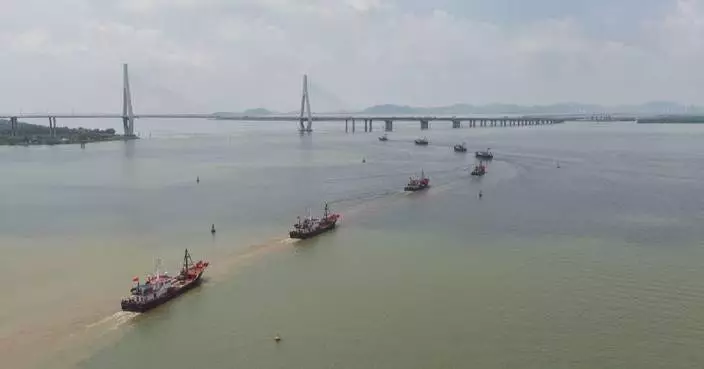
The first batch of fishing vessels from south China's tropical island province of Hainan began returning to port in the early hours of Monday, bringing the first fresh catch of the new fishing season, after the conclusion of the annual three-and-a-half-month summer fishing moratorium in the South China Sea.
The annual seasonal ban, which ran from May 1 to August 16, is intended to protect fishery stocks by restricting commercial fishing across designated waters.
At 7:00 on Monday, the first group of fishing boats returned to Yazhou Central Fishing Port in Sanya City of Hainan. Workers unloaded the freshest seafood from the first catch of the season in a relay.
"We have over a hundred trays of fish, about four to five thousand jin (about 2,000 to 2,500 kilograms), with more than 10 species of fish," said Yang Hongde, a Sanya fisherman.
"We returned with a full catch as soon as we went out to sea. Our business is getting better and better," said Xu Linhao, another Sanya fisherwoman.
At the seafood trading market, buyers had already been waiting early. Before the catch could even be unloaded from the trucks, it was snapped up and pre-ordered.
"We can sell the fish we purchase here anywhere in Hainan, like Sanya, Basuo and Qinglan," said Wang Xiaofei, a Hainan purchaser.
The first batch of catches mainly came from local small fishing vessels operating within 10 nautical miles of the coast.
The catch consisted mostly of high-quality wild marine fish such as mackerel, pomfret, grouper, hairtail and squid. As more fresh catches come ashore in large quantities, the local seafood market supply will continue to rise.
"The first batch of 600 local small fishing vessels has returned to Yazhou Central Fishing Port, bringing in about 600 to 700 metric tons of catch. Compared with the period before the fishing moratorium, wholesale prices have dropped by an average of five to ten yuan (about 0.74-1.48 U.S. dollars) on Monday. As medium and large fishing vessels continue to return, seafood prices will drop further," said An Chuanjun, a fourth-level chief staff member of the Yazhou Agriculture and Rural Affairs Bureau.

First fresh catch arrives in Hainan as fishing moratorium ends