NEW YORK--(BUSINESS WIRE)--Aug 17, 2026--
Faruqi & Faruqi, LLP, a leading national securities law firm, is investigating potential claims against Black Rock Coffee Bar, Inc. (“Black Rock Coffee” or the “Company”) (NASDAQ: BRCB) and reminds investors of the August 17, 2026deadline to seek the role of lead plaintiff in a federal securities class action that has been filed against the Company.
This press release features multimedia. View the full release here: https://www.businesswire.com/news/home/20260817197385/en/
Faruqi & Faruqi is a leading national securities law firm with offices in New York, Pennsylvania, California and Georgia. The firm has recovered hundreds of millions of dollars for investors since its founding in 1995. See www.faruqilaw.com.
As detailed below, the complaint alleges that the Company and its executives violated federal securities laws by making false and/or misleading statements and/or failing to disclose that: (1) Black Rock Coffee’s new store openings were leading to a cannibalization of its existing services and revenue; (2) Black Rock Coffee overstated the manner in which its expansion strategy was tailored to avoid “sales transfer”; (3) as a result of “sales transfer,” the Company’s financial results were materially impacted; and (4) that, as a result of the foregoing, Defendants’ positive statements about the Company’s business, operations, and prospects were materially misleading and/or lacked a reasonable basis.
The court-appointed lead plaintiff is the investor with the largest financial interest in the relief sought by the class who is adequate and typical of class members who directs and oversees the litigation on behalf of the putative class. Any member of the putative class may move the Court to serve as lead plaintiff through counsel of their choice, or may choose to do nothing and remain an absent class member. Your ability to share in any recovery is not affected by the decision to serve as a lead plaintiff or not.
Faruqi & Faruqi, LLP also encourages anyone with information regarding Black Rock Coffee’s conduct to contact the firm, including whistleblowers, former employees, shareholders and others.
To learn more about the Black Rock Coffee class action, go to www.faruqilaw.com/BRCB or call Faruqi & Faruqi partner Josh Wilson directly at 877-247-4292 or 212-983-9330 (Ext. 1310).
Follow us for updates on LinkedIn, on X, or on Facebook.
Frequently Asked Questions (FAQ) for Investors Regarding the Black Rock Coffee Holdings Securities Class Action Lawsuit:
What is the Black Rock Coffee Bar securities fraud lawsuit about?
The Black Rock Coffee Bar securities fraud lawsuit is a federal securities class action alleging that Black Rock Coffee Bar, Inc. (NASDAQ: BRCB) and its executives made false and misleading statements to investors in connection with the Company's September 2025 IPO by overstating the effectiveness of its expansion strategy and concealing that new store openings were cannibalizing revenue from existing locations through "sales transfer." While the Company touted its expansion strategy as carefully tailored to avoid sales transfer, the complaint alleges that this cannibalization was in fact materially impacting the Company's financial results, rendering management's positive statements about the Company's business, operations, and prospects materially misleading.
Who may be eligible to participate in the Black Rock Coffee Bar class action lawsuit?
Investors who purchased or acquired Black Rock Coffee Bar (BRCB) securities may be eligible to participate in the Black Rock Coffee securities class action if they: (a) purchased Class A common stock pursuant and/or traceable to the Registration Statement issued in connection with the Company's September 2025 IPO; and/or (b) purchased BRCB securities between September 12, 2025 and May 12, 2026 — the Class Period — and suffered financial losses as a result. Participation as a class member does not require taking any affirmative legal action; eligible investors may recover losses simply by remaining members of the class. Whistleblowers, former Black Rock Coffee employees, and others with relevant information about the Company's conduct are also encouraged to come forward.
What is a lead plaintiff, and how can I seek appointment in the Black Rock Coffee Bar lawsuit?
A lead plaintiff in the Black Rock Coffee Bar class action is a court-appointed investor — typically the one with the largest financial interest in the case — who directs and oversees the litigation on behalf of all class members. Any Black Rock Coffee investor who purchased BRCB securities during the Class Period or in connection with the IPO may move the Court to serve as lead plaintiff through counsel of their choice. The deadline to seek lead plaintiff appointment is August 17, 2026. Importantly, choosing not to seek the lead plaintiff role does not affect an investor's ability to share in any recovery obtained for the class.
What should investors do if they purchased Black Rock Coffee Bar stock during the Class Period?
Investors who purchased Black Rock Coffee Bar, Inc. (BRCB) securities in connection with the September 2025 IPO or between September 12, 2025 and May 12, 2026 and suffered losses should contact Faruqi & Faruqi, LLP immediately to discuss their legal rights. The deadline to seek appointment as lead plaintiff in the Black Rock Coffee Bar securities class action is August 17, 2026. To speak directly with securities litigation partner Josh Wilson, call 877-247-4292 or 212-983-9330 (Ext. 1310), or visit www.faruqilaw.com/BRCB for more information.
Attorney Advertising. The law firm responsible for this advertisement is Faruqi & Faruqi, LLP ( www.faruqilaw.com ). Prior results do not guarantee or predict a similar outcome with respect to any future matter. We welcome the opportunity to discuss your particular case. All communications will be treated in a confidential manner.

CLASS ACTION DEADLINE TONIGHT: Faruqi & Faruqi, LLP Reminds Black Rock Coffee (BRCB) Investors of Securities Class Action Lawsuit Deadline on August 17, 2026
VIENNA (AP) — A group of European countries announced on Monday that they aim to set up a “return hub” in Rwanda where rejected asylum-seekers could be sent from next year, a move that they hope will also deter more people from coming.
The European Union has worked for years to tighten migration rules, push down the number of asylum-seekers coming to the 27-nation bloc and increase deportations of migrants who aren’t entitled to stay. Sending people to centers outside Europe has emerged as a central plank of that effort.
The plan by Austria, Denmark, Germany, Greece and the Netherlands, which have spearheaded negotiations with non-EU countries, drew immediate criticism from human rights groups.
The aim is for the first center to be set up in Rwanda next year, Austrian Chancellor Christian Stocker said alongside officials from the other European countries and Rwanda's interior minister.
“I think this will be a game changer making us able to confront the massive challenges with illegal migration,” Danish Prime Minister Mette Frederiksen said. “We will break down the business model of human smugglers. We will take back control of our borders and we will remove the incentives for illegal migration.”
She predicted that “many other European countries” would join in. Her immigration minister, Morten Bødskov, said that the plan is to have a fully negotiated agreement with Rwanda “within the next few months.”
Officials were vague about how many migrants might be sent to Rwanda, but emphasized the plan's deterrent effect.
“The most important number is the number that we will never see because hopefully they will not start their journey to Europe,” Frederiksen said. “So this is a milestone.”
Rwandan Interior Minister Vincent Biruta said that his country would give a “second chance” to people who have no right to stay in Europe. He said that those who arrive will be offered the opportunity “to voluntarily return to the countries of origin, integrate into Rwandan society or relocate to another destination where they have the legal right to reside, according to their preference.”
Asked how Rwanda would guarantee refugees' human rights, he said that Rwanda would bring on board organizations such as the U.N. refugee agency and “there will be an independent monitoring mechanism.”
Human rights groups have criticized plans to deport migrants to facilities in third countries, arguing that European nations can't guarantee that their rights will be respected there. European officials insist that the new hubs would abide by European and international law.
“Offshore deportation centers are the latest cynical expression of the EU’s drive to shift its responsibilities to other countries,” Human Rights Watch researcher Clementine de Montjoye said in a statement. “Paying Kigali to host a deportation program would not only cause suffering and harm to those deported, it would finance and provide political leverage to a government responsible for serious human rights abuses at home and abroad.”
Amnesty International Austria asylum and migration expert Aimée Stuflesser said in a statement that “today’s disgraceful deportation deal between European countries and Rwanda repeats mistakes of the past.”
“Sending people to a country they have never been to is irresponsible and there is a real danger that the Rwanda deal will, with its limited chance for scrutiny, become a cruel black hole for human rights,” Stuflesser said.
The U.N. refugee agency said that it only supports the possible use of return hubs in line with human rights standards, and as a way to help returns of people whose claims for asylum were denied after a full and fair assessment.
UNHCR spokesperson Matthew Saltmarsh said that the agency was involved in “constructive discussions” with the five EU countries “to provide advice on the compliance of the return hub process with international human rights law standards.” No agreement with the countries has been signed.
The United Nations' International Organization for Migration said that it doesn’t take part in or negotiate “state-to-state removal arrangements,” but was providing “technical input on the return hub process.” IOM said that it was prepared to provide help to migrants at the request of the receiving government if “necessary safeguards” are in place.
EU laws have changed in recent years because of persistent public and political pressure for tougher measures against migration.
European lawmakers voted in June to allow member states to set up centers outside the EU on their own or in small coalitions, and send rejected asylum-seekers there instead of to their home countries.
Rwanda struck a deal with the U.K. in 2022 under which migrants who arrived as stowaways or in boats would be sent to the African nation, where their asylum claims would be processed and, if successful, they would stay. The U.K. Supreme Court ruled that the policy was unlawful because Rwanda isn't a safe third country for migrants sent there.
Then Prime Minister Keir Starmer scrapped that deal immediately after taking office in 2024.
German Interior Minister Alexander Dobrindt said Monday that the European plan for Rwanda isn't comparable. He said that the U.K. had planned to outsource asylum proceedings to third countries, while the European plan involves people who have been through the asylum process and exhausted their appeals.
Geir Moulson reported from Berlin. Jamey Keaten contributed to this report from Geneva.
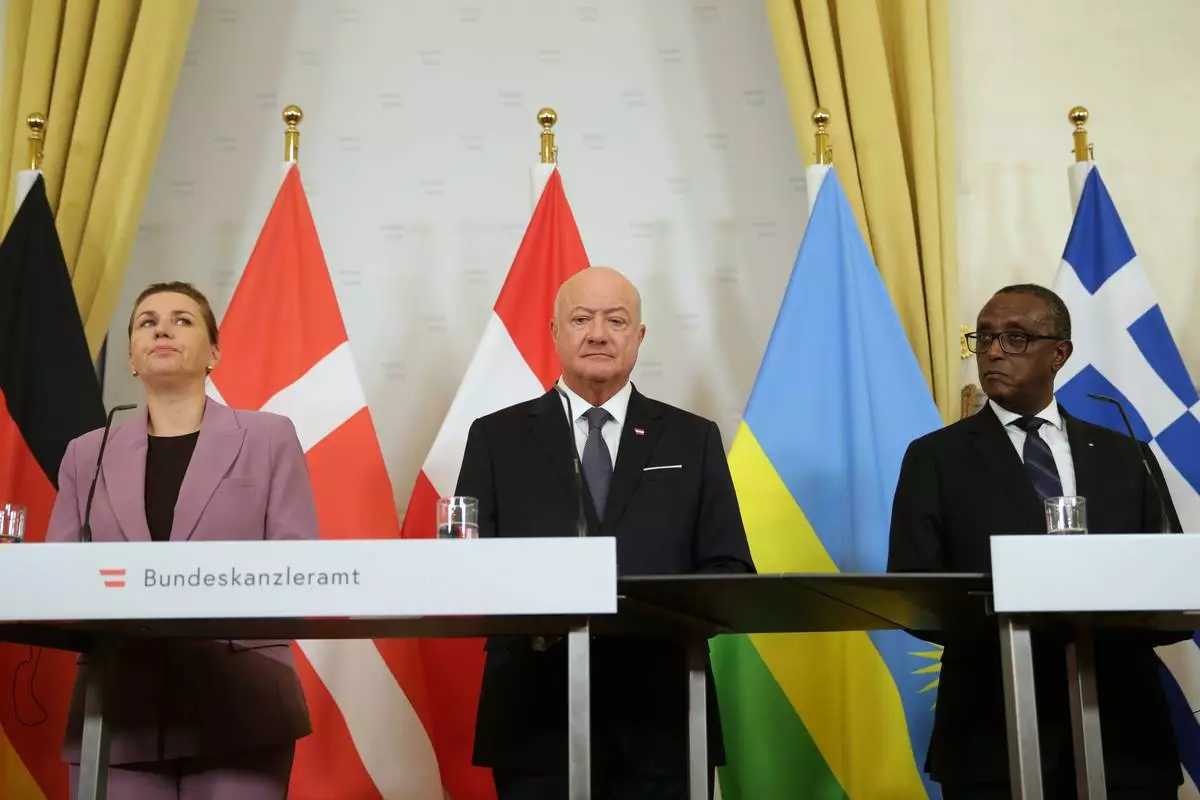
Austria's Chancellor Christian Stocker, center, Rwanda's Interior Minister Vincent Biruta, right, and Denmark's Prime Minister Mette Frederiksen listen to questions as they brief the media after talks at the migration conference in Vienna, Austria, Monday, Nov. 16, 2026. (AP Photo/Heinz-Peter Bader)
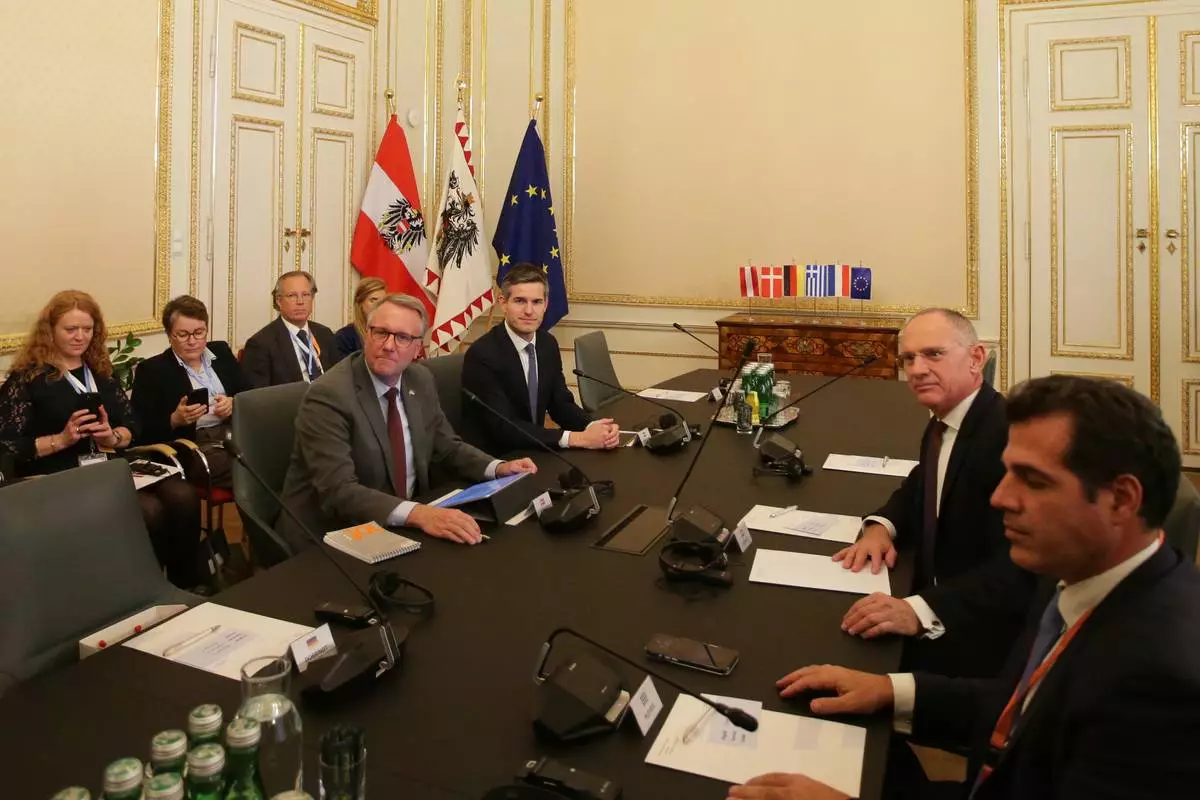
Austrian Interior Minister Gerhard Karner, background right, starts talks with Netherland's Foreign Minister Tom Berendsen, background center, Denmark's Integration Minister Morten Bodskov, left, and Greek Minister of Integration Athanasios Plevris, right, in Vienna, Austria, Monday, Nov. 16, 2026. (AP Photo/Heinz-Peter Bader)

Rwanda's Interior Minister Vincent Biruta, Austria's Chancellor Christian Stocker, Austrian Interior Minister Gerhard Karner, Netherland's Foreign Minister Tom Berendsen, Denmark's Integration Minister Morten Bodskov, German Interior Minister Alexander Dobrindt and Greek Minister of Integration Athanasios Plevris attend a media conference after migration talks in Vienna, Austria, Monday, Nov. 16, 2026. (AP Photo/Heinz-Peter Bader)
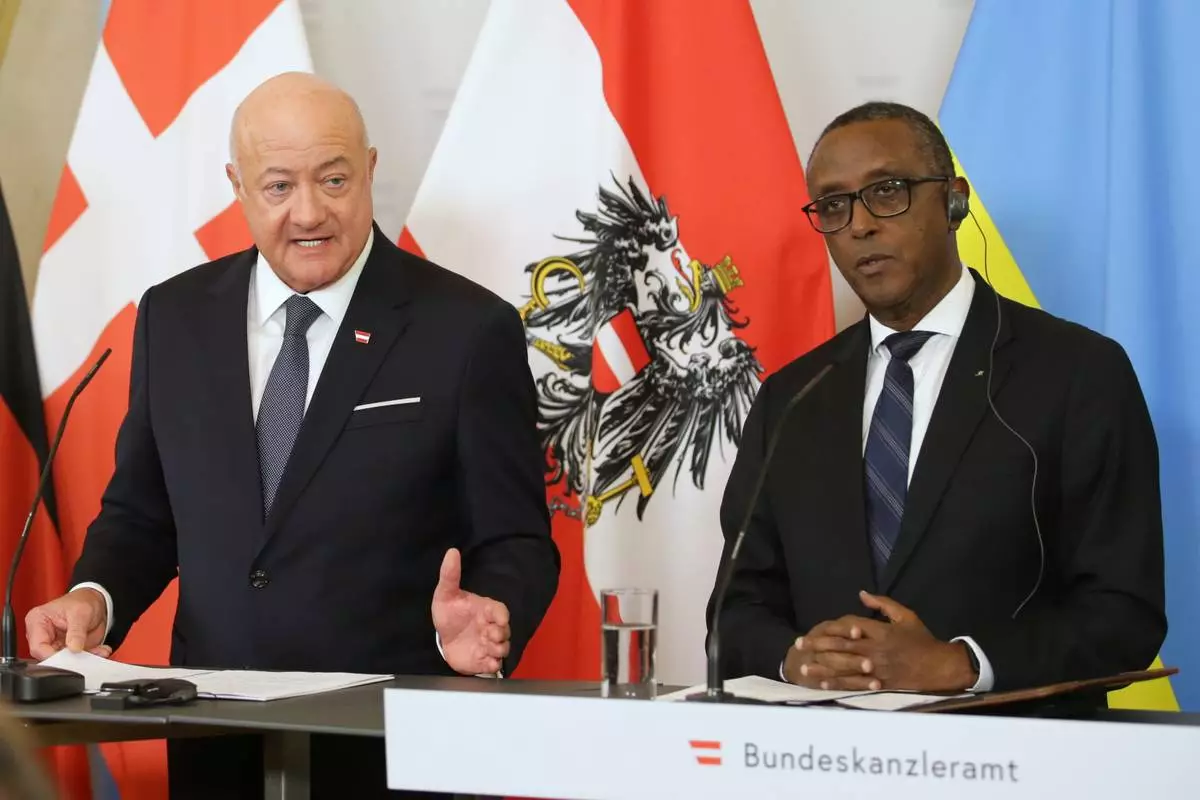
Rwanda's Interior Minister Vincent Biruta and Austria's Chancellor Christian Stocker brief the media after talks at the migration conference in Vienna, Austria, Monday, Nov. 16, 2026. (AP Photo/Heinz-Peter Bader)
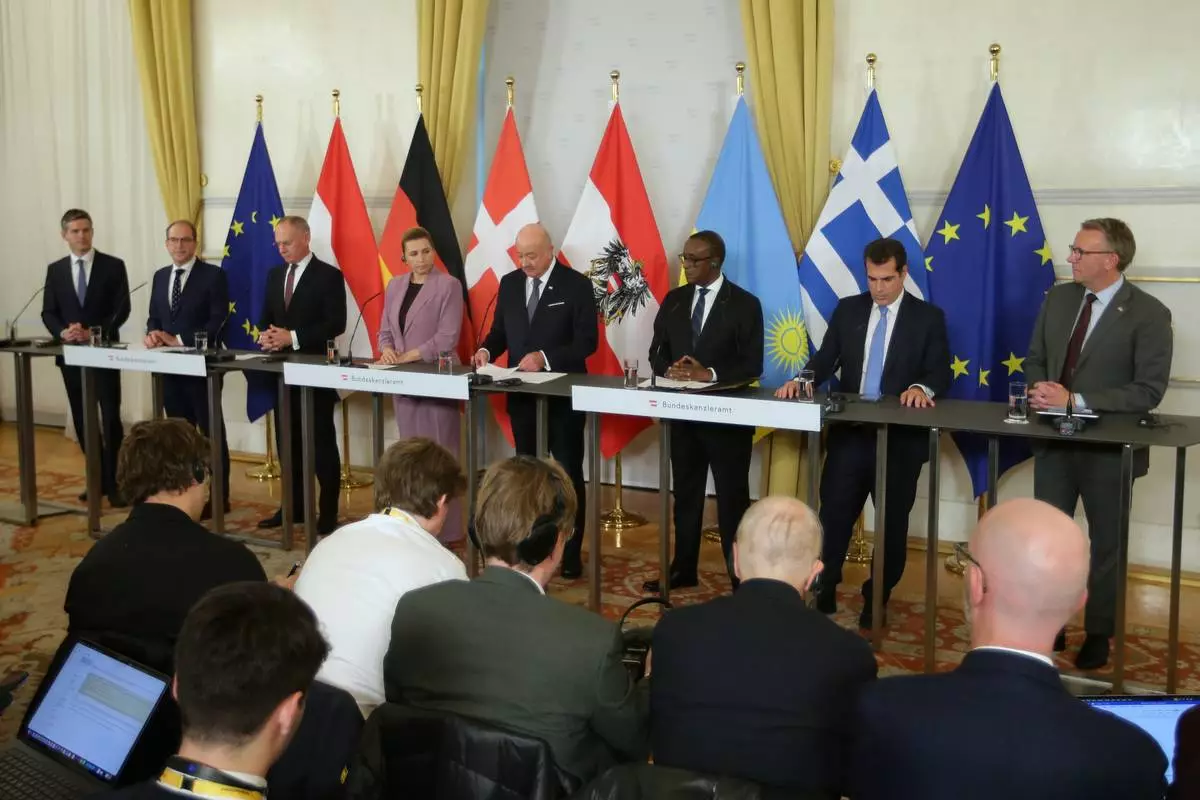
Rwanda's Interior Minister Vincent Biruta, Austria's Chancellor Christian Stocker, Austrian Interior Minister Gerhard Karner, Netherland's Foreign Minister Tom Berendsen, Denmark's Integration Minister Morten Bodskov, German Interior Minister Alexander Dobrindt and Greek Minister of Integration Athanasios Plevris attend a media conference after migration talks in Vienna, Austria, Monday, Nov. 16, 2026. (AP Photo/Heinz-Peter Bader)