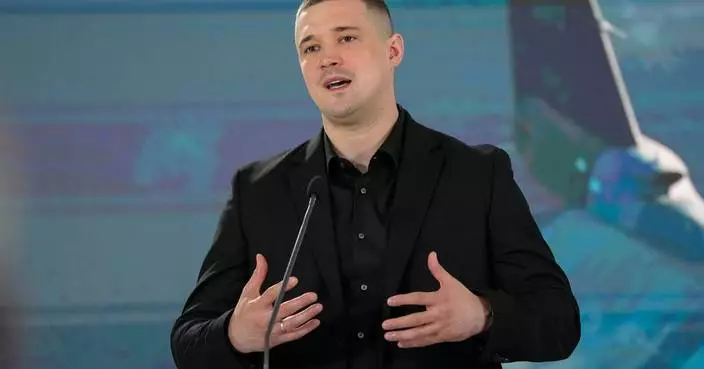
IOWA CITY, Iowa (AP) — 2025 record: 9-4
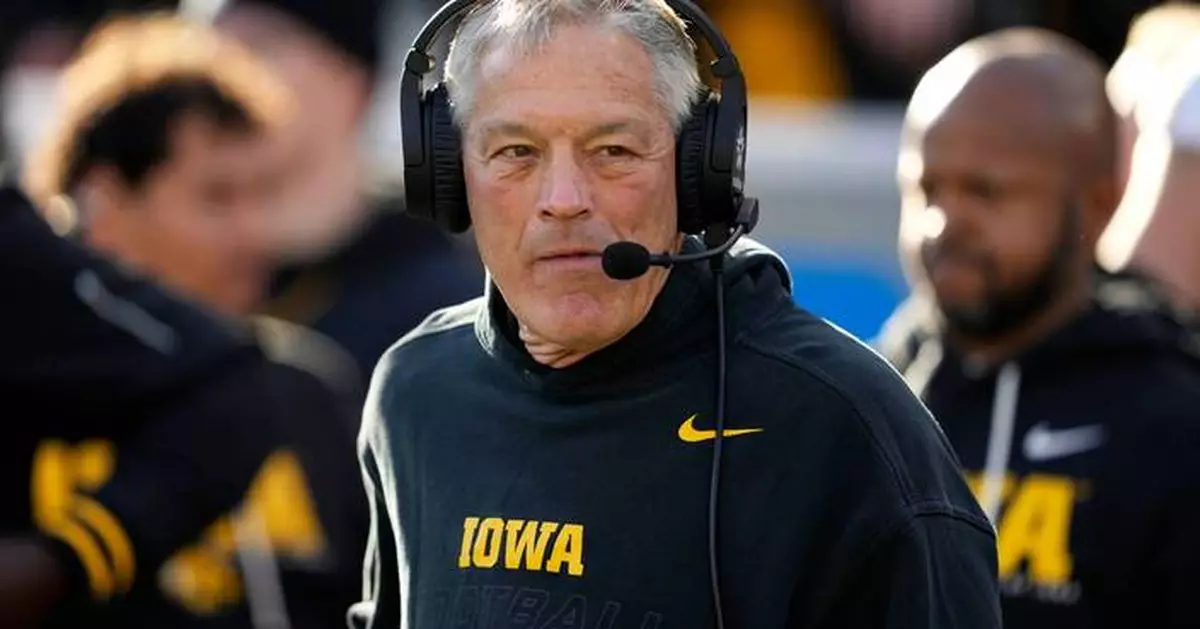
Kirk Ferentz heads into his 28th season as head coach at Iowa and there’s no sign he’s letting up. Ferentz, who became the Big Ten’s winningest coach last season, will find out how good his team is in a hurry. The Hawkeyes' first three conference games are at Michigan, at home against Ohio State and at Washington. No. 22 Iowa has big holes to fill after seven players were selected in the NFL draft. Ferentz certainly has enough talent on the roster to win eight or nine games and go to a 13th straight bowl (not counting 2020 pandemic season).
The running back group is deep. Kamari Moulton rushed for a team-leading 878 yards last season and has a shot to give the Hawkeyes a 1,000-yard rusher for the second time in three years. The workload should increase for Xavier Williams, who had 285 yards last season.
It wouldn’t be a typical Ferentz team without tight ends in the spotlight. DJ Vonnahme led the Hawkeyes in receiving with 29 catches for 434 yards and three touchdowns. He ended last season on a high note with seven catches for 146 yards against Vanderbilt in the ReliaQuest Bowl. Addison Ostrenga missed almost all of last season with an injury, but he is expected to be healthy to give the Hawkeyes the bookend tight ends they always seem to have.
The Hawkeyes are starting over on the defensive line. All four starters and two key backups are gone. The departures of Ethan Hurkett (8 sacks), Max Llewellyn (6 1/2) and Aaron Graves (5) put a big dent in the pass rush.
The quarterback situation is dicey. Returning backups Hank Brown and Jeremy Hecklinski are competing for the starter's job. Brown played 55 snaps and never appeared after the fifth game; Hecklinski got a total of nine snaps over two games.
Special teams, always a strength, will be a work in progress. Iowa must replace its kicker, punter and top return man.
WR Tony Diaz (transfer from UTRGV) was sixth in the FCS with 11 receiving touchdowns and drew good reviews from Ferentz in the early days of camp.
RB LJ Phillips (transfer from South Dakota) was the leading rusher in FCS last season with 1,921 rushing yards and 19 touchdowns on 294 attempts.
K Eli Ozick (transfer from North Dakota State) was an FCS second-team All-American last season after converting 16 of 18 field-goal attempts, including hitting his last 11.
C Logan Jones was a consensus All-American and winner of the Rimington Trophy. The Chicago Bears' second-round draft pick started 51 games for Iowa.
OT Gennings Dunke started every game last season and was an AP second-team All-Big Ten selection.
WR Kaden Wetjen was a consensus All-American after being one of the nation’s best kick and punt returners. Wetjen led the nation with 1,039 combined kick return yards.
At Michigan (Sept. 26), vs. Ohio State (Oct. 3), at Washington (Oct. 9).
AP college football: https://apnews.com/hub/ap-top-25-college-football-poll and https://apnews.com/hub/college-football
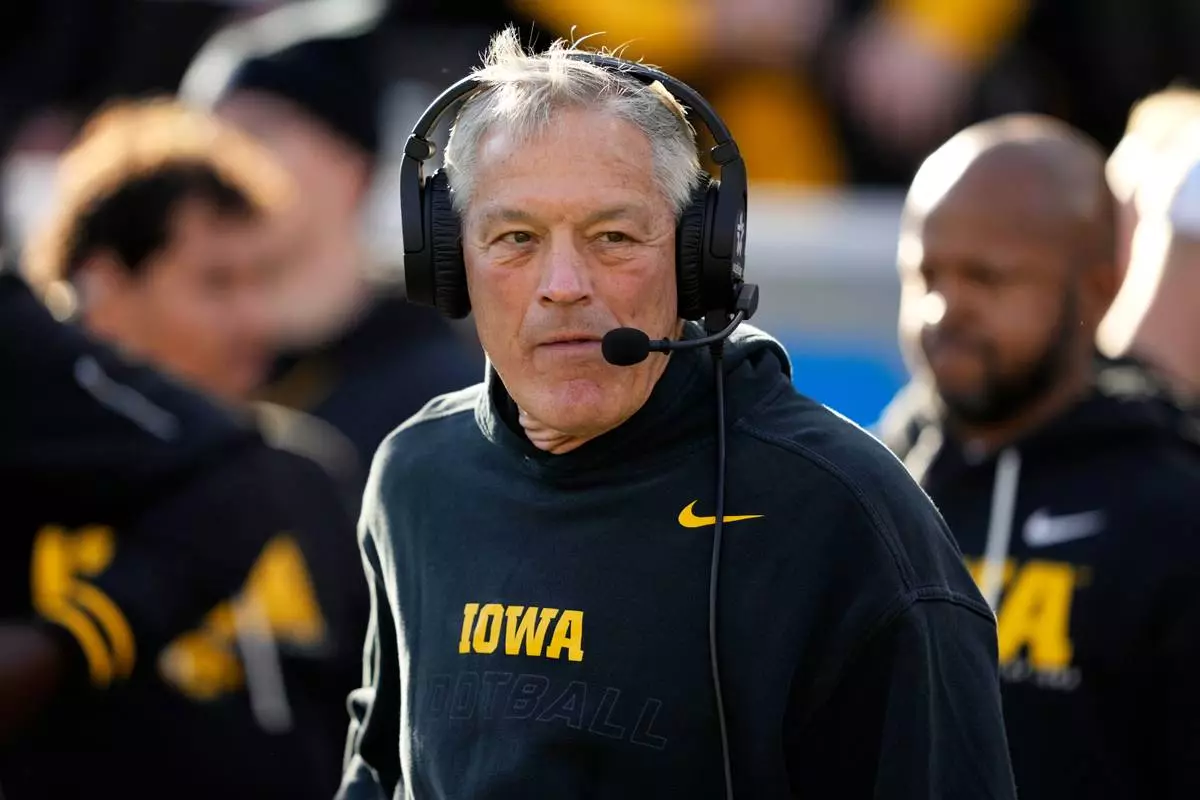
FILE - Iowa head coach Kirk Ferentz stands on the field before an NCAA college football game against Michigan State, Nov. 22, 2025, in Iowa City, Iowa. (AP Photo/Charlie Neibergall, File)
LONDON (AP) — In 2012, a smiling Jason Arday was photographed by the British press carrying the Olympic flame in the torch relay that preceded the London Games. He was back in the news in 2023 when Cambridge University hailed him as the youngest Black professor in the institution’s history.
Three years later, after weeks of news stories presenting evidence that he was a plagiarist and fabulist, Arday, 41, was found dead on Friday at his apartment in south London.
His death quickly led to a blame game. Cambridge has been criticized for elevating Arday in a rush to promote diversity — despite red flags about his qualifications — and the news media has been targeted for driving him to despair when his credentials and life story began to unravel under intense scrutiny.
James Cleverly, a Black member of Parliament who held Cabinet positions in past governments, said a number of universities “failed to do the proper due diligence” on Arday.
“We see now that he was not completely honest and he clearly did have frailties and failings,” Cleverly told Times Radio. “But he was teed up by a number of academic institutions because they desperately wanted a wunderkind. They desperately wanted to play on the fact he was young and Black and good-looking, and they wanted him to be their poster child.”
But Patrick Vernon, who was recently knighted for his work on racial equality, is focused on the media.
Coverage of the Arday story was out of proportion to his position in society, reflecting the higher standard to which people of color are held when compared with their white peers, Vernon said.
“The level of scrutiny that the late Professor Jason Arday faced was unprecedented,” Vernon said.
“He’s not the prime minister of this country. He’s not a current secretary of the civil service or local government or the (National Health Service) or a chief executive of a major PLC. ... But he was treated at the same standard, which is outrageous," Vernon said.
Cambridge hired Arday as a professor of sociology of education in February 2023, when he was 37.
In announcing the appointment, Cambridge highlighted his place as the youngest Black professor in the university’s history and described him as a “respected scholar” focused on increasing the representation of Black, Asian and other minorities in higher education. Arday achieved this stature, the university said, even though he was born with a form of autism spectrum disorder that left him unable to speak until he was 11 and unable to read or write until his late teens — aspects of his biography that have since been questioned in news stories.
British universities have been working to hire more academics from racial and ethnic minority backgrounds so that their faculties better reflect the broader society.
There were 270 Black professors at U.K. universities during the 2024-25 academic year, up from 120 in 2016-17, according to data published by the Society for Research into Higher Education. Black scholars still represent just 1% of all U.K. professors, even though Black people make up about 4% of the working age population, the data shows.
Questions about Arday’s qualifications became public last month.
Nathan Cofnas, a one-time Cambridge researcher who left the university after his vitriolic comments about diversity programs and minorities sparked widespread protests, said he had found evidence of plagiarism in Arday’s Ph.D. thesis. The Times of London and other newspapers picked up the story, publishing an analysis of the thesis and highlighting multiple passages they said were “identical or near-identical” to an earlier paper by another academic.
The news media also questioned Arday’s claims about astounding personal accomplishments, such as running 30 marathons in 35 days, and raising 5.5 million pounds ($7.4 million) for charity over 20 years.
The public scrutiny was partly fueled by the impending publication of Arday’s memoir, “Great and Unfortunate Things.” Simon & Schuster published the book last week in the U.S., and it is scheduled to be published in the U.K. on Aug. 27.
After initially standing by Arday, Cambridge said Aug. 5 that it was opening an investigation after receiving “new information” about his qualifications. Arday resigned later that day. The University of Glasgow and Durham University, where Arday previously taught, have announced their own investigations.
The ceremonial head of Cambridge on Sunday defended the university’s decision and criticized media coverage of Arday.
“I do believe it is possible to hold to two principles at the same time: To believe in the importance of academic integrity, and, where criticisms of plagiarism arise about any academic, whoever they are, ensure that they are rigorously investigated, and also to refuse to join in a racist feeding frenzy over a particular academic,” Chancellor Chris Smith told the BBC.
By Tuesday afternoon, more than 107,000 people had signed an open letter calling on the government to commission a public inquiry into media coverage of Arday.
The letter alleges that media organizations kept up their coverage of Arday even after Simon Baron-Cohen, director of Cambridge University’s Autism Research Centre, publicly warned that their focus on a “vulnerable autistic man” raised “safeguarding issues.” Circulated by the Good Law Project, a campaign group, the letter says Arday and other prominent Black people have been subject to “press harassment with racist overtones."
Steven Barnett, a professor of communications at the University of Westminster, put the onus on British newspapers, not social media. The mainstream press published 289 stories about Arday in 22 days, almost two-thirds of them after he resigned, Barnett said.
No one should doubt that he was overwhelmed by the scrutiny because Arday himself said it was more than anyone could bear, Barnett said. "I don’t think it’s possible to overestimate the impact that those newspapers, those publishers, have had in this particular case,” he said.
Charles Moore, a former editor of the Daily Telegraph who writes about education, rejected that criticism in a column on Monday.
If Cambridge had properly investigated concerns about Arday that surfaced as early as 2023, he wouldn’t have suffered the shame caused by widespread media coverage, Moore wrote.
Rather than trumpeting Arday’s position as the university’s youngest ever Black professor, Cambridge “could quietly have nurtured his talents and sorted out his problems, which were surely those of a young man out of his depth rather than a brazen impostor,” he said.
“It was the university, not the press, which was obsessed with the color of Dr. Arday’s skin,” Moore wrote.
Sarah Ditum, writing in the Times of London, said Arday was a legitimate news story because his actions hurt the academics he plagiarized, public confidence in the rigor of his discipline and other early-career lecturers against whom he competed. But she acknowledged that the story was given extra oxygen because it broke during the summer, when Parliament is closed and journalists are desperate for something to write about.
“Academic plagiarists don’t usually make headlines, but Arday was not any old academic,” Ditum wrote.
“He was publishing a high-profile memoir with celebrity blurbs,” she added. "He had chosen the spotlight.”
Vernon, meanwhile, is encouraging people to remember that there was a man, a husband and father behind the headlines. He has created a GoFundMe campaign to help Arday’s family that has already raised more than 193,000 pounds ($261,000).
“This tells you that Britain still cares about justice, they care about inequalities,” he said. “And more importantly they really want to support Jason and his family in their hour of need.”
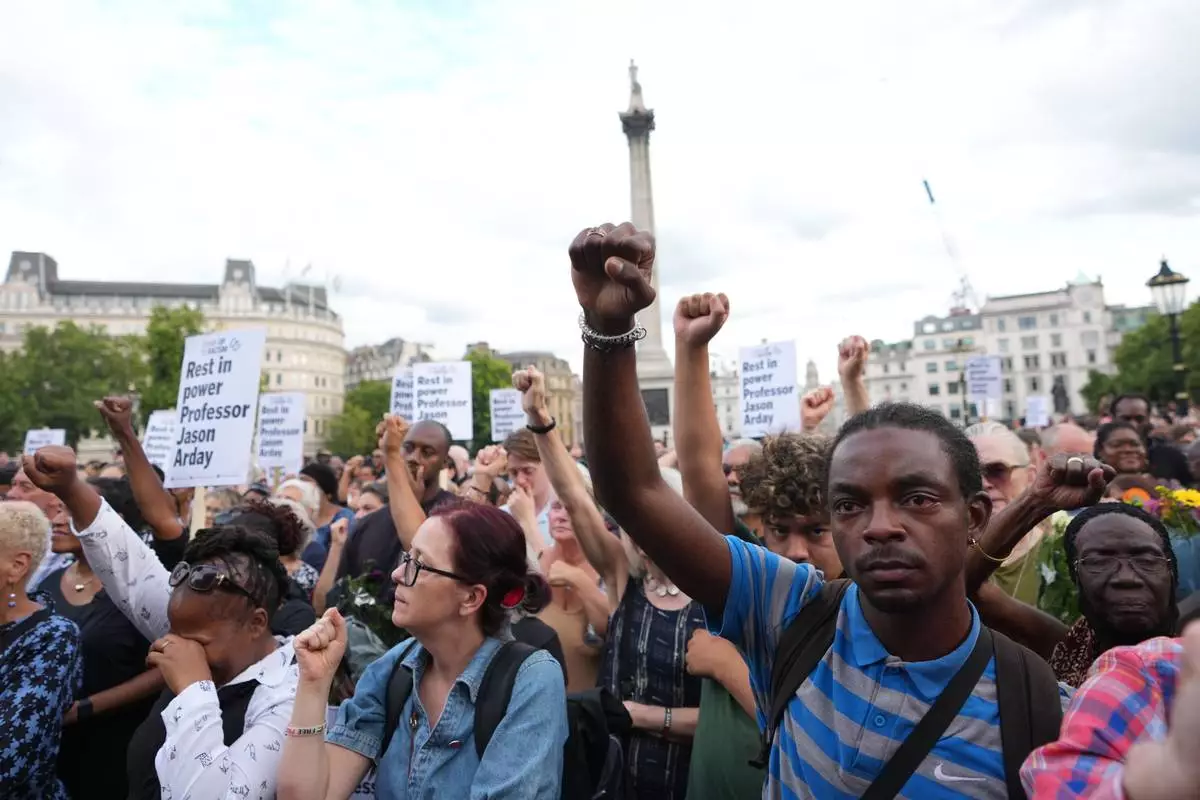
People gesture as they attend a vigil held by Stand Up to Racism, in memory of late University of Cambridge professor Jason Arday, in Trafalgar Square in London, Monday, Aug. 17, 2026. (AP Photo/Kirsty Wigglesworth)
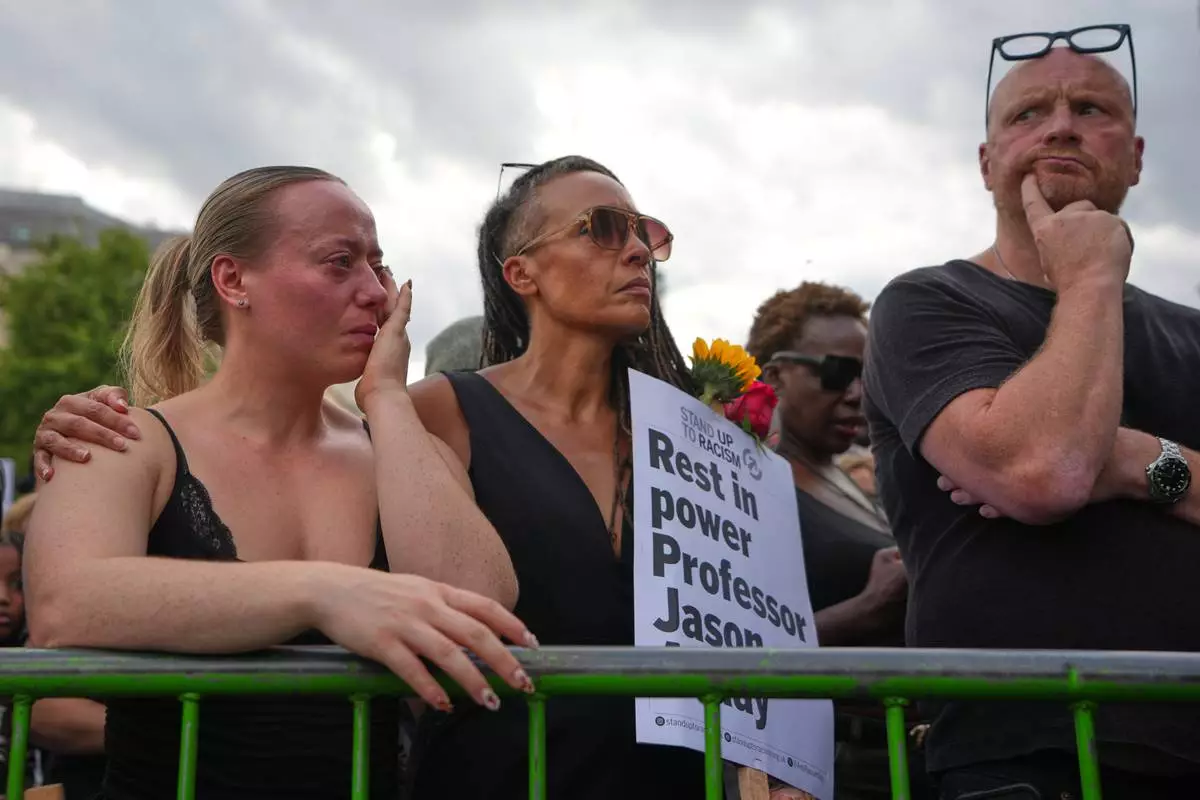
People attend a vigil held by Stand Up to Racism in memory of late University of Cambridge professor Jason Arday at Trafalgar Square in London, Monday, Aug. 17, 2026. (AP Photo/Kirsty Wigglesworth)
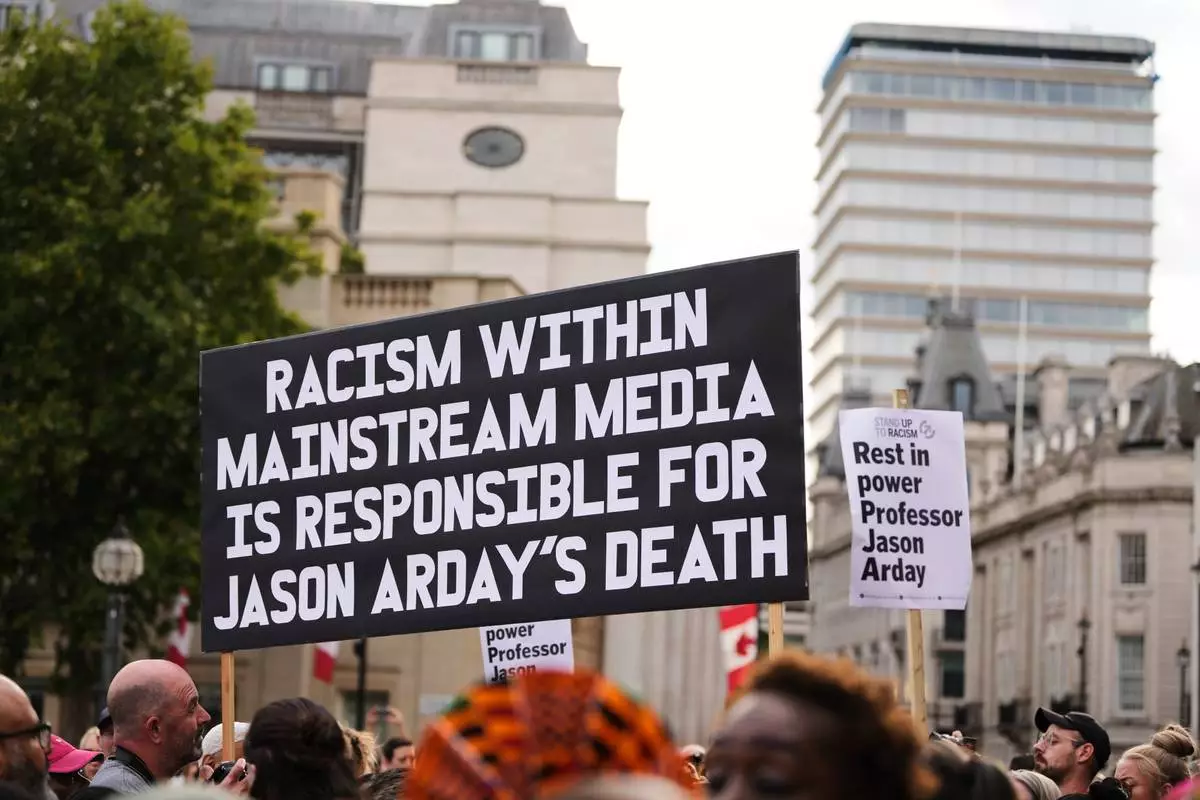
People hold signs during a vigil held by Stand Up to Racism in memory of late University of Cambridge professor Jason Arday at Trafalgar Square in London, Monday, Aug. 17, 2026. (AP Photo/Kirsty Wigglesworth)
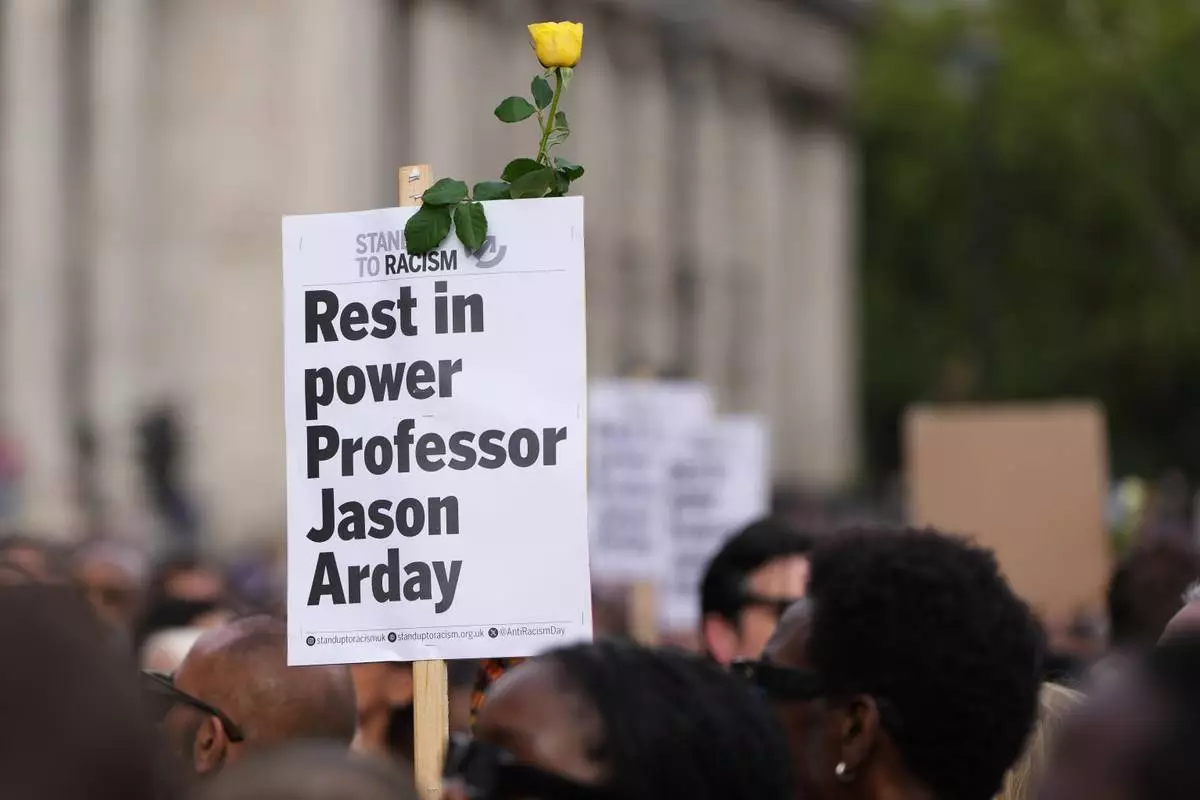
A sign is held during a vigil by Stand Up to Racism in memory of late University of Cambridge professor Jason Arday at Trafalgar Square in London, Monday, Aug. 17, 2026. (AP Photo/Kirsty Wigglesworth)
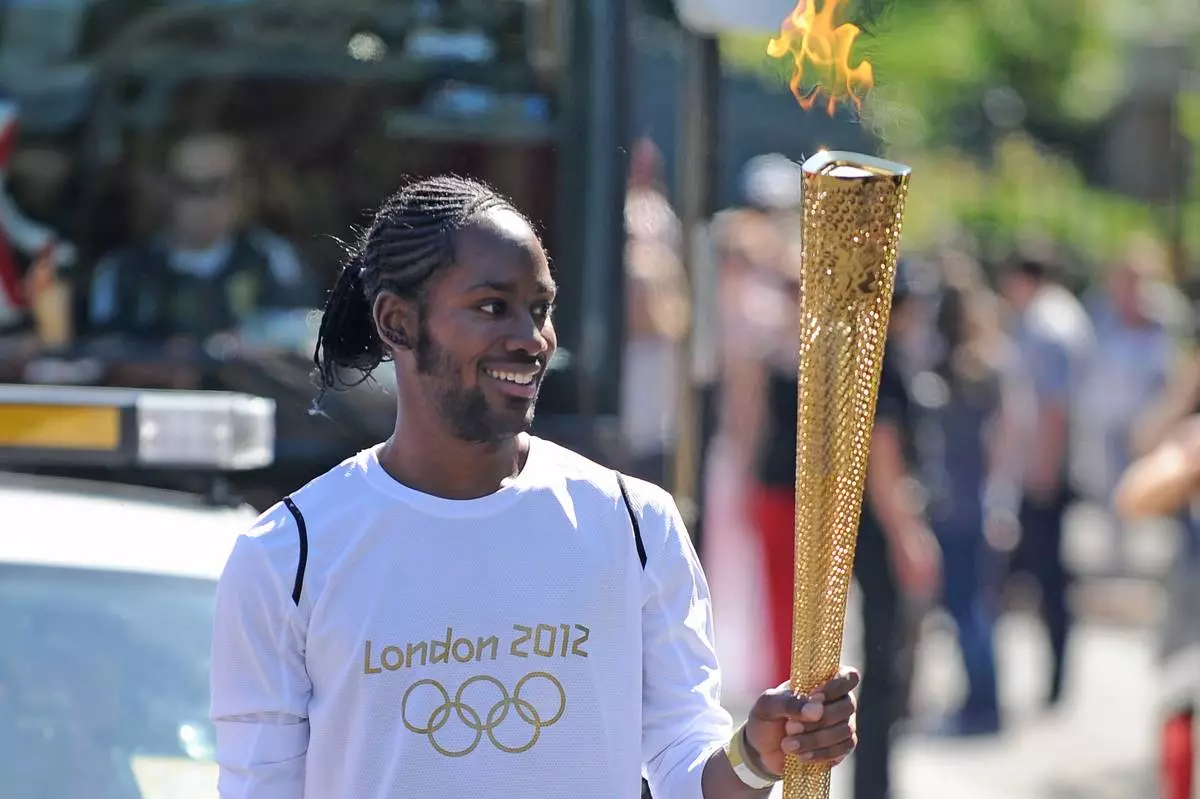
Torchbearer Jason Arday carries the Olympic Flame on the Torch Relay leg between Sutton and Merton, in London, July 23, 2012. (Joe Giddens/LOCOG/PA via AP)