A giant radio telescope project in northwest China's Xinjiang Uygur Autonomous Region reached a significant milestone as its three-layer antenna mount structure was successfully assembled, marking the final construction phase of this world-class scientific research facility.
Located in a valley basin of Qitai County, the Changji Hui Autonomous Prefecture, the telescope has an aperture of 110 meters and is expected to be completed and put into operation in 2028. The project was initiated in September 2022 and is expected to have its main structure completed in 2027.
The height of the antenna structure system exceeds that of a 35-storied building, with the telescope's reception area equal to 23 basketball courts and the antenna weighing more than 6,000 tonnes.
Upon the completion of its construction, the telescope will become a world-leading large-aperture radio telescope which is fully steerable, and has high sensitivity and multi-disciplinary targets. Compared with fixed radio telescopes of the same size, fully steerable radio telescopes can observe a larger part of the sky.
"The assembly of the three-layer antenna mount is a critical milestone. It's like giving the giant telescope a sturdy arm, which is capable of providing a reliable and stable support structure for the approximately 3,000-ton elevation and rotation part and driving the reflector to rotate seamlessly in all directions around the axis perpendicular to the Earth," said Ma Wengang, on-site supervisor of the project.
In addition to meeting the needs of scientific observation and experimental research, the giant radio telescope will also serve as an astronomical science popularization and education base.
"This is the world's most precise and highest-frequency 100-meter-class fully steerable radio telescope currently under construction. Once its construction is completed, it will achieve pointing accuracy at the arcsecond level -- equivalent to precisely identifying a ping-pong ball from a distance of 3.3 kilometers away. Upon the completion of its construction, the telescope will play a pivotal role in frontier scientific research, such as space exploration, and will provide vital technical support for China's major national missions, including deep-space exploration," said Xu Qian, chief engineer of the telescope's antenna system.
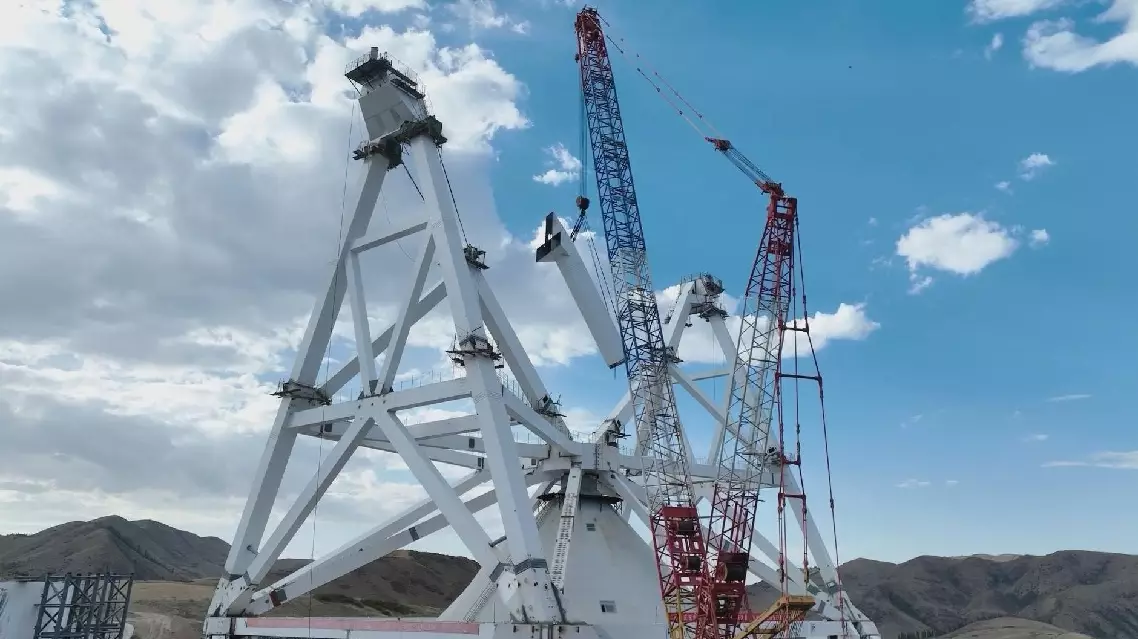
Core structure installation for giant radio telescope completed in Xinjiang