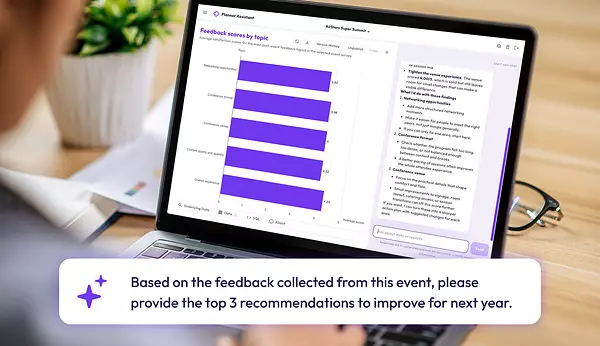
Planner Assistant is now live for all EventsAir customers, giving planners instant, natural-language answers and visualizations across their event data, and the ability to take direct action on what they find.
BRISBANE, Australia, Aug. 18, 2026 /PRNewswire/ -- EventsAir, a global leader in event management technology, today announced that Planner Assistant, part of its Air Intelligence suite, is now live and available to all event planners on the platform.
EventsAir Launches Planner Assistant
Planner Assistant transforms how planners deliver events, combining native, in-product intelligence with a deep contextual foundation built on more than 35 years of event industry expertise.
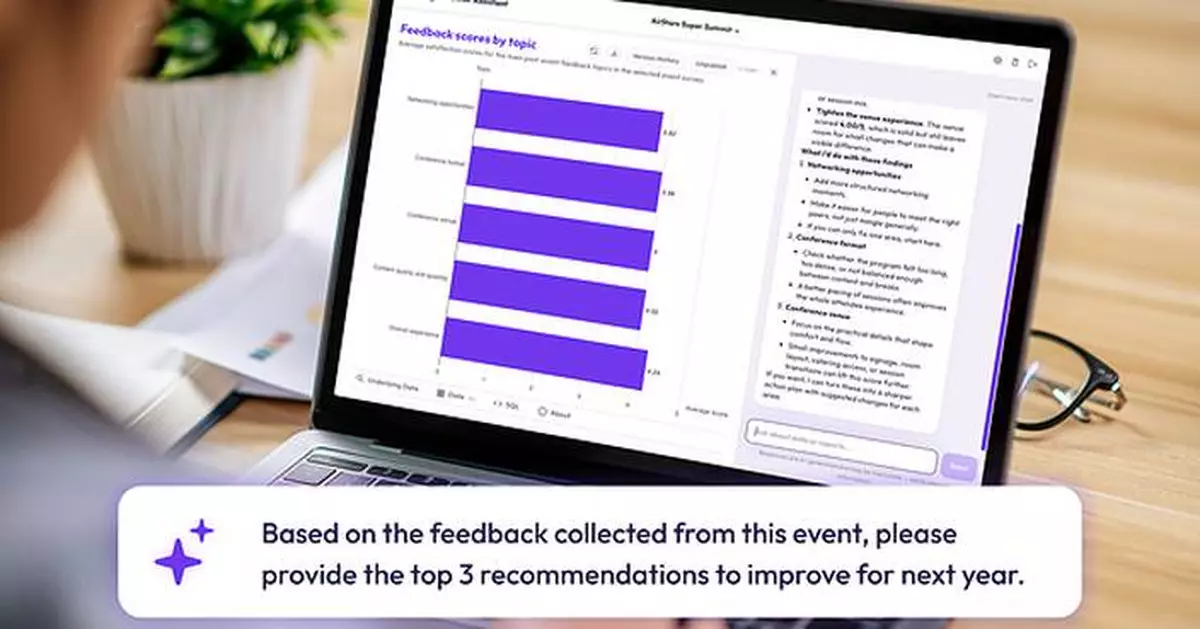
Working across live and historical event data, Planner Assistant lets planners ask complex questions and uncover opportunities directly within EventsAir, without building reports or navigating dashboards. It can summarize what's happening in plain language, turn insights into charts planners can save and share, and perform a growing set of actions within the platform when asked.
A planner can ask " Can you show me total revenue collected so far, broken down by registration type and payment status?" and get an instant, visual answer. Ask "Which sessions are trending toward overcapacity?" and Planner Assistant can go a step further, taking action on the planner's behalf, such as moving a session to a larger hall, on request and in the same conversation.
"Planner Assistant is about giving planners their time back," said Paul Trappett, CEO at EventsAir. "Every hour spent building a report or chasing down a number is an hour not spent on the parts of the job that actually shape a great event. Because Planner Assistant is built directly into the platform planners already rely on, it doesn't just tell them what's happening in their event. It helps them act on it, in the same place, in the same moment."
A native foundation
Planner Assistant is built directly into EventsAir, giving it the live context of a planner's event data across registrations, revenue, sessions, speakers, accommodation and more.
That native approach was a deliberate choice. EventsAir focused first on bringing AI into the environment where planners already manage their events, helping them engage more deeply with their events, analyze data faster, and ultimately set up, manage and update events with less effort.
"Planners need technology that genuinely makes their working lives easier," said Mehdi Khalili, CTO at EventsAir. "Building Planner Assistant directly into EventsAir means we can help planners understand what's happening and act on it without taking them out of the platform where the work is actually happening. And as a fully embedded solution, it gives us complete control over where our AI models are hosted, helping customers meet data privacy and sovereignty requirements while ensuring every response is grounded in the right context, with clear provenance."
Looking ahead, EventsAir is also building Model Context Protocol (MCP) capability on this same foundation, expected in the coming months, giving planners the flexibility to extend EventsAir into the other AI tools and platforms they already use.
What customers are saying
Ahead of today's launch, EventsAir worked closely with customers to put Planner Assistant to work in real event environments. Their experience speaks for itself.
"I would recommend Planner Assistant to any event professional who wants to spend less time pulling reports and more time actually understanding and acting on their event data. I can see it changing the way teams plan events by making event data more accessible, easier to interrogate and faster to act on. It gives event professionals the ability to ask better questions, identify issues earlier and make more informed decisions throughout the event lifecycle." — Petra Bacic, Chief Operating Officer, Public Sector Network
"An assistant that will guess is a liability dressed as a productivity gain. I asked Planner Assistant how many contacts were attached to an event, and it didn't just hand me a number, it showed me exactly how it got there in under 20 seconds. That's the difference between an answer and an answer you can actually stand behind and trust." — Michael Lockett, Founder & CTO, Symbiometry
Availability
Planner Assistant is live now inside EventsAir and available to all event planners on the platform. It joins Attendee Assistant and Content Assistant as part of the Air Intelligence suite, EventsAir's family of growing AI-powered assistants supporting planners and attendees across the full event lifecycle.
About EventsAir
With over 35 years of experience in event management technology, EventsAir is a comprehensive, all-in-one platform that supports in-person, virtual, and hybrid events. Trusted by event planners worldwide, EventsAir delivers a powerful, flexible solution that maximizes productivity across all stages of event planning.
The platform has powered more than 400,000 events globally, helping event professionals create standout experiences. For more information, visit eventsair.com.
** This press release is distributed by PR Newswire through automated distribution system, for which the client assumes full responsibility. **
EventsAir Launches Planner Assistant, Built-In Intelligence That Turns Event Data Into Instant Insight and Action
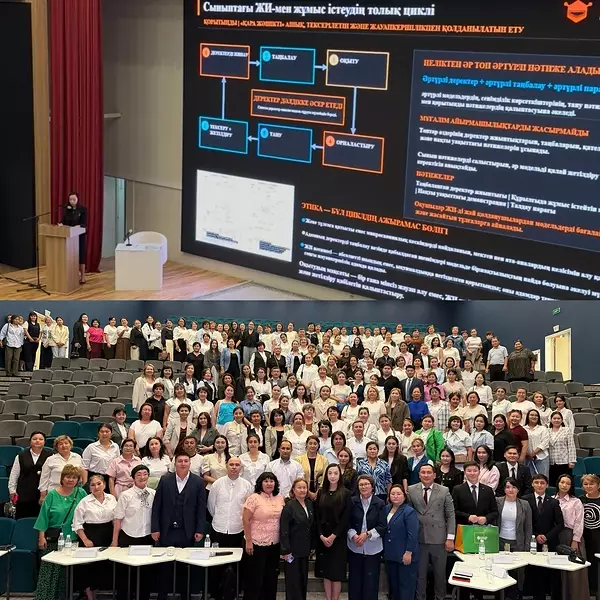
SHANGHAI, Aug. 18, 2026 /PRNewswire/ -- DFRobot, a global provider of open-source hardware and technology solutions, participated in TAMYZ FORUM 2026, the August Education Forum in Astana, Kazakhstan, where DFRobot Vice President Sandy Zhang delivered a keynote titled "Advancing AI Education Through Practical Innovation." She shared DFRobot's experience in open-source hardware, artificial intelligence, STEM education, and building a global ecosystem for developers and innovators.
Held August 17–18 in Astana, TAMYZ FORUM 2026 is organized by the Astana City Education Department and the Astana City Methodological Center under the theme "Strategic Development of the Education System: Constitutional Values, Artificial Intelligence and Human Capital." The two-day forum brings together educators, experts, and technology innovators, with around 3,000 in-person participants, 20,000 online participants, and 15 thematic sessions.
AI Education: From Using Tools to Understanding and Creating
During her keynote, Sandy Zhang noted that although different regions are taking different approaches to AI education, several common priorities are emerging worldwide, including curriculum development, student skills, teacher training, and responsible use of AI.
North America is developing AI education frameworks and curriculum standards, Europe is placing strong emphasis on AI literacy, ethics, and governance, while many Asian countries are moving from pilot programs to broader implementation. The policies may be different, but they share several priorities: curriculum standards, student competencies, teacher development, and responsible AI use.
At the same time, students are increasingly using AI tools in their daily lives, while many teachers and schools are still exploring how to effectively teach with and about AI.
"What's important is not simply teaching students how to use AI, but helping them understand how it works, question its outputs, and use technology to create and solve real-world problems," said Sandy. She emphasized that AI education should help learners develop a developer mindset—understanding how technology works, thinking critically about data and AI outputs, and turning ideas into practical solutions through hands-on experimentation.
Hands-On Learning Makes AI More Understandable
Sandy shared DFRobot's experience using open-source hardware to make AI more tangible in the classroom.
In one example, students use the HUSKYLENS 2 AI Vision Sensor to collect and label data, train AI models, and deploy them to hardware for real-time visual recognition. Because different groups may use different datasets, their models can produce different results. This allows teachers to demonstrate how data affects AI performance and encourage students to test, analyze, and improve their models.
Through this process, students can see how AI works rather than simply using a pre-trained service. AI becomes something they can observe, test, and improve instead of an abstract "black box." Topics including data privacy, algorithmic bias, and responsible use of technology can also be incorporated into these projects.
AI Hardware Meets STEM Education
Sandy also highlighted that supporting AI education and innovation requires more than individual hardware products. DFRobot has developed an integrated ecosystem spanning hardware, software, curriculum, platforms, and services, with solutions covering AI, ICT, and STEAM education.
DFRobot provides easy-to-use AI hardware, robotics products, sensors, and development modules, while its Mind+ programming platform lowers the barrier to AI and hardware development. It also offers curriculum resources, teacher training, hands-on projects, and competition support to help schools, educators, and developers turn technology into real-world applications.
This integrated approach enables DFRobot to support a broad community of innovators—from K–12 students, educators, and universities to developers, makers, and researchers—providing the tools and resources they need to learn, build, and innovate.
Expanding the Global Developer Ecosystem
Building the future of AI education and innovation requires collaboration across governments, international organizations, universities, schools, technology companies, and local communities.
DFRobot has participated in international platforms including UNESCO and the Arab League Educational, Cultural and Scientific Organization (ALECSO), and has worked with institutions such as Kathmandu University in Nepal and Chiang Mai University in Thailand on curriculum development and teacher training. The company also supports international robotics and innovation competitions, helping connect education with broader developer and maker communities.
In closing, Sandy emphasized the importance of building an open and collaborative ecosystem that enables more people to participate in technology innovation.
"Our shared goal is to help every learner develop creativity, practical problem-solving skills, and basic AI literacy, while learning to use technology responsibly," she said.
DFRobot will continue to pursue its mission of "serving innovators and developers worldwide," expanding collaboration across education and technology communities and making open-source hardware and AI technologies more accessible to people who want to learn, build, and create.
** This press release is distributed by PR Newswire through automated distribution system, for which the client assumes full responsibility. **
DFRobot VP Speaks at TAMYZ FORUM 2026 on AI Education and Global Developer Ecosystem