Skip to Content Facebook Feature Image

US stocks halt their slide after the Treasury Department moves to ease pressure from the bond market

Business

US stocks halt their slide after the Treasury Department moves to ease pressure from the bond market
Business

Business

US stocks halt their slide after the Treasury Department moves to ease pressure from the bond market

2026-08-20 04:57 Last Updated At:11:49

NEW YORK (AP) — U.S. stocks rose Wednesday after the U.S. Treasury Department announced a move that could ease pressure coming from the bond market. Strong profit reports for the spring from Estee Lauder, Target and other U.S. companies also helped support Wall Street.

The S&P 500 climbed 0.2% for its first gain in four days after setting its all-time high last week. The Dow Jones Industrial Average added 119 points, or 0.2%, and the Nasdaq composite ticked 0.2% higher.

More Images
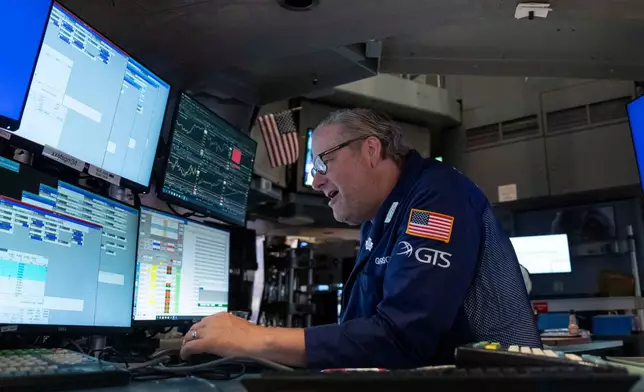
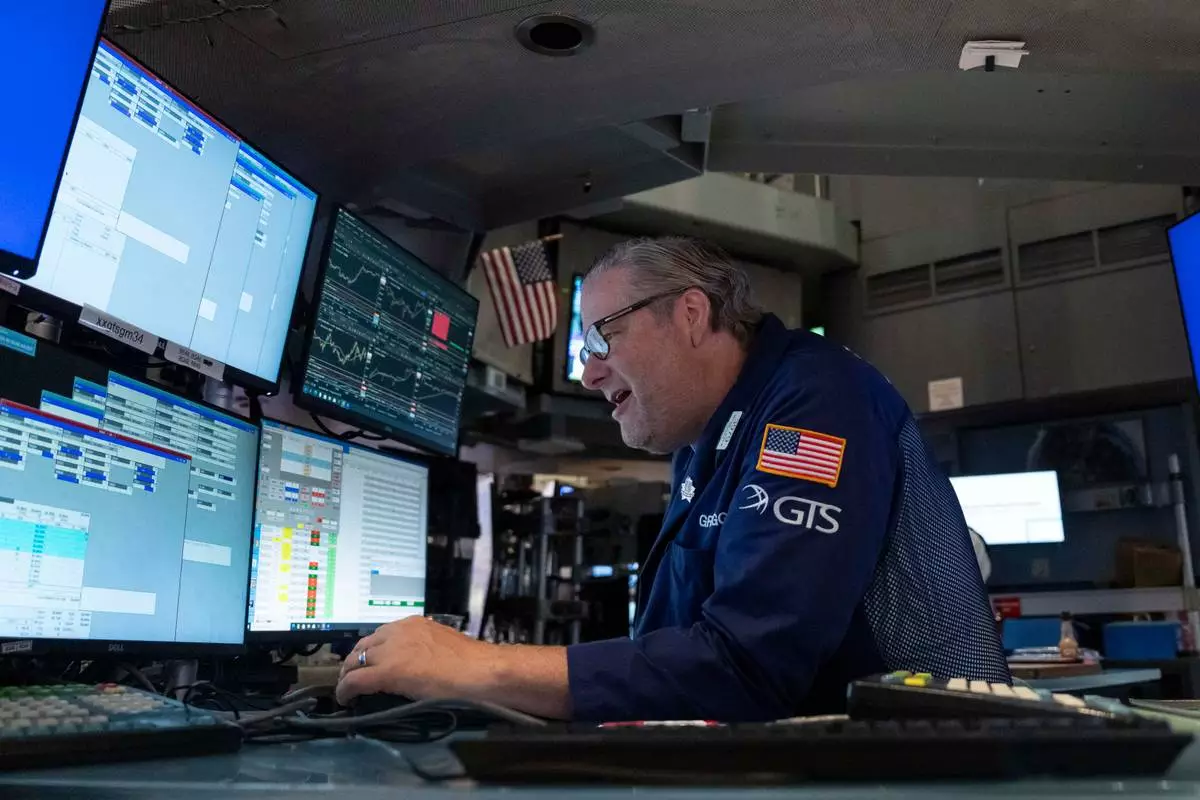
Specialist Gregg Maloney works on the floor of the New York Stock Exchange, Monday, Aug. 17, 2026, in New York. (AP Photo/Yuki Iwamura)
Specialist Gregg Maloney works on the floor of the New York Stock Exchange, Monday, Aug. 17, 2026, in New York. (AP Photo/Yuki Iwamura)

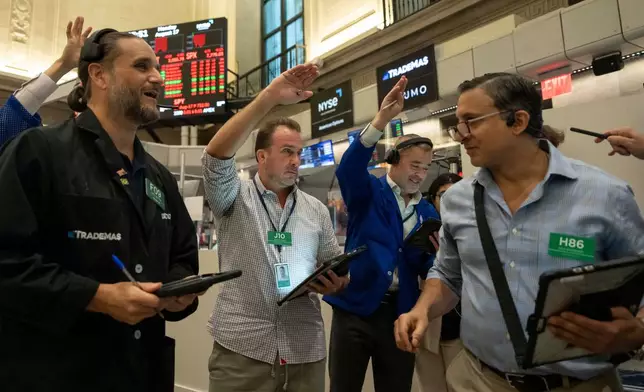
Options traders Chris Dattolo, Scott Frinzi, Justin Kanda, and Ravi Bhandari, left to right, work on the floor of the New York Stock Exchange, Monday, Aug. 17, 2026, in New York. (AP Photo/Yuki Iwamura)

Options traders Chris Dattolo, Scott Frinzi, Justin Kanda, and Ravi Bhandari, left to right, work on the floor of the New York Stock Exchange, Monday, Aug. 17, 2026, in New York. (AP Photo/Yuki Iwamura)

Currency traders work near a screen showing the Korea Composite Stock Price Index (KOSPI), SK Hynix and Samsung Electronics Co. stock price at the foreign exchange dealing room of the Hana Bank headquarters in Seoul, South Korea, Wednesday, Aug. 19, 2026. (AP Photo/Ahn Young-joon)
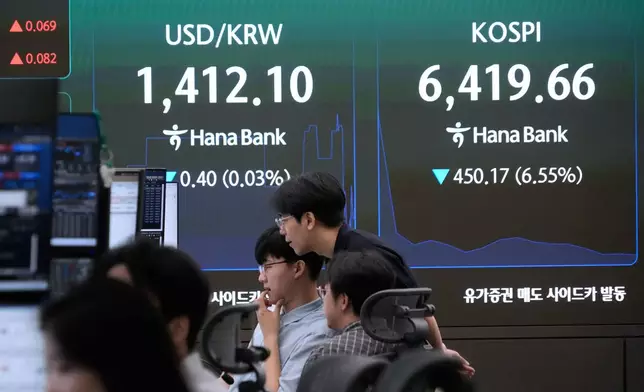
Currency traders work near a screen showing the Korea Composite Stock Price Index (KOSPI), SK Hynix and Samsung Electronics Co. stock price at the foreign exchange dealing room of the Hana Bank headquarters in Seoul, South Korea, Wednesday, Aug. 19, 2026. (AP Photo/Ahn Young-joon)

Currency traders watch monitors near a screen showing the Korea Composite Stock Price Index (KOSPI) and the foreign exchange rate between U.S. dollar and South Korean won at the foreign exchange dealing room of the Hana Bank headquarters in Seoul, South Korea, Wednesday, Aug. 19, 2026. (AP Photo/Ahn Young-joon)

Currency traders watch monitors near a screen showing the Korea Composite Stock Price Index (KOSPI) and the foreign exchange rate between U.S. dollar and South Korean won at the foreign exchange dealing room of the Hana Bank headquarters in Seoul, South Korea, Wednesday, Aug. 19, 2026. (AP Photo/Ahn Young-joon)

A currency trader passes by a screen showing the Korea Composite Stock Price Index (KOSPI) at the foreign exchange dealing room of the Hana Bank headquarters in Seoul, South Korea, Wednesday, Aug. 19, 2026. (AP Photo/Ahn Young-joon)

A currency trader passes by a screen showing the Korea Composite Stock Price Index (KOSPI) at the foreign exchange dealing room of the Hana Bank headquarters in Seoul, South Korea, Wednesday, Aug. 19, 2026. (AP Photo/Ahn Young-joon)

Financial markets have come under growing strain as Treasury yields charged higher through the summer on worries about inflation, big government debts and other factors. That makes borrowing money more expensive for everyone, which slows the economy and undercuts prices for stocks and other investments.

But Treasury yields fell in the morning after the U.S. Treasury Department said it will at least double the size of its planned purchases of longer-term Treasurys from Sept. 9 through Nov. 4. The department said it’s doing so “to provide greater liquidity support in longer-dated nominal sectors where there is consistent strong sponsorship from market participants.”

These longer-term 10- and 30-year Treasurys are less beholden to the Federal Reserve, which can raise or lower very short-term interest rates for overnight loans. President Donald Trump has lobbied for the Fed to lower interest rates to help the economy.

Longer-term yields are set instead by investors in the bond market, who decide how much interest they need to get paid by the U.S. government in exchange for lending it money. And recently, they have been demanding more in interest to make up for the growing risks of high inflation, continued government deficits and other factors.

After the Treasury department’s announcement, the yield on the 10-year Treasury fell to 4.64% from 4.71% late Tuesday. It, though, remains well above its 3.97% level from before the war with Iran sent oil prices and worries about inflation much higher.

The 30-year Treasury yield, which recently touched its highest level since 2007, fell more sharply to 5.18% from 5.28% late Tuesday.

The relief could be short lived, some analysts warn. The amount of bonds the U.S. Treasury is proposing to repurchase is a fraction of the overall total.

“The boost to buybacks is also happening in a world of challenged Fed credibility,” according to strategists at BNP Paribas. Investors are questioning whether the Federal Reserve will raise the federal funds rate soon to match the tough talk its chairman, Kevin Warsh, has been offering on getting inflation down toward its 2% target.

“We do not believe buybacks will be enough to offset a continued loss in Fed credibility,” the BNP Paribas strategists wrote in a report, calling them “necessary, but not sufficient.”

On Wall Street, Moderna and Merck helped lead the market after they announced encouraging initial results from a study of a cancer vaccine they co-developed. The new drug showed better recurrence-free survival in melanoma patients who had a combination of it and Keytruda, a prescription immunotherapy drug made by Merck, than with Keytruda alone.

Moderna soared 177%, while Merck jumped 12.6%.

The continuing parade of U.S. companies reporting bigger profits for the spring than analysts expected, meanwhile, continues to support stocks.

Estee Lauder rallied 16.3% after CEO Stéphane de La Faverie said a key measure of its revenue growth accelerated for a fourth straight quarter. It reported growth in revenue around the world, with the strongest in mainland China.

The skin care company reported earnings per share of 39 cents, after excluding some restructuring and other one-time expenses. That’s up from just 9 cents a year earlier and was better than the 32 cents that analysts expected, according to FactSet.

Such growth is imperative because stock prices tend to follow the path of corporate profits over the long term. And strong growth helps allay criticism that stock prices shot too high in their runs to records.

Target rose 4.3%, Lowe’s added 2% and homebuilder Toll Brothers climbed 4% after they all reported better profits for the latest quarter than expected.

They helped offset drops for some Big Tech stocks, which restrained the overall market.

Broadcom fell 4.6% and was the heaviest weight on the S&P 500. It and other winners of the artificial-intelligence boom have been swinging sharply through the summer on worries that their stocks may have shot too high and that the AI frenzy may not be sustainable if it doesn’t produce big-enough profits.

All told, the S&P 500 rose 16.22 points to 7,707.98. The Dow Jones Industrial Average climbed 119.65 to 53,463.05, and the Nasdaq composite added 41.38 to 26,331.09.

In stock markets abroad, indexes were mostly lower in Asia and mixed in Europe.

Tokyo’s Nikkei 225 sank 3.2%. South Korea’s Kospi, which has been home to some of the world’s sharpest swings because of its heavy reliance on AI stocks, slumped 5.8%.

AP Writers Michelle Chapman, Chan Ho-him, Mike Stobbe and Elaine Kurtenbach contributed to this report.

Specialist Gregg Maloney works on the floor of the New York Stock Exchange, Monday, Aug. 17, 2026, in New York. (AP Photo/Yuki Iwamura)
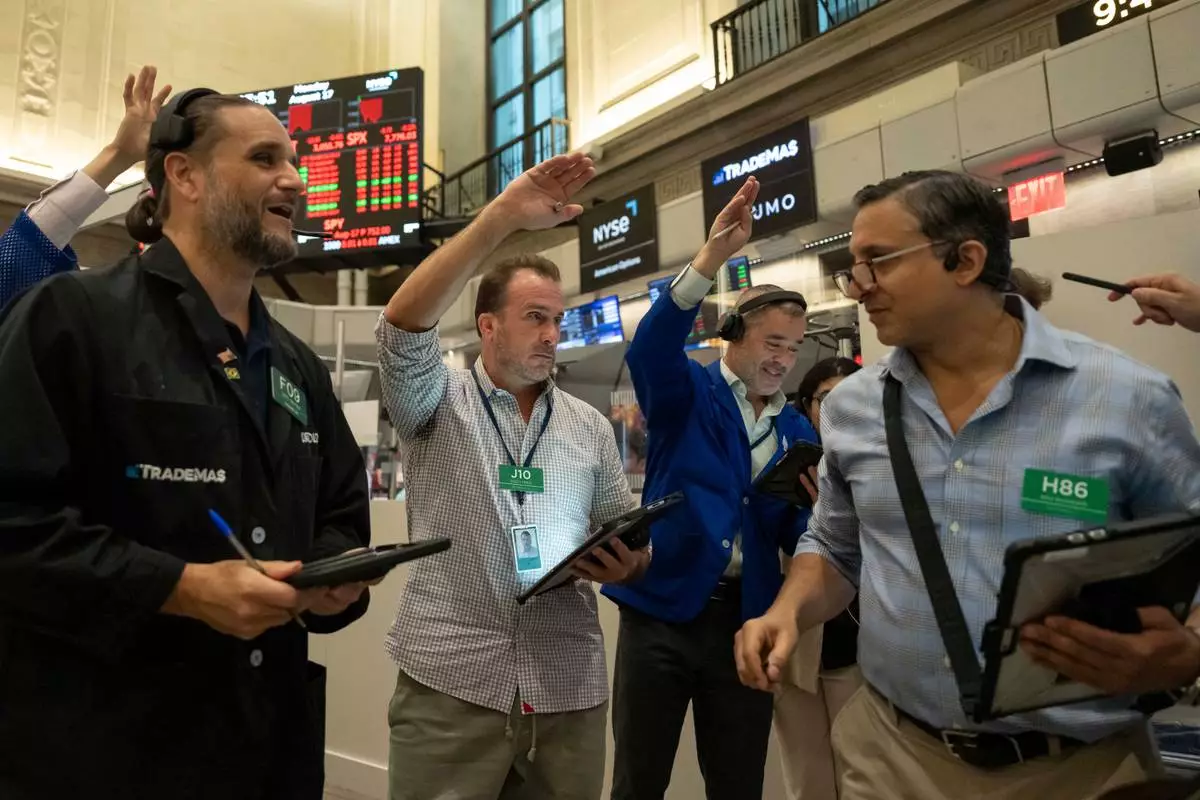
Specialist Gregg Maloney works on the floor of the New York Stock Exchange, Monday, Aug. 17, 2026, in New York. (AP Photo/Yuki Iwamura)

Options traders Chris Dattolo, Scott Frinzi, Justin Kanda, and Ravi Bhandari, left to right, work on the floor of the New York Stock Exchange, Monday, Aug. 17, 2026, in New York. (AP Photo/Yuki Iwamura)

Options traders Chris Dattolo, Scott Frinzi, Justin Kanda, and Ravi Bhandari, left to right, work on the floor of the New York Stock Exchange, Monday, Aug. 17, 2026, in New York. (AP Photo/Yuki Iwamura)

Currency traders work near a screen showing the Korea Composite Stock Price Index (KOSPI), SK Hynix and Samsung Electronics Co. stock price at the foreign exchange dealing room of the Hana Bank headquarters in Seoul, South Korea, Wednesday, Aug. 19, 2026. (AP Photo/Ahn Young-joon)
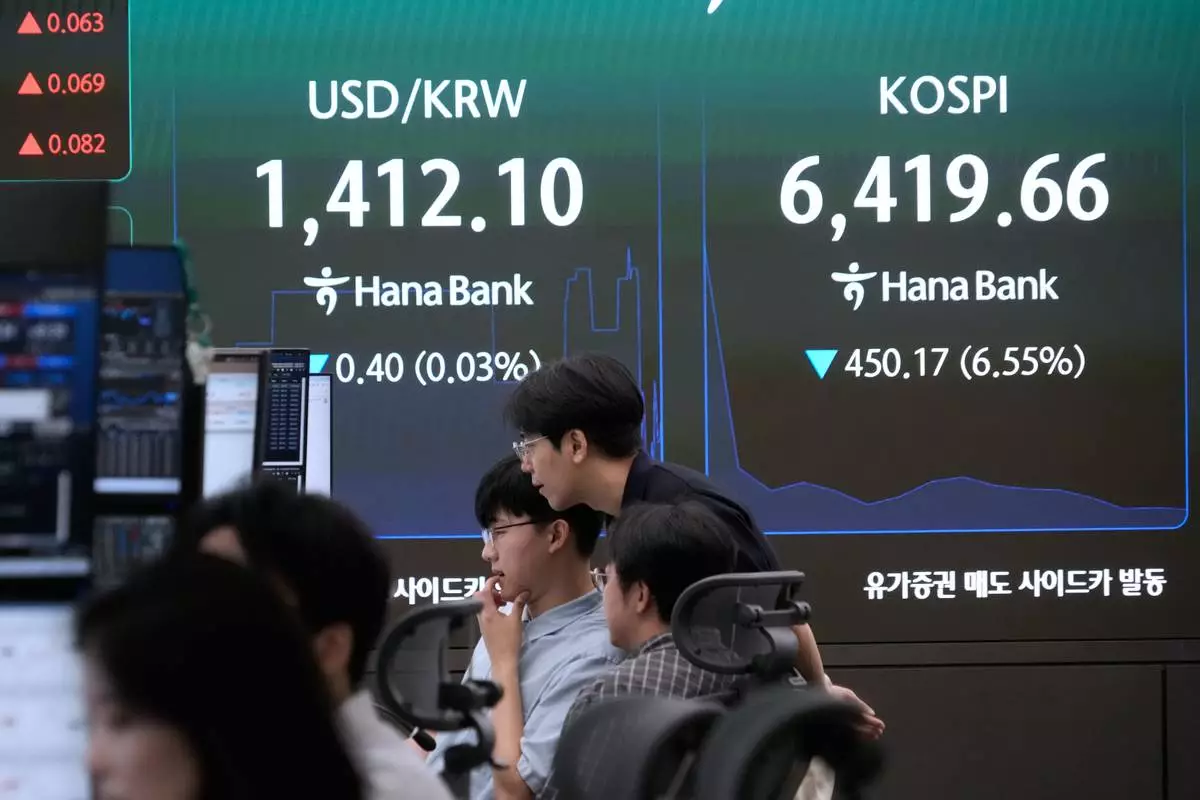
Currency traders work near a screen showing the Korea Composite Stock Price Index (KOSPI), SK Hynix and Samsung Electronics Co. stock price at the foreign exchange dealing room of the Hana Bank headquarters in Seoul, South Korea, Wednesday, Aug. 19, 2026. (AP Photo/Ahn Young-joon)

Currency traders watch monitors near a screen showing the Korea Composite Stock Price Index (KOSPI) and the foreign exchange rate between U.S. dollar and South Korean won at the foreign exchange dealing room of the Hana Bank headquarters in Seoul, South Korea, Wednesday, Aug. 19, 2026. (AP Photo/Ahn Young-joon)


Currency traders watch monitors near a screen showing the Korea Composite Stock Price Index (KOSPI) and the foreign exchange rate between U.S. dollar and South Korean won at the foreign exchange dealing room of the Hana Bank headquarters in Seoul, South Korea, Wednesday, Aug. 19, 2026. (AP Photo/Ahn Young-joon)

A currency trader passes by a screen showing the Korea Composite Stock Price Index (KOSPI) at the foreign exchange dealing room of the Hana Bank headquarters in Seoul, South Korea, Wednesday, Aug. 19, 2026. (AP Photo/Ahn Young-joon)

A currency trader passes by a screen showing the Korea Composite Stock Price Index (KOSPI) at the foreign exchange dealing room of the Hana Bank headquarters in Seoul, South Korea, Wednesday, Aug. 19, 2026. (AP Photo/Ahn Young-joon)

BELHAVEN, N.C. (AP) — Investors and scientists are restoring a 23-square-mile (60-square-kilometer) tract of peatland in North Carolina's Inner Banks to curb emissions of climate-warming carbon dioxide and regenerate native habitat.

Fifty miles (80 kilometers) of ditches dug decades ago for an abandoned farming venture drained much of the water from thousands of years of accumulated peat — partially decayed organic matter up to 15 feet (4.6 meters) deep — leaving the site vulnerable to drought and wildfires, altering native habitats and allowing it to emit 130,000 tons of carbon dioxide every year.

Here are key takeaways from The Associated Press’ reporting:

Though they account for just 3% of the global land surface, peatlands store about one-third of the Earth’s carbon dioxide, more than all forests combined. But when degraded, destroyed or burned they become part of the problem, releasing huge volumes of greenhouse gases, now about 6% of the annual global total from all sources.

When peatlands are intact, gases generated by decomposing plants are trapped in a waterlogged, oxygen-deprived environment, while surface vegetation absorbs carbon dioxide from the atmosphere, scientists say.

They also store about 10% of global fresh water, help control flooding and can help stem wildfires, as well as provide important habitat for many species.

Two-thirds of temperate peatlands — mostly in Europe and the U.S. — have been dewatered for farming, mining and other uses, while about 45% of tropical peatlands have been similarly disturbed, according to a 2025 study published by The Society for Conservation Biology.

Boreal peatlands, in colder climates in places like Canada and Russia, are about 90% intact, but face growing pressure from thawing permafrost and intense fires, both linked to climate change, as well as mining and critical minerals exploration.

Saturated peatlands are nearly fireproof: Just the surface vegetation and a few inches of peat burn, releasing nutrients, regenerating seed banks and creating beneficial biochar.

But when they’re dry, fire can burn underground for weeks or months — drying out and destroying even saturated layers — emitting enormous volumes of carbon dioxide and destroying thousands of years of accumulation.

In North Carolina, 11,000 miles (17,702 kilometers) of canals drain peatlands before the water empties into coastal estuaries. And the type of peatlands found there, and for hundreds of miles along the Eastern Seaboard, are among the most threatened in the world.

Colorado-based Pantheon Regeneration plans to restore its property by blocking off ditches to control the water table and significantly reduce carbon dioxide emissions. Then it will cull invasive species and replant native grasses, flowers and other plants.

Pantheon plans to sell carbon credits to tech companies and other corporations that want to compensate for their own greenhouse gas emissions, then use the money to restore and preserve a million acres of peatland from Virginia to northern Florida over the next decade.

The Associated Press’ climate and environmental coverage receives financial support from multiple private foundations. AP is solely responsible for all content. Find AP’s standards for working with philanthropies, a list of supporters and funded coverage areas at AP.org.

An agricultural field in a peatland area is visible Monday, May 4, 2026, in Roper, N.C. (AP Photo/Joshua A. Bickel)

An agricultural field in a peatland area is visible Monday, May 4, 2026, in Roper, N.C. (AP Photo/Joshua A. Bickel)

Fire-damaged trees stand in an area of peatland Tuesday, May 5, 2026, in Belhaven, N.C. (AP Photo/Joshua A. Bickel)

Fire-damaged trees stand in an area of peatland Tuesday, May 5, 2026, in Belhaven, N.C. (AP Photo/Joshua A. Bickel)

Neal Flanagan, a research scientist at Duke University, works near a solar panel powering a sensor that measures carbon emissions Wednesday, May 6, 2026, in Belhaven, N.C. (AP Photo/Joshua A. Bickel)

Neal Flanagan, a research scientist at Duke University, works near a solar panel powering a sensor that measures carbon emissions Wednesday, May 6, 2026, in Belhaven, N.C. (AP Photo/Joshua A. Bickel)

Construction materials sit near a peatland restoration site Wednesday, May 6, 2026, in Belhaven, N.C. (AP Photo/Joshua A. Bickel)

Construction materials sit near a peatland restoration site Wednesday, May 6, 2026, in Belhaven, N.C. (AP Photo/Joshua A. Bickel)

Curtis Richardson, an ecology professor at Duke University, holds peat soil Wednesday, May 6, 2026, in Belhaven, N.C. (AP Photo/Joshua A. Bickel)

Curtis Richardson, an ecology professor at Duke University, holds peat soil Wednesday, May 6, 2026, in Belhaven, N.C. (AP Photo/Joshua A. Bickel)

Recommended Articles