Chinese robot maker Unitree Robotics made its debut on the Shanghai Stock Exchange's sci-tech innovation board, or STAR Market, on Wednesday, with shares surged 629.44 percent to open at 1,100 yuan (about 161.99 U.S. dollars).
The Hangzhou-based company is offering about 40.45 million shares at 150.8 yuan (about 22.2 U.S. dollars) each, corresponding to a price-to-earnings ratio of 219.23 times, according to its prospectus.
Unitree said the funds raised will go toward intelligent robot model development, robot hardware R and D, new product development and manufacturing base construction, as the business moves from robot manufacturing toward building a broader ecosystem for high-performance general-purpose robots.
Unitree's listing comes as China's robotics sector gains global prominence. Chinese companies accounted for nearly 70 percent of global quadruped robot sales in the first half of 2026, according to the Ministry of Industry and Information Technology.
Market forecasts point to continued growth. Global humanoid robot shipments are projected to exceed 510,000 units by 2030, growing at a compound annual rate of about 95 percent, according to International Data Corporation, a market researcher.
Founded in 2016, Unitree has emerged as one of China's leading robotics firms, specializing in the development of quadruped and humanoid robots, with fully self-developed core components including motors, reducers, controllers and LiDAR.
Its humanoid robot shipments surpassed 5,500 units in 2025, ranking first globally with a 32.4 percent share of the world market, according to a 2025 humanoid robot market research report.
Benefiting from the gradual expansion of downstream application scenarios for humanoid robots and sustained market demand, the company posted revenue of about 1.15 billion yuan (about 170 million U.S. dollars) in the first half of 2026, up 48.54 percent year on year.

Chinese robot maker Unitree surges 629.44 pct on Shanghai market debut

Chinese robot maker Unitree surges 629.44 pct on Shanghai market debut
The Organization of Petroleum Exporting Countries (OPEC) on Tuesday raised its forecast for 2027 global oil demand growth for the sixth consecutive month, coming as the head of Saudi oil giant Aramco warned that global crude inventories have fallen to dangerously low levels.
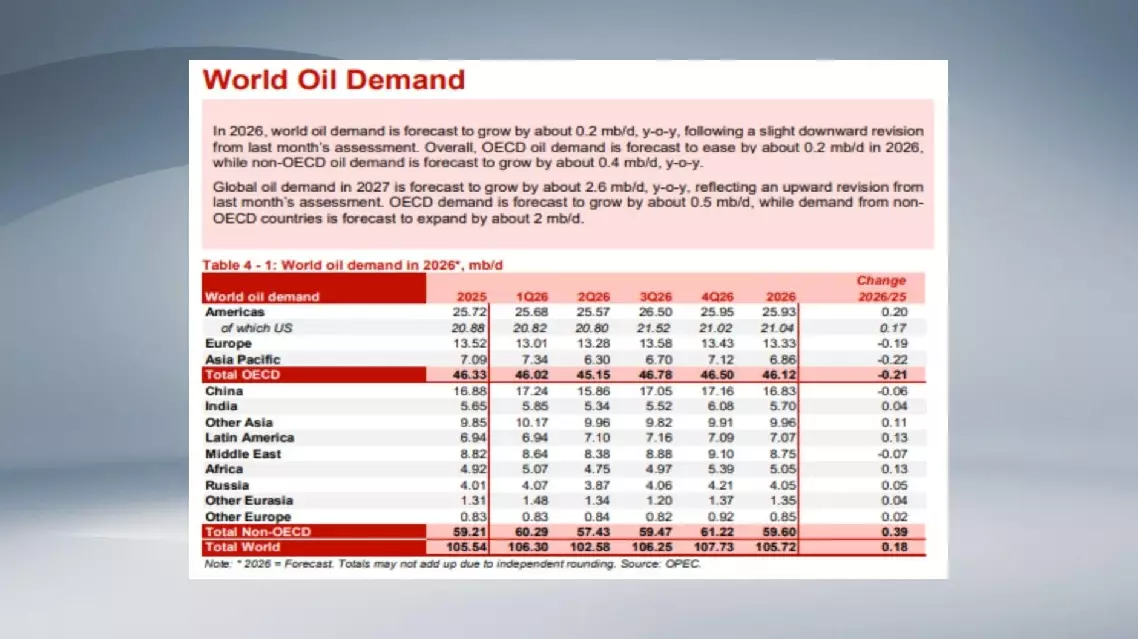
In its monthly oil market report released on Tuesday, OPEC projected that global daily oil demand in 2027 will increase by 2.55 million barrels per day (bpd) compared to 2026, reaching roughly 108 million bpd. This is an upward revision from its September forecast of 2.36 million bpd.
The report also said that global daily oil demand in 2026 will rise by 180,000 bpd from 2025 to about 106 million bpd, down from the 380,000 bpd increase projected in September.
According to the report, the upward revision is driven by increased demand expectations for both OECD (the Organization for Economic Cooperation and Development) and non-OECD countries.
"Oil demand in 2026 will indeed soften as currently expected and will be further bolstered next year by the need to replenish oil inventories at large," said the report.
Against the backdrop of long-term demand growth, immediate supply chain risks are mounting.
Saudi Aramco President and CEO Amin H. Nasser said Monday that global crude oil inventories were approaching dangerously low levels and could take up to two years to replenish.
With disruptions in the Strait of Hormuz pressuring global energy supply chains, crude oil supplies have tightened further, Nasser said at the 25th World Petroleum Council Energy Congress in Riyadh.
He noted that commercial onshore inventories were now well below six billion barrels, describing them as the "last available buffer," with the vast majority of these barrels locked up.
Nasser said that pressure across the energy chain would intensify until the Strait of Hormuz fully reopened and market confidence returned, adding that refilling inventories while meeting demand could take up to two years.
Nasser also said Saudi Aramco aimed to increase sales-gas production capacity by roughly 80 percent by 2030 compared with 2021 levels to meet growing energy demand.
OPEC raises 2027 oil demand forecast amid warnings of low crude inventories