The southern Chinese metropolis of Shenzhen is redefining China's wedding culture, turning new marriages into citywide celebrations of love and a potential new economic driver.
The city is among many across China that have been trying to take weddings beyond the walls of a reception hall and integrate the marriage experience with cultural and tourism offerings.
For Shenzhen, this means tapping into its reputation as the country's tech capital, where humanoid robots march with the wedding parties -- just as they did for a recent wedding between a couple who traveled all the way from central China's Henan Province, over 1,000 kilometers away.
The ceremony was one of many held publicly in a shopping mall in Bao'an District in the run-up to this year's Qixi Festival, also known as Chinese Valentine's Day, which falls on Wednesday.
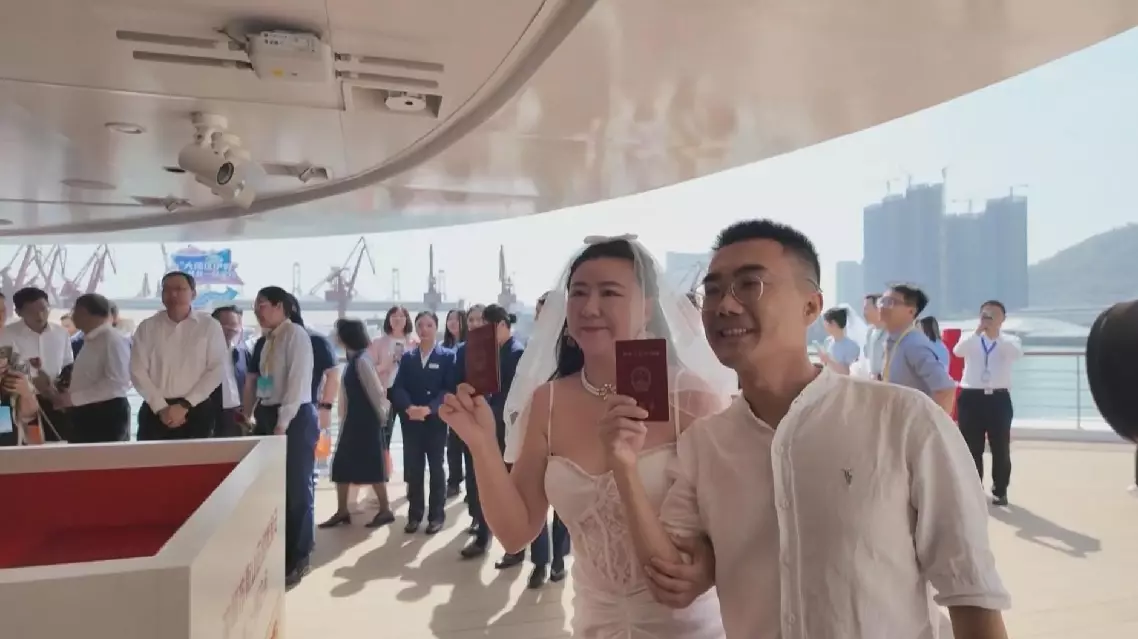
Elsewhere around the metropolis, couples take their vows on board cruise ships, in rural gardens or on picturesque mountaintops. Sites like these have attracted newlyweds from across the country, with over 31,000 non-resident couples marrying in Shenzhen.
Even obtaining a marriage certificate is no longer a mundane procedure in the city, which has relocated its certificate-presentation venues away from bureaucratic offices and into some of its most photogenic locations, transforming the process into a meaningful ritual intertwined with the city's landmarks and scenery.
As couples go all out on weddings, the local economy has gained a massive boost. In the run-up to this year's May 20, a popular unofficial holiday in China for dates, marriage registrations, and other romantic activities, Bao'an District launched a campaign for couples that spans various sectors, directly generating over 240 million yuan (nearly 35.6 million U.S. dollars) in consumer spending.
"Using marriage registration traffic as the starting point, we have integrated eight major business categories, such as wedding ceremonies, wedding banquets, bridal photography, leisure travel, and cultural entertainment," said Wang Wei, deputy director of the Bao'an District Civil Affairs Bureau.
The romance ripple effect is spreading into the broader tourism industry. Around key occasions like the Qixi Festival, Shenzhen has rolled out a series of marriage registration-themed travel routes, partnering with scenic spots and hotels to offer customized honeymoon packages with exclusive couple discounts.
Wang Qian, deputy director of the Social Affairs and Administrative Zoning Division of the Shenzhen Civil Affairs Bureau, said the city will step up efforts to foster a booming wedding-related industry.
"Through government platforms and public-private collaboration, we are integrating weddings, culture and tourism, consumption, and technology into a complete 'romance industry chain.' The aim is to foster a new economic growth driver, while also ensuring that the newlyweds enjoy high-quality, affordable and tailored services," he said.
China's tech hub turns wedding ceremonies into new economic driver