CONCORD, Mass.--(BUSINESS WIRE)--Aug 19, 2026--
aPriori Technologies today announced the general availability of aiSource™, its AI sourcing and negotiation solution that gives direct materials sourcing teams the manufacturing product intelligence and step-by-step guidance to negotiate more effectively with suppliers. Since its early access launch in May 2026, aiSource has been deployed by global manufacturers across automotive and industrial equipment, with consistent results in negotiation preparation speed, cycle compression, and buyer capability development across experience levels.
This press release features multimedia. View the full release here: https://www.businesswire.com/news/home/20260812970314/en/
The problem aiSource solves is fundamental to manufacturing procurement: the supplier knows exactly what their parts cost to make but the buyer's team often does not. That gap has measurable consequences — aPriori's baseline research found that over half of buyers miss their own savings targets every year. Built on aPriori's should-cost models, manufacturability analysis, and manufacturing process data, aiSource closes that gap by delivering clear, actionable manufacturing product intelligence and negotiation guidance grounded in each customer's own product, supplier, and process data, without requiring technical manufacturing expertise.
"Buyers have always been at a disadvantage in supplier negotiations because the supplier knows the manufacturing math and the buyer often does not," said Stephanie Feraday, President and Chief Executive Officer of aPriori Technologies. "What we are seeing in early deployments is exactly what we set out to deliver — buyers walking into negotiations better prepared, engaging suppliers on cost and process rather than just price, and closing the negotiation significantly faster. aiSource is proving that the expertise gap is a solvable problem."
What Early Deployments Are Showing
Across early deployments with global manufacturers in automotive, industrial equipment, and energy, two themes are emerging consistently. Buyers are getting to relevant cost intelligence faster, compressing preparation work that previously took days into hours and shifting their focus from gathering data to evaluating opportunities. And the guidance aiSource provides is proving valuable throughout the entire negotiation, not just at the start, helping buyers prioritize where to focus, respond to supplier feedback in real time, and build negotiation capabilities that previously required years of experience to develop.
"aiSource provided clear guidance on where to focus negotiation efforts, helping to prioritize key opportunities and navigate discussions more effectively. Its ability to start with strategic insights and progressively refine recommendations as supplier feedback becomes available makes it a valuable tool throughout the negotiation process. It is especially valuable for users looking to strengthen their negotiation capabilities and make informed decisions throughout the process.” – Global Strategic Sourcing Manager, Industrial Pump Manufacturer
Built for Scale Across the Entire Procurement Organization
Unlike solutions that require manufacturing expertise or extensive onboarding, aiSource is designed to deliver consistent outcomes across negotiators of every experience level. A commodity manager with twenty years of should-cost experience and a buyer in their first year of negotiations work from the same quality of intelligence. That scalability — consistent guidance, repeatable outcomes, no specialist dependency — is what makes aiSource a platform-level capability rather than a tool for the few.
aiSource is the first sourcing-focused solution built on the aPriori Intelligence Platform. The next planned capability will extend that same AI-powered intelligence into design engineering workflows, where manufacturing cost and manufacturability decisions are made earliest in the product lifecycle.
Availability
aiSource is generally available today to global manufacturing organizations. Visit apriori.com/aisource to learn more or request a personalized demo.
About aPriori Technologies
aPriori provides AI-powered product intelligence that helps manufacturers make faster, more profitable decisions from design through sourcing to production. Built on proprietary simulation engines and deep manufacturing data, the aPriori Intelligence Platform delivers real-time insight into product cost, manufacturability, and carbon footprint — enabling teams to reduce time-to-market, improve margins, and meet sustainability targets. According to a Forrester Total Economic Impact™ study, aPriori customers achieve approximately 600% ROI within three years and payback in under six months. To learn more, visit www.apriori.com.
aPriori on LinkedIn
aPriori on YouTube
aPriori Blog
aPriori and aPriori Technologies are registered trademarks of aPriori Technologies Inc. All other trademarks, registered trademarks, or service marks belong to their respective holders.
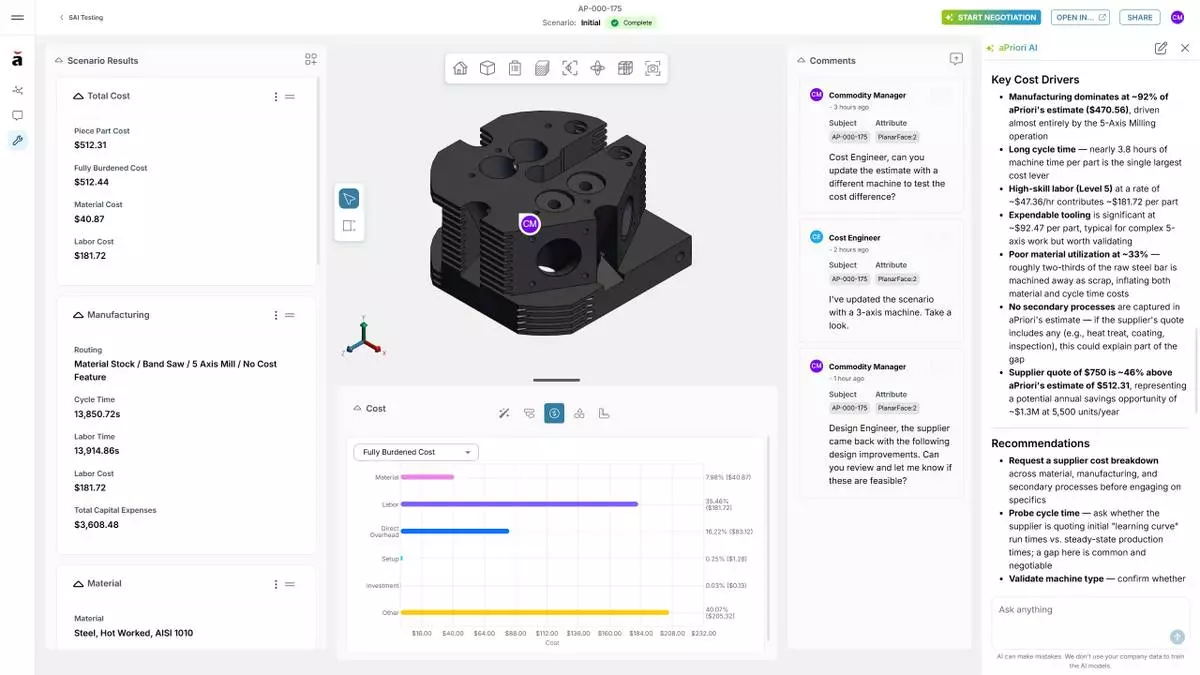
Introducing aiSource, the sourcing solution that brings aPriori Intelligence and AI together to help sourcing teams act faster, align easily, and consistently deliver more savings.
NEW YORK (AP) — U.S. stocks are ticking higher Wednesday after the U.S. Treasury Department said it will buy more U.S. government bonds in a move that eased pressure on financial markets worldwide. Strong profit reports for the spring from Estee Lauder, Target and other U.S. companies are also helping to support the stock market.
The S&P 500 rose 0.2% and is on track for its first gain in four days after setting its all-time high last week. The Dow Jones Industrial Average was up 220 points, or 0.1%, as of 10:15 a.m. Eastern time, and the Nasdaq composite was 0.3% lower.
The stock market has been under growing strain as worries about inflation, big government debts and other factors drive Treasury yields higher in the bond market. That ultimately makes borrowing money more expensive for everyone, which slows the economy and undercuts prices for stocks and other investments.
But Treasury yields fell in the morning after the U.S. Treasury Department said it will at least double the size of its planned purchases of longer-term Treasurys from Sept. 9 through Nov. 4. The department said it’s doing so “to provide greater liquidity support in longer-dated nominal sectors where there is consistent strong sponsorship from market participants.”
These longer-term 10- and 30-year Treasurys are less beholden to the Federal Reserve, which can raise or lower very short-term interest rates for overnight loans. President Donald Trump has lobbied for the Fed to lower interest rates to help the economy.
Instead, longer-term yields are set by investors in the bond market, who are deciding how much interest they need to get paid by the U.S. government in exchange for lending it money. And recently, they have been demanding more in interest to make up for the growing risks of high inflation, continued government deficits and other factors.
After the Treasury department's announcement, the yield on the 10-year Treasury sank to 4.64% from 4.71% late Tuesday, which is a notable move for the bond market. It, though, remains well above its 3.97% level from before the war with Iran sent oil prices and worries about inflation much higher.
The 30-year Treasury yield, which has recently touched its highest level since 2007, fell more sharply to 5.19% from 5.28% late Tuesday.
On Wall Street, Moderna and Merck helped lead the market after they announced encouraging results from a study of a cancer vaccine they co-developed. The new drug showed better recurrence-free survival in melanoma patients who had a combination of it and Keytruda, a prescription immunotherapy drug made by Merck, than with Keytruda alone.
Moderna soared 126.9%, while Merck jumped 11.5%.
The continuing parade of U.S. companies to report bigger profits for the spring than analysts expected, meanwhile, continues to support stocks.
Estee Lauder rallied 15.6% after CEO Stéphane de La Faverie said a key measure of its revenue growth accelerated for a fourth straight quarter. It reported growth in revenue around the world, with the strongest in mainland China.
The skin care company reported earnings per share of 39 cents, after excluding some restructuring and other one-time expenses. That’s up from just 9 cents a year earlier and was better than the 32 cents that analysts expected, according to FactSet.
Such growth is imperative because stock prices tend to follow the path of corporate profits over the long term. And strong growth helps allay criticism that stock prices shot too high in their runs to records.
Target rose 4.7%, Lowe’s added 4.2% and homebuilder Toll Brothers climbed 7.1% after they all also reported better profits for the latest quarter than expected.
They helped offset drops for some Big Tech stocks, which restrained the overall market. Broadcom fell 5.5%, for example, and was the heaviest weight on the S&P 500. It and other winners of the artificial-intelligence boom have been swingingsharply through the summer on worries that their stocks may have shot too high and that the AI frenzy may not be sustainable if it doesn't produce big-enough profits.
In stock markets abroad, indexes were mostly lower in Asia and mixed in Europe.
Tokyo’s Nikkei 225 sank 3.2%. South Korea’s Kospi, which has been home to some of the world’s sharpest swings because of its heavy reliance on AI stocks, slumped 5.8%.
AP Writers Michelle Chapman, Chan Ho-him, Mike Stobbe and Elaine Kurtenbach contributed to this report.
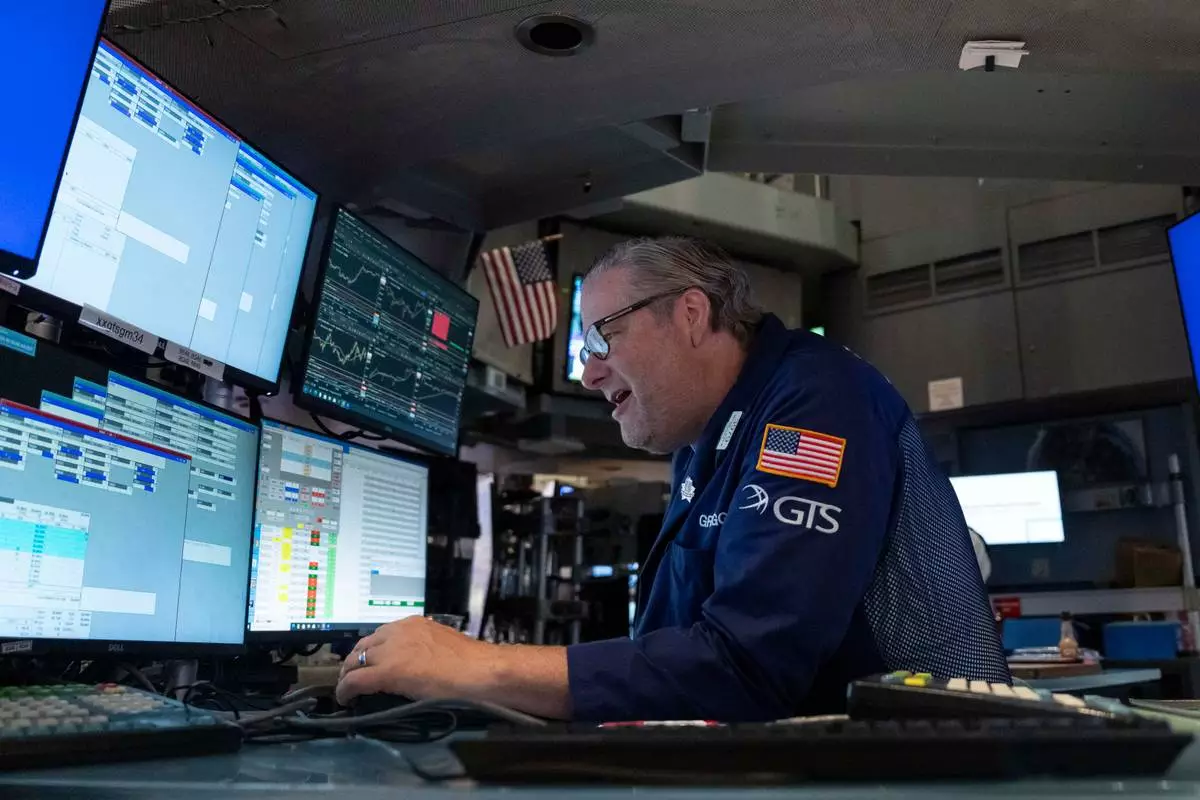
Specialist Gregg Maloney works on the floor of the New York Stock Exchange, Monday, Aug. 17, 2026, in New York. (AP Photo/Yuki Iwamura)
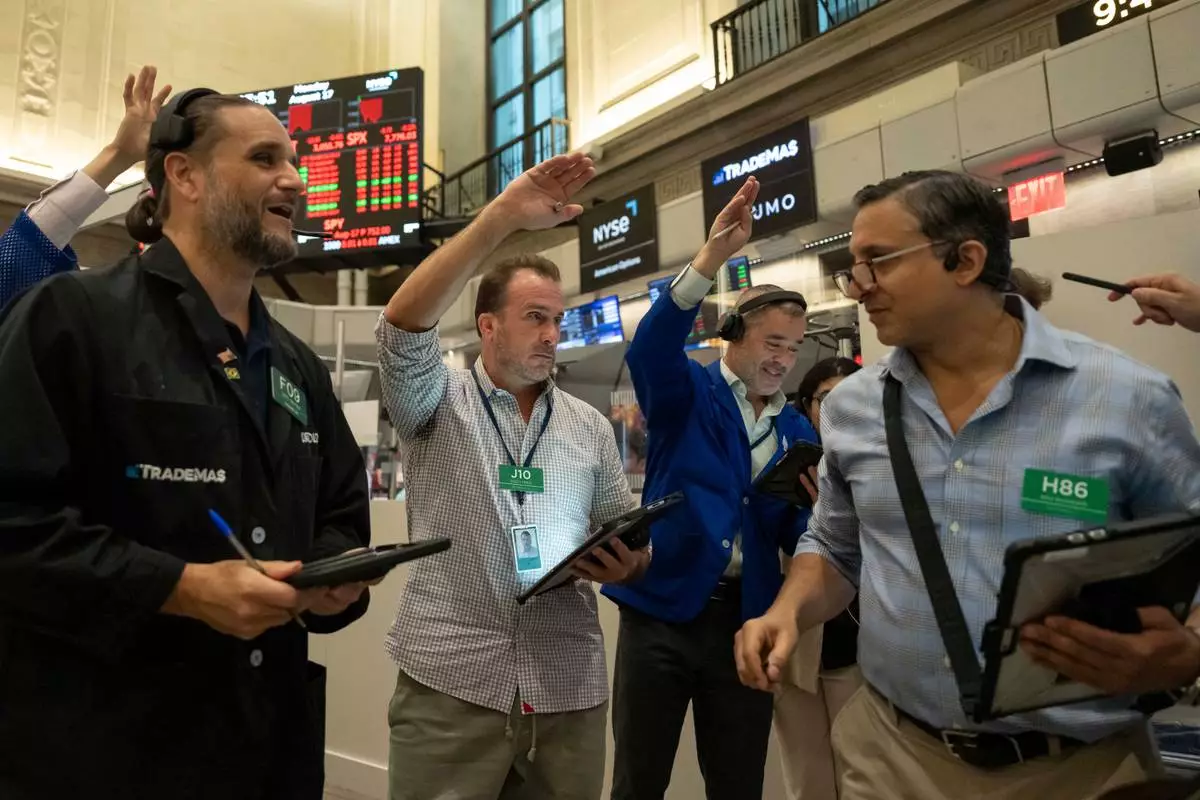
Options traders Chris Dattolo, Scott Frinzi, Justin Kanda, and Ravi Bhandari, left to right, work on the floor of the New York Stock Exchange, Monday, Aug. 17, 2026, in New York. (AP Photo/Yuki Iwamura)
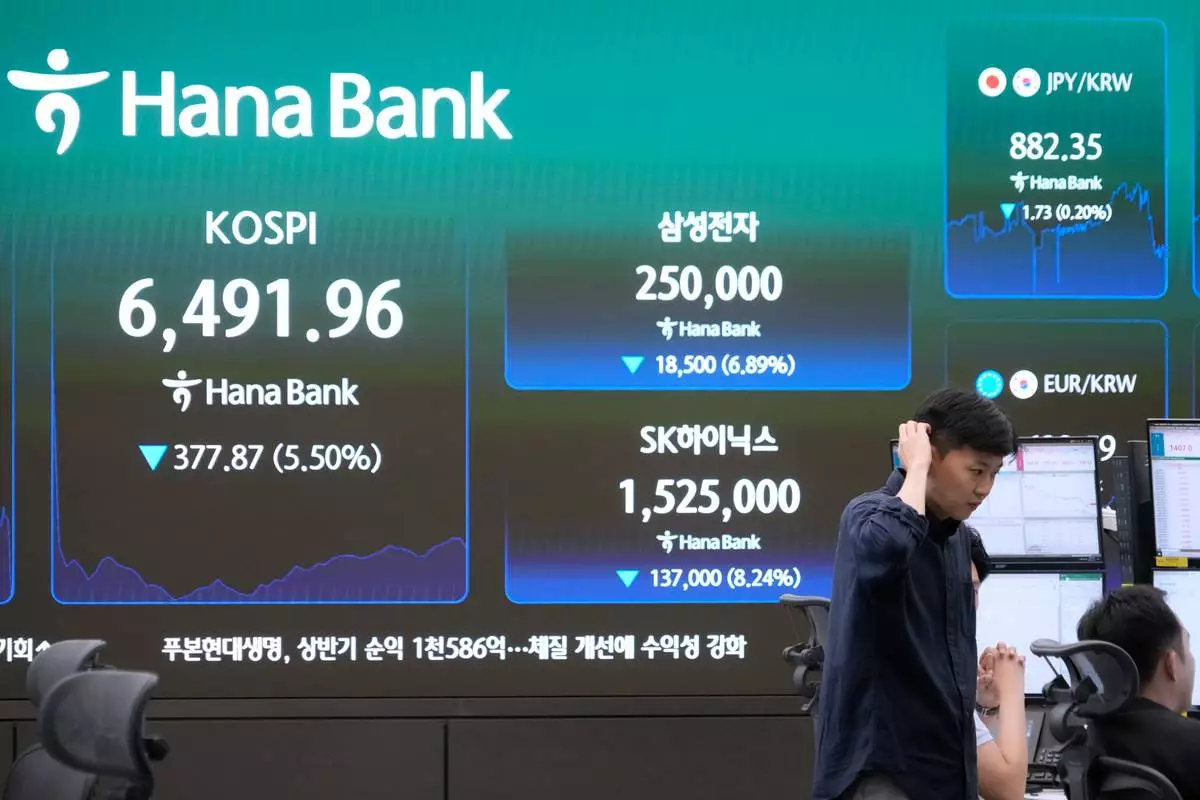
Currency traders work near a screen showing the Korea Composite Stock Price Index (KOSPI), SK Hynix and Samsung Electronics Co. stock price at the foreign exchange dealing room of the Hana Bank headquarters in Seoul, South Korea, Wednesday, Aug. 19, 2026. (AP Photo/Ahn Young-joon)
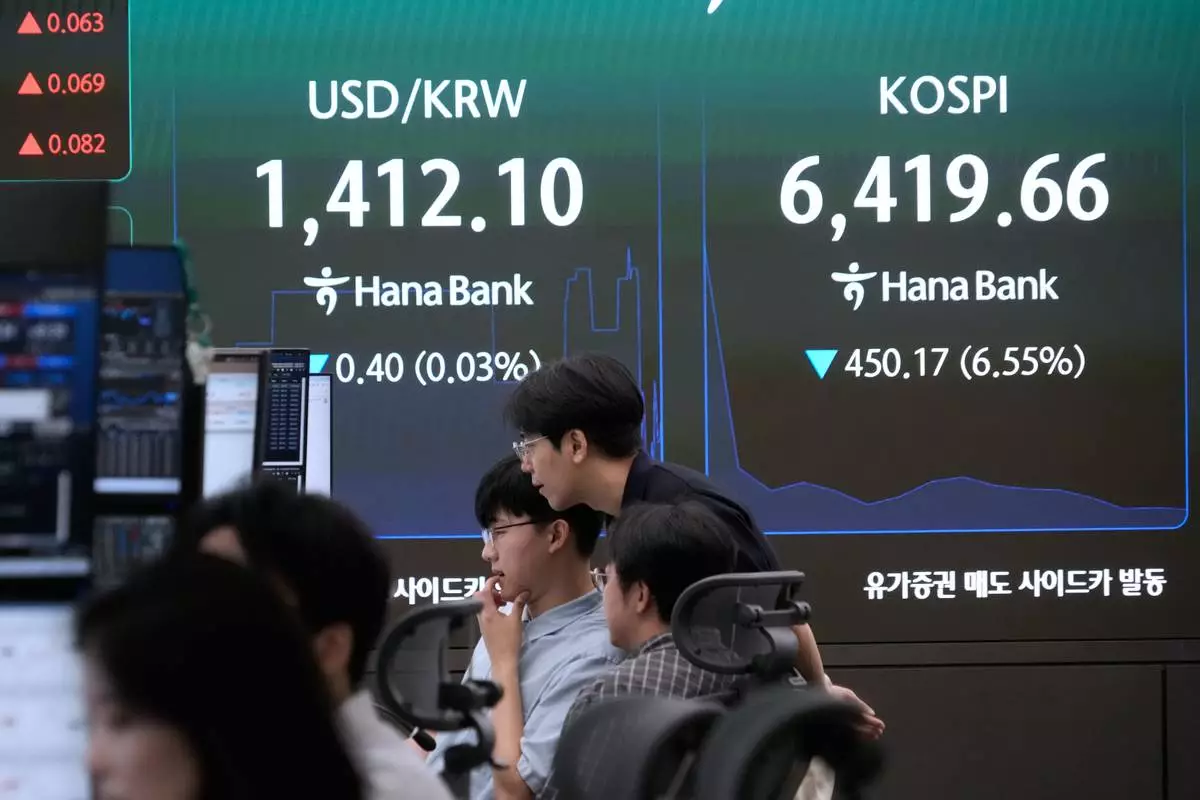
Currency traders watch monitors near a screen showing the Korea Composite Stock Price Index (KOSPI) and the foreign exchange rate between U.S. dollar and South Korean won at the foreign exchange dealing room of the Hana Bank headquarters in Seoul, South Korea, Wednesday, Aug. 19, 2026. (AP Photo/Ahn Young-joon)
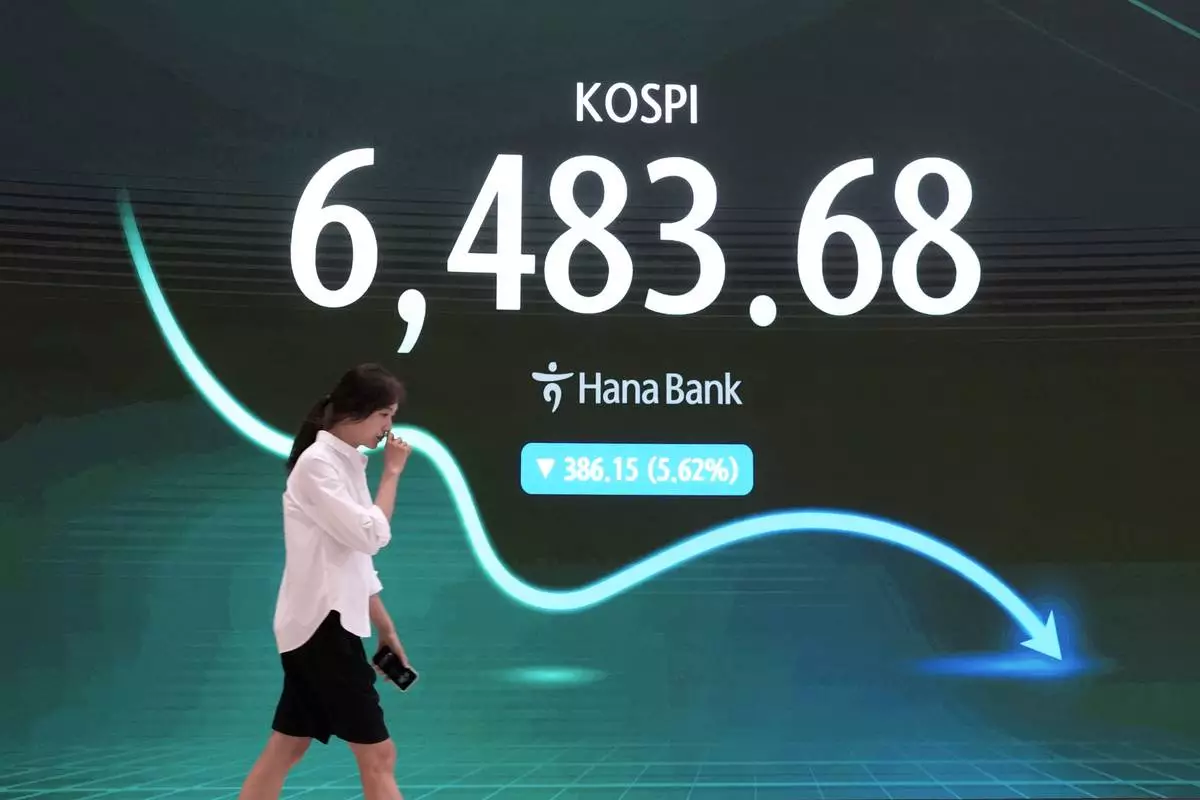
A currency trader passes by a screen showing the Korea Composite Stock Price Index (KOSPI) at the foreign exchange dealing room of the Hana Bank headquarters in Seoul, South Korea, Wednesday, Aug. 19, 2026. (AP Photo/Ahn Young-joon)