Skip to Content Facebook Feature Image

Village doctor in Xinjiang guards herdsmen in remote pastoral area for over 3 decades

China

China

China

Village doctor in Xinjiang guards herdsmen in remote pastoral area for over 3 decades

2026-08-19 22:12 Last Updated At:23:07

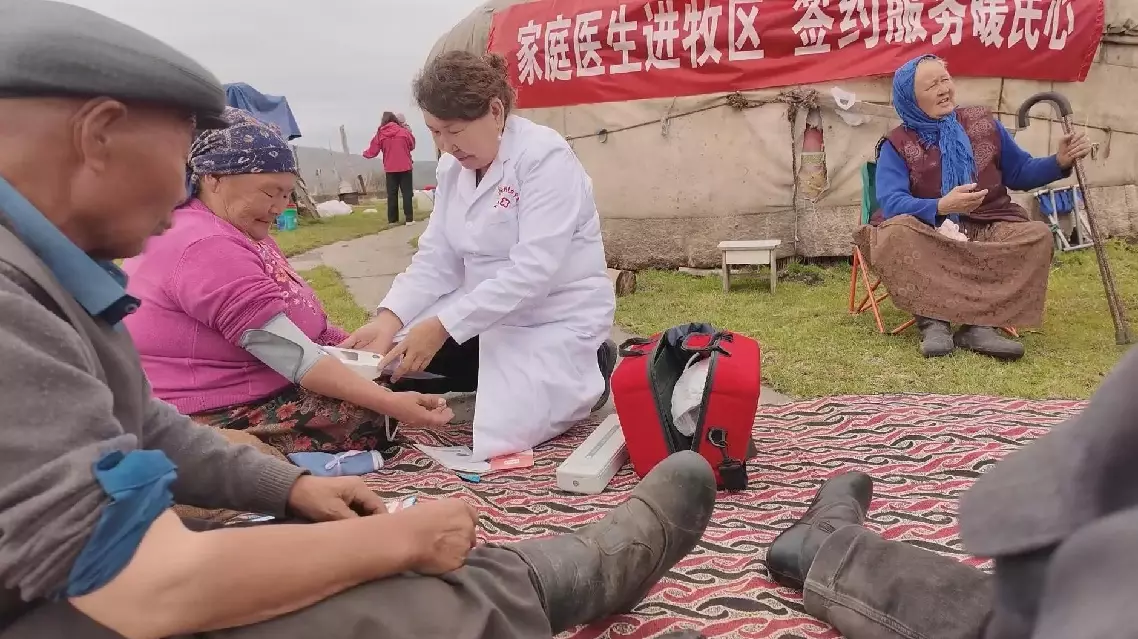
Binur Edihan, a village doctor in northwest China's Xinjiang Uygur Autonomous Region, has devoted her entire career to taking care of herdsmen in remote pastoral area. During summer, herdsmen in the region always move their livestock to further grazing grounds in Ili Kazak Autonomous Prefecture's Xinyuan County.

Their seasonal movement presents a challenge for Edihan's work, as she must ride horse and climb over several hills to find them.

But Edihan said the improvement of infrastructure made her work easier.

"In the past, there was no phone signal on mountains. If any herdsman had emergency illness, it could take them at least two or three hours to get help down here. And by the time we reached them, it was sometimes already too late. Now signals cover the mountainous areas. Once they call, we'll prepare the medicine and head to the mountain," said Edihan.

The doctor was able to drive her truck to the foot of the hill, but from there she had to mount a horse to reach herdsmen's homes, rising up the same dirt path she has ridden for 30 years.

After finally arriving at the home, she immediately began examining the patient and prescribed medicine to relieve the pain.

"My mother has rheumatism and high blood pressure. Despite the distance to the summer pasture, Binur never hesitates to come. She always takes her blood pressure and brings medicine. Every time she visits, I feel truly reassured," said Aygul Hasen, a villager.

When word spread that Edihan had arrived, herdsmen from the surrounding areas gathered around her. She often tells them gives them health tips in the hopes they will stay well. After all these years, these herdsmen have become her family.

"I even helped her deliver her baby. Back then, we didn't have nearly as good conditions. Now, she already has a granddaughter. She is sleeping," said Edihan, holding the baby of the herdswoman.

In such a harsh environment, Edihan admitted that she has also had moments of doubt. But seeing these herdsmen, she chose to stand guard over their health and protect their lives in the pastoral area.

"It's not true if I say I never thought about leaving. When I was young, I wanted to go to a big hospital. But if I left, what would happen to the herdsmen here? There are so many elderly people and so many children. If they got sick, who would take care of them? Thinking about that, I decided to stay and keep working here," said Edihan.

Edihan also oversees the health of several hundred households in the village and knows everyone by name. Routine checkups and home visits are her unwavering duty.

She continues to see herdsmen and their families when they are in need, no matter the weather.
Village doctor in Xinjiang guards herdsmen in remote pastoral area for over 3 decades


Village doctor in Xinjiang guards herdsmen in remote pastoral area for over 3 decades

Macao is well-positioned to play a key role in China's broader development strategy by fully leveraging its distinctive strengths and deepening its integration with the mainland, said Jose Maria Pereira Coutinho, a member of the Legislative Assembly of the Macao Special Administrative Region (SAR).

The Macao SAR government on Tuesday released the Third Five-Year Plan for Economic and Social Development of the Macao SAR (2026-2030). It sets out eight development goals and serves as a comprehensive roadmap for Macao's next phase of growth, aligning closely with the national 15th Five-Year Plan (2026-2030) adopted by the National People's Congress back in March.

In an interview with the China Global Television Network (CGTN) on Wednesday, Coutinho emphasized that the newly-unveiled plan is more than a local blueprint, but rather serves as a strategic instrument for integrating Macao into the country's overall development framework under the "one country, two systems" principle.

"Definitely I believe that there are some list of priorities in Macao. First of all, it stands that the main core is the national security legislation which is essential to put it in effect, the 'one country, two systems' principle. A comprehensive national security legal framework provides a stable environment and other important developments that need to be [in place for the region to] flourish," he said.

He also stressed the urgency of establishing a clear timeline and revising the five key legal codes, including the Penal Code, the Civil Code, and the Commercial Code, to support the plan's implementation and create a sound legal foundation.

When asked how Macao's Third Five-Year Plan aligns with the wider national strategy, Coutinho underscored the SAR's deliberate effort to synchronize with the mainland's 15th Five-Year Plan.

He highlighted Macao's distinctive role as an international bridge, not only between China and Portuguese-speaking countries but also increasingly with Latin America.

"Macao is a special place because under 'one country, two systems', we try to align to the 15th Five-Year Plan of the mainland strategy so that a comprehensive alignment with that core [plan is] essential. [It] reflects the Macao government positioning Macao within not only broader national development, but also the openness about the links that we have with the Portuguese-speaking countries and now with the Spanish [speaking] South America countries" he said.

Coutinho added that Macao's standing as a unique gateway for key global markets to engage with China and vice versa reinforces its value as a vital strategic hub for economic ties.

Macao to play key role in China's broader national development strategy: regional legislator

Macao to play key role in China's broader national development strategy: regional legislator

Recommended Articles