The 2026 Qixi Festival Gala, produced by China Media Group (CMG), got underway at 20:00 Beijing Time on Wednesday, marking the annual celebration of one of China's oldest and most cherished traditional festivals.
The Qixi Festival, also referred to as the Chinese Valentine's Day, falls on the seventh day of the seventh month on the Chinese lunar calendar. It dates back more than 2,000 years and was inscribed on China's national intangible cultural heritage list in 2006.
The festival's enduring romantic association stems from the legends of the cowherd Niulang and the weaver girl Zhinyu, star-crossed lovers separated by the Milky Way who are permitted to meet only once a year when a flock of magpies forms a bridge across the heavens.
In ancient China, young women celebrate the festival by praying to Zhinyu for clever hands and domestic talents. Today, couples usually spend the day by exchanging gifts and many partners choose this auspicious date to register their marriages or hold collective traditional weddings.
This year's gala centered on the motif of a bridge, linking ancient myth with contemporary life.
A travelogue performance themed around the mythological bridge ran through the entire event, which featured songs, dances, traditional operas and ballet.
A highlight of the gala was a micro-film which explores shared Qixi customs between people from the Chinese mainland and Taiwan.
Among the evening's touching highlights was a short film featuring the enduring romance of 88-year-old Chinese radar technology expert Ben De, recipient of China's 2026 State Preeminent Science and Technology Award, and his wife. The award is the nation's highest honor for scientific and technological achievement.
This year's gala centered on co-creation, featuring segments with real couples from across the country to jointly celebrate the millennia-old traditions through contemporary expressions of love.

CMG airs special TV gala to celebrate China's 2,000-year-old love festival
Binur Edihan, a village doctor in northwest China's Xinjiang Uygur Autonomous Region, has devoted her entire career to taking care of herdsmen in remote pastoral area. During summer, herdsmen in the region always move their livestock to further grazing grounds in Ili Kazak Autonomous Prefecture's Xinyuan County.
Their seasonal movement presents a challenge for Edihan's work, as she must ride horse and climb over several hills to find them.
But Edihan said the improvement of infrastructure made her work easier.
"In the past, there was no phone signal on mountains. If any herdsman had emergency illness, it could take them at least two or three hours to get help down here. And by the time we reached them, it was sometimes already too late. Now signals cover the mountainous areas. Once they call, we'll prepare the medicine and head to the mountain," said Edihan.
The doctor was able to drive her truck to the foot of the hill, but from there she had to mount a horse to reach herdsmen's homes, rising up the same dirt path she has ridden for 30 years.
After finally arriving at the home, she immediately began examining the patient and prescribed medicine to relieve the pain.
"My mother has rheumatism and high blood pressure. Despite the distance to the summer pasture, Binur never hesitates to come. She always takes her blood pressure and brings medicine. Every time she visits, I feel truly reassured," said Aygul Hasen, a villager.
When word spread that Edihan had arrived, herdsmen from the surrounding areas gathered around her. She often tells them gives them health tips in the hopes they will stay well. After all these years, these herdsmen have become her family.
"I even helped her deliver her baby. Back then, we didn't have nearly as good conditions. Now, she already has a granddaughter. She is sleeping," said Edihan, holding the baby of the herdswoman.
In such a harsh environment, Edihan admitted that she has also had moments of doubt. But seeing these herdsmen, she chose to stand guard over their health and protect their lives in the pastoral area.
"It's not true if I say I never thought about leaving. When I was young, I wanted to go to a big hospital. But if I left, what would happen to the herdsmen here? There are so many elderly people and so many children. If they got sick, who would take care of them? Thinking about that, I decided to stay and keep working here," said Edihan.
Edihan also oversees the health of several hundred households in the village and knows everyone by name. Routine checkups and home visits are her unwavering duty.
She continues to see herdsmen and their families when they are in need, no matter the weather.
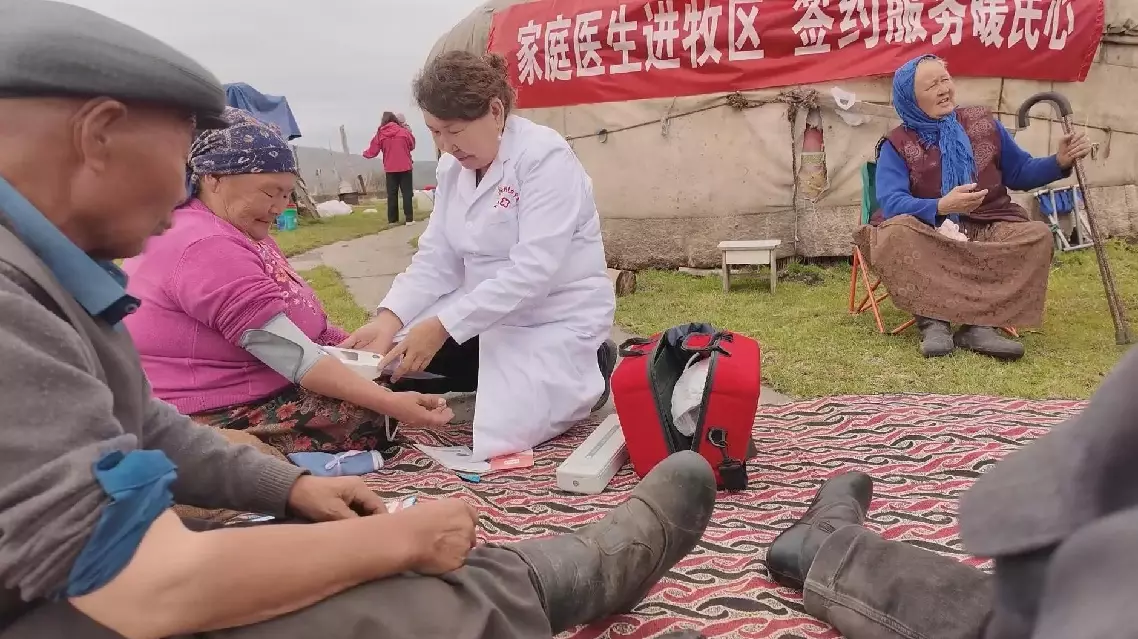
Village doctor in Xinjiang guards herdsmen in remote pastoral area for over 3 decades