The Pac-12 is back with a new look and a host of schools that might seem unfamiliar to longtime fans of the Conference of Champions.
Oregon State and Washington State are the lone holdovers after a max exodus in 2023 that threatened the existence of a conference founded more than a century ago and with a long and storied history across multiple sports.
The league has patiently reloaded with six new football programs, adding Boise State, Colorado State, San Diego State, Utah State, Texas State and Fresno State.
The rebirth of Pac-12 football will include a seven-game round-robin schedule followed by a “flex” game designed to enhance its College Football Playoff and bowl game chances. There is a new television deal that ensures every game will be on linear TV, so the entire country will get a chance to watch “Pac-12 After Dark” instead of searching channels and platforms to find its games.
All the uncertainty is over and now it's finally time for the Pac-12 to get back on track.
Boise State enters its first season in the Pac-12 as the favorite to win the title after winning three straight Mountain West Conference championships.
The Broncos played in the College Football Playoff their first season under coach Spencer Danielson in 2024 and won nine games last season. Boise State has physical lines on both sides of the ball and returns quarterback Maddux Madsen, who threw for 2,334 and 18 touchdowns last season.
Dylan Riley also is back after rushing for 1,125 yards and 10 TDs a year ago and edge rusher Jayden Virgin-Morgan, who has 31 tackles for loss the past three seasons, will anchor the defense.
San Diego State could give Boise State a run for the title with a stout defense and the return of running back Lucky Sutton.
The Aztecs were one of the Mountain West's best defensive teams the past several seasons and were 12th nationally in total defense a year ago. San Diego State lost some key defensive players, but have several others who played significant snaps last season returning and received help from the transfer portal.
Fresno State coach Matt Entz won two FCS national titles at North Dakota State and had an immediate impact on the Bulldogs, leading them to nine wins and victory in the Arizona Bowl in his first season a year ago. Fresno State had one of the nation's best pass defenses last season and has a grinding running game that has most of its components returning.
Utah State could be in position to end a run of five straight losing seasons behind lines that return key players on both sides of the ball.
Texas State had one of the nation's best offenses while in the Sun Belt Conference — fifth nationally last season at 472 yards per game — and gets to see if it can continue the trend in its new conference.
Now that the Pac-12 is in the Group of Six, it no longer receives an automatic bid into the College Football Playoff.
To strengthen its CFP chances, the Pac-12 will have “flex” games the final week of the regular season, creating a rematch that will count as a non-conference game. The flex matchups will be determined the weekend before the games and come a week prior to the Pac-12 title game on Dec. 4.
Utah State, Colorado State, Fresno State and Washington State will host the flex games to ensure every Pac-12 team has four conference home games.
The new version of the Pac-12 will have three new coaches.
Kirby Moore returns to his home state to become Washington State's third coach in as many seasons. Moore, who grew up in Prosser, spent the past three seasons as Missouri's offensive coordinator and brought in a talented group of transfers, led by former UC Davis quarterback Caden Pinnick.
Jim Mora takes over at Colorado State after a pair of nine-win seasons at UConn and will try to turn around a team that went 2-10 in Jay Norvell's final season.
Oregon State has turned to JaMarcus Shephard, an assistant on Kalen DeBoer’s staff at Alabama the last two years. The Beavers have yet to regain traction since Jonathan Smith left for Michigan State, going 7-17 the past two seasons.
Sign up for Top 25 poll alerts here. Visit the Top 25 here and see AP’s full college football coverage here.
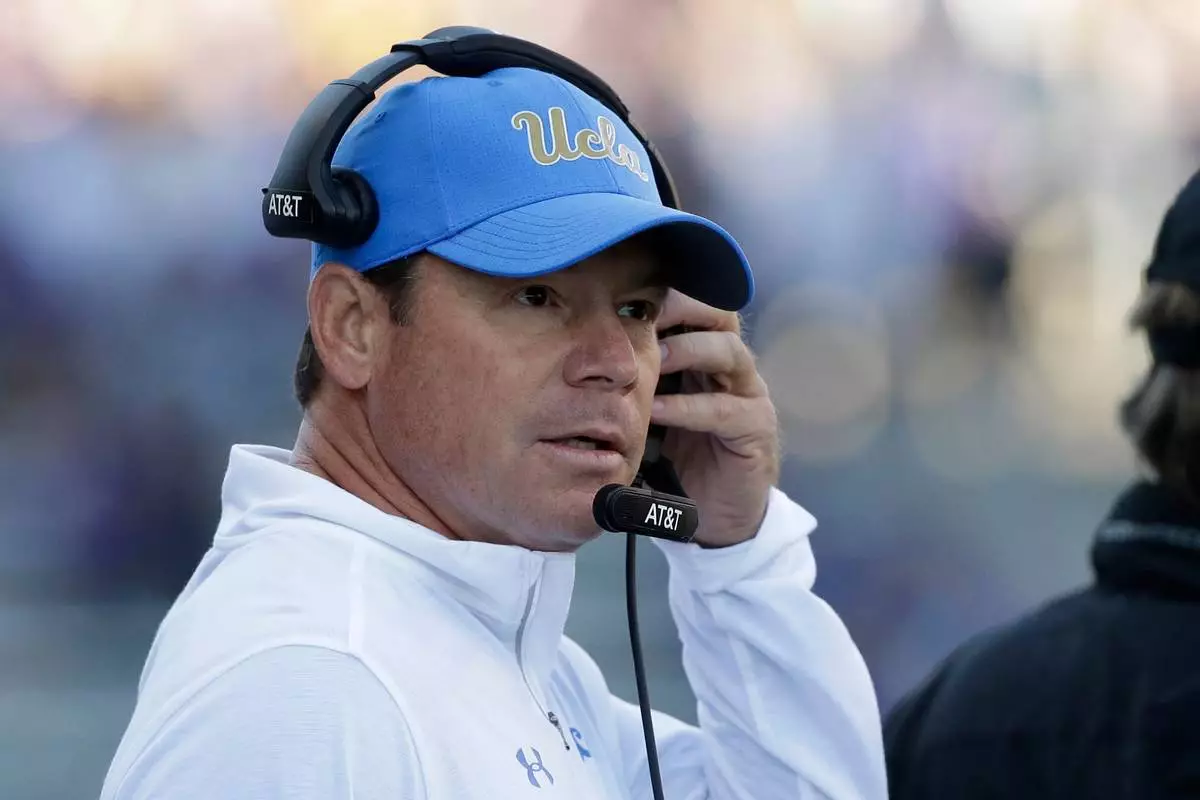
UCLA head coach Jim Mora looks toward the field against Washington in the first half of an NCAA college football game Saturday, Oct. 28, 2017, in Seattle. (AP Photo/Elaine Thompson)
KYIV, Ukraine (AP) — The intensifying use of drones against civilians and humanitarian workers is a dangerous obstacle for aid operations in Ukraine, the U.N.'s humanitarian chief, Tom Fletcher, said on Wednesday.
Fletcher spoke to The Associated Press in an interview after a visit to the southern city of Kherson, where he witnessed how communities there are coping while living under the constant threat of Russian drones. Fletcher described the visit to Kherson, split by the Dnipro River, which acts as an active front line, as “quite chilling."
Russian forces occupy the eastern bank, while Ukrainian forces hold the western bank. From across the water, surveillance and exploding drones routinely hunt and attack civilians, vehicles and public transit.
“It really gives us an insight into the dangers ahead of us,” he said.
The threat is also making it harder for humanitarian organizations to reach people who need assistance.
Fletcher spoke after attending a commemoration for two humanitarian workers who had died while doing their jobs.
“Drones are a real threat to not just civilians but the humanitarians who are here to protect them,” Fletcher said.
He said that aid workers are protected under international humanitarian law and yet marked humanitarian vehicles have still been hit. “So that does restrict what we can do," he said.
Local organizations are particularly exposed. More than two-thirds of operations funded through Ukraine's humanitarian fund are carried out by local organizations, according to Fletcher.
“They’re the ones who are saying most loudly to us, we’re not protected,” he said.
Fletcher said the U.N. needs more than $2 billion for its prioritized humanitarian response in Ukraine this year, with winter among his biggest concerns. Damage to civilian infrastructure, including electricity, water and gas systems, could once again leave millions vulnerable during the harsh winter months, raising fears of a repeat of last winter’s severe conditions.
The U.N. has sharply narrowed its humanitarian priorities all over the world as donor funding has fallen. Fletcher said the organization initially identified 87 million people facing the most severe humanitarian needs, but that figure has since risen to about 92 million with the onslaught of Ebola in Africa, the earthquake in Venezuela and other conflicts.
The U.N. is seeking $23 billion to provide life-saving assistance to those people and had raised about $11 billion, said Fletcher.
Ukraine is relatively well funded compared with many other crises, he added, with roughly 70%–75% of its hyper-prioritized funding requirement covered. But even full funding of the humanitarian plan would address only part of Ukraine’s needs.
Fletcher also admitted that raising money for humanitarian operations has become more difficult as governments have increasingly redirected spending toward defense and domestic priorities.
“We’re in a more transactional world, I would say a more selfish world,” he said.
Fletcher said the U.N. now has to demonstrate that it is using limited taxpayer money efficiently and strategically.
“We have to show governments that we are spending their taxpayers’ money sensibly, wisely, in a prioritized way,” he said.
In a stark new assessment released on Wednesday, the U.N. warned that 907 aid workers were victims of violence last year and over 1,000 have been killed in three years. Fletcher said he could not reassure colleagues that those responsible would be held accountable based on how the international community has reacted.
He said accountability should extend beyond identifying the person who physically carried out an attack.
“I want to see investigations into the people who fired the weapon or flew the drone,” he said.
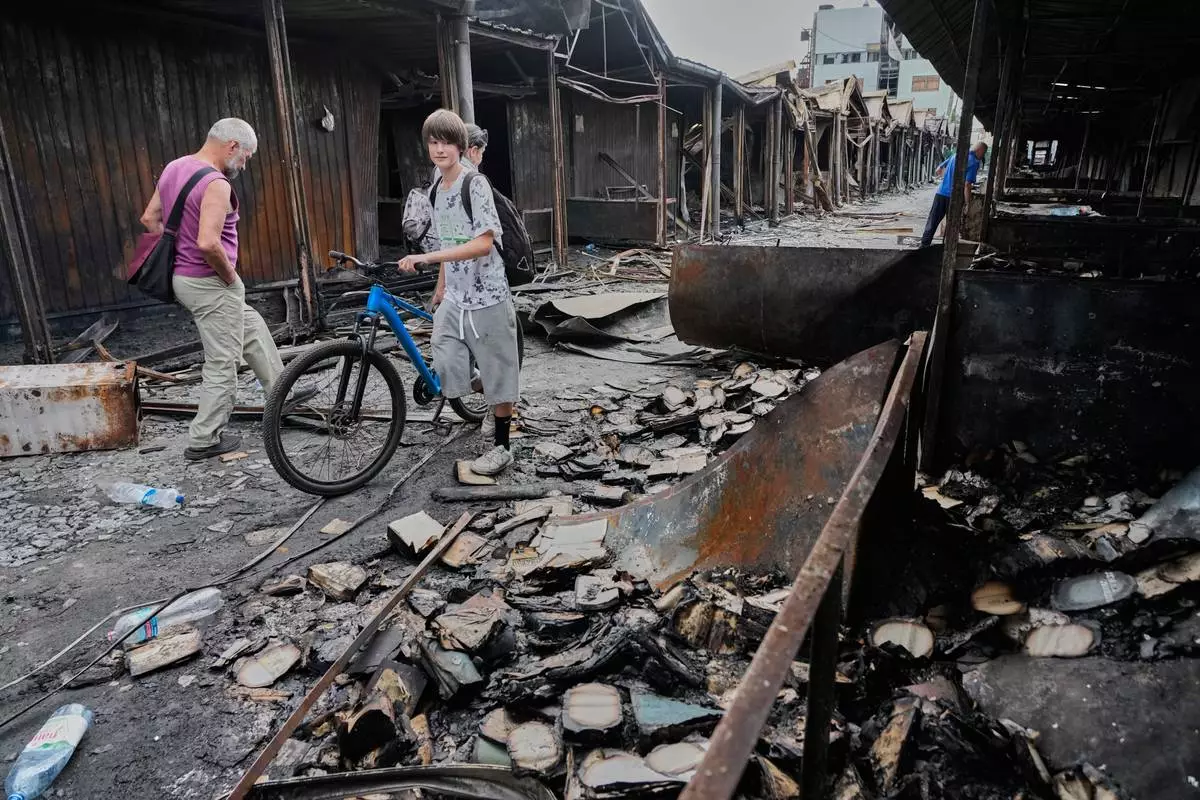
People search for survived books after the fire on the site of the country's biggest book market, cased by Russia's recent missile attack in Kyiv, Ukraine, Wednesday, Aug.19, 2026. (AP Photo/Efrem Lukatsky)

Burned books are seen after the fire on the site of the country's biggest book market, cased by Russia's recent missile attack in Kyiv, Ukraine, Wednesday, Aug.19, 2026. (AP Photo/Efrem Lukatsky)
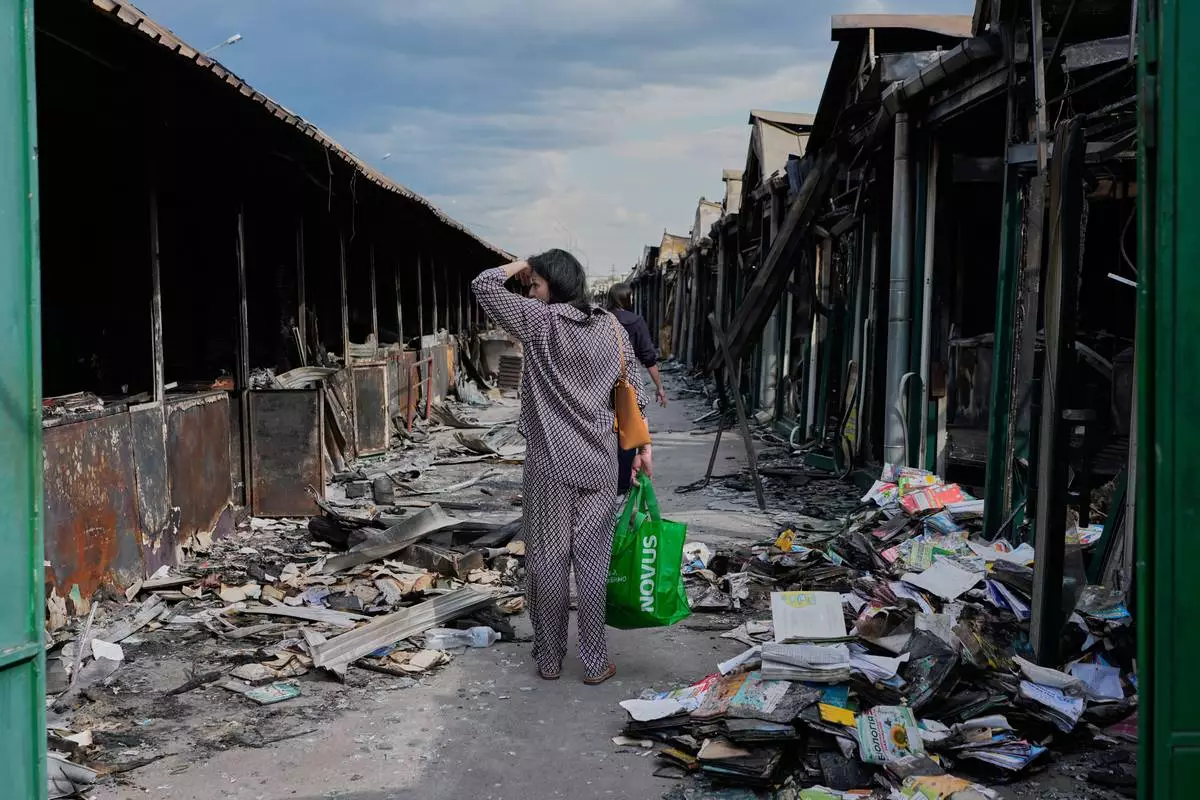
A woman reacts as she looks at charred books after a fire at the country's biggest book market, caused by a recent Russian missile attack, in Kyiv, Ukraine, Wednesday, Aug. 19, 2026. (AP Photo/Efrem Lukatsky)

Tom Fletcher, United Nations Under-Secretary-General for Humanitarian Affairs and Emergency Relief Coordinator, speaks during an interview in Kyiv, Ukraine, Wednesday, Aug. 19, 2026. (AP Photo/Dan Bashakov)

Tom Fletcher, United Nations Under-Secretary-General for Humanitarian Affairs and Emergency Relief Coordinator, speaks during an interview in Kyiv, Ukraine, Wednesday, Aug. 19, 2026. (AP Photo/Dan Bashakov)