Chinese robotics firms at the ongoing 2026 World Robot Conference in Beijing are shifting focus from building standalone machines to harnessing adaptive intelligence, with engineers demonstrating how robots can learn 'general strategies' from human guidance to broaden the potential scope of their use across more real-world scenarios and industries.
The five-day conference opened in the Chinese capital on Wednesday, displaying the latest technological advancements in the global robotics industry, and bringing together over 300 exhibitors, a nearly 70-percent increase from last year, who are presenting more than 3,000 exhibits across four pavilions covering robotics applications in manufacturing, health care, retail, and emergency rescue, among other areas.
While industrial robots and high-precision arms remain a staple of the event, this year's expo places a notable emphasis on AI-driven perception and adaptability, with robots that can see, grip and adjust to carefully handle everyday objects, from oddly shaped packages to soft-sided cartons.
In one demonstration, a robotic arm equipped with an AI vision model proved its worth in a potential shopkeeper scenario. Developed by Shenzhen-based firm DexForce, it was seen picking up products which had been placed at a checkout counter and carefully repositioning them until the item's barcode was clearly readable to scan.
The engineer behind the system explained that robots are not trained on every possible scenario, but rather on representative cases, meaning they are having to apply their own knowledge and adapt to new conditions. Through repeated human demonstration data, the model learns a 'general strategy' and applies it to new situations, enabling it to make the subtle adjustments necessary to pick up a bottle, a bag of chips or a medicine box.
"Currently, humans need to teach the robot, but we cannot teach it every possible situation. We select typical cases that we believe are beneficial for the data, and through demonstration data from humans, the model explores patterns, for example, where the barcode is, or how to grip the upper part of a bottle to stand it upright. All of this is driven by data, and the model finds a 'general strategy' to execute," said Zhang Zhanqi, an algorithm engineer for DexForce.
This concept extends far beyond the checkout counter, with a representative of another Shenzhen-start up named Astribot explaining how they are focusing on widening the potential scope of capabilities of their machines to handle more everyday applications.
"We aim to build robots that can adapt to complex, high-difficulty tasks in unstructured scenarios, including home environments, retail spaces, and sophisticated biopharmaceutical operations. Beyond that, we place greater emphasis on the future relationship between humans and robots as one of 'co-creation' rather than replacement. So right now, we are focusing on expanding applications in a broader range of everyday life scenarios," said Zhao Pan, marketing director of Astribot.
Meanwhile, robotics firm MagicLab is showcasing nine different application scenarios for its bots, spanning the service sector, smart retail, security patrol and logistics sorting, among others. The company says it is also keen to boost the development of the robots through more cross-sector collaborations. "We have always had a vision of co-creating across a wide range of scenarios. Because one robot on its own can hardly present its capabilities at work. So we need to work closely with partners and clients from all industries to help robots land in real-world applications and realize their operational capabilities," said Lin Fan, MagicLab's public relations manager.
The high-tech nature of the conference and the impressive robots on show has also impressed visitors from around the world who are attending the event, including Angel Zinsel, a digital content creator from Spain.
"It's amazing. I think the things that you can see here are really at the edge of robotics. So I think it's a good thing I came here," he said.
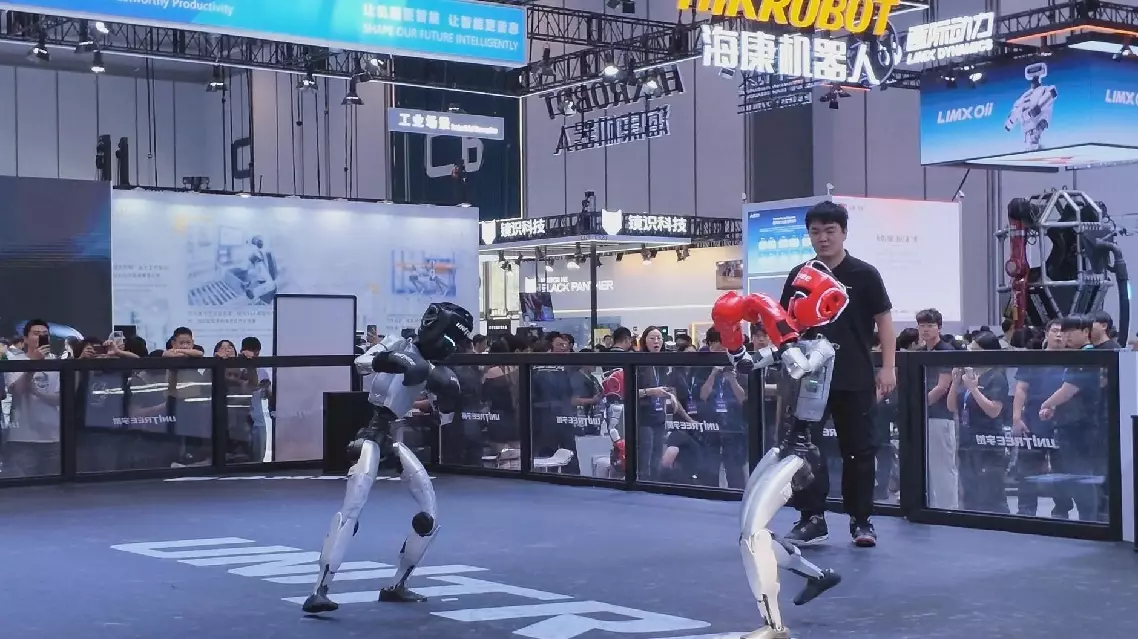
Human-machine 'co-creation' on show at World Robot Conference