SAN FRANCISCO--(BUSINESS WIRE)--Aug 20, 2026--
Cache announced today that it has surpassed $2 billion in assets on its platform, 28 months after launching the Cache Exchange Fund. The company reached its first billion in 21 months. The second arrived in about 7 months.
This press release features multimedia. View the full release here: https://www.businesswire.com/news/home/20260820866841/en/
The milestone reflects accelerating demand from investors managing large, concentrated stock positions.
Cache launched with a single exchange fund in 2024. Since then, it has grown into a broader concentrated-stock platform spanning exchange funds benchmarked to major market indices, tax-aware long/short, and stock-based liquidity solutions. Each is designed for a different decision a concentrated stockholder may face.
The accelerated adoption is also a milestone of trust, and Cache is built with asset safety in mind. Exchange-fund assets are custodied at BNY Mellon, administered by an independent admin, and audited annually. Long/Short assets are custodied at Charles Schwab.
"The milestone represents incredible platform growth, but more importantly, it is a trust milestone," said Srikanth Narayan, founder and CEO of Cache. "Concentrated stock often represents years of someone's work and conviction. Investors are asking us to help with one of the most consequential decisions in their financial lives. Our responsibility is to widen access to these strategies and pair it with the infrastructure, transparency, and discipline those decisions deserve."
Over the next year, Cache expects to expand its platform with additional solutions for concentrated stockholders, helping them diversify, hedge, or access liquidity without forcing an immediate sale.
About Cache
Cache is a San Francisco–based wealth platform built to manage large, concentrated stock positions. Learn more at usecache.com.
Disclosures
"Cache" refers to Cache Financials, Inc., the parent company of Cache Securities LLC (member FINRA/ SIPC ) and Cache Advisors LLC (SEC-registered investment adviser). Registration does not imply a certain level of skill or training.
Cache Flagship Funds (Mosaic, UNIX, Bedrock) are open to Qualified Purchasers only. Cache Exchange Fund – Cobol, LLC is open to Accredited Investors only.
Exchange Funds are alternative investments involving long-term risk, limited liquidity, and higher fees than traditional investments. Exchange Funds defer, but do not eliminate, tax obligations. Past performance is not indicative of future results. Diversification does not ensure profits or prevent losses.
The Cache Long Short Program is sub-advised by Brooklyn Indexing, an unaffiliated SEC-registered investment adviser and a brand name of Nuveen Asset Management, LLC, with assets custodied at Charles Schwab & Co., Inc. (Member SIPC). Long/short strategies involve additional risks including leverage, short selling, and heightened volatility.
Total assets include gross Exchange Fund assets, pending contributions, platform assets, and Collar Advance transactions. Pending contributions and Collar Advance assets are not managed by Cache. Data as of August 4, 2026.
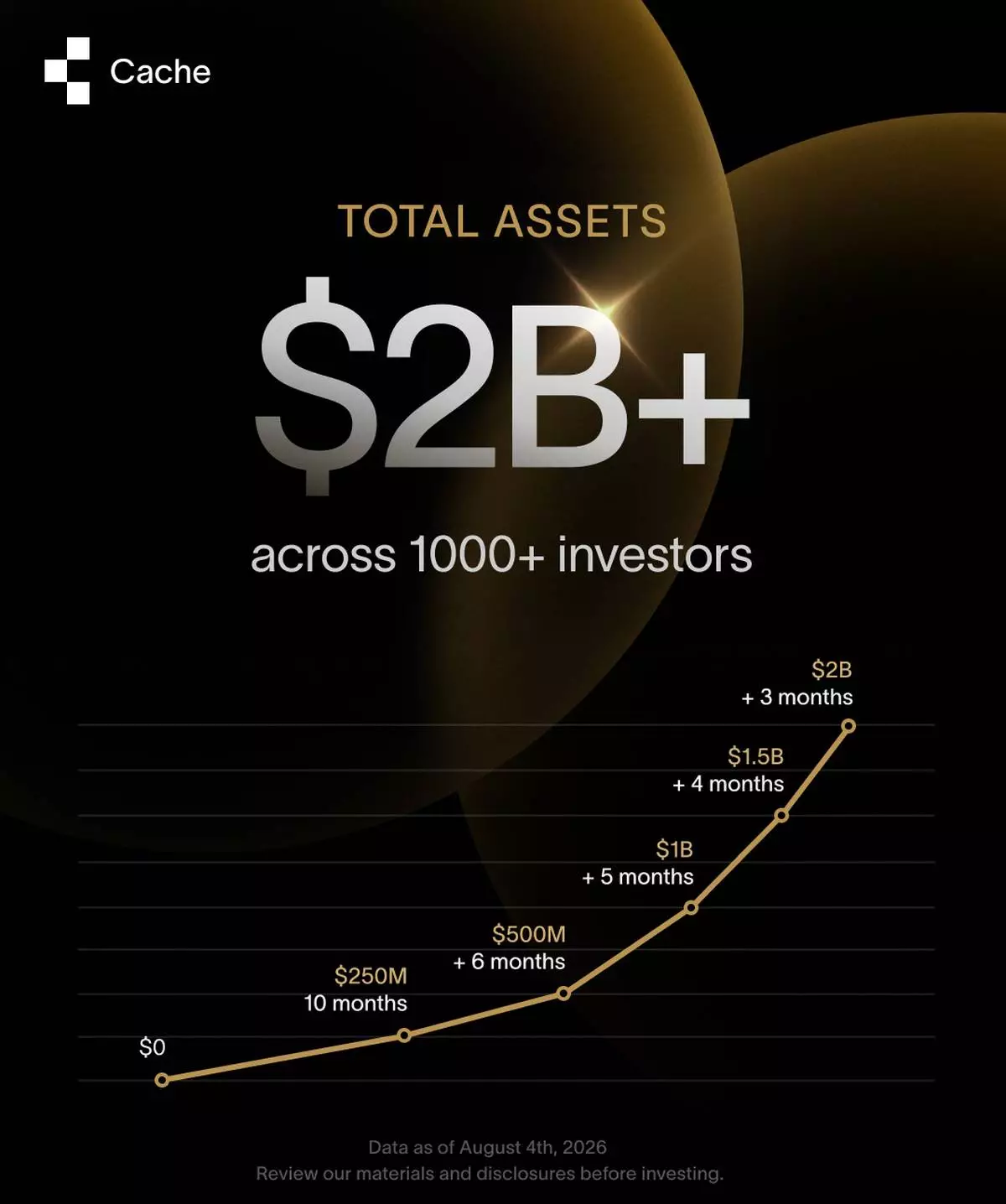
Cache has surpassed $2 billion in assets on its platform, 28 months after launching the Cache Exchange Fund. The company reached its first billion in 21 months. The second arrived in about 7 months.
TORONTO (AP) — Quebec Premier Christine Fréchette said Thursday that Prime Minister Mark Carney had answered many of her questions about an emerging Canada-U.S. trade agreement, but she stopped short of endorsing the deal while the province assesses its potential impact.
Fréchette had said a day earlier that negotiations were “far from over" and that Quebec alone would decide whether U.S. alcohol returns to shelves at the SAQ, the Quebec government corporation that controls most wine and spirits sales in the province.
Dominic LeBlanc, the federal minister responsible for Canada-U.S. trade, returned to Washington on Thursday to meet again with U.S. Trade Representative Jamieson Greer as the two sides continued work to finalize an agreement.
Fréchette said Carney provided answers to many of her questions during a lengthy call Thursday, though Quebec was still awaiting some information.
“I got a number of the answers that I was looking for,” Fréchette said in French, adding that the province would analyze the potential economic impact before taking a position.
Fréchette said Quebec could restore U.S. alcohol to SAQ shelves if its analysis finds the overall agreement is positive for the province.
Canada and the United States moved closer to finalizing a trade agreement that would avert threatened 50% U.S. tariffs. U.S. President Donald Trump has called the emerging agreement “very fair” to both sides and predicted U.S. farmers and manufacturers would benefit. Tariffs on about $20 billion worth of Canadian imports have been postponed until 12:01 a.m. Saturday.
Neither Canadian nor U.S. officials have released the full terms of the emerging agreement.
Quebec does not have a veto over a Canada-U.S. trade agreement, but it controls provincial measures such as whether U.S. alcohol is sold through the SAQ.
Carney asked provincial premiers during a briefing Wednesday to return U.S. alcohol to store shelves, Nova Scotia Premier Tim Houston said, a step aimed at addressing one of the Trump administration’s key trade complaints.
The White House has said the emerging deal includes a Canadian commitment to address restrictions on U.S. alcohol. But Carney cannot order provinces to restore sales.
Fréchette’s Coalition Avenir Québec faces voters in an October provincial election, adding political pressure as she assesses changes that could affect Quebec's dairy and forestry sectors.
Houston and two other premiers voiced support for the direction of the talks, though Houston said whether Canadians would actually buy U.S. alcohol again “is a whole other discussion.”
Eight of Canada’s 10 provinces restrict or ban U.S. alcohol — measures imposed in retaliation for Trump’s previous tariffs on Canadian goods and amid anger over his repeated talk of making Canada the 51st U.S. state.
Ontario, Canada’s most populous province, is especially important. Its government-run LCBO, one of the world’s largest alcohol purchasers, sold nearly 1 billion Canadian dollars ($723 million) worth of U.S. products annually before pulling them from shelves last year.
Ontario Premier Doug Ford, who has clashed with Trump before, has not yet commented on the emerging deal.
While details of the emerging agreement remain vague, Trump has claimed Canada agreed to end tariffs on U.S. agricultural products.
Canada currently allows a set amount of dairy imports at low tariffs. Once imports exceed that limit, much higher tariffs apply. The U.S. says Canada’s supply-management system makes it harder for American dairy producers to gain full access to the Canadian market.
LeBlanc has said Canada’s “agriculture sector will be well protected and we have maintained our tough line.”

FILE - Quebec Premier Christine Frechette is greeted by French President Emmanuel Macron before a meeting at the Elysee Palace in Paris, on May 18, 2026. (AP Photo/Thibault Camus, File)