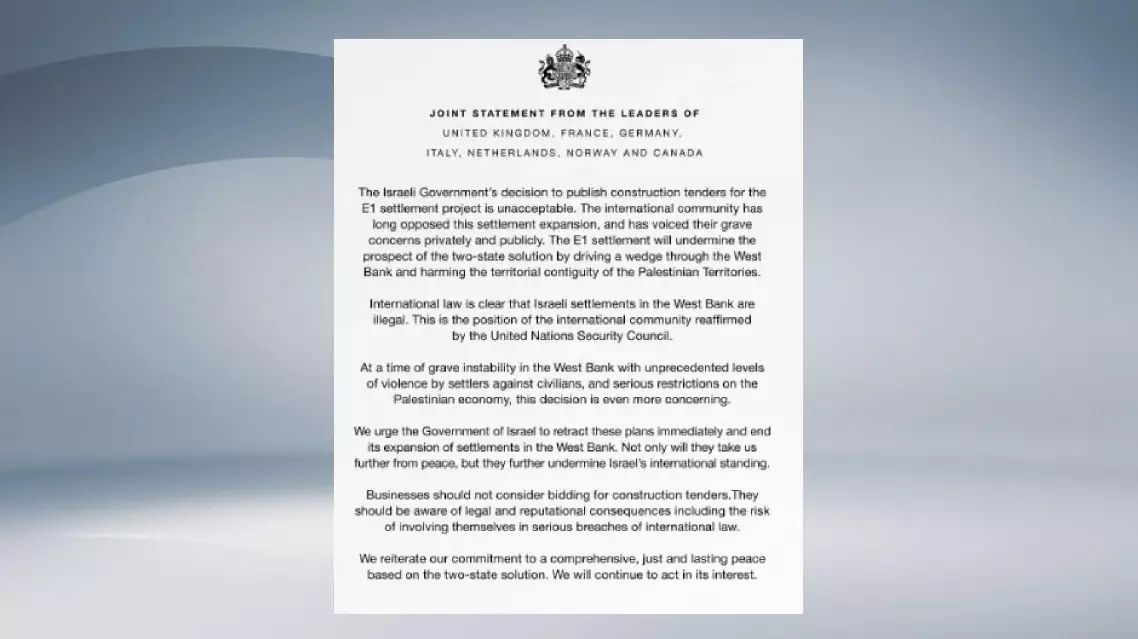
Leaders of seven European nations on Thursday condemned the Israeli government's decision to publish construction tenders for the E1 settlement project in the West Bank, calling on Israel to immediately retract the plans.
In a joint statement, leaders of France, Germany, Italy, the Netherlands, Norway, Britain and Canada described the move as "unacceptable," warning that it will sever the West Bank, harm the territorial contiguity of the Palestinian Territories, and undermine the prospects of a two-state solution.
Reaffirming that Israeli settlements in the West Bank are illegal under international law and UN Security Council resolutions, the leaders noted that the decision came at a time of severe instability, marked by unprecedented levels of violence against civilians and heavy restrictions on the Palestinian economy.
The joint statement urged Israel to end its settlement expansion in the West Bank, emphasizing that the plans will move the region further from peace and damage Israel's international standing.
It also warned businesses against participating in the construction tenders, citing potential legal and reputational consequences, including the risk of involving themselves in serious breaches of international law.
"We reiterate our commitment to a comprehensive, just and lasting peace based on the two-state solution. We will continue to act in its interest," the statement said.
Israel on Tuesday advanced plans for the controversial E1 settlement project in the West Bank, publishing a tender for 1,234 housing units. The tender, published online by the Ministry of Construction and Housing, covers part of a wider plan for 3,401 housing units in E1, an area east of Jerusalem.
Leaders of 7 nations condemn Israeli settlement plan in West Bank
U.S. Treasury Secretary Scott Bessent said Thursday that the government's long-dated bond buyback could be more than the recently announced 4 billion U.S. dollars, sparking concerns over rising inflation and mounting pressures on the Federal Reserve.
The U.S. Treasury announced Wednesday that it would at least double the size of its buyback program for 10- to 30-year Treasury bonds, aiming to provide more liquidity support to the long end of the market and curb the unsettling surge of treasury yields.
Bessent revealed in an interview on Thursday that the size of the buyback could be more than 4 billion U.S. dollars per issue, but didn't provide a specific number, saying the figure will depend on market conditions.
U.S. Treasury yields dropped following Bessent's statement. However, for the whole day, the yield on the benchmark 10-year Treasury note rose 4 basis points to 4.69 percent, while the 30-year bond yield increased by 4 basis points to 5.24 percent.
Speaking of the national debt, which has more than doubled in a decade to surpass the 40-trillion-U.S.-dollar mark, Bessent downplayed the milestone by emphasizing long-term economic expansion.
"There's nothing magic about the 40-trillion number," he said, asserting the U.S. will grow its way out of this.
Market analysts have warned that the intervention risk fueling inflation and complicating the Fed's monetary policy work.
They predict the Treasury will fund the buyback program by issuing short-term debt, an operation of replacing issuance of longer-term debt with shorter-term bills to curb long-term bond yields.
When the Treasury relies more on short-term debt, it becomes more sensitive to changes in interest rates. Once the Fed raises interest rates, the government's interest payments will increase rapidly, further driving up the total size of the national debt.
Therefore, analysts believe the buyback program is not a good solution to market problems, as structural debt pressures have already been out of the control of the Treasury and the government.
Investors are also skeptical that the Treasury's intervention can provide a lasting market relief. If the measure proves ineffective, it could further undermine the credibility the dollar and the Treasury.

US bond buyback expansion could fuel inflation, complicate Fed’s monetary policy work: analysts