Skip to Content Facebook Feature Image

FACT FOCUS: Census Bureau report does not prove Trump's claim about noncitizen voting in 2020

News

FACT FOCUS: Census Bureau report does not prove Trump's claim about noncitizen voting in 2020
News

News

FACT FOCUS: Census Bureau report does not prove Trump's claim about noncitizen voting in 2020

2026-08-22 04:19 Last Updated At:04:20

In his most recent challenge to the results of the 2020 U.S. election, President Donald Trump this week cited a report claiming to show that thousands of noncitizens voted, a practice studies have found to be extremely rare.

Trump's Truth Social post on Tuesday referenced a report published by the U.S. Census Bureau that he said checked “Voter Records from 2020 against their Citizenship Records,” finding 24,000 noncitizens voted illegally in just its initial search. The report is described as a “beginning analysis.”

But experts say its methodology is flawed and could have created many false positives.

Here's a closer look at the facts.

CLAIM: A Census Bureau report looking at 128 million voters proves that more than 24,000 noncitizens voted in the 2020 election.

THE FACTS: This is false. The report says it checked data from a commercial voter file against federal records to identify noncitizens who allegedly voted in the election. According to experts, the methodology described in the report may have created false positives if, for example, an individual's name was linked to the wrong address or their citizenship status hadn't been updated in a certain database. Details about error rates and how the report ensured accurate results were not included.

“This is the weakest methodology description I've ever seen in a Census Bureau publication,” said Mark Lindeman, policy and strategy director at Verified Voting, a nonpartisan group focused on election technology. “This document doesn't tell us anything about elections. It just shows that the Census Bureau has gone off the rails.”

He added that the Census Bureau is not clear about which databases it used in its analysis, which he said “exists essentially as a propaganda offering,” and that it does not explain likely sources of errors.

According to the seven-page report, out of nearly 160 million voter records from the 2020 election reviewed so far, more than 24,000 voters “are linked to administrative records that indicate with a high degree of confidence noncitizen status” at the time of the election. More than 32 million voter records are awaiting analysis.

Justin Levitt, a professor of law at Loyola Marymount University who served as the senior policy adviser for democracy and voting rights under the Biden administration, wrote of the report in a blog post, “There are three potential sources of error in that analysis: potential errors in the private vendor's voter file, potential errors in the federal records, and potential errors in the matching process itself, known in the trade as record linkage.”

Individuals may have been falsely identified as noncitizen voters due to myriad possible flaws in the data, Lindeman said. For example, there may be people living at the same address who share the same name or birthday. People with similar names could have been assigned the other's birthday. And a voter's citizenship status might not have been updated in the data the Census Bureau used to determine that status.

Barry Burden, director of the University of Wisconsin-Madison's Elections Research Center and a professor of political science, agreed that the report lacks credibility.

“The Census Bureau report does meet the standards of rigor and transparency that historically made the agency a trusted authority,” he said. “Contrary to other Census publications, this report is unsigned, is described merely as a ‘beginning’ analysis, and relies on data from an unfamiliar private company. Necessary methodological details such as exactly how a ‘high-quality’ data match was defined are missing entirely.”

Trump also claimed in his Truth Social post, as he has numerous times before, that he won the 2020 election. He urged the passage of the SAVE America Act, which would require people to show documentary proof of citizenship before they register to vote, as well as impose voter ID requirements nationwide. The measure has passed the U.S. House but has not been voted on in the Senate, where even some Republicans oppose it.

Even if the number of noncitizen voters the report allegedly identified was correct and all of them voted for a candidate other than Trump, it would have hardly made a dent in the outcome of the 2020 election, which Trump did not win.

There were 158,429,631 votes cast for president that year, according to Federal Election Commission records. The 24,000 supposed noncitizen voters identified by the Census Bureau represents .015% of the total vote and .018% of the records the Census Bureau says it has reviewed so far. Former President Joe Biden received 7,059,526 more votes than Trump.

“All of the numbers cited in the Census analysis are smaller than the margins of victory in each state and would not have been enough to change the winner of any state in 2020,” said David Becker, executive director of the Center for Election Innovation and Research.

Asked how the administration knows the Census Bureau's report is accurate, White House spokesperson Lauren Bis said: “President Trump is right: Non-citizens are voting in our elections. Despite the media and Democrats claiming it never happens, the evidence of non-citizens registering and voting in our elections continues to pile up.”

The Census Bureau did not respond to requests for comment.

Find AP Fact Checks here: https://apnews.com/APFactCheck.

President Donald Trump speaks outside the White House, Wednesday, Aug. 19, 2026, in Washington, near the construction site of the new helicopter landing zone on the South Lawn of the White House. (AP Photo/Manuel Balce Ceneta)

President Donald Trump speaks outside the White House, Wednesday, Aug. 19, 2026, in Washington, near the construction site of the new helicopter landing zone on the South Lawn of the White House. (AP Photo/Manuel Balce Ceneta)
NEW YORK (AP) — U.S. stocks rose Friday and trimmed their losses from a shaky week. That was even though the bond market, which has been the center of Wall Street’s action, remained jumpy and continued to add pressure.

The S&P 500 rose 0.4% for just its second gain in the six days since setting its all-time high last week. The Dow Jones Industrial Average jumped 517 points, or 1%, and the Nasdaq composite climbed 0.4%.

Ross Stores helped lead the way and rose 4.4% after reporting stronger profit and revenue for the latest quarter than analysts expected. CEO Jim Conroy said it saw both an increase in new customers and more interest from existing customers, while the off-price retailer at the same time benefited from refunds on tariffs.

Most U.S. companies have reported bigger profits for the spring than analysts expected, which has helped drive stocks to records recently. Stock prices tend to follow the path of corporate profits over the long term.

Hopes for continued profit growth got a boost from a preliminary report by S&P Global suggesting growth for U.S. business activity hit a 52-month high. But the other big lever that helps set stock prices, interest rates, has been much shakier.

After soaring through the summer and then hesitating following this week’s surprise move by the U.S. Treasury Department to repurchase more U.S. government bonds, yields climbed further on Friday.

The yield on the 10-year Treasury rose to 4.73% from 4.69% late Thursday. It’s back above its level from before the Treasury market made its move, which analysts said at the time would likely have only a temporary effect. The 30-year Treasury yield, which the Fed is also targeting with its bond repurchases, also rose and is near its highest level since 2007.

Contributing to Friday’s gains for bond yields was continued uncertainty about when the war with Iran will allow oil tankers to freely exit the Persian Gulf again. That caused oil prices to rise, which affects Treasury yields because they increase worries about inflation.

The price for a barrel of Brent crude oil settled at $92.67, up 0.8%.

Besides inflation, concerns about the fast-rising debt for the U.S. government have also been sending yields upward. Higher yields can slow the economy and undercut prices for all kinds of investments.

One of the biggest beneficiaries of U.S. Treasury Secretary Scott Bessent’s move to try to get longer-term yields lower is bitcoin. Cryptocurrencies often rise when interest rates are lower and more money is flowing through the financial system. Hopes for legislation in Washington to help the crypto industry have also helped it.

Bitcoin has climbed above $77,000 from less than $63,000 a week ago. That helped stocks in the crypto industry lead Wall Street. Robinhood Markets jumped 13.7%, and Coinbase Global gained 8.2%.

The price of gold also climbed and briefly topped $4,690 per ounce from less than $4,440 a week earlier. The Treasury Department’s buyback announcement has helped weaken the U.S. dollar’s value against other currencies, which tends to give gold’s price a boost.

That helped drive stocks of miners higher. Newmont climbed 3.1%, and Freeport-McMoRan jumped 7.6%.

They helped offset a 5.2% drop for OSI Systems, which sells security screening equipment to airports and other specialized electronic systems. It reported weaker revenue for the latest quarter than analysts expected, and CEO Ajay Mehra said it was hurt by “the Middle East conflicts which shifted the timing of certain planned deliveries.”

Boston Beer sank 2.6% after the seller of Samuel Adams and Dogfish Head said its chief financial officer is leaving the company and announced an interim replacement.

All told, the S&P 500 rose 33.21 points to 7,674.37. The Dow Jones Industrial Average jumped 517.80 to 53,277.01, and the Nasdaq composite added 113.29 to 26,180.45.

In stock markets abroad, indexes rose in much of Asia and Europe. Hong Kong’s Hang Seng rose 1.2%, and South Korea’s Kospi climbed 0.9% for two of the world’s bigger moves.

AP Business Writers Chan Ho-him and Michelle Chapman contributed to this report.

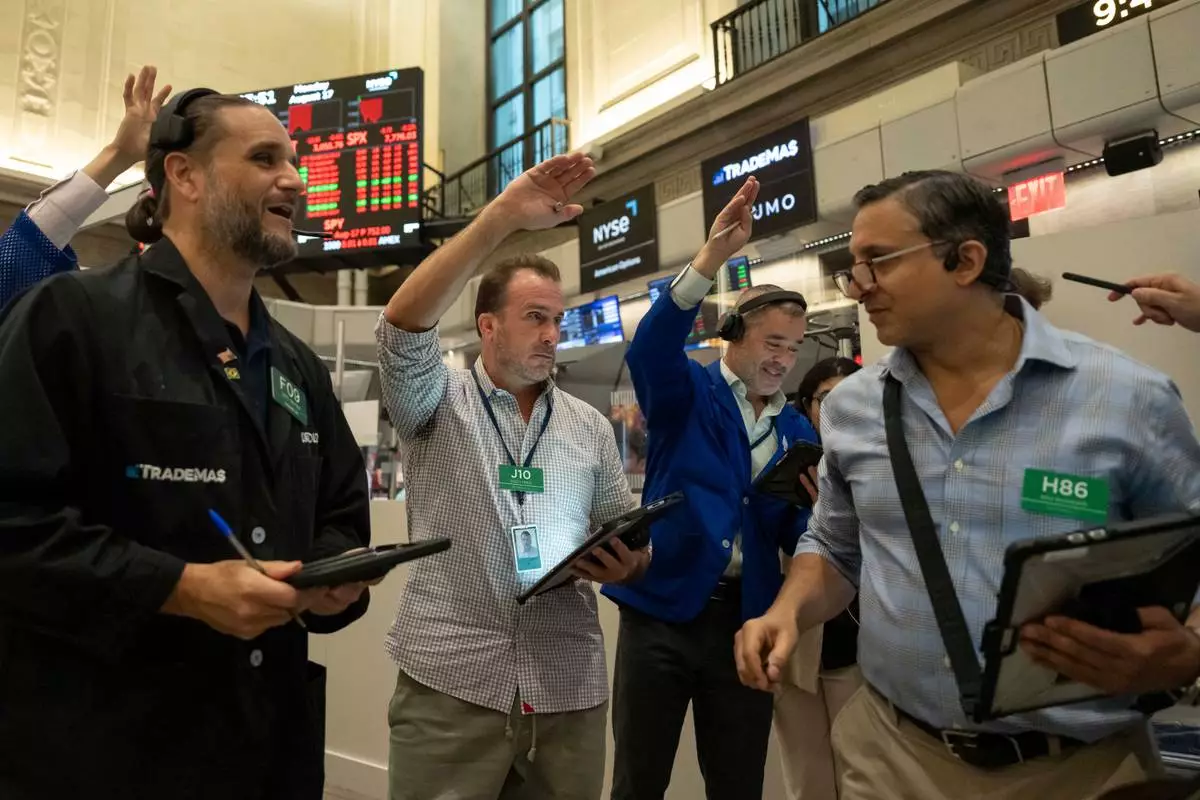
Options traders Chris Dattolo, Scott Frinzi, Justin Kanda, and Ravi Bhandari, left to right, work on the floor of the New York Stock Exchange, Monday, Aug. 17, 2026, in New York. (AP Photo/Yuki Iwamura)

Options traders Chris Dattolo, Scott Frinzi, Justin Kanda, and Ravi Bhandari, left to right, work on the floor of the New York Stock Exchange, Monday, Aug. 17, 2026, in New York. (AP Photo/Yuki Iwamura)

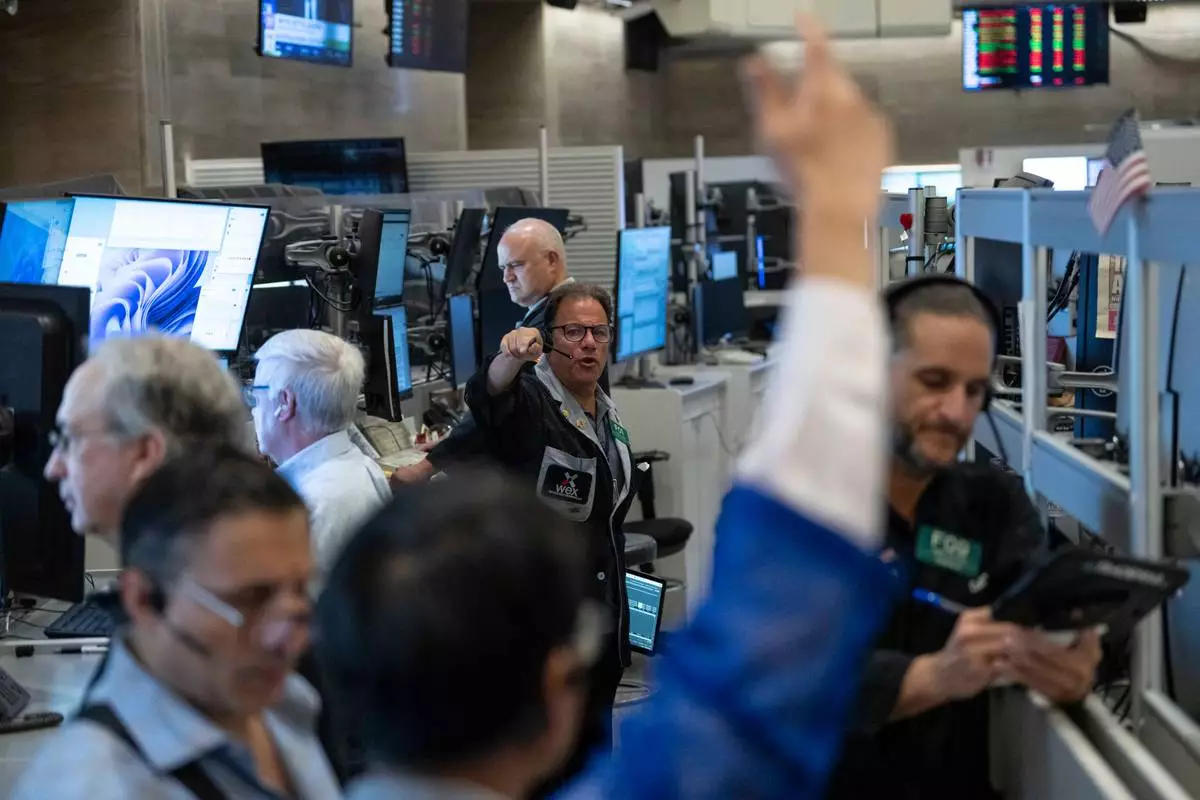
Options trader Anthony Spina works on the floor of the New York Stock Exchange, Monday, Aug. 17, 2026, in New York. (AP Photo/Yuki Iwamura)

Options trader Anthony Spina works on the floor of the New York Stock Exchange, Monday, Aug. 17, 2026, in New York. (AP Photo/Yuki Iwamura)

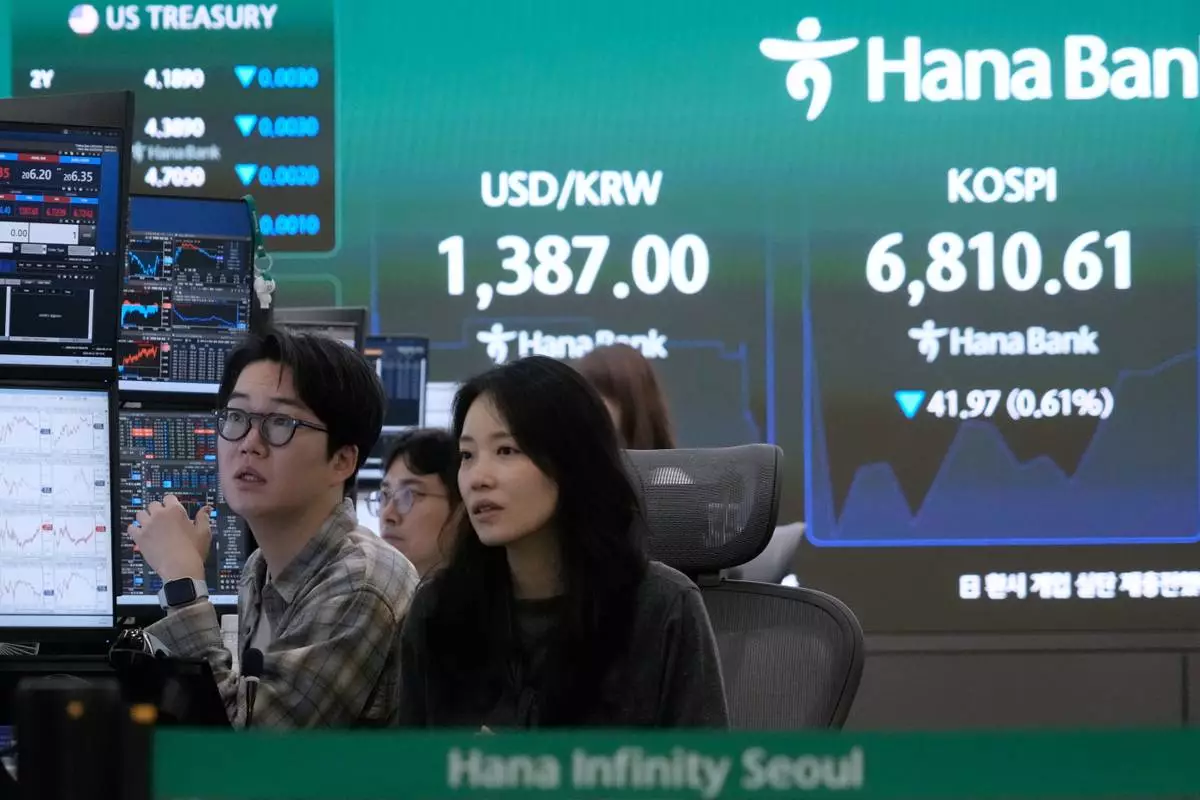
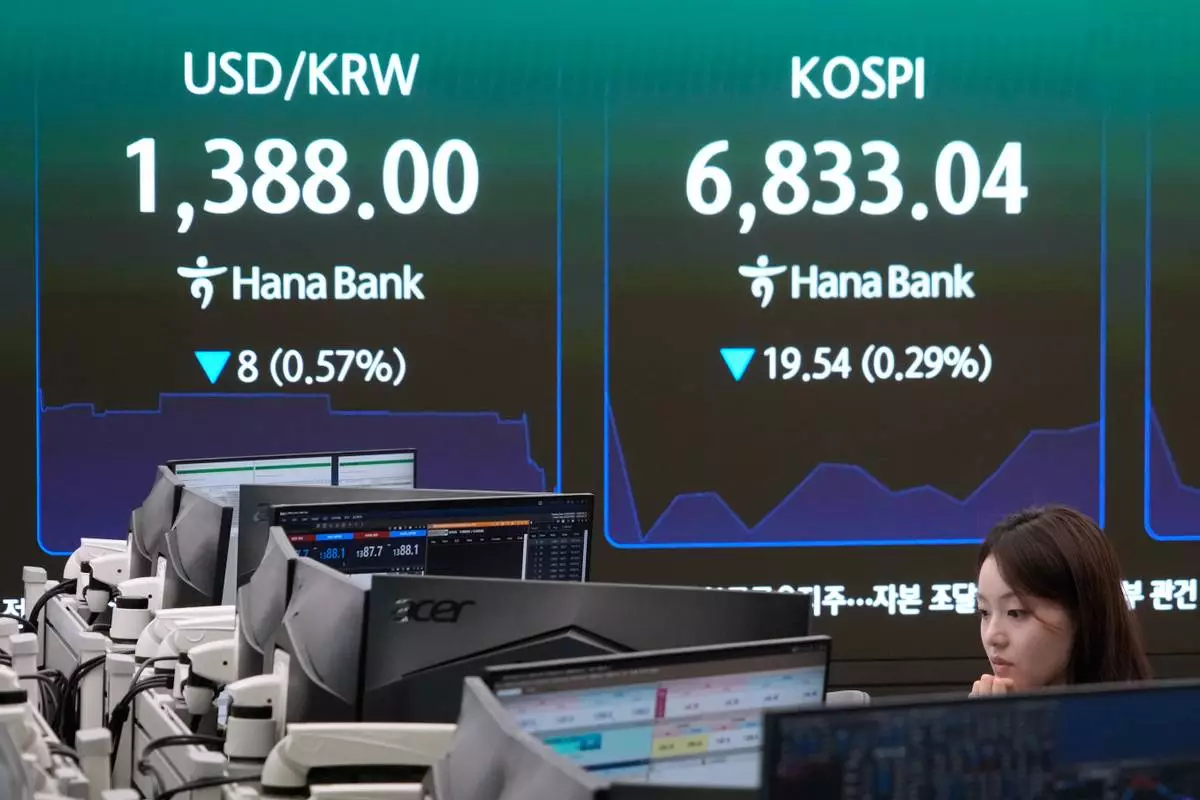
Currency traders watch monitors near a screen showing the Korea Composite Stock Price Index (KOSPI) and the foreign exchange rate between U.S. dollar and South Korean won at the foreign exchange dealing room of the Hana Bank headquarters in Seoul, South Korea, Friday, Aug. 21, 2026. (AP Photo/Ahn Young-joon)

Currency traders watch monitors near a screen showing the Korea Composite Stock Price Index (KOSPI) and the foreign exchange rate between U.S. dollar and South Korean won at the foreign exchange dealing room of the Hana Bank headquarters in Seoul, South Korea, Friday, Aug. 21, 2026. (AP Photo/Ahn Young-joon)

A currency trader watches monitors near a screen showing the Korea Composite Stock Price Index (KOSPI) and the foreign exchange rate between U.S. dollar and South Korean won at the foreign exchange dealing room of the Hana Bank headquarters in Seoul, South Korea, Friday, Aug. 21, 2026. (AP Photo/Ahn Young-joon)

A currency trader watches monitors near a screen showing the Korea Composite Stock Price Index (KOSPI) and the foreign exchange rate between U.S. dollar and South Korean won at the foreign exchange dealing room of the Hana Bank headquarters in Seoul, South Korea, Friday, Aug. 21, 2026. (AP Photo/Ahn Young-joon)

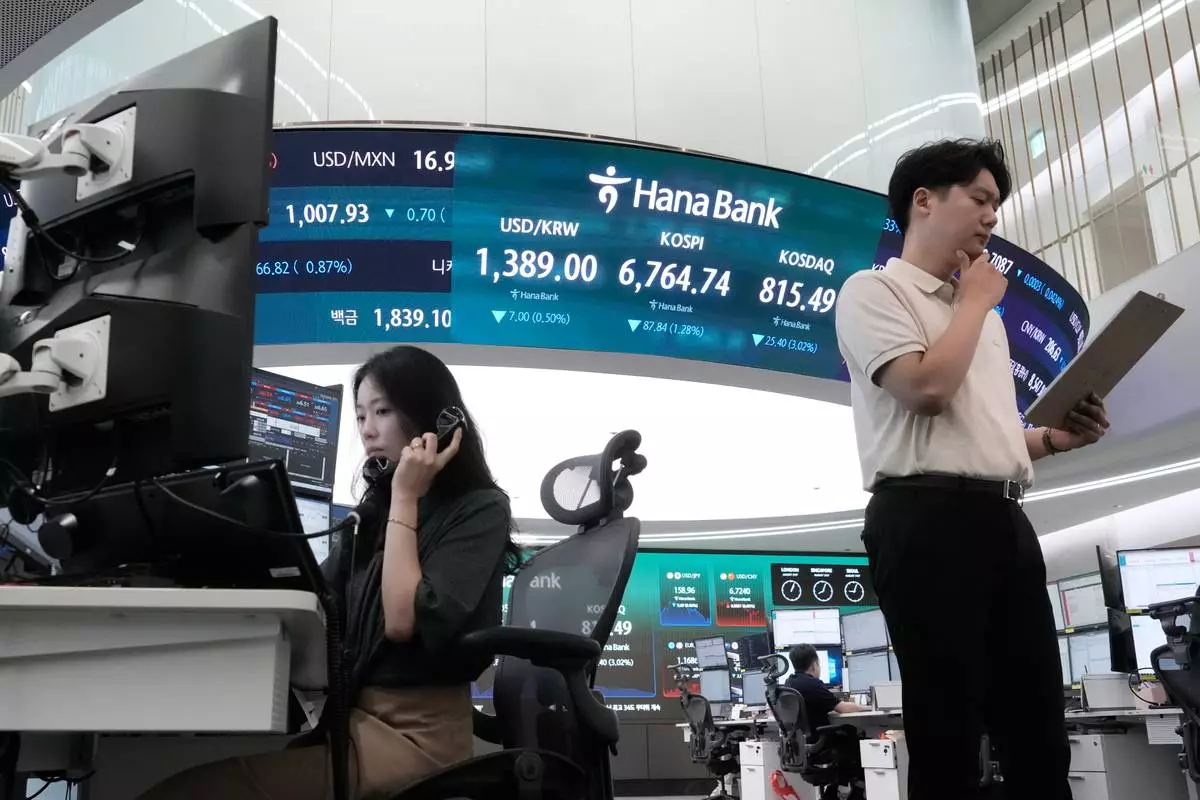
Currency traders work at the foreign exchange dealing room of the Hana Bank headquarters in Seoul, South Korea, Friday, Aug. 21, 2026. (AP Photo/Ahn Young-joon)

Currency traders work at the foreign exchange dealing room of the Hana Bank headquarters in Seoul, South Korea, Friday, Aug. 21, 2026. (AP Photo/Ahn Young-joon)

Recommended Articles