Iran's Foreign Ministry said on Saturday that the planned new U.S. economic sanctions on Iran had no basis in international law and represented an attempt to impose U.S. jurisdiction on other sovereign states.
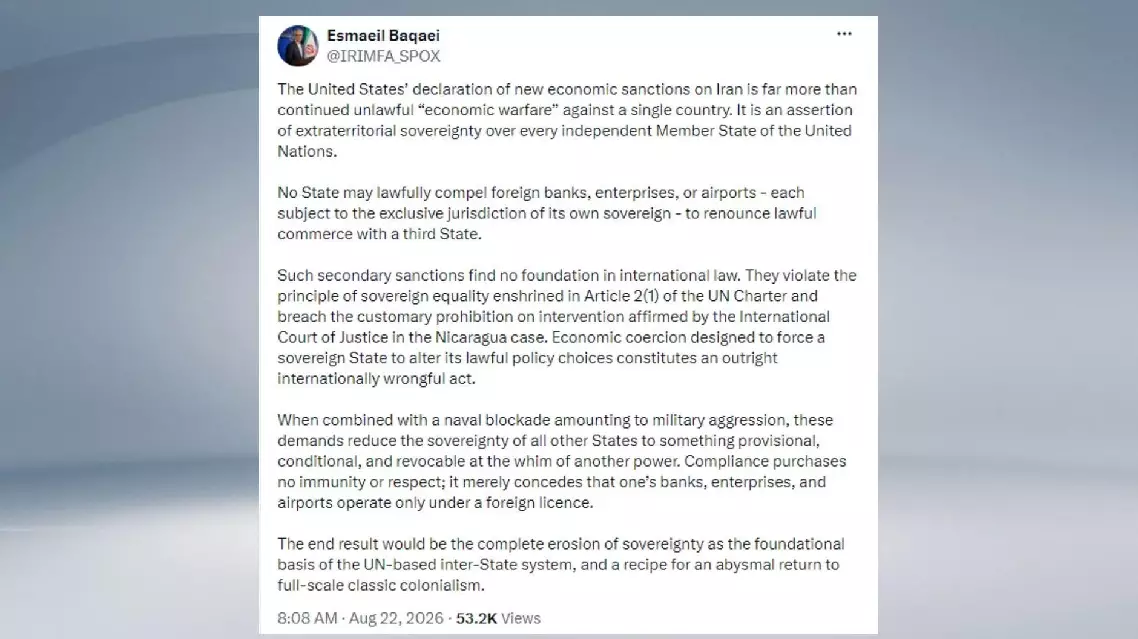
Foreign Ministry Spokesman Esmaeil Baghaei said in a post on X that the measures went beyond what he called continued unlawful "economic warfare" against Iran.
Baghaei said the sanctions would target foreign banks, companies and airports that maintain commercial ties with Iran.
"Such secondary sanctions find no foundation in international law," Baghaei said in the post, adding that the measures violate the principle of sovereign equality set out in Article 2(1) of the U.N. Charter.
He said economic coercion aimed at forcing a sovereign state to change its lawful policy choices constitutes an internationally wrongful act. Baghaei also said the sanctions, combined with what he described as a naval blockade, would erode the sovereignty of other countries.
U.S. Treasury Secretary Scott Bessent said on Friday that a new sanctions package against Iran would be detailed on Monday, as the United States steps up economic pressure on the country.
Iran says planned U.S. sanctions lack basis in international law
China's 16th Arctic Ocean expedition achieved the country's first video call spanning the North and South Poles on September 25, coinciding with the Mid-Autumn Festival, using a domestically developed satellite system with a delay of no more than one second.
The expedition deployed four vessels -- Xuelong, Xuelong 2, Jidi, and Tansuo 3 -- to study extreme environmental changes in the Arctic amid accelerating global warming. On September 29, China's research icebreakers Xuelong and Xuelong 2 returned to Shanghai after completing their missions, while Jidi and Tansuo 3 continue their expedition tasks and are expected to return in mid-October following a three-month journey.
The expedition team held a satellite video conversation with China's Antarctic Qinling Station, extending festive greetings to their polar scientific research counterparts and testing a large-scale constellation designed to provide global broadband internet and support integrated space-Earth 6G networks.
"This is the first time that China has used a domestically developed communications satellite system to make a video call across the largest latitude span," said Liu Feng, a senior engineer at the National Marine Data and Information Service.
The around-13,000-satellite GW constellation, led by China Satellite Network Group (SatNet), is China's first mega low Earth orbit satellite internet project. During the polar test, the maximum uplink and downlink speed reached around 30 megabits per second, equivalent to taking about 10 minutes to download a 1GB file. The equipment can also be used for emergency rescue and maritime communications.
"During the test period, it also supported real-time communications among Xuelong, Jidi, Tansuo 3, the National Marine Data and Information Service and the Polar Research Center. After Jidi and Tansuo 3 entered ice zone operation areas, their communication could not be guaranteed. So file transfers and navigation logs had to be transmitted through the SatNet equipment," said Zhang Bin, an engineer at the National Marine Data and Information Service. The successful test of the domestically produced satellite communication equipment marks China's independent control over polar region communications. The equipment ensures that data remains within the country, effectively safeguarding data security.

China holds first video call between North, South Poles via homegrown satellite system