Skip to Content Facebook Feature Image

Big earth data report highlights China's decade of sustainable development gains

China

China

China

Big earth data report highlights China's decade of sustainable development gains

2026-11-20 22:06 Last Updated At:22:17

China has made marked headway on sustainable development over the past decade, with a growing share of UN Sustainable Development Goal (SDG) indicators assessed in the country nearing or meeting their 2030 targets, according to a report posted Friday on the UN website.

The Big Earth Data in Support of the Sustainable Development Goals report (2026), compiled under the leadership of the International Research Center of Big Data for Sustainable Development Goals, was China's eighth edition since 2019.

The report takes stock of the latest global sustainable development advances in 2025 and offers a key scientific reference for understanding how human societies are evolving and how resources and the environment are changing. Its analysis spans global, regional, national and typical local scales.

The report indicates that, in the water resources sector, 22.2 percent of the world's large lakes have entered a phase of accelerated eutrophication since 2015, while China's water-use efficiency increased roughly 7.3-fold between 2000 and 2024.

In the energy sector, 85.5 percent of the world's centralized photovoltaic (PV) panels are concentrated in a small number of countries and regions. In China, the ecological condition of approximately 84 percent of onshore wind farms and 75 percent of PV power plants is either improving or remaining stable, the report said.

In the urban sector, the methane emission intensity of open-air waste dumps globally is about 4.8 times that of sanitary landfills. In China, the proportion of "urban villages" (informal settlements within cities) relative to the total built-up urban area has declined from 10.4 percent to 8.1 percent, according to the report.

Sustainable development has been a human aspiration for more than half a century. At the 70th UN General Assembly in 2015, 193 countries adopted Transforming Our World: The 2030 Agenda for Sustainable Development, whose centerpiece is the Sustainable Development Goals, or SDGs.

"There are in fact 17 Sustainable Development Goals, such as zero hunger, water resources, marine life, climate change, all of which are important goals of human concern. With 15 years, if they are achieved, humanity will embark on a path of harmonious development between humanity and nature," said Guo Huadong, an academician with the Chinese Academy of Sciences (CAS) and director-general of the International Research Center of Big Data for SDGs.

The report also found out that China's sustainable development progress has been notable over the past decade. By the end of 2025, of the 234 UN Sustainable Development Goal indicators covered by the assessment, 147 in China were nearing or had met their 2030 targets -- 62.8 percent, up 23.9 percentage points from 2015.

"A notable feature of the 2026 annual report is that China's sustainable development process has advanced by another 2.3 percent compared with 2024. In areas such as quality education, new energy, climate change response, and water quality improvement, progress has been particularly notable. Especially in China's efforts to achieve zero hunger and no poverty, that is, China's cause of poverty reduction, great achievements have been made, all of which reflect strengths of our country," Guo said.

Big earth data report highlights China's decade of sustainable development gains

Big earth data report highlights China's decade of sustainable development gains

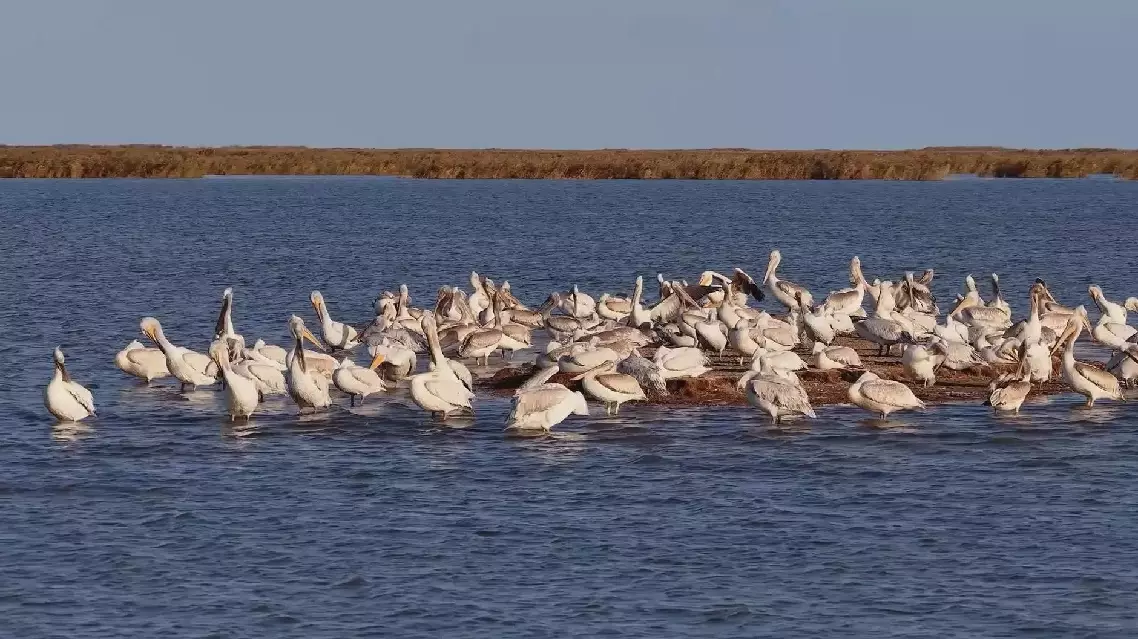
A breathtaking natural spectacle known as "bird waves", formed by tens of thousands of migratory birds soaring in synchronized formations at sunset, has turned the traditionally slow autumn and winter tourism season into a booming peak period in Dongying City, east China's Shandong Province.

As the peak migratory season gets underway, massive flocks of birds have gathered at the Yellow River Delta National Nature Reserve. At dusk, tens of thousands of birds lift off from the wetlands, continuously shifting formations in the sky -- stretching out like a long scroll one moment and gathering like billowing clouds the next, surging and rolling much like ocean waves.

Monitoring data shows that the flocks are predominantly composed of Baikal teals, with approximately 180,000 recorded in the reserve so far.

Viral footage of these swirling avian murmurations has repeatedly placed Dongying on social media trending lists, drawing a massive influx of visitors from across the country.

Statistics reveal that since October, the Yellow River estuary has received 120,000 tourist visits for birdwatching, with visitors from outside the city accounting for over 65 percent of the total. Along the tidal flats and reed beds, crowds of tourists raise binoculars, smartphones, and professional cameras, gasping in awe as the flocks rise and dip across the horizon.

"We came here from Xi'an, and there are also friends here from Beijing and Shenyang. It's truly awe-inspiring. It's my first time seeing a scene like this with tens of thousands of birds. We feel our wait here was completely worth it, and we're thrilled," said Mr. Han, a tourist from Xi'an City, northwest China's Shaanxi Province.

The surge in birdwatchers has directly boosted the local hospitality sector. In Huanghekou Town, Kenli District -- the closest accommodation hub to the viewing sites -- the number of overnight tourists since October has risen by 11.2 percent year on year.

"We are basically fully booked every single day. Some tourists stay for one or two nights, and some photography enthusiasts even stay for an entire week. Most of our guests are here to photograph the birds. Many come from faraway places like Guangdong, Guangxi, and Fujian, while nearby visitors come from Beijing, Tianjin, and Hebei," said Tian Zhenhui, manager of a local homestay in Huanghekou Town.

To convert this ecological popularity into sustained cultural and tourism consumption, local authorities have upgraded supporting infrastructure and diversified tourism offerings. Temporary parking spaces, additional dedicated bus routes for viewing the "bird waves", mobile restrooms, and birdwatching service stations have been introduced to accommodate the growing crowds.

"We have established optimal birdwatching spots and bases, along with birdwatching guides and maps to make travel more convenient for everyone, and we have also built birdwatching service stations. We have also customized several tourism routes targeting professional photographers, parent-child study tours, and general leisure travelers, such as one-day tour routes and specialized photography routes," said Dai Jingyao, a staff member at the promotion and cooperation section of the Dongying Municipal Bureau of Culture and Tourism.

Ecological wonder of "bird waves" fuels off-season tourism boom in east China's Dongying

Ecological wonder of "bird waves" fuels off-season tourism boom in east China's Dongying

Recommended Articles