Skip to Content Facebook Feature Image

Former Norwegian official hails APEC meeting as vital platform for global dialogue, economic cooperation

China

China

China

Former Norwegian official hails APEC meeting as vital platform for global dialogue, economic cooperation

2026-11-20 21:38 Last Updated At:22:11

The first-ever trilateral meeting among the leaders of the United States, China and Russia as well as the APEC meeting in Shenzhen City, south China's Guangdong Province carried particular significance amid global tensions and divisions, said Erik Solheim, former Norwegian Minister of Climate and Environment on Thursday.

During an interview with China Global Television (CGTN), Solheim described the trilateral meeting chaired by Chinese President Xi Jinping as highly consequential, emphasizing the importance of maintaining dialogue among countries with different political systems, cultures and economic models.

At the summit, the three leaders held an in-depth exchange of views on the current international situation and committed to maintaining strategic stability and international security.

"I think this is a very consequential meeting. Maybe the most important message is a very simple one; to normalize dialogue between different countries and mostly needed dialogue in the world. For the foreseeable future, we will have different political systems, different cultures, different religions, different economies in the world and we need to talk together, so we should normalize dialogue. There have been far too many boycotts, far too many sanctions and far too many leaders saying, 'Oh I cannot talk to this or that other leader'. So normalizing a global dialogue is an enormous success for Chinese diplomacy, and we should all applaud it," he noted.

Solheim also welcomed President Xi's call for greater economic cooperation, free trade and a more multipolar world during his speech delivered at the Asia-Pacific Economic Cooperation (APEC) CEO Summit 2026 on Wednesday, saying that avoiding protectionism is essential to sustaining global economic growth.

During his speech, titled "Forging Ahead with Resolve Toward a Bright Future for the Asia-Pacific", Xi called for building a bridge of openness and cooperation so that the region can prosper together, urging support for free and open trade and investment as well as efforts to keep global industrial and supply chains stable and smooth.

Solheim noted that the Asia-Pacific region, together with North America, remains a major engine of global growth, highlighting the importance of closer economic ties and coordinated development.

"China, of course, is the number one trade partner with nearly all nations coming together for this meeting. Pacific is the great growth engine in the world with Asia but also North America providing most of global growth. So avoiding protectionism in this era is very essential. This is somewhat in the shadows of the leaders' meetings, but China has organized something like 300 different meetings between foreign ministers, finance ministers from all these nations, with the aim of providing more trade and a common approach to economic development. So I think this is very, very important," he said.

The two-day gathering drew more than 2,000 representatives from 21 APEC economies and 13 non-APEC economies, including Britain, France, Germany and Switzerland.

Held annually since 1996, it serves as the highest-level platform for leaders of APEC economies and business representatives to compare notes and advance regional economic development.

Former Norwegian official hails APEC meeting as vital platform for global dialogue, economic cooperation

Former Norwegian official hails APEC meeting as vital platform for global dialogue, economic cooperation

Former Norwegian official hails APEC meeting as vital platform for global dialogue, economic cooperation

Former Norwegian official hails APEC meeting as vital platform for global dialogue, economic cooperation

China has made marked headway on sustainable development over the past decade, with a growing share of UN Sustainable Development Goal (SDG) indicators assessed in the country nearing or meeting their 2030 targets, according to a report posted Friday on the UN website.

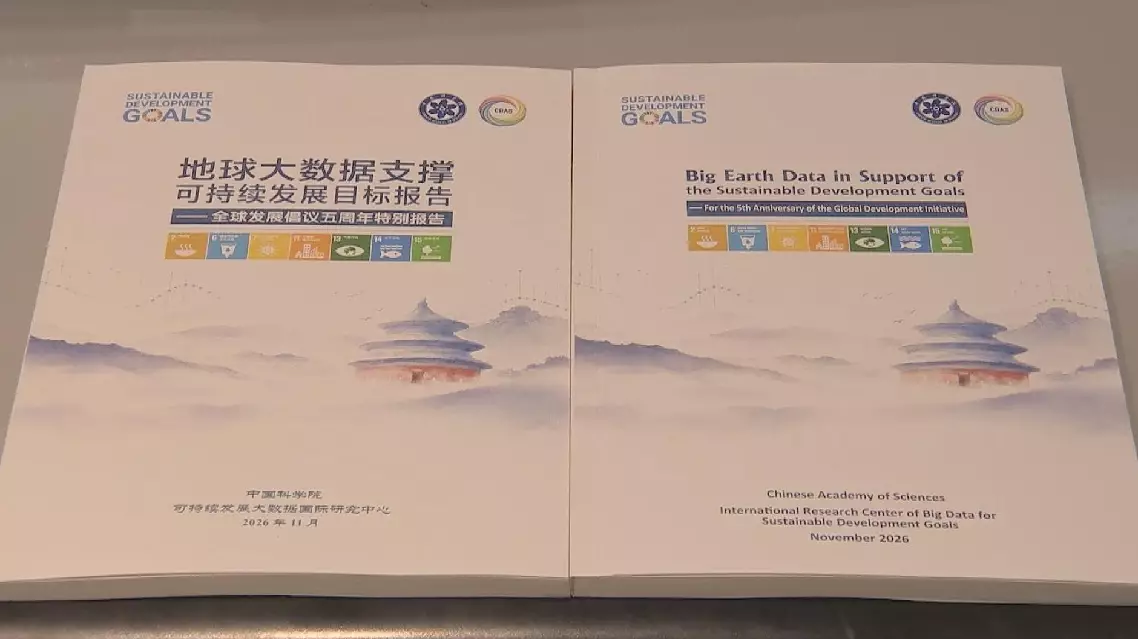
The Big Earth Data in Support of the Sustainable Development Goals report (2026), compiled under the leadership of the International Research Center of Big Data for Sustainable Development Goals, was China's eighth edition since 2019.

The report takes stock of the latest global sustainable development advances in 2025 and offers a key scientific reference for understanding how human societies are evolving and how resources and the environment are changing. Its analysis spans global, regional, national and typical local scales.

The report indicates that, in the water resources sector, 22.2 percent of the world's large lakes have entered a phase of accelerated eutrophication since 2015, while China's water-use efficiency increased roughly 7.3-fold between 2000 and 2024.

In the energy sector, 85.5 percent of the world's centralized photovoltaic (PV) panels are concentrated in a small number of countries and regions. In China, the ecological condition of approximately 84 percent of onshore wind farms and 75 percent of PV power plants is either improving or remaining stable, the report said.

In the urban sector, the methane emission intensity of open-air waste dumps globally is about 4.8 times that of sanitary landfills. In China, the proportion of "urban villages" (informal settlements within cities) relative to the total built-up urban area has declined from 10.4 percent to 8.1 percent, according to the report.

Sustainable development has been a human aspiration for more than half a century. At the 70th UN General Assembly in 2015, 193 countries adopted Transforming Our World: The 2030 Agenda for Sustainable Development, whose centerpiece is the Sustainable Development Goals, or SDGs.

"There are in fact 17 Sustainable Development Goals, such as zero hunger, water resources, marine life, climate change, all of which are important goals of human concern. With 15 years, if they are achieved, humanity will embark on a path of harmonious development between humanity and nature," said Guo Huadong, an academician with the Chinese Academy of Sciences (CAS) and director-general of the International Research Center of Big Data for SDGs.

The report also found out that China's sustainable development progress has been notable over the past decade. By the end of 2025, of the 234 UN Sustainable Development Goal indicators covered by the assessment, 147 in China were nearing or had met their 2030 targets -- 62.8 percent, up 23.9 percentage points from 2015.

"A notable feature of the 2026 annual report is that China's sustainable development process has advanced by another 2.3 percent compared with 2024. In areas such as quality education, new energy, climate change response, and water quality improvement, progress has been particularly notable. Especially in China's efforts to achieve zero hunger and no poverty, that is, China's cause of poverty reduction, great achievements have been made, all of which reflect strengths of our country," Guo said.

Big earth data report highlights China's decade of sustainable development gains

Big earth data report highlights China's decade of sustainable development gains

Recommended Articles