With less than 24 hours to go before the U.S. unveils its new sanctions regime on Iran, Tehran on Sunday threatened to halt all oil exports through the strategic Strait of Hormuz or even the Persian Gulf region if the U.S. wages an economic war.
In a post on Truth Social on Aug 19, U.S. President Donald Trump announced "the most crushing economic operation ever taken" against any country providing a lifeline to Iran. He characterized the upcoming action as "Economic Warfare and Isolation on an unprecedented scale", accusing Iran of failing to take the opportunity to make a deal.
Following up on the president's announcement, U.S. Treasury Secretary Scott Bessent confirmed that a press conference is scheduled for August 24 to detail the specific measures of this "unprecedented economic isolation".
Bessent framed the action as the "greatest coordinated economic isolation in the history of the world", explicitly saying its goal is to collapse the current regime in Iran. He issued a stark ultimatum to the world: "you are either with us or against us."
The United States plans to utilize all enforcement tools to impose secondary sanctions on nations and entities that continue to engage with Iran, specifically targeting three key areas: purchasing Iranian oil, transferring funds to Iran, and ship-to-ship transfers of Iranian crude.
In a notable remark, Bessent suggested that these severe economic measures might reduce the need for future "large-scale" military action.
Iranian officials have responded with swift and forceful rhetoric.
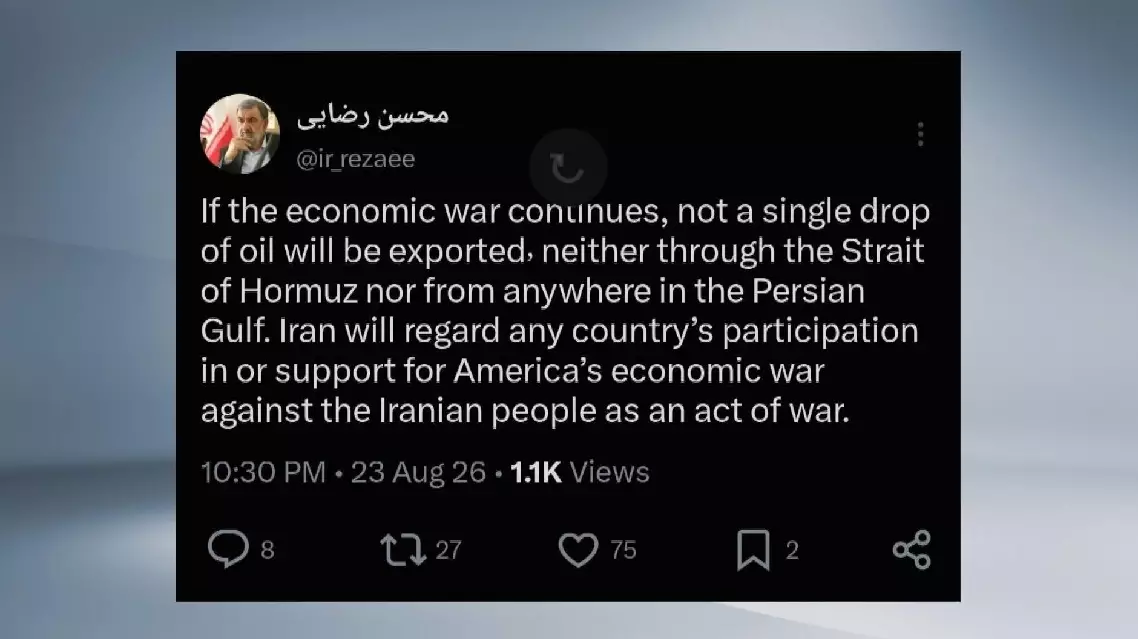
In a social media post on Sunday, Mohsen Rezaei, secretary of Iran's Supreme National Security Council, said, "If the economic war continues, not a single drop of oil will be exported, neither through the Strait of Hormuz nor from anywhere in the Persian Gulf. Iran will regard any country's participation in or support for America's economic war against the Iranian people as an act of war."
Iranian Foreign Minister Seyed Abbas Araghchi dismissed the U.S. sanctions threat, saying that Iran has never been afraid of American sanctions. He characterized the U.S. plan as "a repetitive film that we have seen many times", asserting that Tehran knows how to confront it and that the new U.S. ploy will inevitably fail.
Hossein Mohebbi, spokesperson for the Islamic Revolutionary Guard Corps, claimed Iran has formulated plans to counter economic pressure and will continue to conduct economic activities with other nations "under the eyes of the United States", bypassing restrictions. He also noted that the U.S. has imposed sanctions on Iran for 47 years and that the current rhetoric is aimed at creating psychological pressure on the Iranian people.
Analysts suggest the impending economic operation may be a reluctant move by the U.S. amid stalled negotiations and a prolonged military stalemate. While the full details of the plan remain undisclosed, experts have warned that the escalation risks a "lose-lose" outcome, potentially triggering a cycle of "sanctions, counter-sanctions, and re-sanctions" with no clear winner.
On June 18, the United States and Iran signed a memorandum of understanding (MoU) on ending the war in the region on all fronts, including Lebanon. Under the MoU, they were scheduled to hold negotiations within 60 days, which ended on Aug 17, to reach a final agreement, but the fate of the talks remains unclear following the escalation between the two countries last month.
Tehran vows to block Strait of Hormuz as Trump announces 'crushing' economic operation