OSLO, Norway (AP) — The health of King Harald of Norway deteriorated over the weekend, the royal palace said.
The 89-year-old monarch, who has been on sick leave for several weeks, was admitted to the National Hospital a week ago. He has been on sick leave for several weeks.
He is now receiving antibiotics for a bacterial blood infection and has responded to treatment, the palace said late Sunday, adding that his condition is stable.
His son, Crown Prince Haakon, has been serving as regent during that time, the palace said.
The king suffers from hemolytic anemia and was being treated with cortisone, leading to fluid accumulation in the body that required hospital treatment, the palace said last week.
Harald, who has been monarch since 1991, has been in and out of the hospital several times in recent years.

FILE - Norway's King Harald, centre, leaves the hall after the Nobel Peace Prize ceremony at Oslo City Hall, Norway, on Dec. 10, 2022. (AP Photo/Markus Schreiber, File)
An out-of-control wildfire that jumped over fire trucks and made it difficult for crews to reach hot spots destroyed homes in northwest Reno, Nevada, on Sunday. Shifting winds challenged firefighters trying to bring it under control, and authorities urged some 90,000 people to evacuate.
At least six people — three first responders and three civilians — were injured. Officials said the fire was “human-caused” but did not provide details on how they reached that conclusion, or whether it was intentionally set or accidental.
The Hawk Fire began Saturday and grew to more than 23 square miles (60 sq. km.) as it spread Sunday across the Peavine Peak area of the Humboldt–Toiyabe National Forest, where rugged foothills are ringed by homes and businesses near the California state line. There was zero containment.
Some 42,000 residents have been ordered evacuated as the “GO NOW” zone expanded, reaching the edge of the University of Nevada. An additional 45,000 people were in the adjacent evacuation warning zone. Authorities urged people to be prepared to stay away for several days, because shifting and strengthening winds were expected to make the fire even more unpredictable.
“Please get out if you can right now,” Washoe County Sheriff Darin Balaam said.
A Sunday evening update said crews observed “extreme fire behavior” as gusts pushed flames through dry brush.
“Over the next 12 hours, the fire is expected to continue to make moderate to high intensity runs in pockets of dense fuels,” the statement said.
It wasn't known how many homes were destroyed. Cari Kieffer said a video posted on social media showed her house entirely burned down, with only a scorched basketball hoop still standing.
“I woke up this morning and just started crying — all my kids, they lost everything,” Kieffer said Sunday. “We lost all our stuff. Everything we own is gone.”
Kieffer had been watching her son’s football game Saturday when she learned that their home on the outskirts of Reno was in the evacuation zone. An app the family used to track the fire’s progress had been lagging significantly behind its actual location, she said, so they thought firefighters had kept the blaze from their neighborhood.
Instead, Kieffer, her husband and their four children ages 3 to 16 raced to save their dogs and whatever possessions they could retrieve. Ash rained down, and the wind blew like an oven blast from a wall of flames advancing down the hillside toward their neighborhood, she said.
“I kept looking outside and the flames just kept getting closer and closer every time I looked,” Kieffer said. “I was like, we gotta go like now.”
Eyes watering and throat burning, Kieffer grabbed a handful of clothes, a Bible, her wedding photos and her mother’s ashes. In the frenzy, as firefighters yelled at her family to leave immediately, she said she forgot her family’s birth certificates and was unable to salvage her childhood photos.
The family drove to a friend’s home but had to evacuate again. They learned later Saturday evening that their own home was gone.
Nevada Gov. Joe Lombardo declared a state of emergency in Washoe County and mobilized the Nevada National Guard to support aerial firefighting with two helicopter crews as well as 60 troops to help police safeguard evacuated neighborhoods. Also responding were 800 fire personnel.
Nearly 10,000 customers were without power in Washoe County on Sunday, down from 60,000 on Saturday. Portions of U.S. Route 395, a major north-south highway, were closed due to the fire. Reno, with more than 280,000 residents, is the largest city in Nevada outside of metro Las Vegas.
Washoe County emergency officials opened the Reno-Sparks Convention Center to evacuees, but said they couldn’t bring their pets — small animals and large animals were to be left at two other locations. Casinos in Reno offered discounts on hotel rooms to evacuees.
The fire was so small Saturday morning that it wasn’t even a concern, said Tyler Duvall, who went camping over the weekend. By the next day, his house was in the evacuation zone.
“The wind really blew it up,” Duvall said.
On Saturday alone, 15 new fires popped up across Nevada. Months of dry weather and a record lack of snow this past winter across the American West have created prime fire conditions. Earlier this month, wildfires in eastern Washington state forced the evacuation of 60,000 people in the Spokane area, while three wildfires north of Reno forced more than 13,000 residents from their homes.
Jaida Hargrove’s grandfather, Rick Arrate, lived alone on Peavine Mountain, which overlooks Reno and Sparks. Firefighters used a bulldozer, cut down trees and applied fire retardant in their attempt to contain the flames, Hargrove said.
“They all thought it would be OK,” she said. “And then, in about 30 minutes, the winds just changed and it came way too fast.”
Arrate and the firefighters were quickly forced off the mountain. “All he was able to take with him was his two golden retrievers,” Hargrove said.
Arrate spent Saturday night with Hargrove’s parents, his next steps unknown.
Separate GoFundMe crowdfunding campaigns were set up to assist Arrate and the Kieffer family.
Retired police officer and firefighter Ted Melden has seen his share of Mother Nature’s fury since moving to Reno with his wife earlier this month from Chapin, South Carolina. So far, he has experienced a hailstorm with flash flooding, two different power outages and, now, the second wildfire incident in the region in two weeks.
“Just another natural disaster,” Melden said.
In the two years he lived in South Carolina, Melden said Hurricane Helene knocked over trees in his yard, while a tornado did some damage in his neighborhood.
For now, Melden hasn’t been ordered to leave his home, but he has his bags packed just in case.
“You just have to roll with the flow and be ready,” he said.
David Barb returned from a weekend hunting trip to find the fire had leveled his taxidermy shop, but his house nearby appeared to have been spared thanks to workers with a landscaping company who cut a fire break, he said. His wife was home when the fire started on the other side of the mountain and later evacuated to a friend’s house.
“I’m kind of devastated, but thank God everyone’s safe,” he said Sunday.
The University of Nevada, where many of the 20,000 undergraduates moved into their housing this weekend, was just outside the evacuation zone Sunday.
Two hospitals evacuated patients and the sheriff said his office was keeping a close watch on whether to evacuate the county jail.
The fire moved exceptionally fast Saturday night, jumping over fire trucks and making it difficult for responders to get to hot spots while residents were trying to get out, the sheriff said.
“It was extremely confusing,” Balaam said, describing how changing winds sent the flames in different directions.
Raby reported from Charleston, West Virginia, Brook from New Orleans and Seewer from Toledo, Ohio.
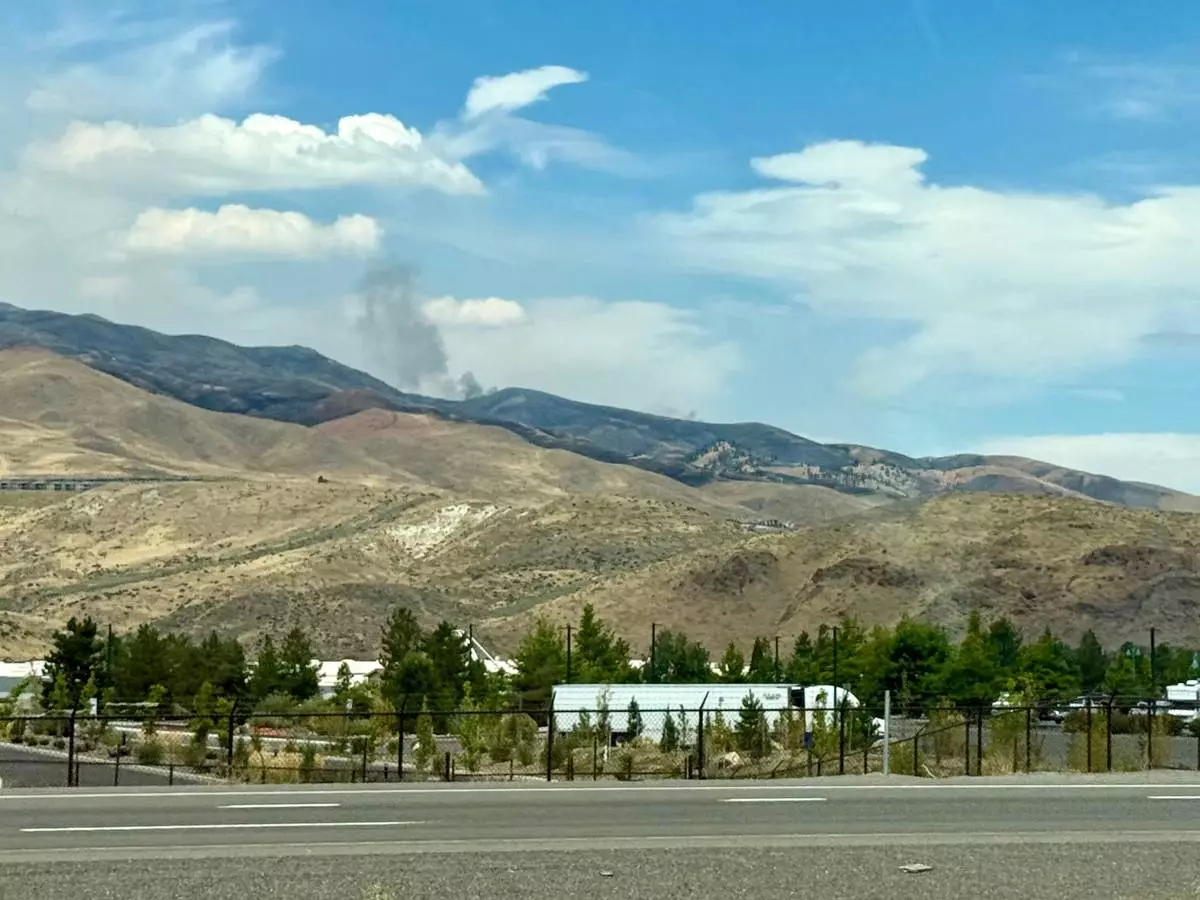
Smoke billows in the distance as a wildfire in Reno, Nev., destroyed homes and caused thousands to evacuate their homes, Sunday, August 23, 2026. (AP Photo/Haven Daley)
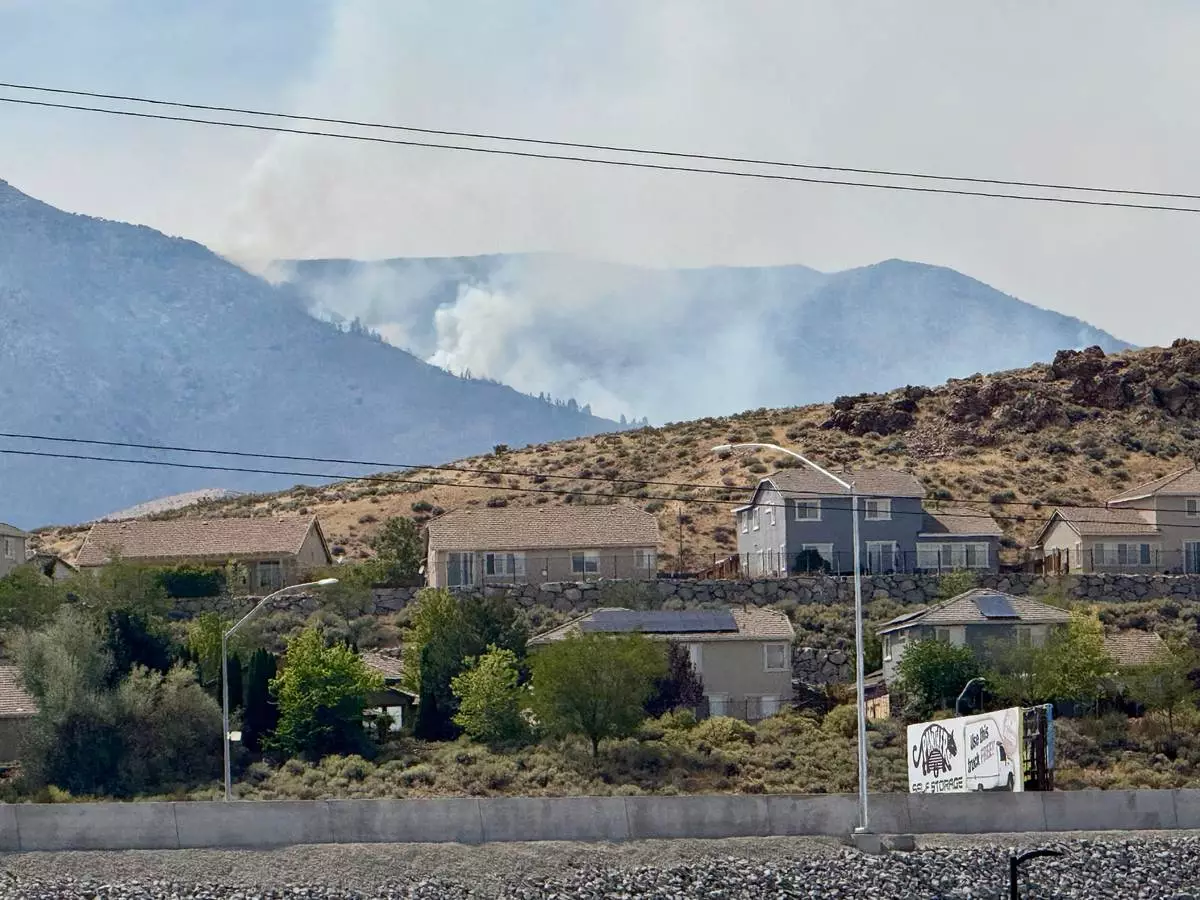
Smoke billows in the distance as a wildfire burns in Reno, Nev., Sunday, August 23, 2026. (AP Photo/Haven Daley)