Persistent high temperatures and severe drought in France's renowned "wine capital" of Bordeaux have accelerated grape ripening and triggered an unusually early harvest, resulting in a significant drop in this year's yields.
The area has experienced a challenging time in recent weeks as devastating wildfires closed in earlier in the summer, forcing hundreds of thousands to be evacuated from their homes amid a large-scale emergency operation.
The fires and extreme heat have hit numerous local industries, not only keeping tourists away but also impacting on businesses. The wine sector is also reacting, as the weather necessitates some adjustments to their usually well-managed annual practices.
The Chateau de Fontenille estate in southeastern Bordeaux is having to respond, and is already alive with activity from the early dawn. Each morning, harvesters move steadily through the vine rows, swiftly loading the ripe grapes into bins.
This year's grapes are exceptionally sweet because the intense heat and prolonged drought have spurred early ripening and concentrated sugar accumulation, according to the estate's operator.
Across the entire Bordeaux region, the harvest season has come unexpectedly, arriving more than a month sooner than usual.
"For the first time, we start the harvest on the 6th of August for Cremant de Bordeaux. And we start the Sauvignon Blanc for dry white last week. And for the first time ever, we started the red in the Saint-Emilion yesterday (Aug 19). This is very unusual," said Christophe Chateau, communications officer at the Bordeaux Wine Trade Council (CIVB).
Stephane Defraine, operator of the Chateau de Fontenille estate, has worked in the industry for nearly 50 years, yet he has never seen such an early harvest.
What worries him most is the smaller size of the grapes. The prolonged drought has restricted growth, reducing the amount of juice that can be pressed and leading to a tangible drop in overall production.
"We had an average yield of 5,500 liters of wine per hectare in the past. However, based on the first harvest this year, that is, the first pickings we've done, the yield is about 4,000 to 4,500 liters per hectare. So, in terms of yield, it has decreased by about 20 percent," said Defraine.
He added that the estate could lose around 60,000 bottles compared to its usual annual output, which is this year estimated to fall to 220,000 bottles.
CIVB data shows that the local vineyard area has already shrunk to less than 80,000 hectares. Combined with the reduced yields, this year's total grape harvest in the region could be the lowest for 40 years.
The difficulties brought by the extreme heat extend from the vineyards straight into the wine cellars, as the harvested grapes must be quickly pressed and cooled to facilitate the subsequent winemaking process.
This means the Chateau de Fontenille estate has had to significantly increase its cooling investments, leading to much higher electricity costs than in previous years.
"We will keep it cool, employing low-temperature techniques to prevent oxidation and allow the wine to maintain its rich fruity aromas. Solid carbon dioxide can help lower temperatures while also preventing oxidation," said Defraine.
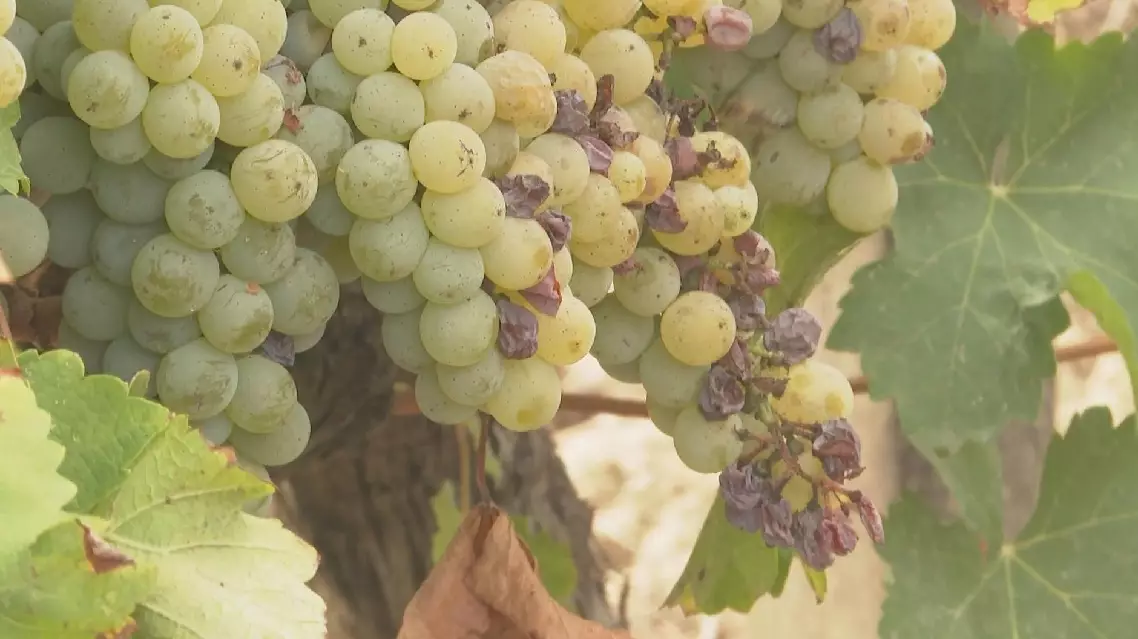
French vineyards count costs as extreme heat forces early harvest, slashes yields