THE HAGUE, Netherlands (AP) — A Dutch broadcaster announced Monday it is boycotting the Eurovision Song Contest for a second year, calling it a “platform for division” because of tensions over Israel's involvement.
The decision by AVROTROS comes after broadcasters in the Netherlands, Iceland, Ireland, Slovenia and Spain refused to take part in this year's contest because of Israel's participation.
“AVROTROS will not participate in the Eurovision Song Contest in 2027 because the event can no longer be considered neutral, with a participating country still involved in a large-scale military conflict,” it said.
The Dutch broadcaster, which has a long history of involvement with the competition, said it was leaving it up to the public network NPO to decide on any Dutch involvement.
“The Eurovision Song Contest was originally created to bring people and countries together. It is undeniable that international conflicts are increasingly affecting the contest, undermining its neutral character,” AVROTROS director-general Taco Zimmerman said in a statement. “The Eurovision Song Contest has therefore become a platform for division.”
Eurovision Song Contest Director Martin Green said in a statement that the organization regretted the move, but respects the views of member broadcasters. The contest is run by the Geneva-based European Broadcasting Union (EBU) — a group of public broadcasters from 56 countries.
“The Eurovision Song Contest has always been a place to bring people together, celebrate diverse communities, and show that a better world is possible even in the most difficult times," Green said in a statement sent to The Associated Press.
"We will now continue our dialogue with NPO, the umbrella organization for Dutch public service media, regarding the opportunities for another broadcaster to participate. We very much hope that audiences and artists in the Netherlands can continue to be represented in the Eurovision Song Contest,” he added.
In a statement, the NPO said it recognized that "geopolitical tensions are having a divisive effect. That’s why this hasn’t been an easy decision for our colleagues. We will reflect on the upcoming edition and will come back to this at the right moment.”
NPO said it was “too early to comment on the next steps at this point; we’re currently deliberating on that.”
AVROTROS said it has called on the EBU to establish transparent rules for the participation of countries involved in military conflicts. “However, the recently announced changes by the EBU do not provide sufficient confidence that the independent and neutral character of the Eurovision Song Contest has been restored,” it said.
While AVROTROS did not mention Israel by name, it said the network will boycott Eurovision in 2027 “because the event can no longer be considered neutral, with a participating country still involved in a large-scale military conflict.”
It added: “The severe humanitarian suffering in Gaza and the ongoing restrictions on press freedom have contributed to increasing divisions surrounding the Eurovision Song Contest in recent years.”
The contest was founded in 1956, in part to help unite a shattered continent after World War II. It pits acts from dozens of countries against one another for the continent’s musical crown. Bulgarian singer Dara won the event this year with her infectious party anthem “Bangaranga.”
A number of performers and countries have called for the exclusion of Israel, which has taken part in Eurovision since 1973, one of a few non-European countries to compete.
Associated Press journalist Jamey Keaten in Geneva contributed.
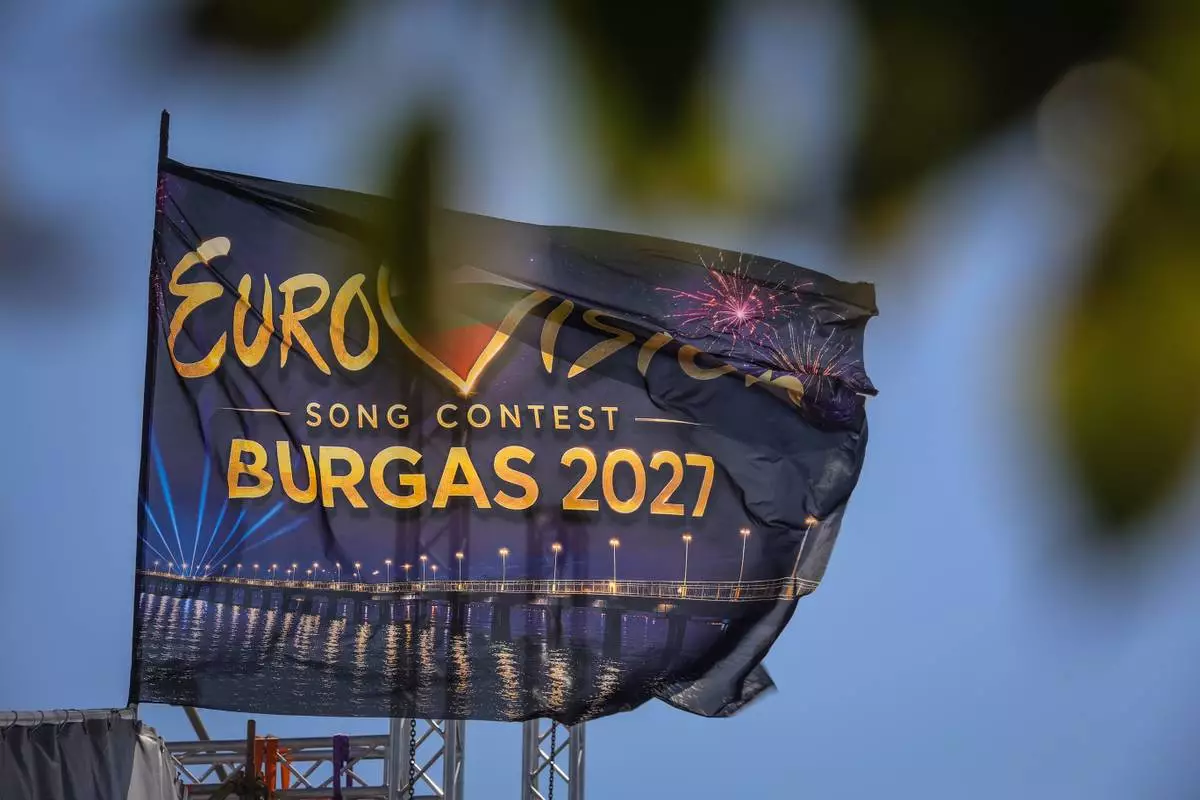
An Eurovision flag flies at the port of Burgas, on Bulgaria's Black Sea coast, which will host the 71st Eurovision Song Contest in 2027, Friday, Aug. 14, 2026. (AP Photo/Valentina Petrova)

FILE - Dara from Bulgaria attends a press conference with the trophy after winning the Grand Final of the 70th Eurovision Song Contest in Vienna, Austria, on May 17, 2026. (AP Photo/Martin Meissner, File)
KYIV, Ukraine (AP) — European leaders joined President Volodymyr Zelenskyy in Kyiv on Monday for celebrations marking the 35th anniversary of Ukraine’s Independence Day as Russia pressed on with its 4-year-old invasion of the country.
One of President Vladimir Putin’s key goals in starting a war with Russia’s neighbor in February 2022 was to place Kyiv in Moscow’s orbit. Ukrainian lawmakers voted on Aug. 24, 1991, to proclaim the country’s independence from Moscow, and a nationwide referendum later that year overwhelmingly approved it.
With no significant changes on the front line for months and no apparent progress after more than a year of U.S.-led peace efforts, both countries are locked in a spiral of escalating aerial attacks that are killing civilians and smashing infrastructure.
U.K. Prime Minister Andy Burnham, on his first overseas trip since taking office last month, joined almost a dozen other European leaders, as well as other dignitaries including European Council President Antonio Costa, in Kyiv on Monday.
“For Ukraine, independence is not an abstract idea. We defended it against all odds,” Ukrainian Foreign Minister Andrii Sybiha said on social media. “In times like these, nations learn how important it is to have allies by your side.”
Burnham was to co-chair a meeting of what has been dubbed the Coalition of the Willing — a group of countries helping Ukraine resist Russia's onslaught, with the leaders of France and Germany expected to join online.
Zelenskyy said in a speech at Kyiv’s St. Sophia Square that the presence of European leaders reflected continental fears about Russia’s wider ambitions.
“We all understand that in this Russian war against us — against Ukraine — far more is being decided than the future of Ukraine and Eastern Europe,” Zelenskyy said, adding that foreign help was vital.
“No nation in a war like this could rely solely on its own weapons," he said. "No nation could withstand attacks of such intensity without the world’s help.”
The visiting leaders brought pledges of further military and financial support. Burnham is expected to announce that his government has agreed to allow defense company MBDA to release classified information relating to British components used in the SCALP long-range missile, according to his office. That would pave the way for France and Ukraine to advance plans for production of the weapon in Ukraine.
SCALP is the French version of the UK’s Storm Shadow missile, with both systems incorporating shared French and British technology.
Kremlin spokesman Dmitry Peskov said the Kremlin views the plan “extremely negatively.” He accused the U.K. of “taking part in this war” on Kyiv’s side.
Ukraine has leaned heavily on NATO countries for help fighting Russia’s bigger army, although relations with the United States have been cooler under President Donald Trump.
Russia, meanwhile, is getting help from North Korea and China.
Ukraine’s swift development of innovative drone technology has enabled it to blunt Russia’s battlefield progress as well as hit targets deep inside Russia, as far as 2,000 kilometers (1,200 miles) from their border. The St. Sophia Square speeches were accompanied by a street parade of domestically produced weapons.
Both Russia and Ukraine are trying through long-range strikes to inflict economic pain, disrupt military supplies and erode public morale.
Ukraine's long-range drones have repeatedly hit facilities in Russia's vital oil industry, causing fuel shortages, and have also engaged in a campaign against Russia's largest online retailer, Wildberries.
But foreign suppliers also have to take into account their own needs, weapon production levels and the depth of stockpiles.
As the air war has intensified, Ukraine’s stocks of U.S.-made Patriot interceptors to counter Russia’s ballistic missiles have run desperately low. Kyiv urgently needs more interceptors before winter, when Russia routinely bombards its power grid, but the demands of the Iran war and slow output of the sophisticated interceptors have left Ukraine short and vulnerable.
Three teenagers were killed and six children were wounded in the southern Russian city of Krasnodar, Russia’s children’s rights ombudswoman Maria Lvova-Belova said, as Ukraine attacked several warehouses of Ozon, another online retailer, for the third straight day, according to officials and the company.
The company said a large fire raged at an Ozon logistics facility in the suburbs of Krasnodar following the overnight attack.
A drone also hit the grounds of an Ozon logistics center in the southern Russian region of Adygeya, regional Gov. Murat Kumpilov said, although the company said its Adygeya warehouse wasn’t damaged.
In all, four Ozon premises appeared to have been targeted.
Meanwhile, Ukraine’s General Staff said its forces struck the Russian state-owned Kamenetsky Combine defense company in the Rostov region, overnight, starting a fire. The plant produces fuel for rockets and missiles, it said.
Russia's Defense Ministry said its air defenses overnight intercepted and destroyed 351 Ukrainian drones over eight Russian regions, the Crimean Peninsula and the Azov and the Black seas. Moscow illegally annexed Crimea in 2014.
The ministry also said that its forces overnight continued to strike Ukrainian ports and vessels delivering cargo for the armed forces.
Russia has also turned its sights on Ukrainian shopping malls, supermarkets and gas stations in recent months. Russian drones struck a shopping center in central Ukraine in a daytime attack Friday, killing 16 people and wounding 130, Ukrainian officials said.
Ukraine’s southern Odesa region came under a large-scale Russian missile and drone attack Monday, with food storage facilities and energy infrastructure among the targets, regional authorities reported.
Fifteen people, including two children, were injured in a Russian drone strike on Chernihiv in northern Ukraine, according to Ukraine’s Emergency Service.
It was not possible to independently verify each side's reports.
Follow the AP’s coverage of the war in Ukraine at https://apnews.com/hub/russia-ukraine
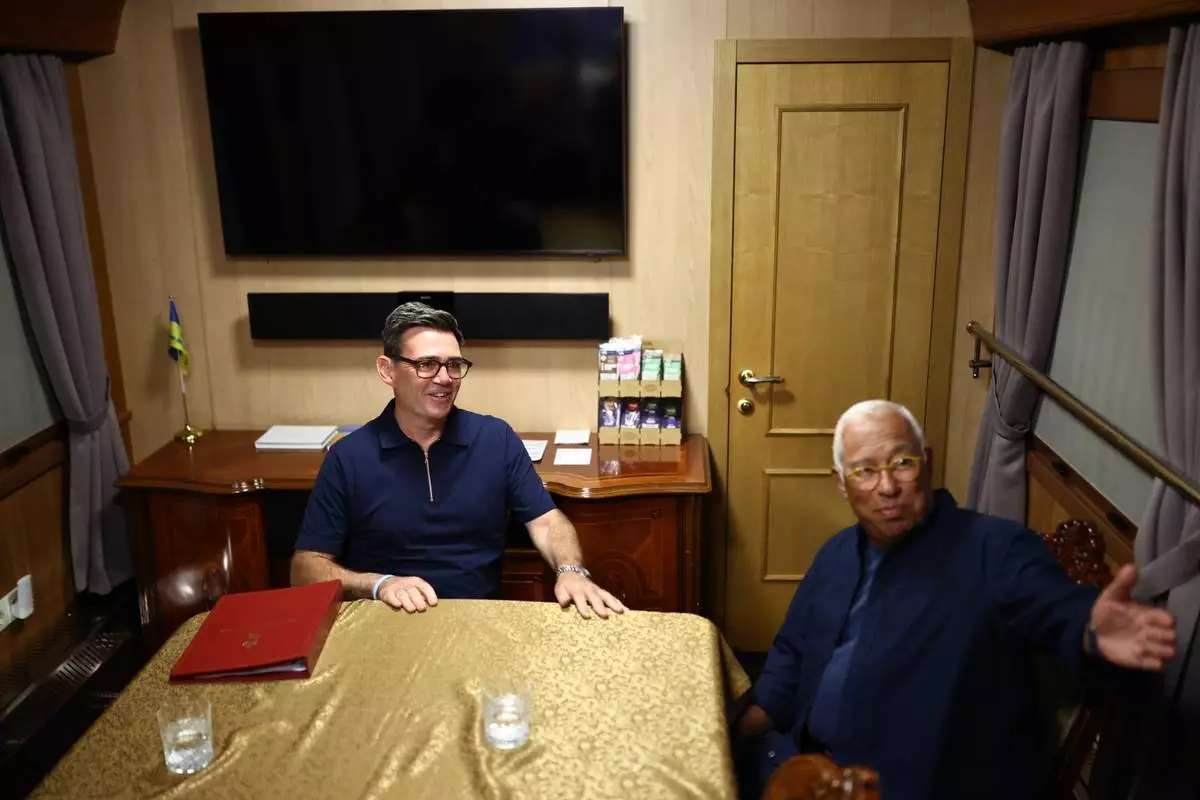
Britain's Prime Minister Andy Burnham, left, talks with President of the European Council Antonio Costa aboard a train headed to Kyiv, at an undisclosed location in Ukraine, late Sunday, Aug. 23, 2026. (Henry Nicholls/Pool Photo via AP) CORRECTION: Corrects date from Aug. 24, 2026 to Aug. 23, 2026.
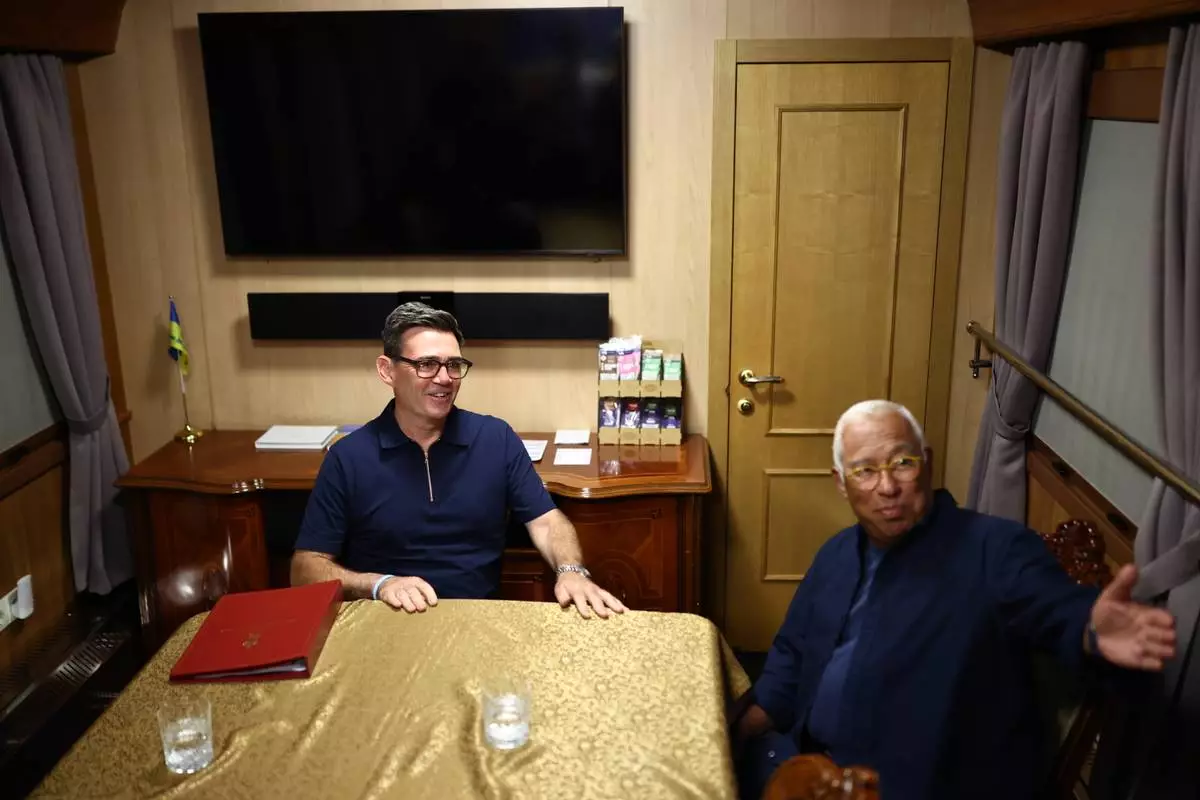
Britain's Prime Minister Andy Burnham, left, talks with President of the European Council Antonio Costa aboard a train headed to Kyiv, at an undisclosed location in Ukraine, Monday, Aug. 24, 2026. (Henry Nicholls/Pool Photo via AP)
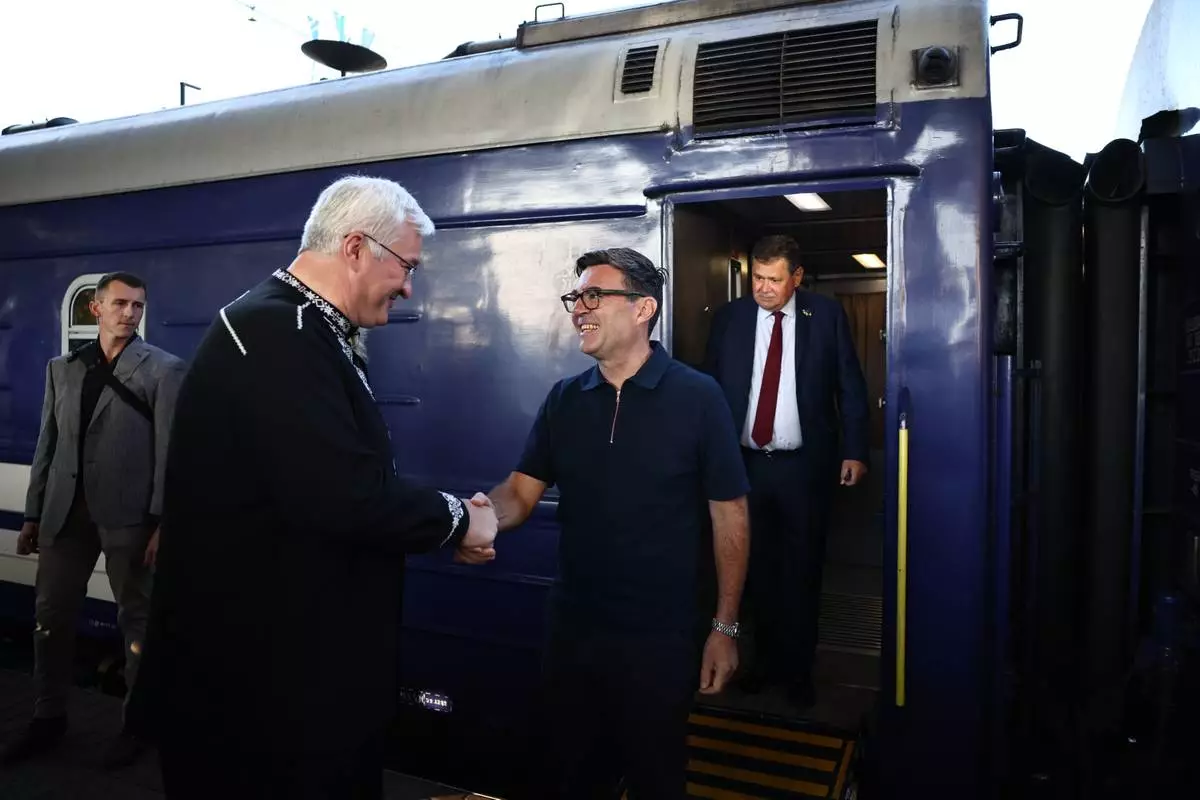
Ukraine's Foreign Affairs Minister Andrii Sybiha, left, greets Britain's prime minister Andy Burnham upon his arrival by train, in Kyiv, Monday, Aug. 24, 2026. (Henry Nicholls/Pool Photo via AP)
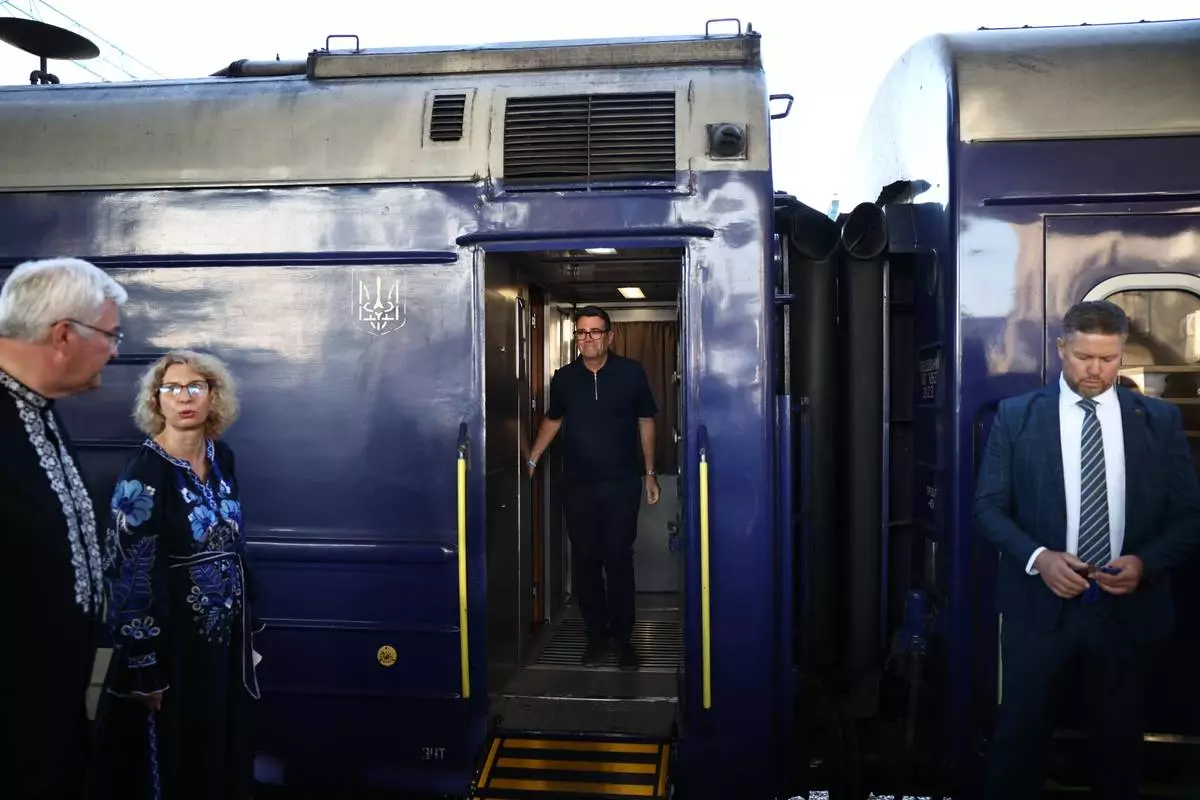
Britain's Prime Minister Andy Burnham, centre, walks out of a train upon his arrival , in Kyiv, Monday, Aug. 24, 2026. (Henry Nicholls/Pool Photo via AP)
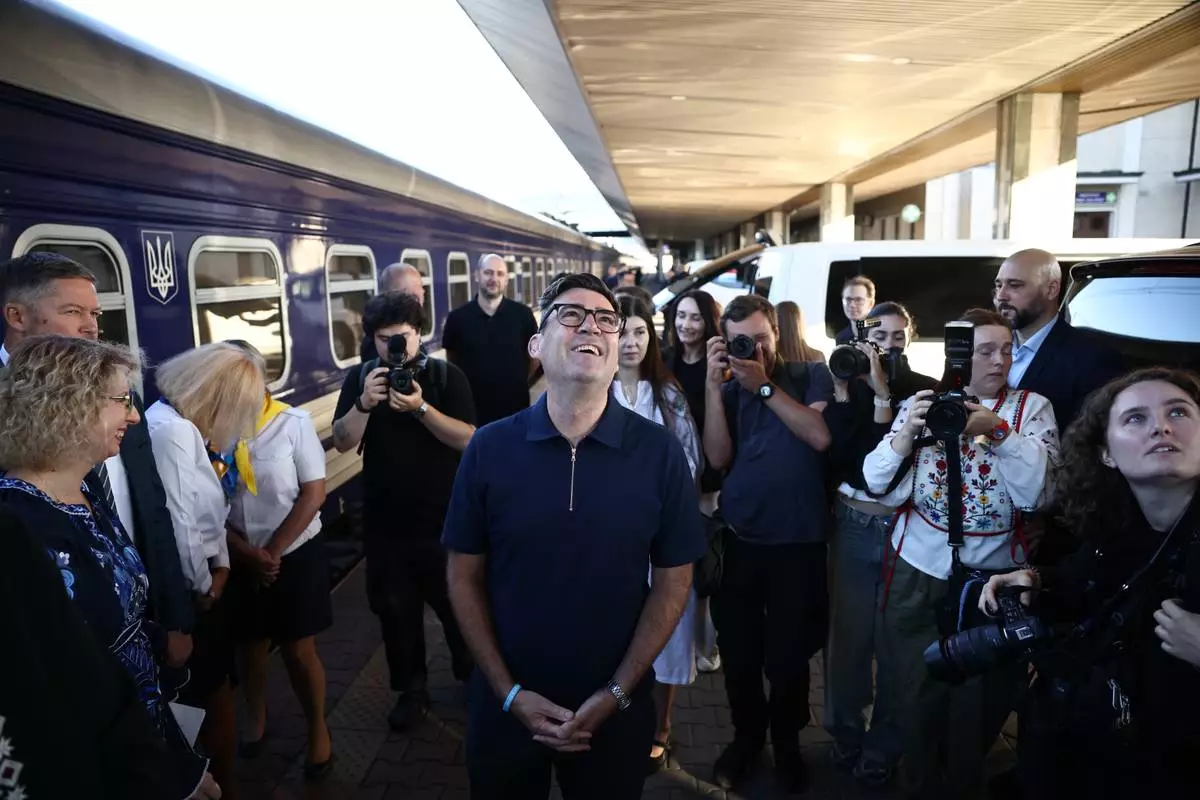
Britain's prime minister Andy Burnham, centre, smiles upon his arrival by train, in Kyiv, Monday, Aug. 24, 2026. (Henry Nicholls/Pool Photo via AP)