AUSTIN, Texas--(BUSINESS WIRE)--Aug 24, 2026--
Global AI data security leader Forcepoint today announced that Vincent Merlin has joined the company as Chief Marketing Officer. Reporting to CEO Ryan Windham, Merlin will lead global marketing across brand, demand generation, product marketing and analyst relations as Forcepoint defines the AI data security category, enabling enterprises to keep command of AI while putting their best intelligence to work.
This press release features multimedia. View the full release here: https://www.businesswire.com/news/home/20260824961805/en/
“Trust used to be a posture, and it is becoming a deliverable for the agentic enterprise: every AI interaction with data governed, every decision recorded, every time," said Windham. "The next decade won't be won by organizations using the most AI. It will be won by those that never lost control of it. Vincent’s global go-to-market expertise will help our customers and partners see what command of AI makes possible."
Merlin joins Forcepoint from Proofpoint, where he spent 10 years in senior marketing leadership roles, most recently as Senior Vice President of Global Growth Marketing. His responsibilities spanned the worldwide marketing organization and inside sales, helping build the global growth engine and drive AI-led transformation as the company scaled from approximately $400 million to more than $2.4 billion in annual recurring revenue. He previously held global and regional marketing leadership roles at AVEVA, as well as Dell EMC and RSA. Merlin holds an MBA from the Tuck School of Business at Dartmouth and an engineering degree in quantum photonics and optics from Institut d'Optique Graduate School.
“Every technology worth adopting showed up before anyone knew how to secure it. The web, email, the cloud,” said Merlin. “Companies moved anyway, and the ones that moved early could because somebody made it survivable. Forcepoint is doing that for AI, giving enterprises the confidence to put their best information to work while staying in control. That’s why I’m here.”
Merlin will join Forcepoint executives, customers and industry leaders at Forcepoint AWARE: Decoding Agentic AI Security, a free virtual conference on Sept. 16, 2026. Get more information about AI Data Security and register for AWARE from the website.
About Forcepoint
Forcepoint is the global AI data security leader. The company’s AI Data Security platform knows sensitive data as it is created, adapts the moment risk changes and protects continuously across cloud, web, networks, email, endpoints and AI through a unified, single-policy framework. Based in Austin, Texas, Forcepoint creates safe, trusted environments for customers and their employees in more than 150 countries.

Forcepoint names Vincent Merlin as CMO
LOS ANGELES--(BUSINESS WIRE)--Aug 24, 2026--
In the release dated August 19, 2026, the seventh key finding understated the number of North American facilities holding R2v3 Appendix G certification. Following S3's direct query of SERI's R2 Certified Facility Directory, the finding has been corrected to reflect the registry record, and a disclosure line has been added. Please also replace the graphic with the accompanying corrected graphic.
This press release features multimedia. View the full release here: https://www.businesswire.com/news/home/20260818324604/en/
The updated release reads:
U.S. SOLAR PANEL 'RECYCLING' IS MOSTLY LANDFILLING, OFFSHORING, AND DISPOSAL IN DISGUISE, A NEW WHITE PAPER FROM SUSTAINABLE SOURCE STUDIOS FINDS
S3's review of regulatory records, peer-reviewed studies, and operators' public disclosures finds over one million tons of decommissioned U.S. solar panels on track for landfills, disguised disposal, or a single foreign-owned smelting chain by 2030 — and a January 2027 certification deadline that may decide which model wins.
Sustainable Source Studios (S3), an independent sustainability research and strategy practice, today announced the publication of its white paper "SOLAR RECYCLING REALITY — Millions of Old Panels Are Being Replaced. Where Does This Hazardous Waste Actually Go?" — a market survey of U.S. solar panel end-of-life practices. The paper's central finding: almost none of what the United States calls "solar recycling" is closed-loop recovery. The dominant pathways, the paper concludes, are landfilling, offshoring, and what the author terms "camouflaging" — disposal disguised as recycling.
The white paper, authored by sustainability-industry veteran Isaac Nichelson and built exclusively on regulatory records, independent market assessments, peer-reviewed research, and operators' own public disclosures, documents seven findings, each footnoted in the paper to its public source:
The paper also flags an economic-security dimension: silver, copper, aluminum, and silicon — all U.S. federal critical minerals as of November 2025 — consistently and permanently exit U.S. jurisdiction under the export model. Silicon is not recovered at all.
"This is not an anti-solar argument — it is the opposite," said Isaac Nichelson, the paper's author and founder of Sustainable Source Studios. "Solar has always been one of the most logical and elegant forms of energy production, and its efficiency keeps improving. That is exactly why the industry cannot afford an end-of-life chain that, as the cited record shows, leaches lead into groundwater and sends toxic material to overseas communities under the label of recycling. Our team was greatly encouraged to find that certified, traceable domestic recycling now operates at industrial scale, and that the R2 standard will require downstream traceability beginning in January 2027. We expect the next six months to define the leaders in solar's end-of-life segment — and we believe the polluter-pays principle should apply here as it does everywhere else."
The white paper closes with specific recommendations for solar asset owners, procurement teams, capital allocators, regulators, and ESG investors — including mandatory Appendix G certification in supplier contracts, per-shipment chain-of-custody documentation, and treating any recycling bid priced at or below landfill cost as a red flag for sham recycling.
The full white paper, supporting field notes, and media kit are available at https://s3source.com/resources-reports/solar-recycling-reality
About the Research: The white paper is a documentary review of publicly available records, conducted in 2026 and current as of its July 22, 2026 publication. Sources comprise federal and state regulatory records (including Texas Commission on Environmental Quality enforcement filings and a Korean Ministry of Environment administrative order), the IEA PVPS Task 12 life-cycle inventory dataset (Report T12-32:2026, April 2026), the SERI R2 certification registry, peer-reviewed environmental studies, and the public disclosures of the operators discussed. No proprietary data, surveys, or interviews were used; every figure is footnoted to its source in the published paper. The research was self-commissioned and self-funded by S3; no third party commissioned, funded, or reviewed it prior to publication. Disclosure: S3 has provided sustainability consulting to Comstock Inc. The white paper's findings rest solely on cited public records.
About Sustainable Source Studios: Sustainable Source Studios (S3) is an independent sustainability strategy practice founded by Isaac Nichelson, a 25+ year veteran of circular and regenerative product/systems innovation and supply chain design. S3 publishes primary-source research on industrial sustainability claims and other related topics on Substack. Subscribe at s3source.substack.com.
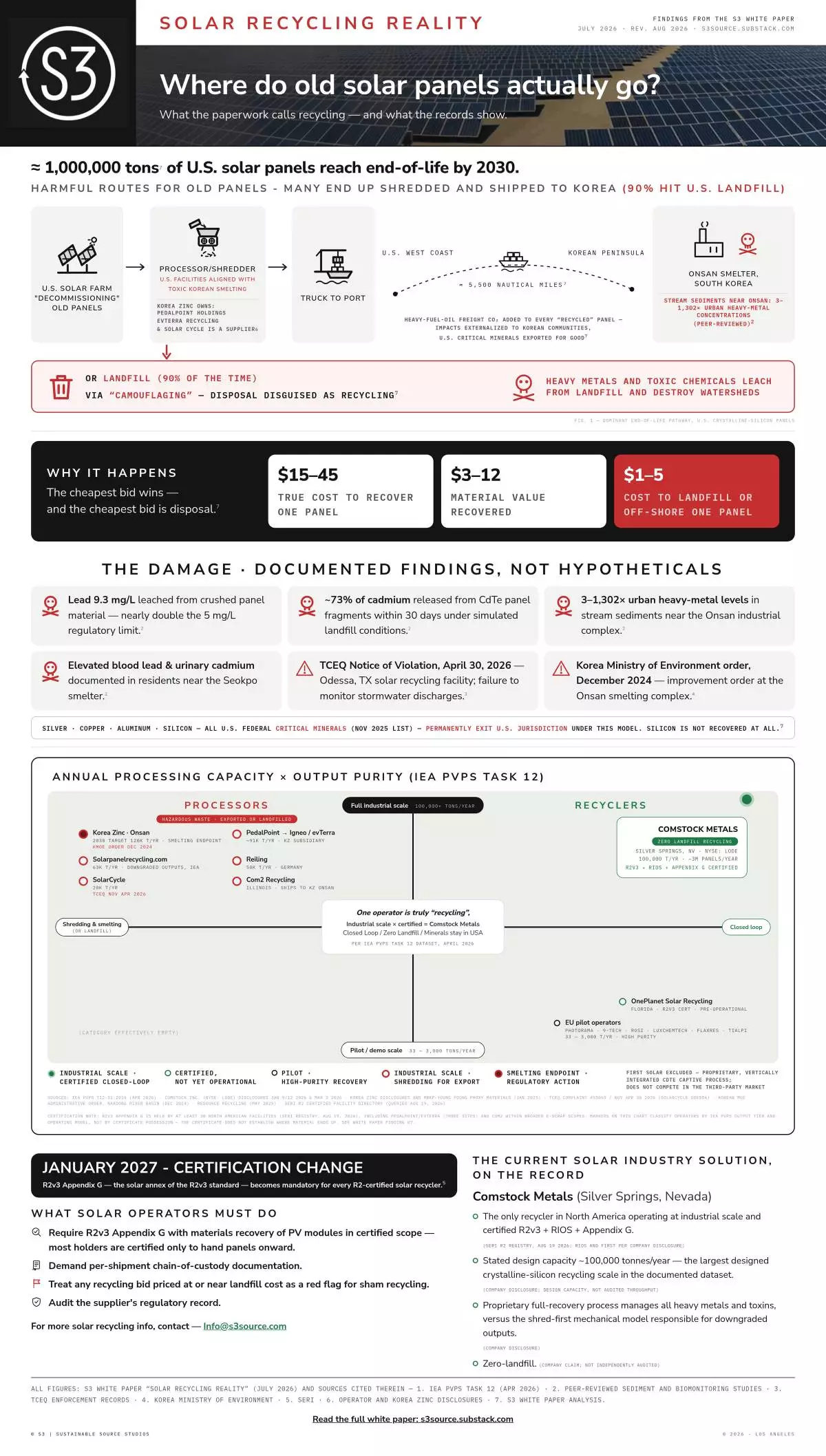
This infographic breaks down the core findings of the Solar Recycling Reality report, and includes citations.