BATON ROUGE, La. (AP) — RJ Luis Jr., a former St. John's standout who recently signed with LSU after spending time with two NBA clubs, was cleared by a court Monday evening to start practicing and potentially play for the Tigers this season.
Luis, who briefly was under contract with the Utah Jazz and Boston Celtics but never played in an NBA game, hugged LSU coach Will Wade after the ruling by East Baton Rouge Parish District Court judge Ronald R. Johnson.
After a five-hour hearing, Johnson granted the player's request for a preliminary injunction against the NCAA, which had argued Luis was unlikely to win reinstatement after leaving college to turn pro in 2025.
“This is precedent. It's monumental,” said Baton Rouge-based attorney Tony Clayton, who represented Luis along with Elliot Abrams of Raleigh, North Carolina. “This allows him to go practice, go play and we'll let the legal process work itself out.”
The timeline for that process was not immediately clear.
“I don't know, but there's a lot of discovery that Elliot and I have to obtain,” Clayton said. “We've got a lot of questions.”
Luis' attorneys noted that the NCAA had granted exceptions allowing numerous players from overseas professional leagues to join college basketball programs, and argued that American players must be afforded the same opportunity.
They stressed that Luis not only had never played in an NBA game, but also had not played for the Celtics' G League affiliate because of an injury, and had far less of a professional basketball resume than numerous college players who'd been recruited from abroad.
NCAA attorney Taylor Askew argued that Luis' situation was not comparable to those who played for the developmental squads of pro organizations overseas because Luis chose to leave college for the NBA.
Askew noted that the only player in a similar situation to Luis was Alabama's Charles Bediako, who won a temporary retraining order allowing him to play five games for Alabama last season before an Alabama judge ultimately sided with NCAA assertions that he was ineligible.
“I understand Mr. Luis is disappointed that he was not drafted and did not play in the NBA as much as he would have liked,” Askew said. “Actions have consequences. Decisions have outcomes and they're not always the right ones or the ones that you want.”
As he made his ruling, Johnson said, “In the court's mind, (Luis) did not actually play professional basketball,” and that whether Luis was properly advised of his options at the time he left college “lingers heavily before this court.”
Sign up for Top 25 poll alerts here, visit the Top 25 here and see AP’s full men’s basketball coverage here

FILE - St. John's RJ Luis Jr. looks toward the basket during the first half of an NCAA college basketball game against Creighton in the championship of the Big East Conference tournament, March 15, 2025, in New York. (AP Photo/Frank Franklin II, File)
BANGKOK (AP) — An amnesty for political offenses committed in Thailand over the past two decades took effect Monday, but the law excludes some of the more serious cases, including those involving lese majeste, or defaming the monarchy.
The amnesty was introduced to promote reconciliation after past political instability, violent protests and military coups and could cover about 6,000 people, according to estimates made in Parliament. But the exclusion of lese majeste offenses has drawn criticism that the amnesty will not truly resolve political divisions.
The Peaceful Society Promotion Act passed a final vote by lawmakers in July and was published in the Royal Gazette on Sunday. A committee chaired by the prime minister will determine who qualifies for the amnesty. The committee must hold its first meeting within 30 days, although it's unclear how long the process will take.
The law covers a range of offenses related to political activities from Jan. 1, 2005 to July 15, 2025. It will not only grant release for current prisoners, but also close investigations and prosecutions, dismiss pending court cases, and clear criminal records of those eligible for the amnesty.
In addition to lese majeste, the amnesty will also exclude corruption and crimes resulting in death or serious injury.
The lese majeste law, also known as Article 112 of the Criminal Code, is controversial not only because it has been used to punish things as simple as liking a post on Facebook, but also because anyone — not just royals or the authorities — can lodge a complaint that most of the time leads to detention during lengthy legal proceedings.
A conviction of defaming the monarchy carries a prison term of up to 15 years, and critics say Article 112 has often been used to quash political dissent.
Student-led pro-democracy demonstrations starting in 2020 sought reforms of the lese majeste law, but the protesters became targets of the law.
Thai Lawyers for Human Rights, a law advocacy group, says more than 290 people, many of them student activists, have been charged with violating Article 112 since early 2020.
As of July, the group said at least 54 people remained imprisoned in connection with political cases. Only about 10 were expected to benefit from the new amnesty, since the others were accused of lese majeste.
Thailand’s machinery of state remains deeply conservative. Its political establishment is sensitive about any perceived threats to the status of the monarchy.
The country’s political conflicts revolved mostly around former Prime Minister Thaksin Shinawatra, who was ousted by a military coup in 2006.
His populist policies won strong support among poorer voters, particularly in the rural north and northeast, but his popularity and sometimes high-handed style created deep fractures between his base and the country’s urban elites, royalists and the military. Violent protests and political upheaval repeatedly followed as parties aligned with Thaksin returned to power while he remained in self-imposed exile.
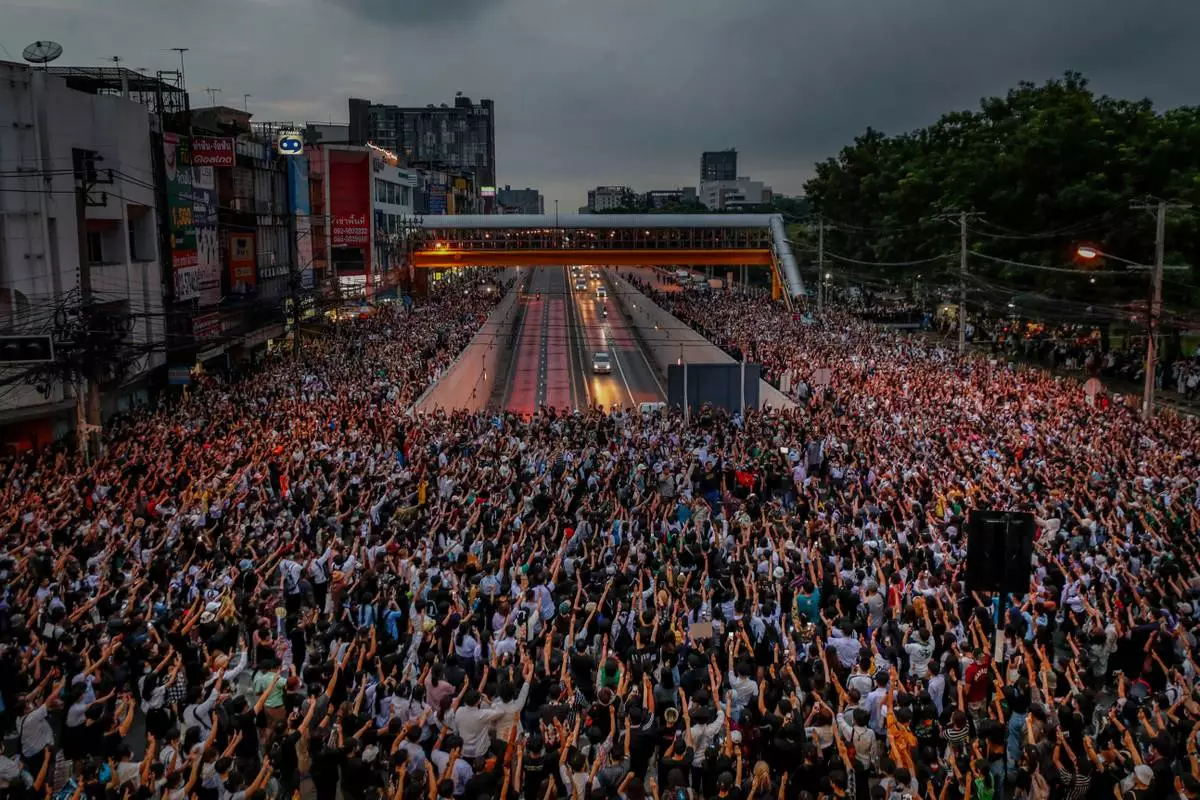
FILE - Pro-democracy activists flash three-fingered salutes during a demonstration at Kaset intersection, suburbs of Bangkok, Thailand, on Oct. 19, 2020. (AP Photo/Sakchai Lalit, File)
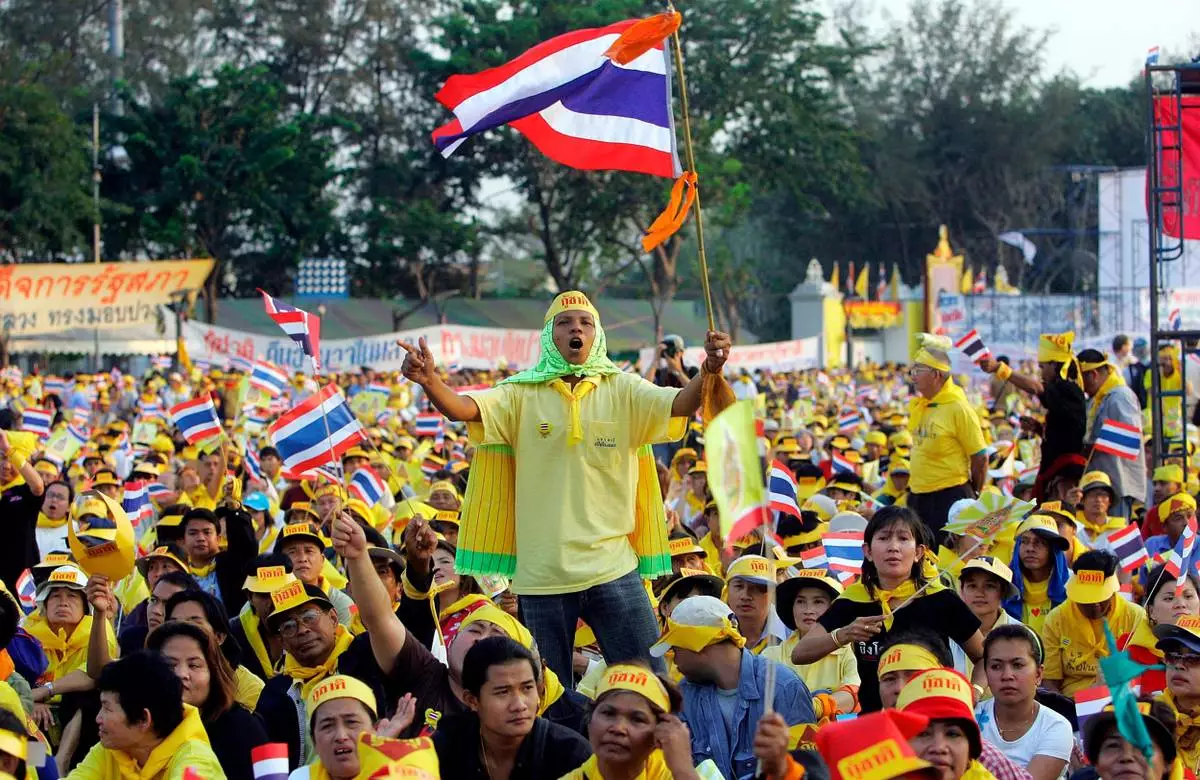
FILE - Thai protesters wave flags and cheer during a rally opposing Prime Minister Thaksin Shinawatra at the Royal Plaza in Bangkok, Thailand, on Feb. 4, 2006. (AP Photo/Sakchai Lalit, File)
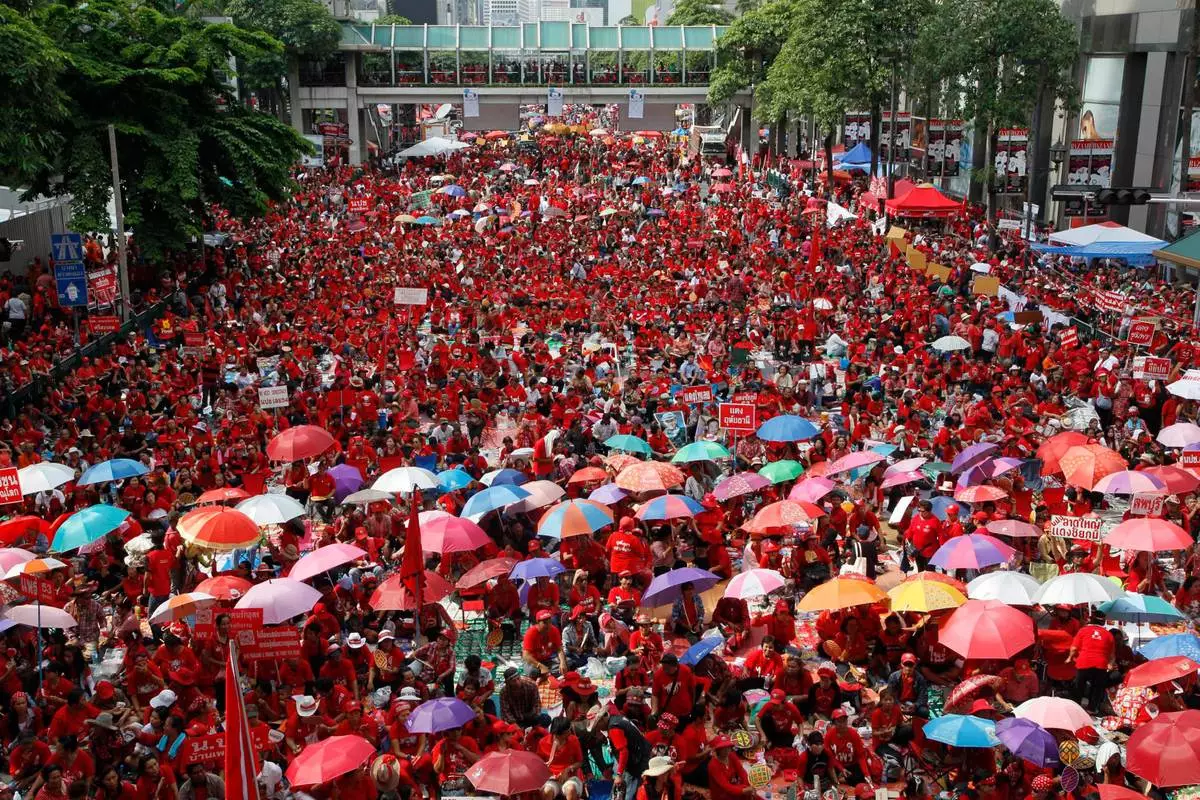
FILE - "Red Shirts" protesters attend a prayer session marking the first anniversary of the army's crushing of a two-month-long protest in central Bangkok on May 19, 2011. (AP Photo/Sakchai Lalit, File)