Backed by its massive consumer market, China is transforming into the world's "super buyer," bringing the globe's finest products to domestic consumers through optimized customs hubs and rapid logistics networks.
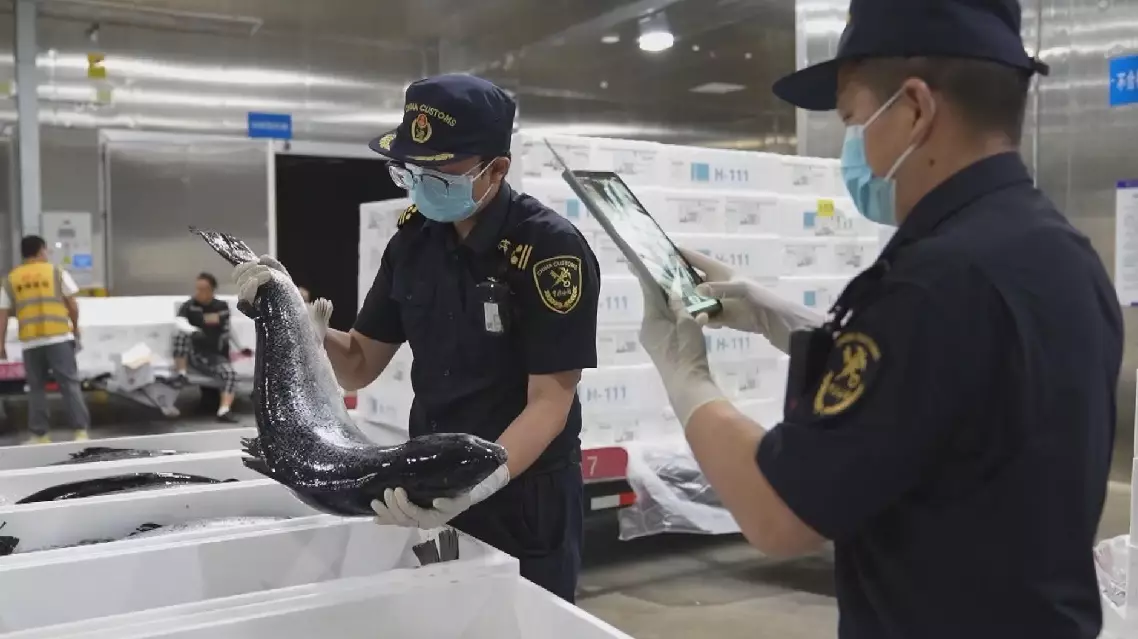
At the center of this push is Huahu International Airport in Ezhou City, central China's Hubei Province, China's first dedicated air cargo hub. At this place, chilled salmon from Norway and Chile are flown in and distributed nationwide, with some Atlantic catches even able to reach Chinese dining tables within 24 hours of leaving the water.
The speed is made possible by Ezhou's supply chain based on its aviation cold-chain system. In May, a salmon processing plant opened just a wall away from the airport, allowing long-haul shipments to move directly from aircraft to factory. Automated production lines and temperature-controlled intelligent operations preserve the fish's freshness at every step.
From the airport, processed salmon products are rapidly dispatched across Huahu's dense domestic route network. A 1.5-hour flight covers 80 percent of China's population, ensuring both peak freshness and fast delivery.
"We can feel the growth in domestic salmon consumption. The biggest change is that salmon has moved from high-end dining to everyday consumption. Small-packaged, high-freshness products are very competitive and popular. Backed by Huahu Airport's hub advantages, we have established a system featuring cross-border cold chain logistics, direct sourcing, transoceanic express shipping, port processing, and nationwide distribution, which allow us to source quality fresh products globally for the national market," said Cheng Hu, on-site manager of China Eastern Airlines Cold Chain's Central China Fresh Port.
The salmon boom is just the beginning. In June, Ezhou launched a seafood holding and processing base where live lobsters and other deep ocean catch are held, sorted, and processed before reaching dinner plates across China within 48 hours from source.
Customs data show that in the first seven months of this year, Ezhou handled 13,000 tonnes of imported fresh produce, including Boston lobster and salmon from North America and Europe, worth 1.28 billion yuan (about 1.90 billion U.S. dollars), up 3.5 percent year on year.
To keep the flow moving, Ezhou Customs has rolled out dedicated fast tracks for fresh products, round-the-clock clearance, and advance declaration services.
"Salmon imports have performed impressively this year. In the first half alone, imports surpassed 7,000 tonnes, up 260 percent, and we expect to top 10,000 tonnes by end of August. The variety of fresh products is also expanding. Niche high-end products like bluefin tuna and spiny lobster are now being imported through our port," said Liu Shi, a section chief from Ezhou customs.
The logistics revolution extends beyond air freight. On Sunday, the first return China-Laos freight train using a new "bonded logistics plus rail express" model arrived at Guiyang International Land Port in southwest China's Guizhou Province.
Carrying 40 standard containers with 1,100 tonnes of imported potash fertilizer, the train completed the journey from Vientiane South Station to Guiyang in just five days, further opening the corridor between the two countries.
"After the train arrives, we strengthen coordination and guide it onto the designated line immediately, then organize shunting to move the cars quickly to the unloading point. The goal is fast receiving and fast delivery," said Chen Shuanglin, deputy station master of Dulaying Station, a land port station in Guiyang.
Under the new model, trains no longer need to stop at border ports, but travel directly to Guiyang for customs clearance. For Guizhou, the system leverages the bonded zone's cargo and port functions, boosting clearance efficiency and cutting logistics costs.
China expands global express corridors, serving domestic consumers with global freshness