LOS ANGELES--(BUSINESS WIRE)--Aug 25, 2026--
Giadzy is expanding its retail presence with the nationwide launch of its gluten-free pasta at Sprouts Farmers Market. Created by entrepreneur and celebrity chef Giada De Laurentiis, the Italian-made pasta is now available at 480 Sprouts locations nationwide, marking Giadzy’s first partnership with a national retail chain.
This press release features multimedia. View the full release here: https://www.businesswire.com/news/home/20260825694797/en/
The collection was developed to offer gluten-free shoppers and households a pasta that delivers the quality and flavor of a premium Italian pasta, with varieties suited to everything from everyday pasta dishes to soups and other family meals.
The Sprouts assortment will include:
Made in Lombardy’s Po River Valley by master pasta makers, Giadzy’s gluten-free pasta combines Italian-grown, non-GMO corn and rice flours with pristine spring water. Crafted using time-honored methods and slowly air-dried, the pasta contains no emulsifiers, preservatives or mystery additives.
“To me, pasta is sacred. It’s the dish that brings my family to the table, and I never wanted my gluten-free friends to feel like they had to settle for something different,” said Giada De Laurentiis. “That’s why I worked so hard to create our gluten-free pasta. It’s made in Italy with Italian-grown grains and mountain spring water, and nothing else. No gums, no fillers, no additives. Just pasta that cooks beautifully and tastes like the pasta I grew up with.”
The Sprouts launch extends Giadzy’s growing retail availability and introduces the line to a wider audience through a retailer known for its selection of better-for-you food and specialty grocery products. For gluten-free shoppers, the launch offers a convenient way to access Giadzy’s Italian-made pasta in stores nationwide.
Photos of Giadzy products can be downloaded here.
About Giadzy
Launched in 2017 by Emmy award-winning personality Giada De Laurentiis, Giadzy is a lifestyle and e-commerce platform that brings the best of Italy—including its least known, yet most delicious food products—directly to your home. Along with Italy-inspired lifestyle tips on entertaining and food, and blogs covering wellness, beauty and style, Giadzy showcases a wide range of pantry products, personally curated by De Laurentiis, including Giadzy's own line of specialty products, from mostly small, family-owned producers whose goods are only available in certain regions of Italy. For more information, visit giadzy.com.

Giadzy’s Italian-made gluten-free pasta collection, now available at 480 Sprouts Farmers Market locations nationwide.
Canada has announced retaliatory tariffs against the United States as relations sharply deteriorate, after President Donald Trump mused about renaming Lake Ontario “Lake America” and insulted Canada’s Prime Minister Mark Carney by calling him “Governor Carney.” More than 700 U.S.-made products are on Canada's tariffs list, hitting everyday purchases such as seafood, cheese, clothing, cosmetics and toilet paper with duties as high as 50%.
The Supreme Court on Monday cleared the way for Trump to move ahead with his executive order restricting mail-in voting, though it remains unclear how much his administration can implement before the fast-approaching midterm elections. Mail balloting has long been a favorite target for Trump, who has claimed that it breeds fraud despite strong evidence to the contrary and his own use of the voting method.
Treasury Secretary Scott Bessent announced a new round of sanctions aimed at Iran on Monday and warned every country that does business with the Islamic Republic to sever those financial ties or face retaliation from the U.S. The announcement follows Trump’s pledge last week to unleash an “economic D-Day” against Iran, in an effort to sever it from the rest of the global economy.
Here's the Latest:
Talking to reporters outside the White House on Tuesday, Agriculture Secretary Brooke Rollins said she’s proud that Trump is “willing to stand up and make the hard decisions.”
“There’s no doubt that it causes concern amongst our farmers and ranchers,” Rollins said, adding that there are “a lot of unknowns” in the situation.
Rollins spoke shortly after Canada announced retaliatory tariffs on about $20 billion worth of American goods, responding to Trump’s new tariffs on about $20 billion in Canadian imports, including dairy products.
“I believe strongly that once they finish this next round of negotiations, whatever you want to call it, that America will certainly be the better for it, and that our farmers and ranchers will benefit the most,” Rollins said.
U.S. Immigration and Customs Enforcement arrested nearly 50,000 people during July, the highest single monthly arrest total during the second Trump administration, according to new figures.
The spike in immigration arrests shows that the administration has continued to advance its mass deportations agenda despite a shift in approach earlier this year from high-profile operations in large American cities that sparked a public outcry to arrests that have garnered less attention but have nonetheless been disruptive.
The July arrest tally of 49,571 marks a 15% jump from 43,021 arrests a month earlier and a 70% increase from 29,241 in February, in the aftermath of the Trump administration’s enforcement surge in Minnesota, according to government data that was provided by ICE to the University of California, Berkeley’s Deportation Data Project and analyzed by The Associated Press.
▶ Read more
“This a moment to stand up,” François-Philippe Champagne also said.
Canada will not accept restrictions on its ability to choose its trading partners, he said.
“Maintaining our economic sovereignty is non-negotiable. That’s what we did, and that’s what we’ll do,” Champagne said.
The “unjust tariffs” and “economic warfare” have consequences, said Patty Hajdu at the press conference, noting that the impact of tariffs has been felt before, though not at this level.
The unknowns of what comes next — how big a dent tariffs will make in people’s pocketbooks — causes “worry and anxiety” that makes it challenging to plan for the future, she said.
“It has an effect of sort of freezing people in place: Should I make that investment? Should I buy that new house? Should I take that vacation? Should I add on to my businesses? Should I add a product line?” Hajdu said.
Canada also announced a support package for workers and businesses affected by the dispute worth $7.5 billion in Canadian dollars (US$5.4 billion). They said the counter tariffs will raise costs for some businesses and consumers, but expect the overall economic effects to be moderate.
They said the government has provided more than $30 billion Canadian dollars (US$21.7 billion) in tariff-related support since the beginning of 2025 — far more than it has collected in retaliatory duties — as it tries to cushion the blow.
The two countries have deeply integrated supply chains across autos, energy, agriculture and manufacturing, making a prolonged trade fight potentially costly for businesses and workers on both sides of the border.
Industry Minister Mélanie Joly urged Canadians to buy Canadian products as they “launch this movement of resistance to what is happening to us.”
Canadian officials led by Finance Minister François-Philippe Champagne announced the retaliatory tariffs, which they said would go into effect on Sept. 8.
Trump’s tariffs “will have real consequences for Canadian workers, businesses and communities across our nation. Canada must respond, and today we are,” Champagne said.
“We did not choose this conflict, but when our economic integration is used as a weapon rather than the foundation for a win-win partnership, we need to stand up,” Champagne added in French.
Canada is targeting more than 700 U.S.-made products as the trade war escalates. The list extends well beyond industrial goods, hitting everyday purchases such as seafood, cheese, clothing, cosmetics and toilet paper, with some facing duties as high as 50%.
The tariffs on American steel, dairy products, appliances, farm equipment, pulp and paper and electronics take effect Sept. 8 at rates of 15%, 25% and 50%, with Canada matching the corresponding U.S. tariff rate on each product.
Canadian officials said the goal is not to raise revenue but to protect Canadian companies and reduce U.S. imports. Goods facing 50% tariffs also include some aluminum products, furniture, clothing and apparel. Appliances, dairy products including cheese, fish and seafood, and certain steel and aluminum derivatives will face 25% tariffs. Existing Canadian countertariffs on U.S. autos will remain in place.
Trump’s trade war threatens Republican efforts to address voters’ economic concerns as control of the U.S. Senate hinges on states along the border.
“Imposing new tariffs on Canada is a mistake,” Republican Sen. Susan Collins of Maine, one of Democrats’ top targets this year, said while campaigning Monday.
The issue also puts pressure on Republicans in the border states of Michigan, Ohio and Alaska, and in Iowa, whose main trading partner is Canada.
“Trump is escalating a trade war with Canada for his own vanity,” Michigan’s Democratic nominee Abdul El-Sayed said on social media, adding that his Republican opponent, former Rep. Mike Rogers, is a “rubber stamp” for such policies.
▶ Read more
Doug Ford, who traded personal insults with Trump a day earlier, struck a more conciliatory tone Tuesday, dismissing the president’s Lake Ontario threat as “a lot of rhetoric” and urging the two countries to resume negotiations.
Ford acknowledged in a CNN interview that the dispute had “got a little personal” and agreed it’s time to lower the temperature. He said the trade fight is hurting both countries and that Canada and the United States should “get back to the table” and negotiate a fair deal.
Americans’ confidence in the economy declined again this month as the ongoing conflict in Iran keeps pump prices over $4 a gallon.
The Conference Board said Tuesday that its consumer confidence index dipped to 89.4 in August from 90.2 in July. That’s the lowest in seven months and essentially in the same lukewarm range its been in since the beginning of the year. In late 2024 and early 2025 the readings were consistently above 100.
Respondents’ views of their present situation improved, but their outlook for the near-term future soured. Americans remain frustrated with the economy after five years of elevated inflation, potentially posing a risk to Trump and Republicans with fewer than 70 days to go before Election Day.
Michael Howard II, owner of a furniture business in Warren, Michigan, outside Detroit, said the tariffs will hamper the “ability for us to put food on the table for our family, but also impacts the ability for us to give back to our community.”
Howard and his wife started their business a decade ago. They make and sell everything from dining room tables to bookcases.
“To say that we don’t need Canada is just disingenuous,” he said. “It’s dishonest. And it’s just absolutely not truthful. We need our neighbor, but also they need us.”
Ontario Premier Doug Ford told The Associated Press in an exclusive interview Monday that “everything is on the table,” noting his province would be ready to cut off electricity and critical minerals to the U.S. if the trade war worsens. Trump “underestimates Canada. We’re all in,” Ford said.
Cars and auto parts, as well as energy products, were excluded from Trump’s latest round of tariffs — but remained key sticking points in negotiations that crumbled over the weekend, and Carney said Monday that Washington’s auto-sector proposals would “gradually dismantle” Canadian production.
Canada is the largest customer for U.S. automobiles, Carney noted — and he questioned what Trump’s latest move would mean for workers in states such as Ohio, Kentucky and Alabama who depend on that demand.
Here are just some of the many items specified by the White House that are subject to Trump’s 50% import tax:
“There is a huge gap between the American perspective and the Canadian perspective. That’s the first point,” Carney added. “In the final hours of the negotiations, it was a question of — you mentioned Netflix — discoverability on platforms, the streamers. You can see whether, if you want to watch some television, it is easy or not to find French-language and Quebec programs. Because of legislation here in Quebec, it is easier now. But for the Americans, that is an irritant. No, it is a law.”
Labeling is another example, he said: “That is also on the list of irritants the Americans mention. And the government says each time: No, no, no. The joke is over. It’s not amusing. It’s not a ‘funny fact.’ It’s a right.”
Carney said Monday that U.S. negotiators had raised the discoverability of French-language content on streaming platforms, along with French-language labeling rules, as trade irritants.
And he rejected the idea that such protections were negotiable, saying in French: “For the Americans, questions about the French language, Quebec culture, francophone culture and Canadian culture are irritants. Here in Quebec, here in Canada, they are rights — fundamental rights.”
“I love French Canadians,” the president said in a follow-up social media post.
Trump appeared to be responding to assertions by Carney that the United States had proposed measures he deemed unacceptable that would hurt French language protections.
Trump accused Carney of telling a “lie” and disparaged the prime minister as “weak” and “ineffective.”
“I would never interfere with Canadians speaking French! In fact, I have never even thought of doing such a stupid thing,” he said, asserting the claim was made up by Carney in a bid to boost his political standing at home.
The Democratic leader said affordability is not a hoax as Trump has said, but very real — “People are drowning in this failed economy.”
The meeting between Jeffries and Kushner, the president’s son-in-law and top outside adviser, was seen as an overture from the administration before the midterms elections.
Speaker Mike Johnson, a close Trump ally, had bristled that Kushner better not be hedging his bets against Republicans.
“He asked for a meeting and I took it,” says Rep. Hakeem Jeffries in a defiant video posted to social media.
Wearing a New York Yankees cap and looking straight into the camera, Jeffries, who is in line to become House speaker if Democrats seize majority control of the House, leveled a follow-up warning: “I shouldn’t have to say it but I am: No one is going to get a pass.”
“We are going to hold every single member of the Trump cartel accountable — from day one,” Jeffries said, foreshadowing a robust oversight agenda.
Such a change would be reminiscent of the Republican president’s unilateral action last year by executive order to rename the Gulf of Mexico to the Gulf of America.
The United States and Canada are locked in a trade dispute, with Canada expected to announce retaliatory measures Tuesday. That’s in response to the Trump administration enacting 50% tariffs on $20 billion of Canadian goods over the weekend after talks between the countries broke down.
“The United States is giving serious consideration to changing the name of Lake Ontario to Lake America in that we don’t expect to doing much business with Ontario any longer,” Trump said Tuesday on social media.
The U.S.-Canadian border runs through the middle of the lake on the shore of New York state. Ontario is Canada’s most populous province and is home to the country’s auto industry.
▶ Read more
Canada will announce retaliatory tariffs against the United States on Tuesday after relations deteriorated sharply Monday, with President Donald Trump telling Canadian leaders to “fall in line” or face consequences “far WORSE” than existing tariffs and Prime Minister Mark Carney accusing Washington of trying to subordinate Canada.
Trump also threatened new 50% tariffs on Canadian vehicles, auto parts and steel, while Carney said U.S. trade demands showed Washington wanted to “destroy our major industries,” including autos, steel and aluminum.
Finance Minister François-Philippe Champagne and three other Cabinet ministers are also expected Tuesday morning to share details of supports for workers affected by tariffs. Carney said earlier Monday that Canada may need to move away from matching U.S. tariffs dollar for dollar and instead use more targeted retaliation aimed at protecting Canadian workers and businesses.

Motorcyclists pass a billboard depicting U.S. President Donald Trump underwater amid explosions, with the words "Great Victory! Strait of Hormuz," in Tehran, Iran, Monday, Aug. 24, 2026. (AP Photo/Vahid Salemi)
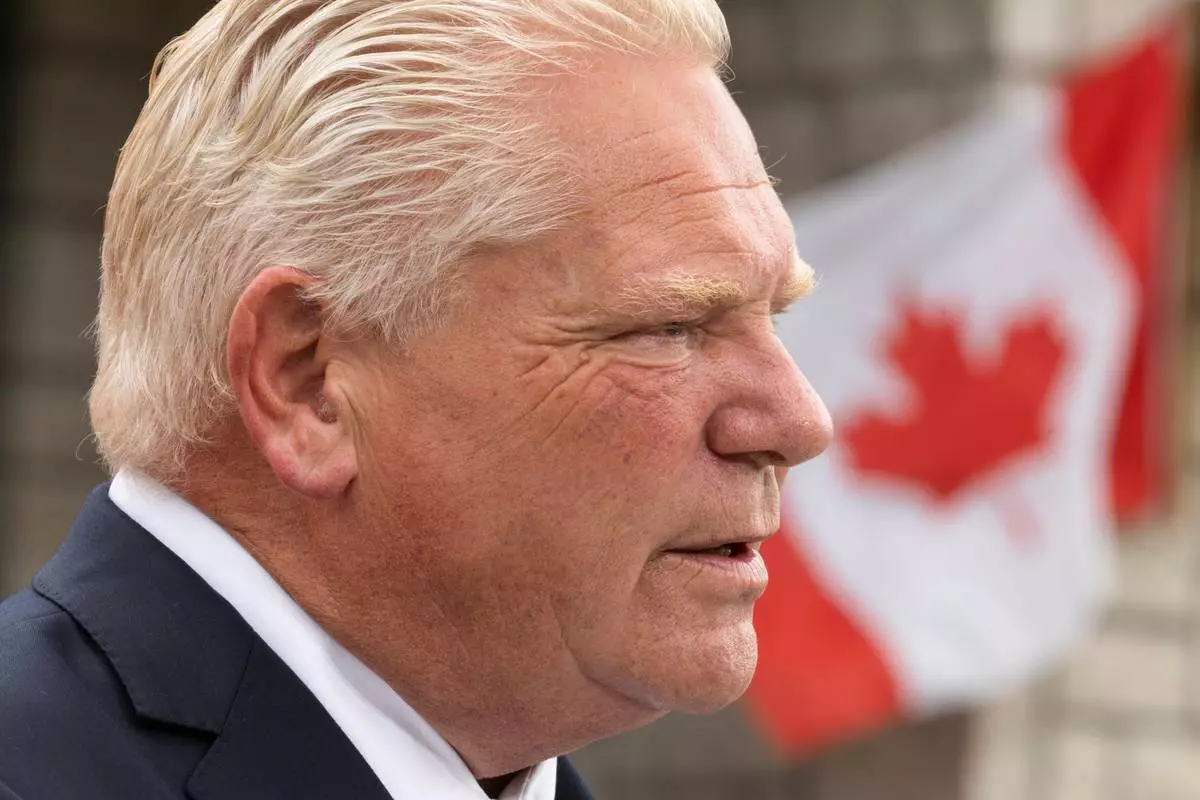
Ontario Premier Doug Ford speaks to media at a housing development in Hamilton, on Monday, Aug. 24, 2026. (Nick Iwanyshyn/The Canadian Press via AP)
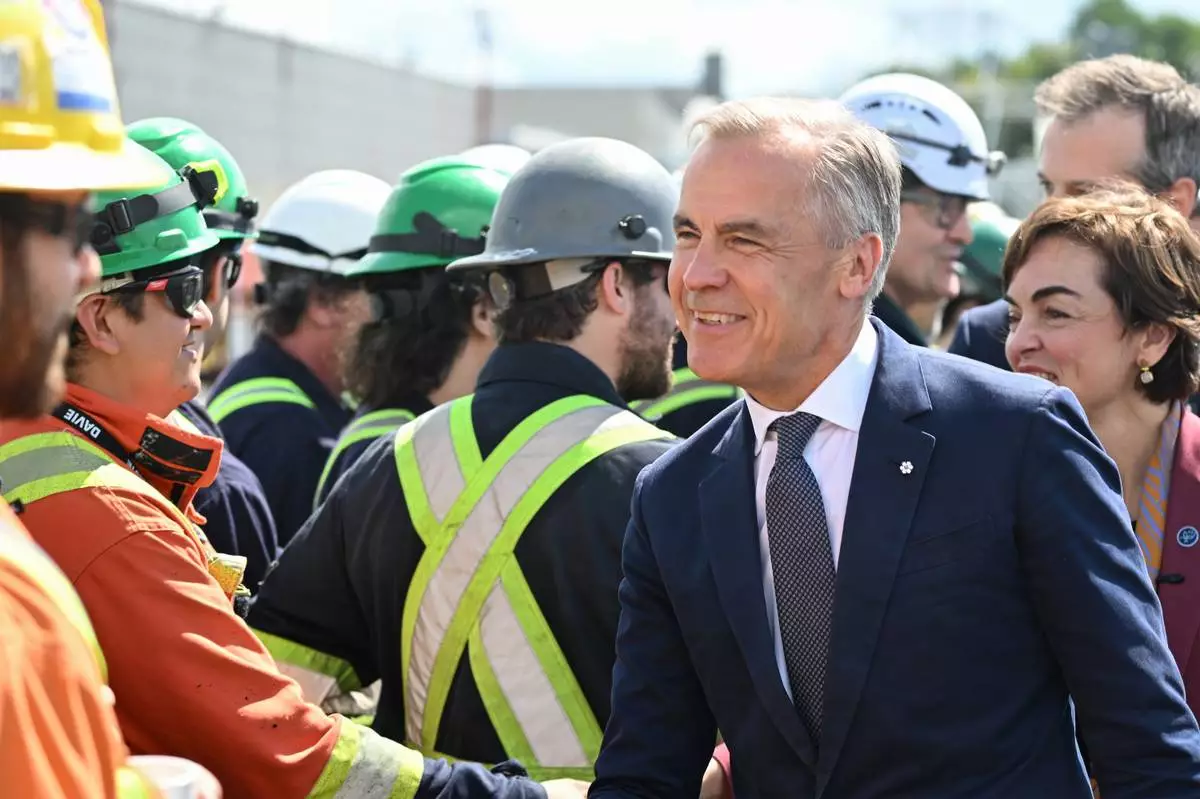
Canadian Prime Minister Mark Carney meets workers at the Davie shipyard in Levis, Monday, Aug. 24, 2026. (Jacques Boissinot/The Canadian Press via AP)

President Donald Trump speaks during a back to school event in the Rose Garden of the White House, Monday, Aug. 24, 2026, in Washington. (AP Photo/Alex Brandon)