Skip to Content Facebook Feature Image

How a Chinese film shot in dialect is finding a global audience

ENT

How a Chinese film shot in dialect is finding a global audience
ENT

ENT

How a Chinese film shot in dialect is finding a global audience

2026-08-26 09:03 Last Updated At:09:11

BANGKOK (AP) — The buzziest film in China this year was shot almost entirely in a southern Chinese dialect that most Chinese viewers need subtitles to understand.

Yet “Dear You” has become China's second-highest-grossing film of the year. Now it is heading overseas, part of a broader wave of Chinese cultural exports.

More Images
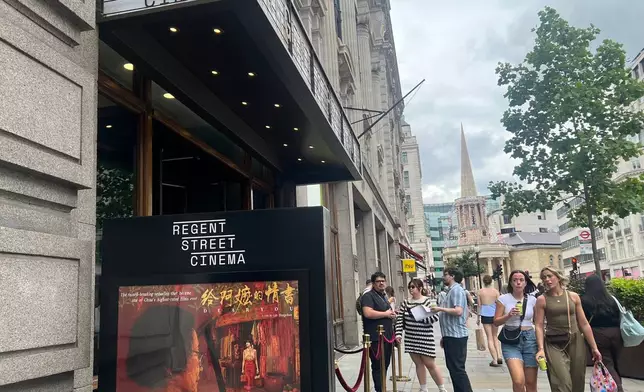
In this photo released by Xinhua News Agency, a poster is displayed outside a cinema before the premiere of Chinese film "Dear You" in London, on June 20, 2026. (Zhao Jiasong/Xinhua via AP)
In this photo released by Xinhua News Agency, a poster is displayed outside a cinema before the premiere of Chinese film "Dear You" in London, on June 20, 2026. (Zhao Jiasong/Xinhua via AP)

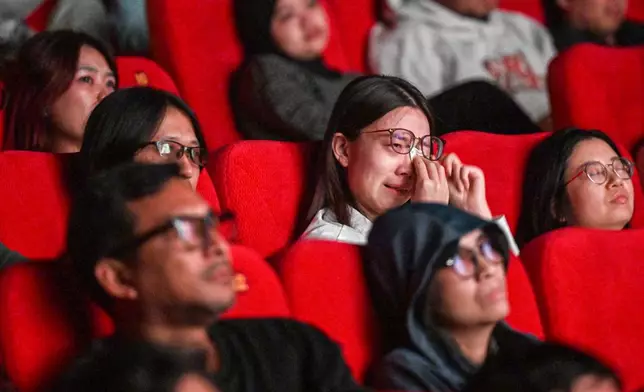
In this photo released by Xinhua News Agency, audience react to the Chinese film "Dear You" during its premiere in Jakarta, Indonesia, on Aug. 5, 2026. (Agung Kuncahya B./Xinhua via AP)

In this photo released by Xinhua News Agency, audience react to the Chinese film "Dear You" during its premiere in Jakarta, Indonesia, on Aug. 5, 2026. (Agung Kuncahya B./Xinhua via AP)

In this photo released by Xinhua News Agency, a woman takes photos during the special screening of Chinese film "Dear You" in Kuala Lumpur, Malaysia, on June 15, 2026. (Chen Zeguo/Xinhua via AP)

In this photo released by Xinhua News Agency, a woman takes photos during the special screening of Chinese film "Dear You" in Kuala Lumpur, Malaysia, on June 15, 2026. (Chen Zeguo/Xinhua via AP)

A man walks past a poster for the movie "Dear You" at a shopping mall in Rayong, Thailand, on Aug. 10, 2026. (AP Photo/Sakchai Lalit)

A man walks past a poster for the movie "Dear You" at a shopping mall in Rayong, Thailand, on Aug. 10, 2026. (AP Photo/Sakchai Lalit)

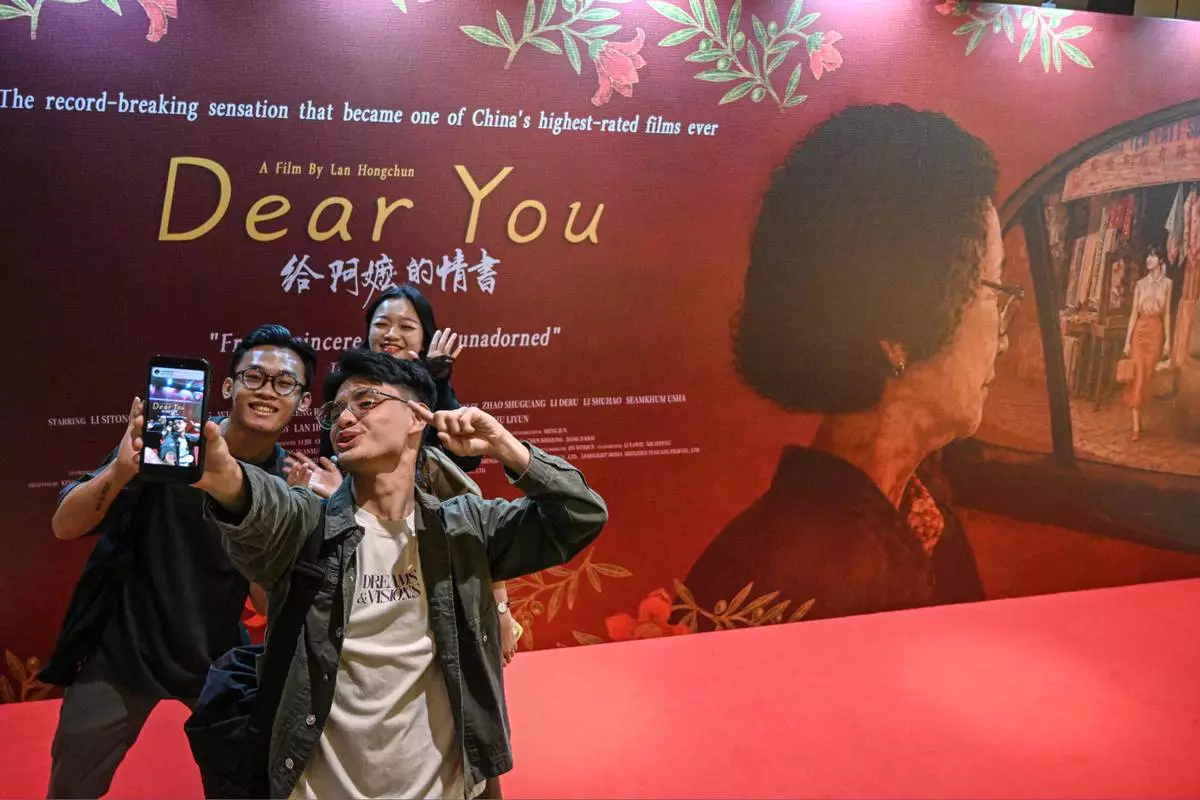
In this photo released by Xinhua News Agency, viewers take selfie in front of an advertisement for the Chinese film "Dear You" during its premiere in Jakarta, Indonesia, on Aug. 5, 2026. (Agung Kuncahya B./Xinhua via AP)

In this photo released by Xinhua News Agency, viewers take selfie in front of an advertisement for the Chinese film "Dear You" during its premiere in Jakarta, Indonesia, on Aug. 5, 2026. (Agung Kuncahya B./Xinhua via AP)

“Dear You" was shot mostly in Teochew, a dialect spoken in Guangdong’s Shantou region. Set among the Teochew immigrant community in Bangkok, it tells the story of people who left China in search of work to support their families. Made on a low budget, it features a cast of mostly unknown actors.

The film provides a glimpse into the centuries-long history of Chinese migration to Southeast Asia. It has succeeded in making this little-discussed history visible to a wider audience, threading the fine needle of passing official censorship requirements, experts say, while telling a compelling story.

As of August, the movie had grossed about 269 million yuan ($40 million) at the Chinese box office. It was released in Thailand in early August after being shown in Singapore, Malaysia and Australia. It will be released in the U.S. next month.

The film's popularity comes as Chinese culture and consumer brands have been gaining global cachet — from collectible Labubu dolls to “Chinamaxxing,” a social media trend of embracing aspects of the Chinese lifestyle.

The Chinese government began promoting the film as it became a hit and prepared for its international release.

The Chinese consul in Sydney said at a June screening of the film that it “reflects the Chinese nation’s virtues of diligence, kindness, courage and unity.”

The movie aligns with Beijing’s broader goal of “telling China’s stories well,” highlighting themes of friendship, tradition and family, including motherhood and kinship, said Belinda He, an assistant professor of East Asian cinema and media studies at the University of Illinois Urbana-Champaign.

China’s ambassador to Thailand presented the film at a special screening in July and again at a red carpet event this month.

“We’re grateful to Guangdong for making such a wonderful film,” Chinese ambassador Zhang Jiangwei said at the red carpet event, which was attended by officials from Guangdong's Information Office. “Stories about ordinary people and simple, genuine emotions can be even more moving. This film is an excellent vehicle for telling China’s story well.”

The film first resonated in Malaysia and Singapore because it showcases a history that's rarely featured in mainstream films.

Chinese migration to Southeast Asia dates back centuries, with many migrants coming from the Guangdong and Fujian provinces in southern China. Many worked as laborers in building projects in an era of Western colonial rule across much of Asia.

The film starts with a young man trying to find his grandfather, Deng Musheng, in hopes of getting a loan to repay his debts. In the family lore, there was supposedly a wealthy grandfather in Thailand, who left his young wife and children behind in China and never came back.

Using an address on an old remittance letter his grandfather had sent, he meets people who became part of his grandfather’s life in Bangkok, uncovering the mystery of why his grandfather never returned.

The film's director, Lan Hongchun, wrote in a column for the People's Daily, a state media outlet, that he grew up hearing stories from his grandmother about people she knew migrating to Bangkok, and wanted to tell these stories in film.

The plot revolves around “qiaopi,” remittance letters used by Chinese immigrants to send money and news back home. Many workers who could not write Chinese relied on scribes to compose the letters.

Scenes set in the centralized offices where the scribes worked, called “poy kuan,” were directly out of the childhood of 74-year-old Sathien Tuntipaiboontana.

“I connected emotionally with that part of the film quite strongly," he said after watching the first screening of the film in a Bangkok theater with his older sisters and sisters-in-law. Among them was his eldest sister, who is 89 and needed help climbing the stairs to the cinema.

Their father had immigrated to Bangkok from China in search of work, leaving behind a wife and children. He ended up remarrying and never returned to China. But Sathien’s family continued to send remittances to the family left behind in China.

Thitikorn Phanprayoon, a third-generation Thai Chinese, said he decided to see the film after hearing Teochew, the Chinese dialect he speaks at home, in the trailer. It surprised him since most Chinese films are in Mandarin. He plans to return with his parents.

“I felt like I was sitting at home," he said. “It felt like my family was performing in the movie in front of me.”

AP writer Fu Ting contributed to this story from Washington, D.C.

In this photo released by Xinhua News Agency, a poster is displayed outside a cinema before the premiere of Chinese film "Dear You" in London, on June 20, 2026. (Zhao Jiasong/Xinhua via AP)

In this photo released by Xinhua News Agency, a poster is displayed outside a cinema before the premiere of Chinese film "Dear You" in London, on June 20, 2026. (Zhao Jiasong/Xinhua via AP)

In this photo released by Xinhua News Agency, audience react to the Chinese film "Dear You" during its premiere in Jakarta, Indonesia, on Aug. 5, 2026. (Agung Kuncahya B./Xinhua via AP)

In this photo released by Xinhua News Agency, audience react to the Chinese film "Dear You" during its premiere in Jakarta, Indonesia, on Aug. 5, 2026. (Agung Kuncahya B./Xinhua via AP)

In this photo released by Xinhua News Agency, a woman takes photos during the special screening of Chinese film "Dear You" in Kuala Lumpur, Malaysia, on June 15, 2026. (Chen Zeguo/Xinhua via AP)

In this photo released by Xinhua News Agency, a woman takes photos during the special screening of Chinese film "Dear You" in Kuala Lumpur, Malaysia, on June 15, 2026. (Chen Zeguo/Xinhua via AP)

A man walks past a poster for the movie "Dear You" at a shopping mall in Rayong, Thailand, on Aug. 10, 2026. (AP Photo/Sakchai Lalit)
A man walks past a poster for the movie "Dear You" at a shopping mall in Rayong, Thailand, on Aug. 10, 2026. (AP Photo/Sakchai Lalit)

In this photo released by Xinhua News Agency, viewers take selfie in front of an advertisement for the Chinese film "Dear You" during its premiere in Jakarta, Indonesia, on Aug. 5, 2026. (Agung Kuncahya B./Xinhua via AP)


In this photo released by Xinhua News Agency, viewers take selfie in front of an advertisement for the Chinese film "Dear You" during its premiere in Jakarta, Indonesia, on Aug. 5, 2026. (Agung Kuncahya B./Xinhua via AP)

These used to be among the fundamental facts about going to college in America: College lasts four years. And though that timeline had been flexible when it comes to sports, there was never much debate over the notion that once a player moved on to the pros, their days as a college athlete were over.

A recent rule passed by the NCAA has resulted in confusion, lawsuits and the once unthinkable notion of players leaving college, signing with professional teams and then turning around to head back to college.

Among this week's headline grabbers were Dae’Quan Wright and Zxavian Harris, a pair of undrafted players out of Mississippi who had tryouts in the NFL over the summer, hoping to play this season at Ole Miss' rival in the Southeastern Conference, No. 11 LSU.

Wright and Harris are among a number of college athletes who have sued for the right to return to college to play as the start of both the college football and NFL seasons approach. Their moves, however, might not work out, as both the SEC and Big Ten passed new rules Tuesday barring pros from heading back to college to play. Those rules themselves could also be challenged in court.

A quick look at how we got here:

This part happened in June, and by the NCAA's plodding standards, it happened quite fast.

The rule now allows athletes to play five seasons over the span of five years. Most college athletes now see the “clock” start on their eligibility either when they enroll full-time in college or at the start of the regular school year immediately following their 19th birthday, whichever comes first.

The rule itself isn't all that outlandish. A lot of players were taking redshirt years (and getting extensions due to the pandemic) to prolong their eligibility to five, six, seven years and more, so putting some guardrails around it made some sense.

But the NCAA's decision to start applying this new rule to athletes who graduated high school in 2023 is what caused the chaos. By not including those from the Class of '22, many of whom saw their fourth and final year of eligibility end after last school year, they opened themselves up to trouble.

The members of the Class of ‘22 are arguing they’re being deprived of education and potential NIL financial benefits by being excluded from the rule.

Meanwhile, college athletes are suddenly looking at unexpected competition for roster spots and playing time coming from a class of players they thought would be gone this season. And teams, most of which have locked in their football rosters, are seeing a potential influx of talent they didn't expect.

A basketball player named Brock Wisne filed a federal class-action lawsuit, saying the NCAA violated antitrust law by excluding that Class of 2022 from the new rule. A judge in Denver ruled in favor of Wisne, opening the door for everyone in the class to come back to college, but only to their former college. The judge left NCAA transfer portal rules intact, meaning the players couldn't come back, enter the (currently closed) portal and find a new school.

An appeals court last Friday temporarily halted that judge's order, though that was hardly the end of the confusion.

Despite the federal court ruling, players across the country have filed lawsuits in state courts and many judges granted orders allowing them to come back to school. This “find a local judge” approach has generally been successful for the athlete over the past couple of years.

In some cases — including the case involving Wright in Louisiana — a judge not only said the players could come back, but also ordered a weeklong reopening of the transfer portal, which gave the players a chance to shop around.

Sam Ehrlich, a former lawyer who follows college sports litigation at Boise State, said the state lawsuits were filed “just in case” the federal order got overturned. It did, and that federal case had no bearing on the various state lawsuits.

According to Ehrlich's College Sports Litigation Tracker, at least 26 eligibility cases have been filed in state and county courts across the U.S. In at least 10 of those, judges have granted a restraining order or injunction favoring the players. In only one — involving basketball player Filip Borovicanin — has an appeals court overturned the initial decision, leading to a favorable outcome for the NCAA.

Court cases move slowly, and in the Wisne case, odds are nothing will be final until long after football (and maybe basketball and baseball) season is over and there's no relief left to give to the impacted players.

While football teams are madly scrambling, trying to make sense of it all, basketball teams are also feeling some pressure. Teams are allowed to start practice on Sept. 25. A notable instance of where confusion might set in is Gonzaga, which recruited two players from that Class of '22 who (presumably) had their eligibility restored.

One, however, is Javon Bennett, who was part of the Borovicanin lawsuit that an Ohio court overturned. The other is Chauncey Wiggins, who comes from Florida State and was part of a case in Georgia, where the ruling favorable to the players remains in force.

Sign up for Top 25 poll alerts here. Visit the Top 25 here and see AP’s full college football coverage here.

The NFL logo is shown the field before the start of a preseason NFL football game between the Green Bay Packers and the Pittsburgh Steelers in Pittsburgh, Thursday, Aug. 13, 2026. (AP Photo/Gene J. Puskar)

The NFL logo is shown the field before the start of a preseason NFL football game between the Green Bay Packers and the Pittsburgh Steelers in Pittsburgh, Thursday, Aug. 13, 2026. (AP Photo/Gene J. Puskar)

Recommended Articles