Robots picked up their paddles and served up a hard-fought sporting battle as table tennis debuted at the second World Humanoid Robot Games in Beijing, with teams of engineers programming their bots with the perfect match play strategy.
The five-day Games are set to conclude at the National Speed Skating Oval in the Chinese capital on Wednesday, after over 2,000 robots developed by more than 600 teams from 16 countries and regions battled it out in 51 competitive events.
At the Games, the ‘robo’ table tennis competition drew considerable attention given the sport's popularity in China. The opening ceremony on Saturday even featured an entertaining exhibition rally between 3-time Olympic champion Ding Ning and a humanoid robot.
When it came to the fiercely-contested competition itself, the robots -- decked out in baseball caps and athletic-looking footwear -- relied entirely on their own split-second judgment. Using high-speed visual perception, they tracked the ball, worked out where to move, and how they should swing to hit the perfect return, with no remote control or human input guiding their shots.
The event drew 12 teams from China and around the world. Games were played under International Table Tennis Federation best of three rules, though officials modified the rulebook to suit robotic competitors. The standard five-minute break between sets gave the bots a breather and allowed engineers to troubleshoot hardware issues or recalibrate software ahead of the next round of play.
Chief referee Mu Chunlei said there were even robot-specific rules when it came to executing the serve.
"There is a 10-minute preparation time before the match. The robot must serve the ball within the set time. We do not require the height of the ball toss, and we do not limit how the robot holds the ball. A motion capture system is also used in this table tennis competition, which is not employed in human athletes' competitions," said Mu.
In their quest for success, engineers from the participating teams carefully created a custom-built algorithm which determined each play. This involved feeding real-time video of the ball's trajectory and the robot's own position, enabling the robo-player to calculate precisely when to hit the return shot entirely on its own.
In the end, the Peking University-Beijing Academy of Artificial Intelligence (PKU BAAI) side proved victorious as they sealed a 2-0 victory over the University of Hong Kong SMASH Team in Tuesday’s final.
The Games has already showcased the staggering potential of the robotics sector after one humanoid sprinter smashed Usain Bolt’s long-standing 100-meter world record.
Following their win in the inaugural table tennis event, PKU BAAI team captain Li Xianglong said they are now hoping to close the gap with human players even further.
"We hope our robot can move more dynamically like a real human athlete in the future, and perform more skilled batting moves," he said.
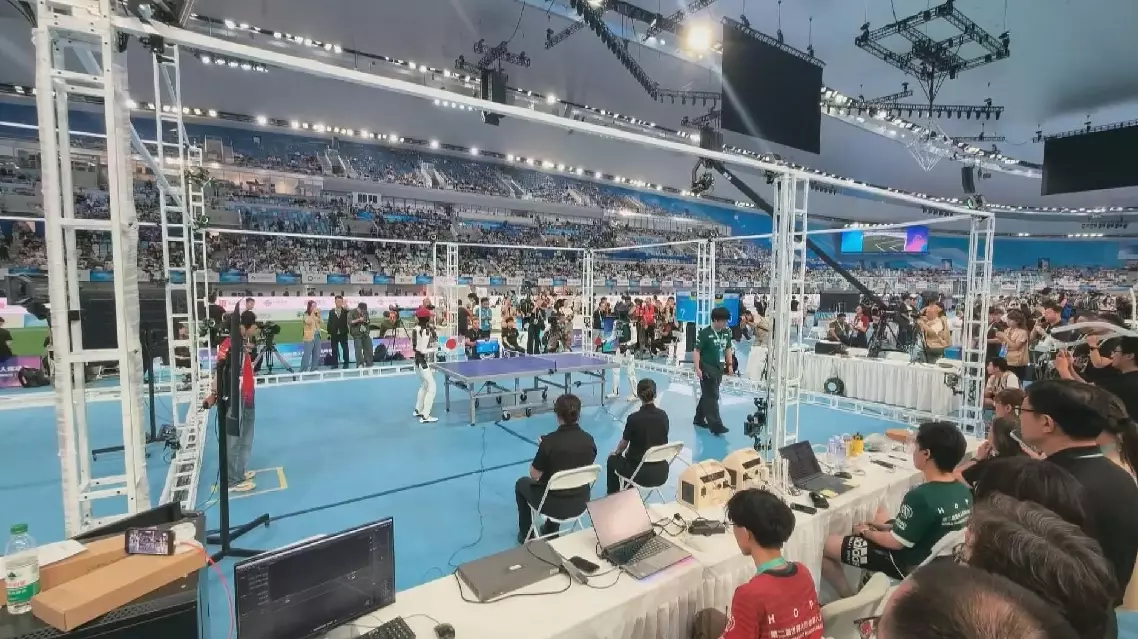
Robot table tennis players serve up tech showdown in Beijing