LINKÖPING, Sweden--(BUSINESS WIRE)--Aug 26, 2026--
AMRA Medical is pleased to announce the publication of new research in Neurology demonstrating the potential of quantitative whole-body MRI to measure disease progression in Spinal and Bulbar Muscular Atrophy (SBMA), a rare, progressive neuromuscular disease. The research was also selected for the cover of the issue, providing additional visibility for this important work in neuromuscular disease research.
This press release features multimedia. View the full release here: https://www.businesswire.com/news/home/20260826386576/en/
The manuscript, titled “Muscle MRI as an imaging biomarker of muscle damage in patients with spinal and bulbar muscular atrophy” highlights how MRI-based muscle composition biomarkers can provide sensitive and objective measures of disease-related change over time. With AMRA Ⓡ Researcher, the study evaluated 25 participants with SBMA to investigate the ability of fat-referenced MRI to assess changes in muscle composition. Using quantitative whole-body MRI, researchers measured longitudinal changes in muscle composition and examined their relationship to established clinical assessments of disease severity and function.
The findings demonstrated that MRI-derived measures were able to detect significant changes in muscle composition over a 12-month period, underscoring their responsiveness to muscle changes related to progression of SBMA. In addition, baseline MRI measures were correlated with established clinical outcomes, including the Spinal and Bulbar Muscular Atrophy Functional Rating Scale (SBMAFRS) and the 2-Minute Walk Test. These baseline correlations suggest that quantitative muscle imaging may be relevant in SBMA, but additional studies are needed to further characterize the relationship between MRI measures and clinical outcomes.
These results add to a growing body of evidence supporting the use of quantitative MRI as a potential biomarker in neuromuscular disease research. Detecting disease progression in rare neuromuscular disorders can be challenging due to disease heterogeneity, slow progression rates, and limitations associated with traditional functional assessments. Sensitive imaging biomarkers capable of capturing subtle changes in muscle composition may help researchers better understand disease biology, evaluate therapeutic interventions, and improve endpoint selection for clinical trials.
Publication of this work in Neurology, one of the world’s leading journals in clinical neurology research, expands the growing evidence base for quantitative whole-body MRI beyond previously studied neuromuscular diseases and highlights the potential for additional studies to be conducted utilizing these MRI-based measures within SBMA. As interest continues to grow in the development of therapies for rare neuromuscular disorders, standardized imaging biomarkers have the potential to provide researchers and sponsors with more objective and reproducible measures of disease progression. Recently, AMRA has worked extensively in the neuromuscular disease research space, both in rapidly and slowly progressing neuromuscular diseases as well as inflammatory myopathies (FSHD, DMD, sIBM).
You can find the full manuscript, published in the most recent issue of Neurology,here.
About AMRA Medical
AMRA Medical is a global leader in health informatics, pioneering the field of fat and muscle analysis with proprietary, MRI-based technologies. Our gold-standard platform delivers highly precise and standardized biomarkers, providing an advanced understanding of metabolic and musculoskeletal health that surpasses conventional body composition metrics. These insights play a critical role in optimizing clinical trial design, improving endpoint selection, and supporting data-driven decision-making in both research and clinical practice.
Built on rigorous science and driven by continuous innovation, AMRA’s solutions are designed to meet the complex demands of modern healthcare and pharmaceutical development. Through standardized, cloud-based workflows and strategic collaboration, we enable partners to access actionable data with clarity and confidence–accelerating progress from early-stage discovery to impactful clinical outcomes.

AMRA Medical - Measuring Muscles with Quantitative MRI
Iran will not allow military vessels to transit through the Strait of Hormuz under an agreement the Islamic Republic is currently negotiating with Oman, Iran's Deputy Foreign Minister told state TV late on Tuesday night.
The top diplomats of the two countries met to discuss managing commercial shipping traffic in the vital waterway, which remains largely shut down nearly six months after the Iran war began.
Officials in Thailand said the USS Lincoln was scheduled for a brief stopover in the country as the aircraft carrier prepares to reposition after a lengthy deployment, including support for the Iran war.
Meanwhile, Israel’s strikes continued in Gaza, testing the already fragile ceasefire with Hamas.
Here’s a look at the latest developments in the Iran war and the wider Middle East. Full coverage can be found here.
Iran and Oman have reached an understanding on a new framework for managing ship traffic in the Strait of Hormuz that would exclude military vessels from traversing the vital waterway, Iranian Deputy Foreign Minister Kazem Gharibabadi told state TV late on Tuesday night.
“If the understanding becomes binding, no military vessel will be permitted to pass through the Strait of Hormuz,” he said. “No military vessel at all.”
Gharibabadi said the proposed route is temporary, and that Iran and Oman must negotiate within 30 to 60 days on a permanent maritime traffic scheme.
Commercial shipping traffic into the Persian Gulf from the Gulf of Oman would pass entirely through Iranian waters, while the outbound route would pass partly through Iranian waters and partly through Oman’s territorial waters, he said.
The Trump administration told Oman it opposed parts of the evolving deal, including the joint Iranian and Omani management of the exit route out of the passage that’s critical to global supplies of oil and natural gas.
U.S. President Donald Trump last week threatened to bomb Oman if it “gets in the way.”
An Israeli strike on a tent for displaced people Wednesday in southern Gaza killed one person and wounded at least four others, according to officials at the territory’s Health Ministry. The Israeli military said it struck a “military operative,” without elaborating.
Even as U.S. efforts to advance the fragile ceasefire in the nearly three-year Israel-Hamas war continue, Palestinians in the strip have reported a surge in deadly Israeli strikes.
Israel has said it targets Hamas and other militants who pose a threat, as well as those who participated in the Oct. 7, 2023, attack that triggered the war. About 1,200 people, mostly civilians, were killed that day in Israel and 251 abducted by militants. Israel's retaliatory military campaign in the enclave killed more than 73,400 people, according to the Gaza Health Ministry.
The health ministry, part of the Hamas-controlled government, is staffed by medical professionals and maintains detailed records viewed as generally reliable by United Nations agencies and independent experts. It does not distinguish between civilians and militants.
Dubai International Airport, one of the world's busiest travel hubs, said Wednesday it saw a sharp drop in passengers during the second quarter as the war with Iran disrupted air travel and prompted many travelers to choose routes that avoided the Middle East.
The airport recorded 13 million passengers in the second quarter, down 31.3% in passenger traffic in the first-half of 2026 compared to the same period last year, with 31.5 million passengers
Air traffic in the United Arab Emirates and elsewhere in the Gulf region was disrupted by shutdowns and restrictions since Feb. 28. The airport itself suffered minor damage in attacks from Iran.
CEO Paul Griffiths noted, however, that passenger volume has steadily increased each month in the second quarter, and said the momentum is expected to continue in the second half.
The U.S. aircraft carrier USS Abraham Lincoln will make a stop in Thailand after its grueling deployment in the Middle East, Thai officials said, without specifying a date or port for security reasons.
The Lincoln has been deployed during the Iran war. Its very lengthy deployment, including a record-setting uninterrupted time at sea of more than 250 days, raised concerns about deteriorating mental health among the crew.
A statement from the Royal Thai Navy on Tuesday said a short stopover by U.S. Navy ships was for recuperation and that no military exercises would be carried out during the visit.
Germany has ended the military mission of its advisers in Iraq’s semiautonomous northern Kurdish region after years of supporting the U.S.-led coalition’s efforts against Islamic State militants, the Kurdish region’s Ministry of Peshmerga Affairs said Wednesday.
The ministry said it held an official ceremony at Camp Stephan at Irbil International Airport to mark the mission’s end. Germany had already reduced its footprint in Iraq but had maintained a small contingent at the base.
The end of the German mission comes as U.S. forces have also begun withdrawing from northern Iraq ahead of a Sept. 30 deadline to end their military presence in the country.
U.S. bases in the Kurdish region have regularly come under attack since the U.S. and Israel launched the Iran war on Feb. 28.
Human Rights Watch condemned a decision by Yemen’s Houthis to refer at least six people to a criminal court known for trying terror and espionage charges.
The New York-based advocacy group said at least five of those facing charges in the notorious Specialized Criminal Court are either United Nations employees or civil society workers. The group also said one of the defendants, Ali Mudhwahi, a national public health expert with UNICEF, was tortured and forced to confess that vaccines were spying tools.
Since the Houthis took over in 2015, dozens of journalists, political activists and members of religious minorities have stood trial in the Sanaa-based court on charges that are usually punishable by death.

Palestinians look at a food-aid warehouse damaged in an Israeli airstrike that targeted a nearby house in Deir al-Balah, central Gaza Strip, Wednesday, Aug. 26, 2026. (AP Photo/Abdel Kareem Hana)
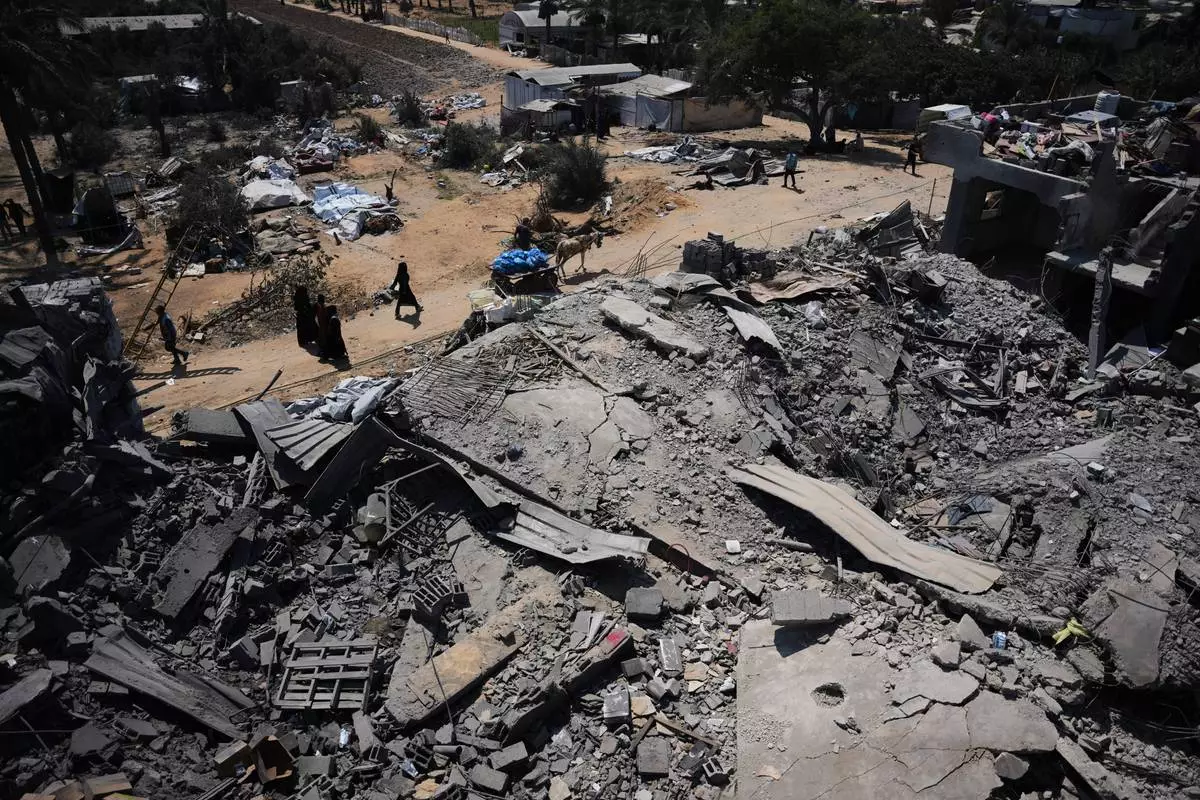
Palestinians walk past a food-aid warehouse damaged in an Israeli airstrike that targeted a nearby house in Deir al-Balah, central Gaza Strip, Wednesday, Aug. 26, 2026. (AP Photo/Abdel Kareem Hana)

Palestinians walk past a food-aid warehouse damaged in an Israeli airstrike that targeted a nearby house in Deir al-Balah, central Gaza Strip, Wednesday, Aug. 26, 2026. (AP Photo/Abdel Kareem Hana)