VENTURA, Calif.--(BUSINESS WIRE)--Aug 27, 2026--
The Trade Desk, a leading global advertising technology company, today introduced Kokai Zuma, the new release of its Kokai platform. Introduced in 2023, Kokai is The Trade Desk’s platform for planning, buying and measuring advertising across the open internet. The Zuma release makes Kokai easier to navigate, learn and use, bringing together new agentic AI capabilities and a simpler measurement framework.
This press release features multimedia. View the full release here: https://www.businesswire.com/news/home/20260827823634/en/
As advertising becomes increasingly fragmented across channels, formats and devices, media buyers face more complexity in managing campaigns and understanding what drives performance. Zuma is designed to remove that friction, helping traders find what they need faster, make changes with greater confidence, and spend less time managing workflows so they can focus on optimizing campaigns and driving better results. Additionally, the update builds on the AI forecasting engine that has been at the heart of Kokai.
While the redesigned interface is the most visible change, the larger resource investment has gone into upgrading the platform's forecasting engine and the AI infrastructure underneath the platform – predicting available inventory, modeling campaign outcomes and powering Koa's agentic capabilities in real time. Initial results of Zuma’s improved modeling and forecasting capabilities have seen an average 32% improvement in CPA performance. These backend investments are what make the workflow – and campaign – improvements possible, and they mark a strategic shift in how The Trade Desk is investing in the platform going forward, making it foundational to everything clients see within their experience.
“Kokai changed the way digital media is bought and sold programmatically, and Zuma builds on that foundation, making our platform faster, simpler and smarter,” said Jeff Green, founder and CEO, The Trade Desk. “AI is helping our customers move faster than ever, while making measurement more intuitive and actionable. We’ve listened closely to our users about what they need to navigate an increasingly fragmented digital media ecosystem, and Zuma brings those learnings into Kokai. We’re continuing to build the platform that advertisers deserve – one that removes friction from the work, puts agentic AI to practical use and gives them a clearer view of the outcomes their media dollars are driving.”
Agentic AI Powered by Koa
Koa is the artificial intelligence that powers The Trade Desk, helping advertisers make smarter decisions and improve campaign performance through real-time analysis of more than 20 million ad impressions every second. Introduced in 2018, Koa has continuously evolved as The Trade Desk has expanded the use of AI across its platform. Today, Koa powers a growing set of agentic capabilities within Kokai, including a new conversational experience and specialized Koa Agents that help users automate tasks, uncover opportunities, and take action faster.
Simplified Measurement and Reporting
Zuma makes it easier for advertisers to measure campaign impact and access the insights they need to optimize performance.
A Simpler, More Intuitive Kokai Experience
Zuma incorporates feedback from The Trade Desk’s users to make common workflows easier to understand and manage, while surfacing the information traders need to make decisions quickly.
"This is impressive,” said Karsten Weide, Principal and Chief Analyst, W Media Research. “It's great to see The Trade Desk go full-bore on agentic, and the performance gains are real numbers. That's encouraging – this is real change."
Zuma is rolling out to Kokai clients globally beginning today, with additional capabilities and enhancements expected over time. The capabilities described here are either generally available or available through open or closed beta. References to upcoming capabilities are for informational purposes only and subject to change. To learn more about Zuma and the latest innovations in Kokai, visit https://www.thetradedesk.com/resources/zuma-q3-2026-zuma-release-highlights
About The Trade Desk
The Trade Desk™ is a technology company that empowers buyers of advertising. Through its self-service, cloud-based platform, ad buyers can create, manage, and optimize digital advertising campaigns across ad formats and devices. Integrations with major data, inventory, and publisher partners ensure maximum reach and decisioning capabilities, and enterprise APIs enable custom development on top of the platform. Headquartered in Ventura, CA, The Trade Desk has offices across North America, Europe, and Asia Pacific. To learn more, visit thetradedesk.com or follow us on Facebook, Twitter, LinkedIn, and YouTube.

The Trade Desk Introduces Kokai Zuma, the Latest Release of Kokai
WASHINGTON (AP) — A new study suggests that El Ninos — the natural climatic chaos agent that pops up periodically and spikes global temperatures — are getting stronger because of human-caused climate change.
El Ninos are more than 36% stronger than they were before the industrial age began in the mid 1800s, with a 16% jump in just the last 40 years showing that the increase is accelerating, according to a study in Thursday's journal Science. The findings come as a strong El Nino that formed a couple months ago is forecast to be the biggest on record in coming months. El Ninos, which are a temporary warming of parts of the equatorial Pacific, warp weather worldwide and increase extreme events, including heat waves, floods in some places and droughts in others. They can cost trillions in damage.
“That’s important because strong El Ninos have much stronger impacts on climate hazards and extremes worldwide. When we set out to answer the question of why this might be happening, we set our data up against a record of global temperature, and we found that the increase in El Nino’s strength closely parallels the rise in global temperature that is due to human causes such as the burning of fossil fuels,” said study lead author Julia Cole, a paleoclimate scientist at the University of Michigan.
Her study looks back at El Ninos going back 900 years or so.
“El Nino is the most violent aspect of climate variability worldwide, with effects ranging from local fisheries collapse, to widespread coral die-offs to severe droughts and food shortages around the world,” said Dalhousie University marine scientist Boris Worm, who wasn't part of the study.
Worm quoted the late climate scientist Wallace Broecker who warned “the climate system is an angry beast and we are poking it with sticks.” And then Worm added: “Human emissions are the stick and El Nino is of the ‘angry’ outbursts that can be so threatening to our collective safety.”
An El Nino's strength is determined by measuring water temperature in a region of the central Pacific around the equator and comparing a three-month average to normal. If it's 0.5 degrees Celsius (0.9 degrees Fahrenheit) warmer than normal, it's becomes an El Nino. The top of the scale is 2 degrees Celsius (3.6 degrees Fahrenheit) and is called “very strong." The most recent weekly El Nino figure is at 2.7 degrees (4.9 degrees Fahrenheit) and is expected to keep growing for another two to four months, according to Columbia University's El Nino tracker.
Scientists have long theorized that as the world warms, El Ninos would get stronger because they are based on ocean temperature differences compared to average. But observational records only goes back about 75 years, so scientists have previously said the data is too spotty for a trend. So scientists have looked for clues that indicate an El Nino without measuring water temperatures directly. Scientists, for example, have looked back at historical records of changes in weather around the world and figured out past El Ninos — such as the super-sized one in 1877 — due to the changes they cause across the globe.
Cole's team took a novel approach by looking at at what happened to coral over the centuries to act as “a time machine to look into the past,” she said. Cole said measurements of the ratio of calcium and strontium in coral skeletons and of different oxygen isotopes create two independent readings of the seawater in which the coral formed. Another measurement of uranium and thorium tell when those skeletons were formed.
Cole looked at 29 coral fossils in the Galapagos Islands — 14 from before the industrial era, 14 after the modern era began and one more from about the time the industrial era was starting up. The oldest was from around year 1100.
The temperatures she derived from the fossils over more than 900 years are patchy, with gaps, but when charted it, she said it looks like a hockey stick, the same description used for a 1990s landmark study of past global temperatures.
She and other scientists say it's only going to get worse.
“It raises the specter of a future where larger El Niño and La Niña events are dialing up the pace and severity of weather and climate extremes.,” said Kim Cobb, a coral and climate scientist at Brown University, who wasn’t part of the study.
Outside scientists are split on the research with some hailing it as important and trustworthy and others saying they don't buy it because it clashes with some recent observations.
“Corals are the gold standard for El Niño reconstruction, and this brings a goldmine of new material to the table,” Cobb said. “We can either wait many many decades for the instrumental record to get long enough to detect a shift in El Niño properties, or we can use centuries of El Niño reconstructions provided by paleoclimate records. Taken together, the paleoclimate data that we have, from across the Pacific, is fairly consistent in pointing to an intensification of El Niño’s with global warming.”
Both University of Pennsylvania climate scientist Michael Mann — originator of the temperature hockey stick — and University of North Carolina marine scientist John Bruno said that the coral data conflicts with recent observations of water temperature in the Galapagos. Data shows “a substantial decline in recent decades” of El Nino related variations near the Galapagos during the time greenhouse gases increased temperatures the most, Mann said.
What’s being reflected by the coral is not a change in El Nino as much as the warming from greenhouse gases, Bruno said.
Cole said the huge 1997-1998 El Nino and then small ones until 2023-24 created a situation where it seems like El Nino's aren't strengthening because measurements are based on a 20-year time period and there were a few years that fell between super El Ninos that skewed data. She said El Nino varies in strength so much and that up-and-down nature doesn’t go away just because it is responding to warmer conditions.
But the scientists all agreed that climate change is a problem, with or without El Nino worsening.
“It's important to point to this as one more reason why we need to get off fossil fuels,” Cole said. “There isn't a magic bullet that's going to slow El Ninos down.”
——
Julian Trejo Bax contributed from New York.
The Associated Press’ climate and environmental coverage receives financial support from multiple private foundations. AP is solely responsible for all content. Find AP’s standards for working with philanthropies, a list of supporters and funded coverage areas at AP.org.

FILE - Locals and tourists gather to look at a fishers' catch on a beach in Rongshanliao village on southern China's Hainan province, Aug. 23, 2026. (AP Photo/Ng Han Guan, File)

FILE - Woodhead reservoir is visible amid a drought near Manchester, England, Thursday, Aug. 13, 2026. (AP Photo/Jon Super, File)

FILE - Somali women displaced by drought line up at Feynuus Nutrition Centre on the outskirts of the capital, Mogadishu, Somalia, Aug. 19, 2026. (AP Photo/Farah Abdi Warsameh, File)
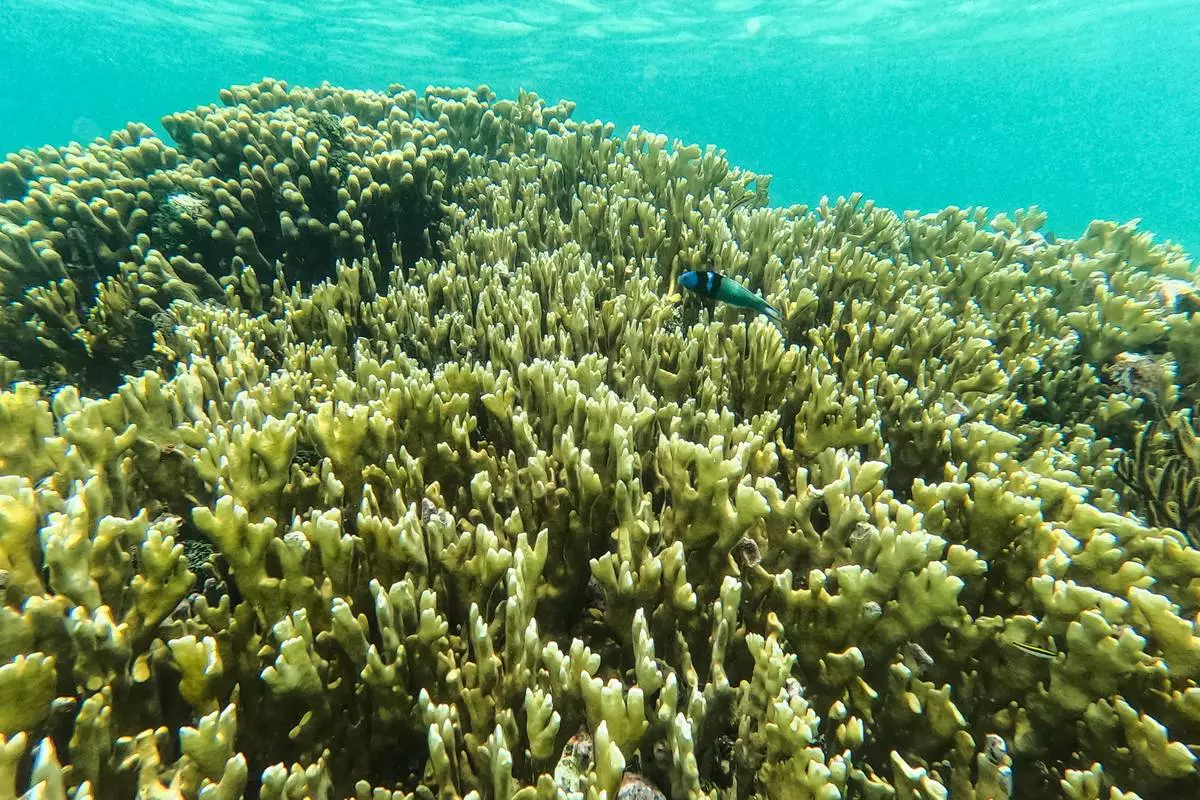
FILE - A fish swims through a coral reef in the Dutch Cays of Guna Yala on Panama's Caribbean coast, Aug. 25, 2026. (AP Photo/Matias Delacroix, File)

FILE - A woman uses a fan to cool off while riding a bus on a hot day in Bucharest, Romania, Aug. 6, 2026. (AP Photo/Vadim Ghirda)