BERLIN (AP) — A man suspected of fatally stabbing a 31-year-old British woman with a knife early Sunday morning in the southern German town of Rosenheim was detained, authorities said.
The woman, who was attacked at the Rosenheim train station, was taken to a nearby hospital where she died due to serious injuries, Rosenheim police said.
Federal police officers, called to the scene, detained the suspect right after the stabbing.
Police identified him as a 27-year-old German man from the nearby county of Fürstenfeldbruck.
They did not release the names of the victim or the suspect in line with German privacy rules and said they were still investigating the circumstances and motive behind the crime.
They asked any witnesses to come forward and asked whether anybody had witnessed “an argument or a physical altercation” in the early hours of Saturday night into Sunday at the train station.

The train station in the city of Rosenheim, Germany, Sunday Aug. 30, 2026, where a British woman was fatally stabbed in the early hours of Sunday. (Peter Kneffel/dpa via AP)
CAPE CANAVERAL, Fla. (AP) — NASA’s newest crown jewel blasted off Sunday to hunt for planets around other stars, explore secret dark energy and survey the cosmos like never before.
SpaceX launched the $4.3 billion Roman Space Telescope shortly after daybreak aboard a triple-the-fire-power Falcon Heavy rocket from Kennedy Space Center. Roman blazed toward an observation point 1 million miles (1.6 million kilometers) away that's home to the Webb Space Telescope, one of NASA's other big-ticket eyes in the sky.
The bus-sized telescope — named after the late Nancy Grace Roman, NASA’s first chief astronomer — will take more than three months to reach its destination. Once there, it will cast the widest gaze yet on the hidden parts of the universe from space, uncovering the unimaginable with unsurpassed speed.
“It’s going to find thousands of supernovae, tens of thousands of planets, billions of galaxies and tens of billions of stars,” said NASA science mission director Nicky Fox. “It’s going to be able to do things that we’ve never been able to do before with its massive field of view.”
Several minutes after the thunderous launch, the rocket's two reusable side boosters descended tail-first in a thrilling scene, producing sharp sonic booms as they landed back at Cape Canaveral. Fox was in tears watching the action unfold. “It's such a good day!” she said.
Roman’s field of view is more than 100 times wider than that of NASA’s Hubble Space Telescope, still churning out celestial glamour shots after 36 years in orbit. Webb joined the effort several years ago with an even narrower yet spot-on vision capable of zooming in on objects almost as old as the universe-creating Big Bang.
These three orbiting powerhouses will join forces — along with the European Space Agency’s Euclid spacecraft and the National Science Foundation’s Vera C. Rubin Observatory in Chile — to reveal some of the universe’s biggest secrets.
Inside the countless galaxies awaiting discovery are stars with planets. Once these new worlds are spotted by Roman, the more powerful and sensitive Webb will take aim to fill in the blanks.
“Roman’s vast reach will allow us to find the weird, the rare and the unusual,” senior project scientist Julie McEnery said on the eve of launch. “We’ll redefine what it means to find a needle in a haystack.”
Perhaps even more important, astronomers expect Roman to shed light on the dark matter and dark energy that make up most of the universe yet remain concealed. Roman's catalog of galaxies will help scientists ascertain how quickly the universe is expanding due to these puzzling, unseen forces.
Roman’s superpower is speed.
A month of Milky Way observations by Roman would take Hubble a century to complete, according to McEnery. Roman should make quick work of scanning the galactic bulge at dead center, she added, providing the deepest look yet into the heart of our galaxy.
Besides a wide-field infrared camera that matches Hubble’s sensitivity but is 1,000 times faster, Roman holds an instrument to block out starlight. This experimental, eclipse-creating coronagraph will allow Roman to directly image any planet, however faint, that might be orbiting the masked star.
The telescope is designed to be refueled, meaning if a robotic tanker becomes available in the coming decade, that could extend its life.
Launching nearly a year ahead of schedule and within budget, Roman is NASA's first space telescope to be named after a woman.
Retired NASA scientist Ed Weiler said the honor is long overdue. He coined the phrase “Mother of Hubble” for Roman, who hired him in 1978. Observatories above Earth’s obscuring atmosphere can see farther and better, she insisted after joining the brand new NASA in 1959. She died in 2018 at age 93.
“This is very, very fitting. I think Nancy would be very proud” that the namesake telescope will tackle some of the biggest, lingering questions about the universe such as dark energy, Weiler said.
Hubble launched in 1990 with a flawed mirror that required spacewalking astronauts’ dramatic intervention. Roman’s primary mirror is the same size as Hubble’s — nearly 8 feet (2.4 meters) in diameter — and is actually spy satellite surplus.
The National Reconnaissance Office donated two leftover mirrors to NASA more than a decade ago for repurposing. The second mirror is still in storage.
The Associated Press Health and Science Department receives support from the Howard Hughes Medical Institute’s Department of Science Education and the Robert Wood Johnson Foundation. The AP is solely responsible for all content.
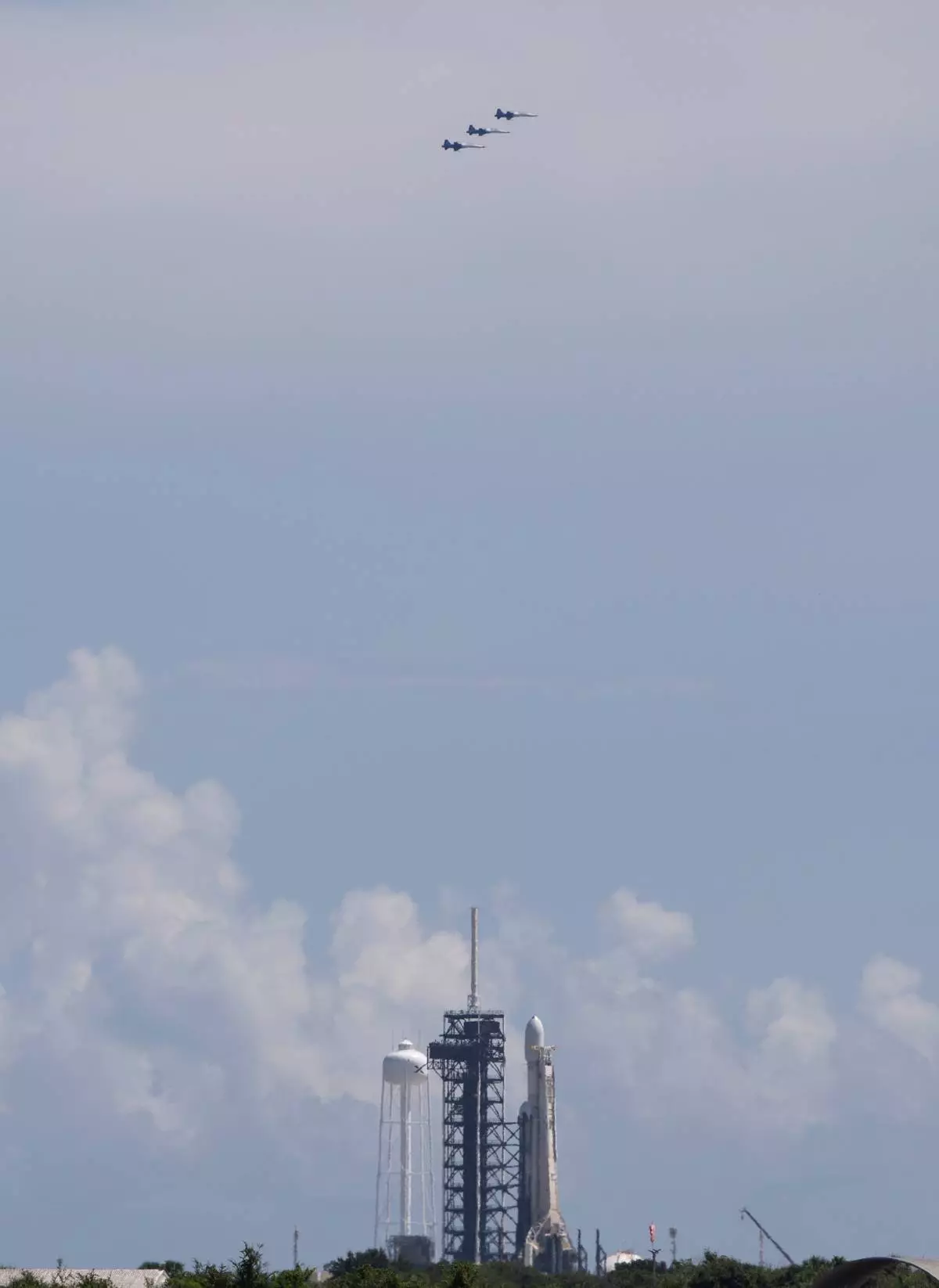
NASA Administrator Jared Isaacman leads a flight of his personally owned F-5 Tiger II aircraft on a flyby of Launch Complex 39A where a SpaceX Falcon Heavy rocket with NASA's Nancy Grace Roman Space Telescope, encapsulated in a protective payload fairing, is undergoing final launch preparations, Saturday, Aug. 29, 2026, at NASA Kennedy Space Center in Florida. (Joel Kowsky/NASA via AP)
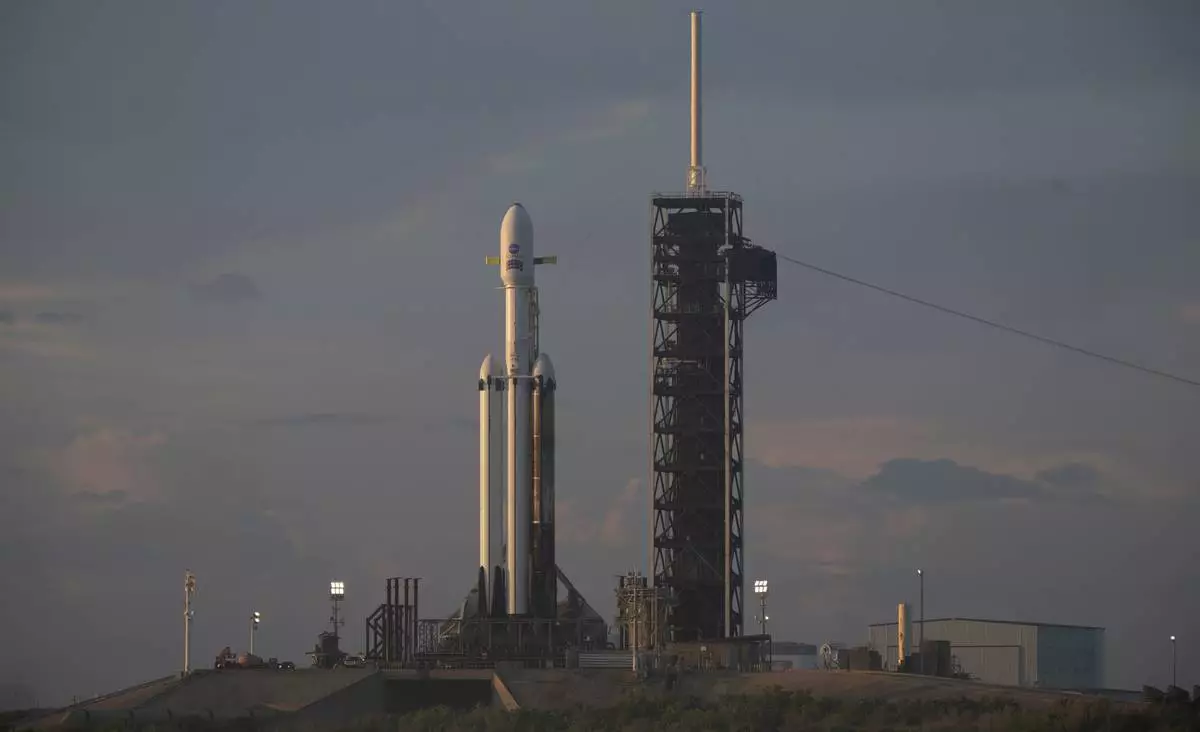
NASA's Nancy Grace Roman Space Telescope, encapsulated in a protective payload fairing atop a SpaceX Falcon Heavy rocket, is seen at sunrise, Saturday, Aug. 29, 2026, at Launch Complex 39A at NASA's Kennedy Space Center in Florida. (Joel Kowsky/NASA via AP)