In a world first, scientists in central China's Hubei Province are using non-invasive electrical imaging to explore deep beneath a dinosaur egg fossil site, a technique they describe as giving the ancient treasure an "electrocardiogram" without digging.
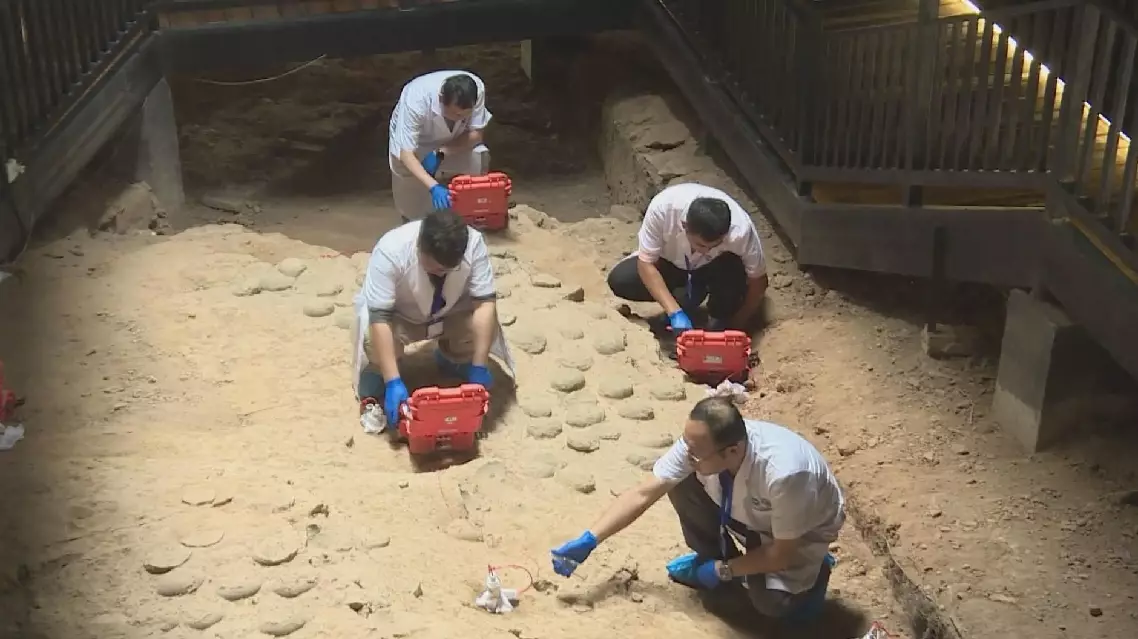
At the Qinglongshan Dinosaur Egg Fossil Group National Nature Reserve in Hubei’s Shiyan City, researchers are deploying high-precision 3D electrical detection technology to map the underground geological structure of the semi-exposed site, without disturbing a single fossil.
On the ground, researchers lay cables, place electrode arrays, and record data. The technique works by establishing an artificial electric field and transmitting stable currents underground. By measuring how different rock and sediment layers conduct electricity, the team can reconstruct the subsurface geology in vivid detail.
"These electrode points will allow us to fully map the underground electric field beneath Qinglongshan. We urgently need to know two things. First, how thick is the red sandstone layer that actually contains the dinosaur eggs? And how far does it extend? Neither of these can be determined from surface surveys alone. We've also found that groundwater poses the greatest threat to the eggs, which chemically react and decompose when exposed to water. We hope to trace the water source," said Zhao Bi, deputy chief engineer at the Hubei Institute of Geosciences.
Qinglongshan is home to the world's largest and best-preserved in-situ dinosaur egg fossil cluster, the only site that has achieved large-scale, intact conservation of eggs in their original setting. Over the years, conservation efforts have included surface laser scanning and other foundational research. But exploring underground has always been a challenge, as traditional drilling risks disturbing the remains and damaging the fossils meant to be protected.
"The greatest significance of this work is that we are applying deep-probing technology to conduct an underground survey of a fossil site for the first time in China, and even the world. We are collecting information in a non-intrusive way. We haven't damaged the site itself," said Zhao.
The survey aims to precisely map the boundaries of the egg-bearing rock layers, detect fractures, and assess groundwater infiltration risks, all critical data for future conservation and site management. Beyond protection, the findings will help scientists reconstruct the ancient geography and ecology of northwestern Hubei during the Cretaceous period, from about 145 to 66 million years ago, potentially unlocking new clues about life in the age of dinosaurs.
Hubei dinosaur egg site undergoes non-invasive 'heart checkup' scan