AUCKLAND, New Zealand--(BUSINESS WIRE)--Sep 1, 2026--
Boomi, the data activation company for AI, today announced that HEB Construction has established a single source of truth for automating bios and resumes to support part of the tender process through the Boomi Enterprise Platform, giving teams instant access to accurate, reusable information.
This press release features multimedia. View the full release here: https://www.businesswire.com/news/home/20260901620235/en/
HEB Construction, a subsidiary of VINCI Construction Group, is a New Zealand construction company that specialises in large-scale, environmentally sustainable civil engineering projects across the country. The business operates in a competitive market, where securing major contracts requires high-quality, trustworthy tender proposal delivery at scale for both public and private-sector developments. As part of this process, HEB Construction must demonstrate its capabilities to potential clients through project-specific CVs and professional team member biographies.
Data is one of HEB Construction’s greatest assets, with every project, innovation, and customer engagement creating valuable information. However, much of this unstructured data was stored in fragmented repositories. Without a trusted, centralised source of information, multiple versions of resumes and bios had accumulated across disparate folders and locations.
Producing a tailored, project-specific CVs had become a frustrating and repetitive process, increasing deadline pressure and pulling experienced staff into low-value, manual document work., putting proposals at unnecessary risk of being delayed or containing errors from being rushed through. HEB Construction needed a way to automate parts of this process, to better manage workforce information and reduce the time spent generating project-specific tender content.
“We were looking for an enterprise solution that could provide supportability, reliability, and data consistency needed to improve up time across our business,” said Annette Rangi, Head of Digital Transformation at HEB Construction.
HEB Construction implemented the Boomi Enterprise Platform to build AI agents that simplify the process of accessing and reusing up-to-date employee information. The company first built ‘Shredder’ to run in the background and deconstruct CVs. Shredder uses a secure lookup anchored on HEB Construction’s employee golden records, which are created and stored with Boomi Data Hub, producing a structured representation of that person’s skills in an easily accessible and reusable format. The second agent, ‘Bob’, is a conversational agent that through chat interface pulls out the appropriate profile and generates a tailored CV or short bio for tender teams.
“Most organisations have large amounts of data, but what’s important is activating the data and making it available for users,” said Rangi. “When the data available to the businesses has a high level of integrity, people can focus on the things that really matter.”
HEB Construction understood that when AI or automation are introduced into the process, the quality of the outcomes depends on the quality of the underlying information. To strengthen data integrity, HEB created a trusted source of information to help ensure consistency throughout the business by identifying all relevant information in its records, extracting it, ripping it apart, and storing it in a more structured way.
“This is not really a story about technology, it is a story about our people, their knowledge and how we can make that knowledge more accessible and useful. Technology simply helps us unlock the value that already exists within our organisation,” said Rangi. “We often describe Boomi as everything connecting ‘payroll to potholes’.”
The Boomi AI agents built by HEB Construction have transformed unstructured and hard-to-find documents into a reusable and structured database of employee profiles. Instead of starting from a blank page to generate project-specific CVs and bios, teams start with trusted information that already exists within the business, saving hours of effort on each proposal. The company is now producing more consistent drafts and achieving faster turnaround times, allowing focus to shift to improving proposal quality and high-level tender management.
“Before we implemented Boomi, teams would spend hours going through our documents and CVs. The information existed, but it was locked inside documents, and often difficult to reuse efficiently,” said Medcen Fatuloa, Integration Engineer at HEB Construction. “The information is valuable because it represents the knowledge and experience of our people at HEB Construction. The better we can access it and reuse it, the more value we can create for our teams and our customers.”
Although Boomi orchestrates the agentic workflow and helps improve efficiency, HEB Construction believes accountability remains with its people, meaning humans remain firmly in control of the process, to ensure the firm is always putting its best foot forward. Due to the project’s success and scalability the company plans to add additional agents to its tender proposal pipeline, such as a client-specific formatting agent.
“HEB Construction has shown when data is unlocked and connected across an organisation, the benefits go far beyond a single document,” said David Irecki, Chief Technology Officer, APJ at Boomi. “Boomi is delighted to have helped HEB Construction turn scattered data into a trusted and structured source of truth, powering an AI workflow that gives tender teams instant access to accurate, reusable information.”
Additional Resources
About Boomi
Boomi, the data activation company for AI, powers the agentic enterprise by bringing data to life across the business. The Boomi Enterprise Platform is the active data foundation that delivers essential agentic infrastructure to drive agentic transformation. By unifying agent design and governance, API and MCP management, integration and automation, and data management into a single platform, Boomi enables organizations to harness the power of AI with secure, scalable connectivity. Trusted by over 30,000 customers and supported by a network of 800+ partners, Boomi helps organizations of all sizes achieve agility, efficiency, and innovation at scale. Discover more at boomi.com.
© 2026 Boomi, LP. Boomi, the ‘Boomi’ logo, the ‘B’ logo, and Boomiverse are registered trademarks of Boomi, LP or its subsidiaries or affiliates in the US and other countries. All rights reserved. Other names or marks may be the trademarks of their respective owners.

HEB Construction Activates Talent Data for Accurate, Bid-Ready Tender Responses
Deadly flooding at the Grand Canyon is damaging the area's economy, with a washed-out pipeline severing the South Rim's water supply and shutting down lodging at the popular tourist vista for an indefinite period.
The national park remained open Tuesday but tourists who planned to stay overnight — many traveling long distances for reservations from a year or more ago — have had to scramble to find rooms elsewhere.
The flooding that killed two people and left a third missing washed out an already decrepit pipeline spanning the canyon that supplied every shower, faucet and spigot at the South Rim.
Now, hundreds of rooms are no longer available due to insufficient water, thwarting plans for thousands of tourists staying at the canyon or headed that way in the days ahead.
Michelle Allen, of Olathe, Kansas, got word Sunday evening she'd need to check out the next morning after just one night into a five-night stay.
“We had to hurry up and make accommodations somewhere else,” Allen said. “Luckily we were able to do that.”
As of Tuesday, it's uncertain how long the lodging would be closed. Experts warn that the economic toll of such closures would affect not only northern Arizona but southern Nevada.
Many who visit the Grand Canyon also visit Las Vegas, said Christine Vogt, a consultant on sustainable tourism and outdoor recreation in the Western U.S.
“This will be catastrophic,” Vogt said, adding that the water shut-off could last weeks.
An extended lodging shutdown could also affect hundreds of service jobs in and around the national park and cost hundreds of thousands of dollars in local revenue, said Megha Budruk, an Arizona State University associate professor who studies communities near public lands.
This is the latest economic blow to the region after a wildfire last summer destroyed a historic lodge at the Grand Canyon's less busy but lusher North Rim, putting all rooms and cabins on that side of the canyon out of commission.
Grand Canyon was the fourth-most visited national park in 2025, behind Great Smoky Mountains, Zion and Yellowstone. Summer is the park's busiest time, although tourist visits typically dip under 500,000 in September. After the North Rim fire last year, visitation was just 372,000 for the month.
In 2024, the park drew almost $1 billion a year in spending by close to 5 million tourists visiting the otherwise remote northern Arizona region, according to the National Park Service.
That spending further supported almost 9,000 jobs, which in turn generated $400 million in labor income and $1.1 billion in economic output in nearby communities, according to the park service.
Besides the shuttered Phantom Ranch lodge and campground at the canyon bottom directly affected by the floods, closed South Rim accommodations included El Tovar Hotel, Bright Angel Lodge, Maswik Lodge and the Yavapai Lodge and Trailer Village, park officials said.
South Rim campgrounds remained open but without spigots. Campground bathroom faucets would remain operational, but campfires were banned since less water would be available to fight a wildfire.
Restaurants and other food and beverage services at the South Rim remain open. But only so much water will be available from tanks that were supplied by the cross-canyon pipe.
In all, some 1,600 year-round residents and the South Rim's millions of annual tourists rely on the 12.5-mile (20-kilometer) pipe built down, across and up the sheer canyon walls in the 1960s.
Grit in the water has scoured the aluminum pipe, weakening it from the inside and causing dozens of failures in recent years. A more than $200 million repair project was well underway before the flooding that had damaged about 40% of the pipeline.
Conservation will be at least part of the plan to keep water flowing from tanks that still have weeks' worth of water in them. After that, how the tanks might be refilled is an open question.
Park officials planned a public meeting Wednesday at the canyon to provide updates on the water situation.
In the meantime, the priorities will be reporting leaks, using reclaimed water for nondrinking uses, running dishwashers and washing machines only if they're full or in eco mode, Andy Stiles, South Rim general manager for Xanterra Travel Collection, said by email.
“And asking guests and staff to be mindful of things like handwashing length and running water,” Stiles said. “Actions like these across the South Rim are what’s helping the available water reserves go as far as possible.”
Unaffected was Tusayan, a tourism hub just outside the park boundary 15 minutes from the South Rim.
“We’re just heartbroken about what has happened at Phantom Ranch,” Tusayan Mayor Clarinda Vail said, adding: “We are open. Full services in Tusayan.”
The community with 1,200 lodging rooms doesn't rely on the pipeline but uses well water. Besides hotels and camping, Tusayan hosts restaurants and businesses that offer tours of the canyon by air and ground.
At Grand Canyon Camper Village in Tusayan, business had been “oddly slow” for this time of year, but now general manager Joan Marquez is seeing a surge in business at showers and laundry rooms. Both are available for the general public as well as people staying at the campground.
South Rim lodging companies such as Delaware North, which runs the 350-room Yavapai Lodge, promised to get as many customers rebooked in Tusayan as they could.
But the community’s five main hotels were filling up quickly. Grand Canyon Plaza Hotel is usually the last in town to sell out but was seeing a surge in South Rim lodgers seeking rooms, front desk supervisor Steven Ayres said.
“We’re going to have more coming, I guarantee you,” Ayres said.
Gruver reported from Fort Collins, Colorado, and Yu from Phoenix. Associated Press journalist Ty ONeil contributed to this report from Grand Canyon National Park, Arizona.
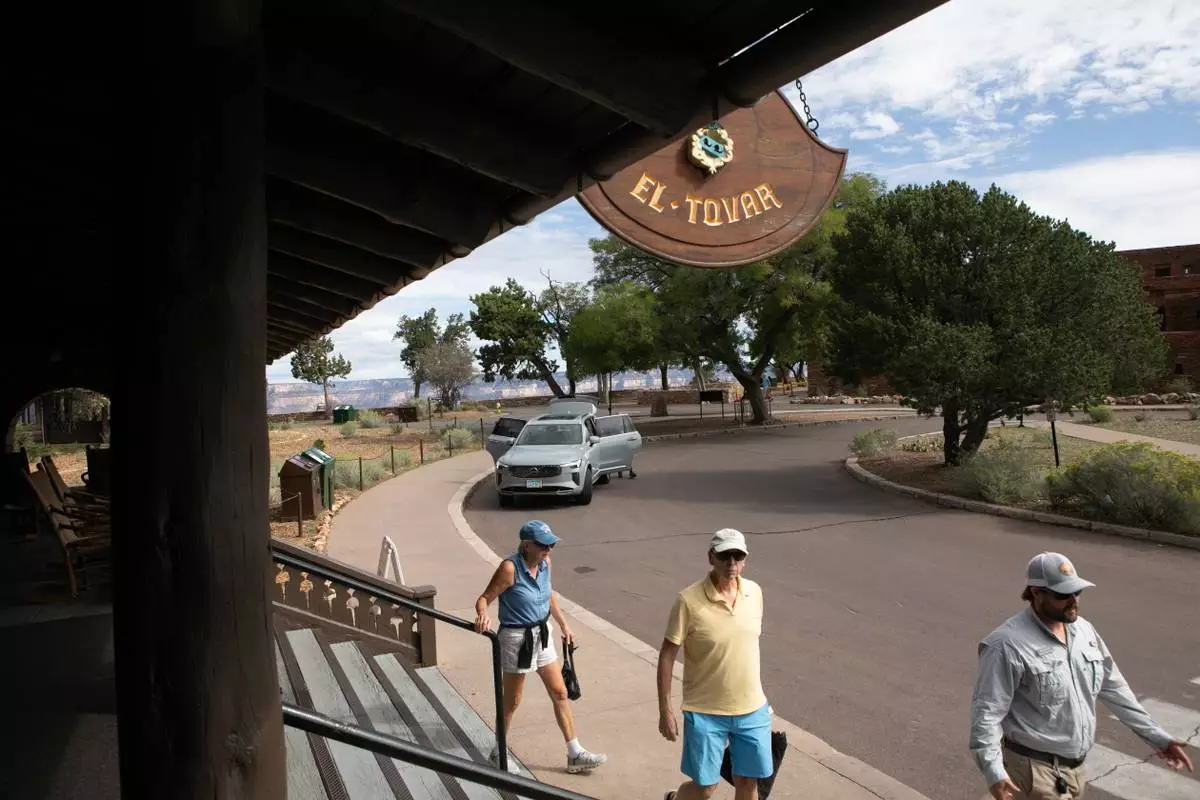
Tourists check out of the El Tovar Hotel as lodging along the rim of the canyon was shut down due to flooding, Monday, Aug. 31, 2026 at Grand Canyon National Park, Ariz. (AP Photo/Josh Biggs)
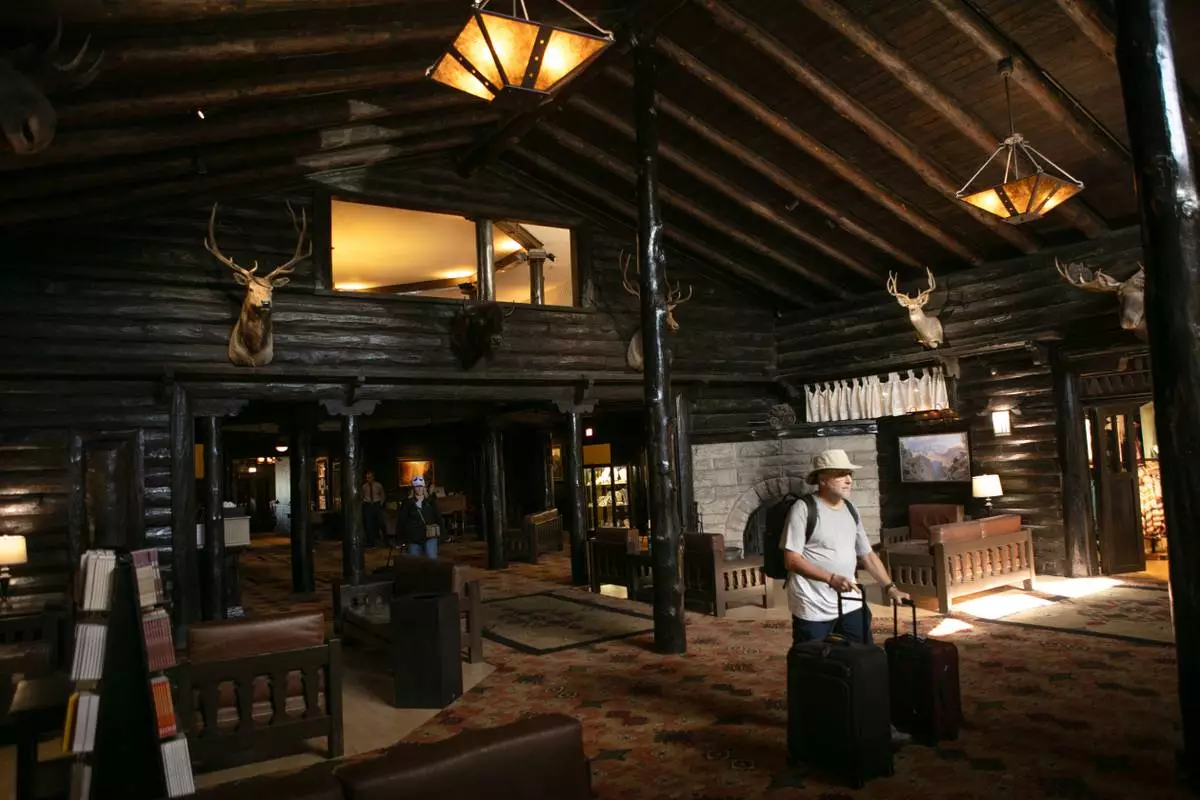
Tourists check out of the El Tovar Hotel as lodging along the rim of the canyon was shut down due to flooding, Monday, Aug. 31, 2026 at Grand Canyon National Park, Ariz. (AP Photo/Josh Biggs)
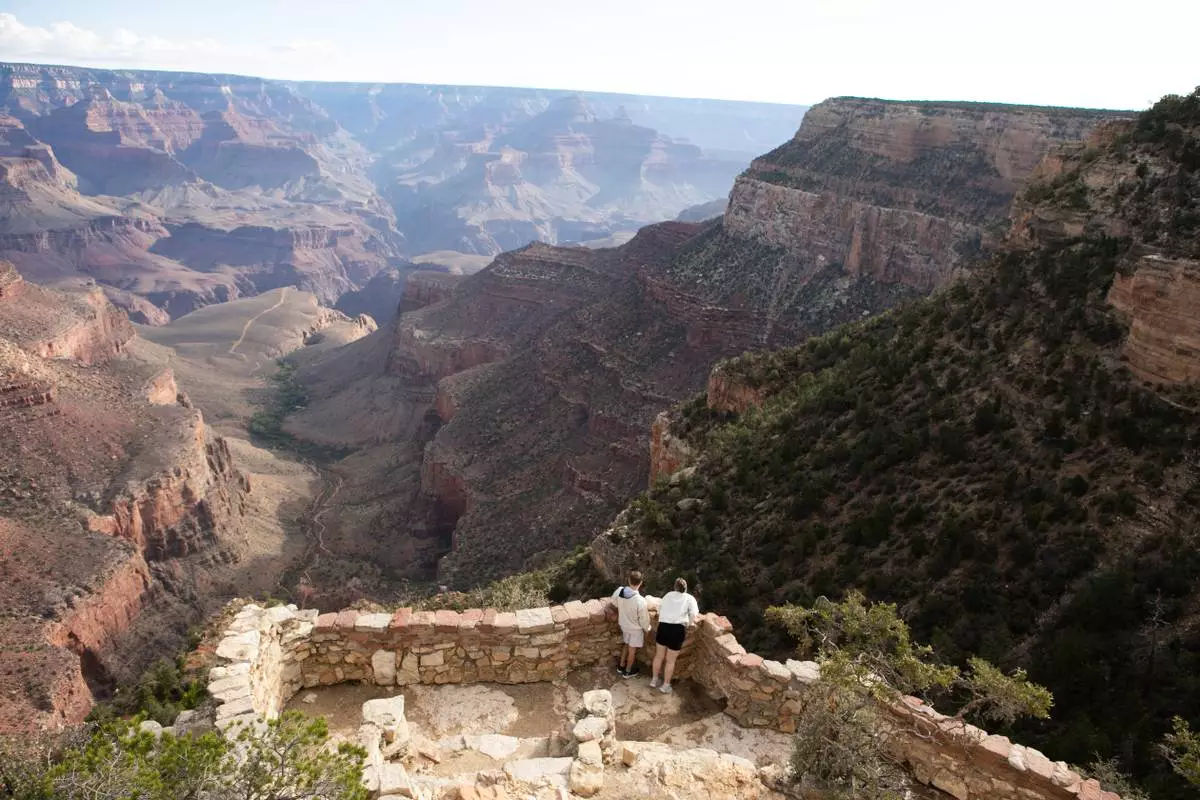
Tourists look down into the Grand Canyon off of the south rim, Monday, Aug. 31, 2026 at Grand Canyon National Park, Ariz. (AP Photo/Josh Biggs)
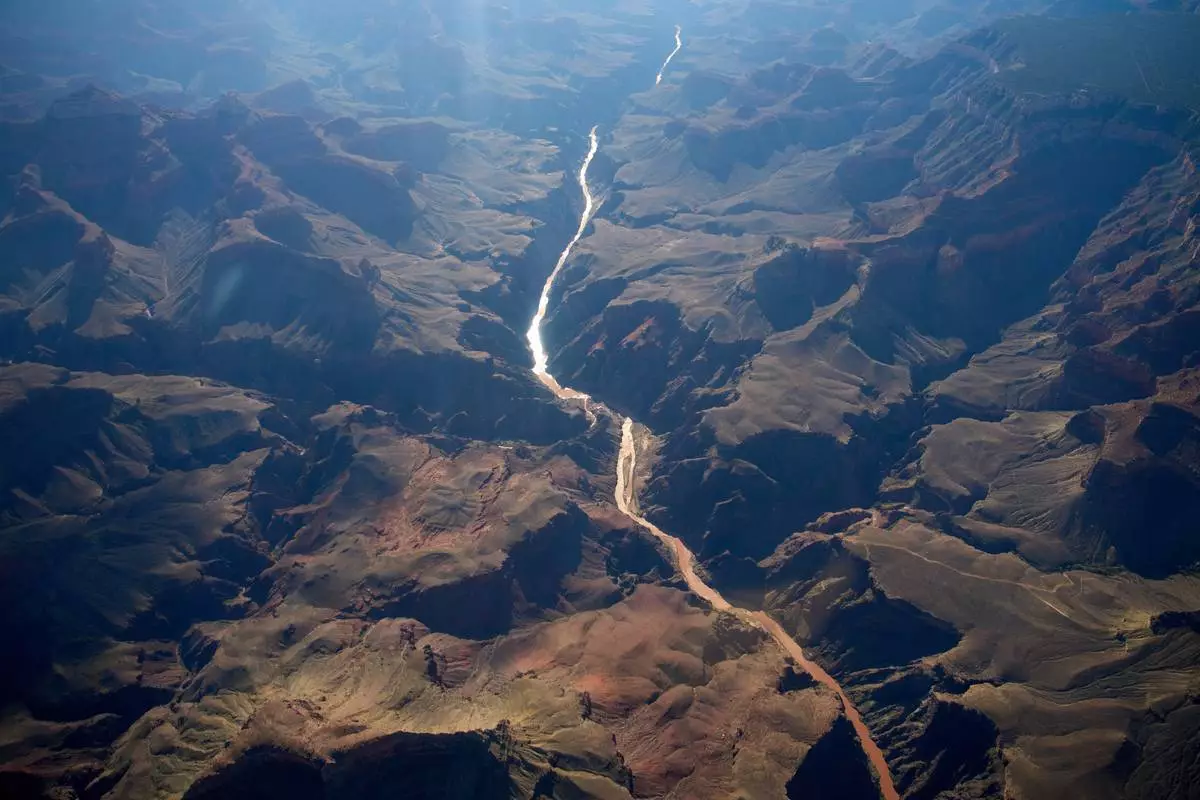
Bright Angel Canyon, middle left, the scene of flash floods, meets with the Colorado River in the Grand Canyon, Monday, Aug. 31, 2026, at Grand Canyon National Park, Ariz. (AP Photo/John Locher)
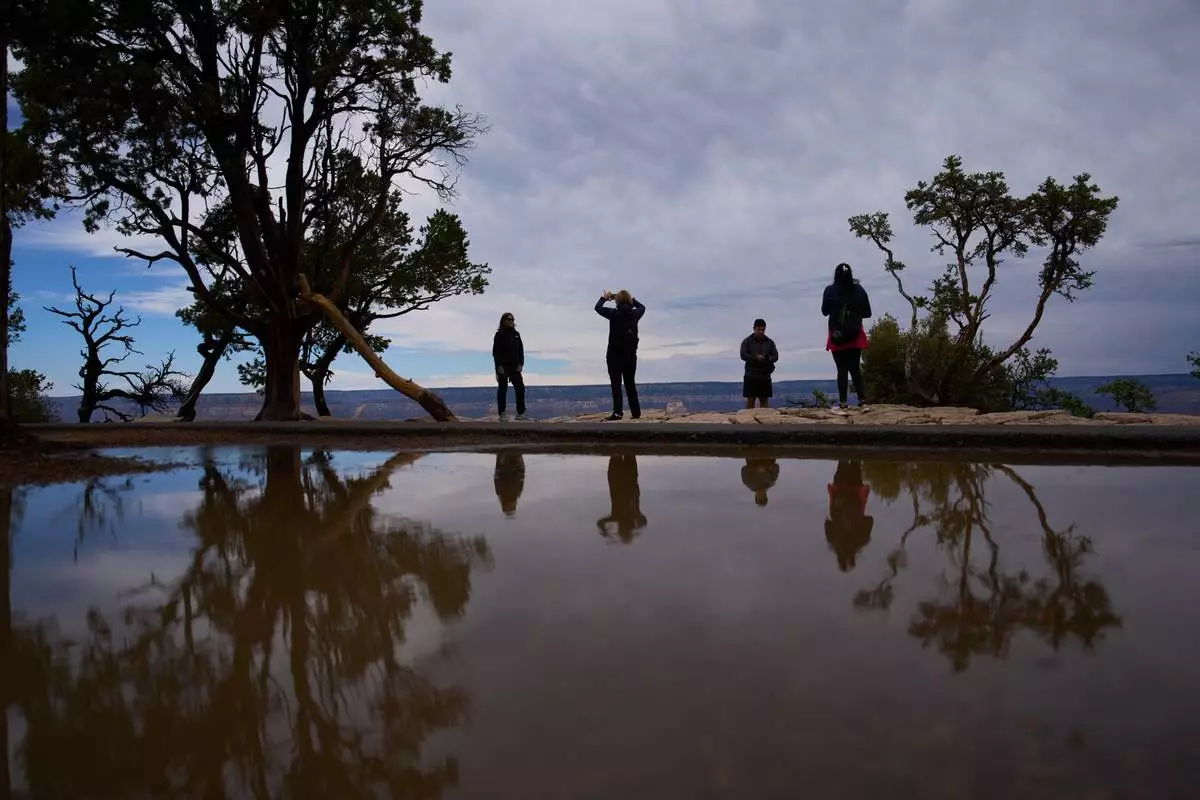
People stand at the rim of the Grand Canyon, Monday, Aug. 31, 2026, in Grand Canyon National Park, Ariz. (AP Photo/John Locher)
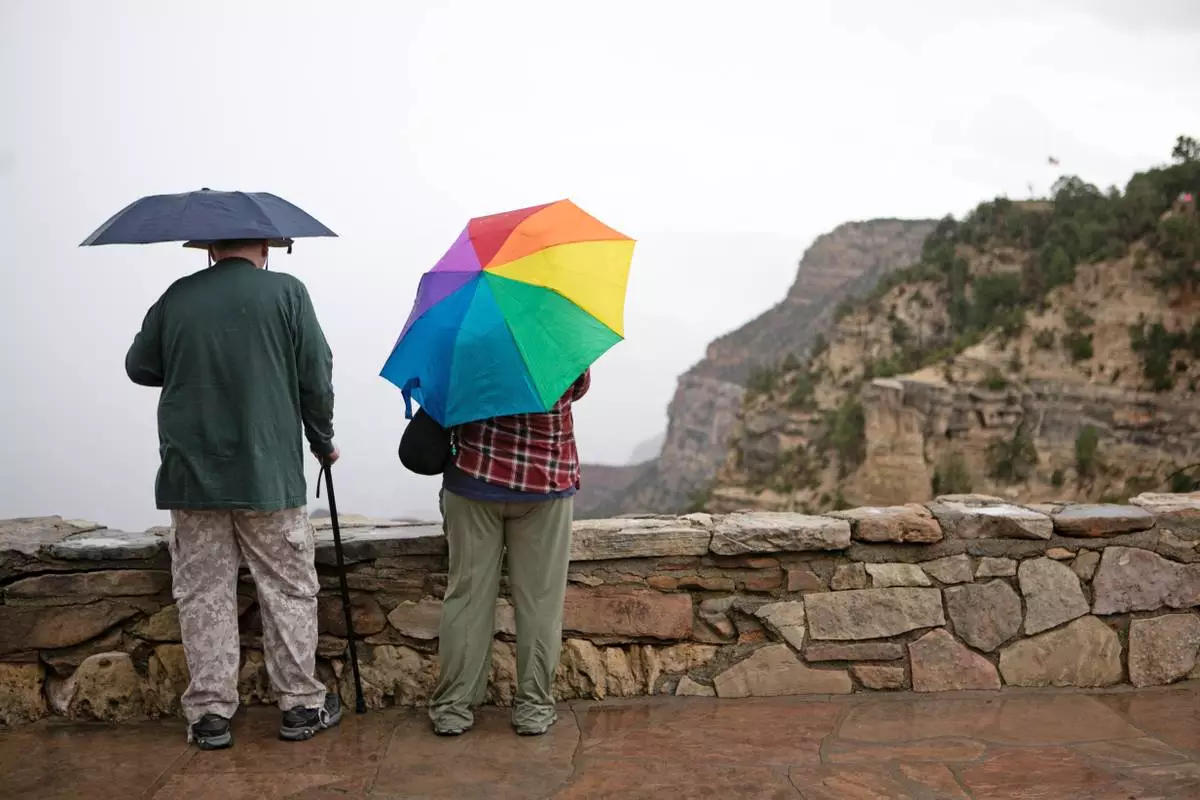
Tourists look over the rim of the Grand Canyon in the rain, Monday, Aug. 31, 2026, in Grand Canyon National Park, Ariz. (AP Photo/Josh Biggs)
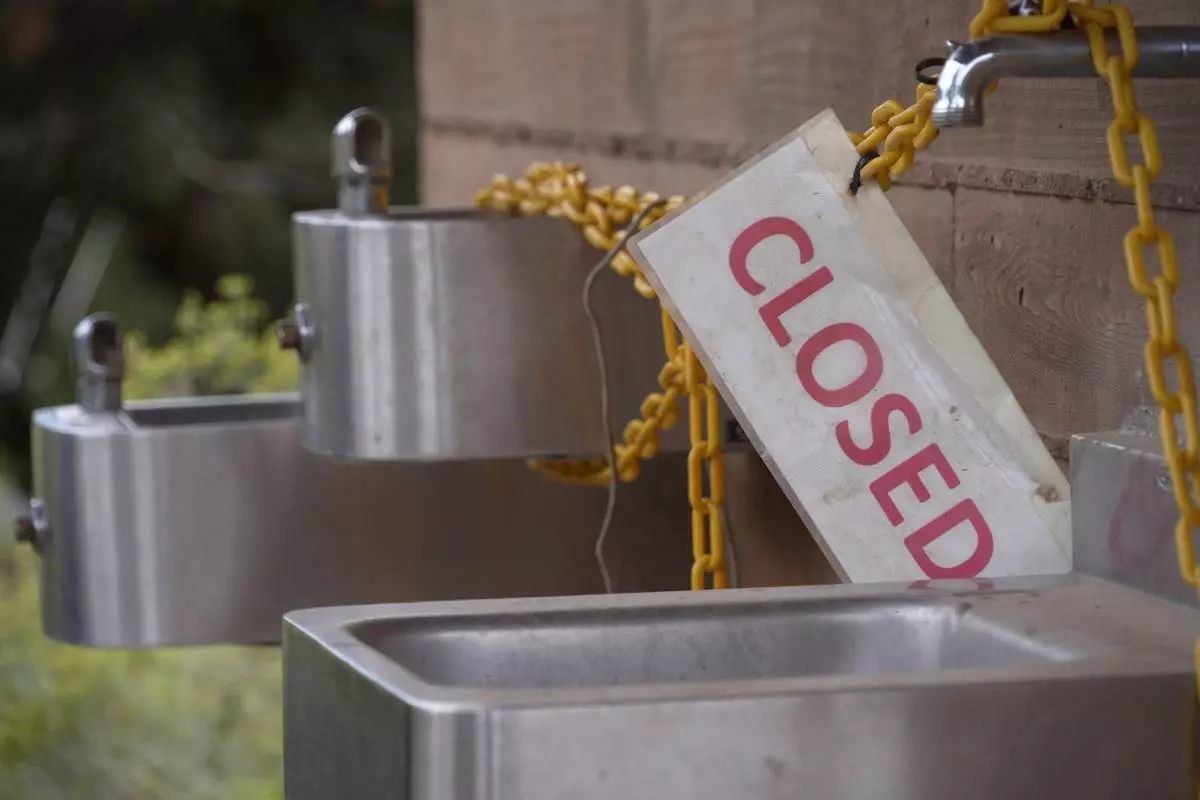
A sign is seen as officials at Grand Canyon National Park in northern Arizona have closed off access to water sources at the park after a flash flood damaged the only water pipeline that serves the canyon, Monday, Aug. 31, 2026. (AP Photo/Ty ONeil)