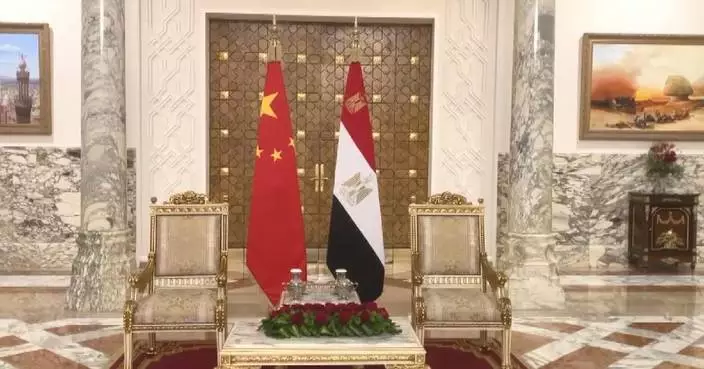
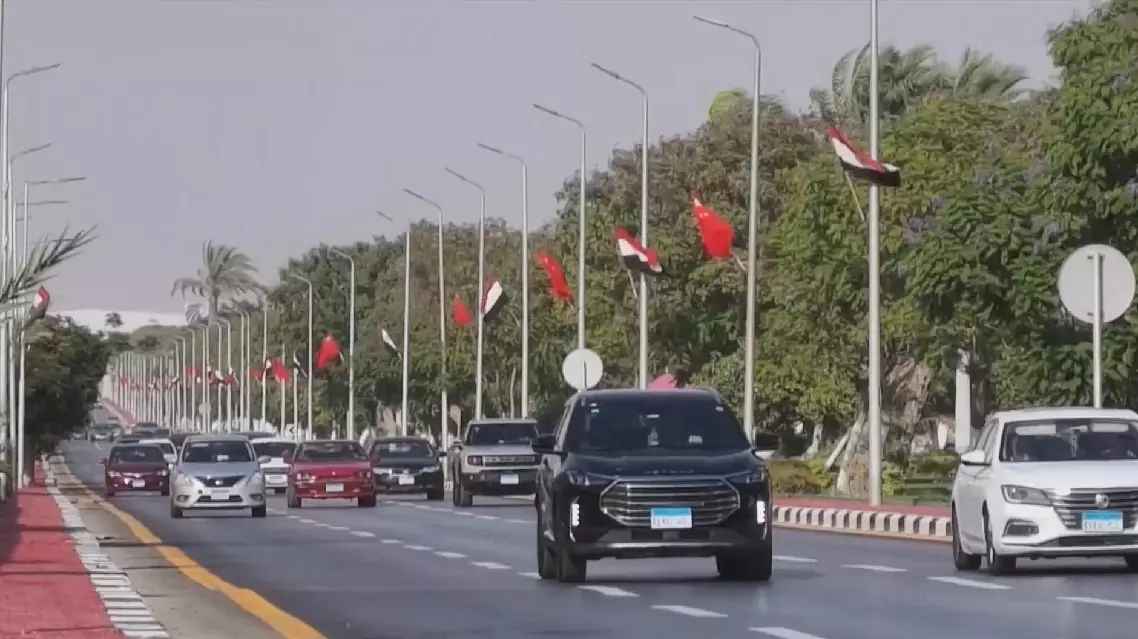
Chinese President Xi Jinping arrived at the Al-Ittihadiya Palace in Cairo, Egypt on Wednesday morning to attend a welcome ceremony hosted by Egyptian President Abdel Fattah El-Sisi.
The limousine carrying Xi and his wife, Peng Liyuan, was escorted by motorcycle convoy and met by a cavalry guard of honor upon arrival at the palace.
Xi arrived in Cairo on Tuesday evening to pay a state visit to Egypt at the invitation of Sisi.
The trip marks Xi's first state visit to the country in a decade, and coincides with the 70th anniversary of the establishment of diplomatic relations between China and Egypt.

Xi arrives at Cairo's Al-Ittihadiya Palace to attend welcome ceremony

Xi arrives at Cairo's Al-Ittihadiya Palace to attend welcome ceremony
Egypt's former Prime Minister Essam Sharaf has emphasized that mutual trust built through leadership diplomacy forms the key foundation of Egypt-China relations, as he called for deeper Africa-China cooperation and joint efforts to promote dialogue which can deliver peace in the turbulent Middle East.
Ties between China and Egypt are in the spotlight as Chinese President Xi Jinping arrived in Cairo Tuesday evening to pay a state visit at the invitation of President Abdel Fattah El-Sisi.
It marks Xi's first trip to Egypt in a decade and coincides with the 70th anniversary of the establishment of bilateral diplomatic ties between the two sides.
In a video interview with the China Media Group (CMG) ahead of Xi's visit, Sharaf reflected on the history of relations, and pointed to the consistently strong relationship between the two countries' leaders which has allowed ties between these two ancient civilizations to flourish from friendship into a comprehensive strategic partnership in the modern age.
"For me, the keyword in China-Egypt relations is 'trust'. For 70 years, our leaders have remained in close contact. This has helped the relationship grow from friendship into a comprehensive strategic partnership. Leadership gives the relationship direction, but trust gives it strength and continuity. And when trust exists between leaders, it gradually reaches institutions, businesses and, most importantly, the people. That's why I believe trust is the real foundation in China-Egypt relations," he said.
Turning his attention to the wider African continent, Sharaf also gave his assessment of how China's partnership with Africa, which has the largest concentration of developing nations, has been evolving.
In 2024, China elevated bilateral relations with all African countries with whom it holds diplomatic ties to the strategic level, while the overall positioning of China-Africa relations was raised to an all-weather China-Africa community with a shared future for the new era.
Another pivotal move came in May this year, when China implemented zero-tariff treatment for all its strategic partner nations in Africa with whom it holds diplomatic ties in a further sign of deepening economic cooperation.
Sharaf says this all points to how China-Africa cooperation is advancing and becoming more sustainable, with the relationship shifting from China merely providing development assistance to now pursuing joint development.
"For me, the important changes is very clear. China-Africa relations are moving from assistance to development partnership. Greater access to the Chinese market can support African exports, investment, and local production. But we should go further from trade to industry, from infrastructure to technology, and from individual projects to stronger development capacity, that all should be shared as sustainable development, development that creates opportunities for everyone," he said.
Sharaf also noted Egypt's unique position as not only an important African country but also a significant Arab nation. Against the backdrop of the current turbulent and unstable situation in the Middle East, the former prime minister believes that strengthened Egypt-China cooperation can help play an active role in restoring regional peace and stability during these challenging times.
"In today's Middle East, I believe dialogue is more important than ever. Egypt has deep experience in this issue. China has strongly supported political and peaceful solutions. Together, the leaders can help keep the diplomatic channels open, reduce tensions and encourage dialogue because peace cannot be built by one country alone. Peace needs dialogue, peace needs trust and peace needs shared responsibility," said Sharaf.
Former Egyptian PM highlights historic trust in Egypt-China relations