Company Maintains Steady Revenue Momentum Following Recent Acquisitions
DUBAI, UAE, Sept. 2, 2026 /PRNewswire/ -- Robo.ai Inc. (Nasdaq: AIIO) ("Robo.ai" or the "Company"), a UAE-based Nasdaq-listed company, today provided an update on its revenue performance following its acquisition of Quantum Core Capital Limited ("QC Capital"). This update reflects the Company's continued progress in expanding its businesses and integrating recently acquired operations as it builds toward establishing technology-empowered platforms spanning artificial intelligence, robotics & smart mobility, advanced manufacturing, and digital assets & capital.
For the three-month period from June through August 2026, Robo.ai recorded total revenue of over US$180 million, primarily contributed by QC Capital, which the Company acquired on June 15, 2026. Since the acquisition, the Company has sustained steady operations and continued to deliver revenue, with the new business contributing meaningfully to overall growth.
"Since completing the acquisition in June, we have seen steady operating momentum and continued revenue contribution from our acquired business," said Benjamin Zhai, Chief Executive Officer of Robo.ai. "Our overall revenue performance over the past several months gives us greater confidence in the progress we are making and provides a solid foundation for our next stage of development. We remain focused on disciplined execution and integration, while continuing to strengthen our business and build on this momentum as we work toward sustainable growth."
The revenue information presented in this press release is preliminary and unaudited and has not been reviewed by the Company's independent registered public accounting firm. The information may be subject to adjustment in connection with the Company's financial closing and review procedures.The consideration shares for the QC Capital acquisition are subject to a phased, revenue-linked release mechanism, as previously disclosed on Form 6-K on June 18, 2026.
About Robo.ai Inc.
Robo.ai Inc. (Nasdaq: AIIO), headquartered in Dubai, United Arab Emirates, is a Nasdaq-listed technology group building intelligent infrastructure across four platforms: artificial intelligence; robotics and smart mobility; advanced manufacturing; and digital assets and capital. Its industrial group, Alif Holding, is dedicated to building intelligent industries through the development, integration and manufacturing of AI systems, serving government, public sector and mission-critical domains. Through its subsidiary Neurovia AI, the Company develops AI software and visual data infrastructure. Quantum Core Capital ("QC Capital"), its AI-powered deep-tech holding and venture-building platform, incubates, invests in and operates businesses across artificial intelligence, robotics, digital infrastructure and the next-generation digital economy.
Forward-Looking Statements
This press release contains statements that may constitute "forward-looking" statements pursuant to the "safe harbor" provisions of the U.S. Private Securities Litigation Reform Act of 1995. These forward-looking statements can be identified by terminology such as "will," "expects," "anticipates," "aims," "future," "intends," "plans," "believes," "estimates," "targets," "likely to," "challenges," and similar statements. Robo.ai may also make written or oral forward-looking statements in its periodic reports to the U.S. Securities and Exchange Commission (the "SEC"), in its annual report to shareholders, in press releases and other written materials, and in oral statements made by its officers, directors, or employees to third parties. Statements that are not historical facts, including statements about Robo.ai's beliefs, plans, and expectations, are forward-looking statements. Forward-looking statements involve inherent risks and uncertainties. A number of factors could cause actual results to differ materially from those contained in any forward-looking statement, including but not limited to the following: Robo.ai's strategies, future business development, and financial condition and results of operations; Robo.ai's limited operating history in its current business; Robo.ai's ability to generate positive cash flow and profits; Robo.ai's ability to compete successfully; Robo.ai's ability to build its brand and withstand negative publicity; and changes in customer demand and government incentives, subsidies, or other favorable government policies. Further information regarding these and other risks is included in Robo.ai's filings with the SEC. All information provided in this press release is as of the date of this press release, and Robo.ai does not undertake any obligation to update any forward-looking statement, except as required under applicable law.
For investor and media inquiries, please contact:
For investors:
Robo.ai Inc. Investor Relations
E-mail: ir@roboai.group
For media:
Robo.ai Inc. Corporate Communications
E-mail: pr@roboai.group
Website: www.roboai.group
** This press release is distributed by PR Newswire through automated distribution system, for which the client assumes full responsibility. **

Robo.ai Inc. Reports More Than US$180 Million in Revenue for June-August Period
Researchers at Allora Labs demonstrate that intentionally worsening individual AI models through genetic mutations improves their collective performance
NEW YORK, Sept. 2, 2026 /PRNewswire/ -- Current AI systems are limited by their inability to adapt when the world they were trained on changes. A new paper by the Chief Scientist at Allora Labs proves mathematically that this fundamental limitation can be overcome using the same evolutionary principles that generated intelligence in nature. The research shows that introducing deliberate random mutations into a population of AI models enables the population to collectively outperform any single optimized model as the world around it changes. The paper is titled "Flawed in Nature, Perfect through Evolution" and is published in the journal Allora Decentralized Intelligence.
"Any single AI model, no matter how well trained, accumulates error the moment the world it was trained on changes," says Dr. Diederik Kruijssen, Chief Scientist at Allora Labs and the paper's author. "This is an inescapable information-theoretic ceiling. We prove that a population of deliberately diversified models breaks through that ceiling, for the same reason that biological species survive environmental change. They exhibit pre-existing variation, some of which is well-suited to the post-change world."
The key insight draws directly from evolutionary biology. In nature, species maintain genetic variation through mutation. Most mutations are harmful to the individual organism, but the population benefits because some variants happen to be well-suited to new conditions when the environment shifts. This research demonstrates that the same principle applies to AI model populations: each mutated model is individually worse, but the best model in the mutated swarm outperforms the best model in an optimized swarm approximately 80% of the time when conditions change.
"The idea that individual imperfection enables collective adaptation is well-established in evolutionary theory, but seeing it formalized with mathematical guarantees for artificial systems is a significant step. This work opens a new dimension for thinking about AI robustness under changing conditions."
— Prof. Steven Longmore, Liverpool John Moores University, AI-driven biodiversity conservation
The paper's four mathematical theorems prove, step by step, that no single model can escape this performance ceiling, and that a population of mutated models provably breaks through it. Numerical experiments validate all four theorems, with the mutated swarm's combined output outperforming the original at high statistical significance.
The advantage peaks when the rate at which models mutate roughly matches the rate at which the environment is changing: a "Goldilocks zone" that mirrors evolutionary dynamics. The optimal regime is broad: there is about a hundredfold range around the peak, and the penalty for mutating too slowly is gentle, while mutating too fast degrades performance sharply. This forgiving behavior opens up practical applications.
Nick Emmons, CEO of Allora Labs, says about the work: "As AI systems are deployed in financial markets, healthcare, autonomous vehicles, and other environments that change constantly, the inability to adapt to shifting conditions has become their primary failure mode. Most AI research focuses on making individual models bigger and faster. We think the bigger gain is in how populations of models interact and evolve, and this work proves that's the right perspective."
"The qualities we associate with intelligence, like originality, adaptability, and creativity, all require the ability to perform well under conditions you've never encountered before," says Dr. Kruijssen. "Current AI models can't do that. They replicate what they've learned, but they don't adapt to the unknown. A population of evolving models can. That's what this work demonstrates, and it's what evolution has been doing for billions of years."
The paper outlines several future directions, including the application of the Flawed-in-Nature principle to large language models through fine-tuning methods, its extension to decentralized AI networks, and the development of a controller algorithm that tunes mutation strength automatically without requiring knowledge of how the environment changes. "A result like this opens up so many downstream directions," adds Dr. Kruijssen. "Our team has already built the controller that makes this principle work in practice, and the work on several concrete applications has started too."
About Allora Labs
Allora Labs is the main developing contributor to Allora Network, a decentralized AI inference network that harnesses a globally distributed community of machine learning models to produce highly accurate, context-aware predictions in real time. Founded by CEO Nick Emmons, Allora Labs conducts research in swarm intelligence, model coordination, and inference synthesis. The company has partnered with organizations including AWS, Alibaba Cloud, Saudi Telecom, and Vodafone's Pairpoint, and has raised backing from investors including Polychain, Framework, Blockchain Capital, and CoinFund. To learn more, visit alloralabs.xyz and allora.network.
About Allora Decentralized Intelligence
Allora Decentralized Intelligence (ADI) is a scholarly research journal publishing innovation in decentralized machine intelligence, model coordination, and swarm intelligence. ADI was founded and is led by Dr. Diederik Kruijssen, Chief Scientist at Allora Labs. He is an AI/ML researcher and astrophysicist with 20 years of experience in state-of-the-art quantitative modeling across research, tech, finance, and web3, and authored more than 300 peer-reviewed publications.
Paper details
- Title: "Flawed in Nature, Perfect through Evolution"
- Author: J. M. Diederik Kruijssen
- Journal: Allora Decentralized Intelligence, Volume 3, 1-32
- Publication date: September 2, 2026
- https://doi.org/10.70235/allora.0x30001
- arXiv:2609.00129
Media contact
Phi Tran
VP of Marketing, Allora Labs
phi@alloralabs.xyz
** This press release is distributed by PR Newswire through automated distribution system, for which the client assumes full responsibility. **
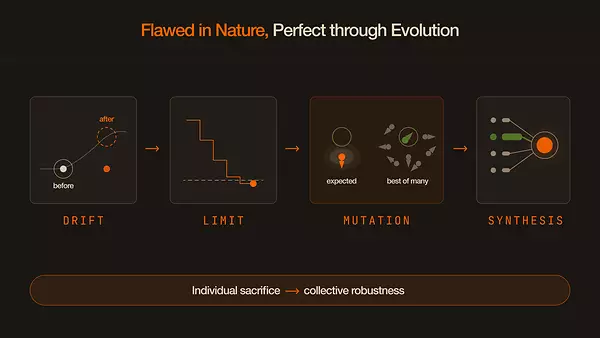
New research proves mutant AI swarms outperform optimized models in a changing world