PASADENA, Calif.--(BUSINESS WIRE)--Sep 2, 2026--
ExchangeRight, one of the nation's leading providers of diversified REIT and DST investments, has announced the full subscription of Net-Leased Portfolio 74 DST. The $63.34 million portfolio, backed by investment-grade tenants operating in necessity-based industries, provides investors with monthly distributions at a current annualized rate of 5.00% covered by in-place lease revenue from the offering. Net-Leased Portfolio 74 DST is a closed offering and is not accepting new investors.
This press release features multimedia. View the full release here: https://www.businesswire.com/news/home/20260902319201/en/
Net-Leased Portfolio 74 was designed with the end in mind, leveraging ExchangeRight's vertically integrated platform and scalable aggregation strategy to structure the offering for a potential future acquisition by the Essential Income REIT. Individual investors are provided with multiple targeted exit options, including a tax-deferred Section 721 exchange into the Essential Income REIT, a tax-deferred Section 1031 exchange, a cash-out, or a combination of these options. There is no guarantee that Net-Leased Portfolio 74 DST's or the Sponsor's objectives, including its exit strategies, will be achieved.
"Net-Leased Portfolio 74 continues our disciplined approach to building diversified portfolios of necessity-based real estate on behalf of investors," said Joshua Ungerecht, a managing partner at ExchangeRight. "By combining long-term net leases with investment-grade tenants successfully operating across historically recession-resilient industries, we aim to provide dependable passive income that can carry investors throughout economic cycles."
The past performance of ExchangeRight and its offerings does not guarantee future performance.
About ExchangeRight
ExchangeRight and its affiliates' vertically integrated platform features more than $7.7 billion in assets under management that are diversified across over 1,400 properties and 30 million square feet throughout 47 states, as of July 31, 2026. ExchangeRight pursues its passion to empower people to be secure, free, and generous through 1031 DST portfolios, Essential Income REIT, and cash management funds, all of which have historically met or exceeded investor projections since ExchangeRight's inception. On behalf of investors nationwide, the company structures and manages net-leased portfolios of assets backed primarily by investment-grade corporations that have successfully operated in the industrial, necessity retail, and healthcare industries. Past performance does not guarantee future results. Please visit www.exchangeright.com for more information.

Net-Leased Portfolio 74 comprises 11 long-term, net-leased properties spanning 11 markets in California, Iowa, Michigan, Mississippi, Nebraska, North Carolina, Ohio, Pennsylvania, and Texas, with a weighted-average lease term of 16.3 years. The portfolio includes $26.75 million in non-recourse debt at a 42.23% loan-to-value ratio. The properties are net-leased to historically recession-resilient national companies including Tractor Supply Company, Dollar General, CVS Pharmacy, and Dollar General Market.
NEW YORK (AP) — Stocks drifted in morning trading on Wall Street Wednesday amid the latest updates on the jobs market and further escalation in the U.S. war with Iran.
The S&P 500 index rose 0.1%. The Dow Jones Industrial Average rose 265 points, or 0.5%, as of 9:58 a.m. Eastern time. The Nasdaq composite fell 0.1%.
Markets were mostly lower in Europe and Asia.
Technology stocks were the biggest force holding the market back. Microsoft fell 0.6% and Broadcom slipped 0.8%. They are among several companies with big market values that tend to have more influence over the market’s broader direction.
Oil prices held relatively steady despite the intensification in the six-month long U.S. war with Iran. The U.S. attacked site in Iran over the weekend, ending a six-month lull in major hostilities and Iran has since retaliated against sites around the Gulf region.
Prices for Brent crude, the international standard, fell 0.5% to $94.71 a barrel. Energy stocks mostly fell. Chevron edged 0.1% lower after confirming it will expand operations in Venezuela.
A surge in oil prices following the start of the U.S. war with Iran fueled a jump in gasoline prices and global shipping costs. The conflict shut down the Strait of Hormuz, through which 20% of the world’s oil is typically shipped.
Higher energy costs worsened inflation that was already stubbornly high amid a volatile U.S. tariff war with much of the world.
Inflation has been squeezing businesses and households at the same time that the mostly resilient jobs market shows signs of weakening. Payrolls processing firm ADP reported that private-sector employment slipped in August, according to its monthly survey. It is just a small snapshot, though, of the broader jobs market and follows a government report on Tuesday that showed U.S. job openings rose in July.
The big focus this week will be the government’s broader monthly employment report for August, which will be released Friday. The previous report for July showed that the jobs market stalled, with employers cutting positions.
Both inflation and the jobs market have been key focuses for Wall Street and the Federal Reserve.
The Fed is trying to balance its task of supporting employment and taming inflation. Wall Street expects the central bank to raise interest rates before the year ends in an effort to cool inflation, which remains well above 3%. The Fed has a stated goal of cooling inflation to a target of 2%.
The bond market has been selling off, which is a signal that it expects borrowing costs to rise.
The yield on the 10-year Treasury, which tends to impact mortgage rates, held steady at 4.79% from late Tuesday. It has been rising steadily throughout the year and was as low as 4.20% at the beginning of 2026.
The yield on the 2-year Treasury, which closely tracks expectations for Federal Reserve moves on interest rates, held steady at 4.39% from late Tuesday. It is significantly higher for the year, though, and was as low as 3.50% at the beginning of 2026.
Investors are also betting on a 66% chance that the Fed will raise rates at its upcoming meeting in September.
The Fed’s position is growing more complicated. Raising the benchmark interest rate would help cool inflation by making borrowing costs higher and slowing the economy. Doing so, though, could also hurt the employment market at a time when it is seemingly already weakening.
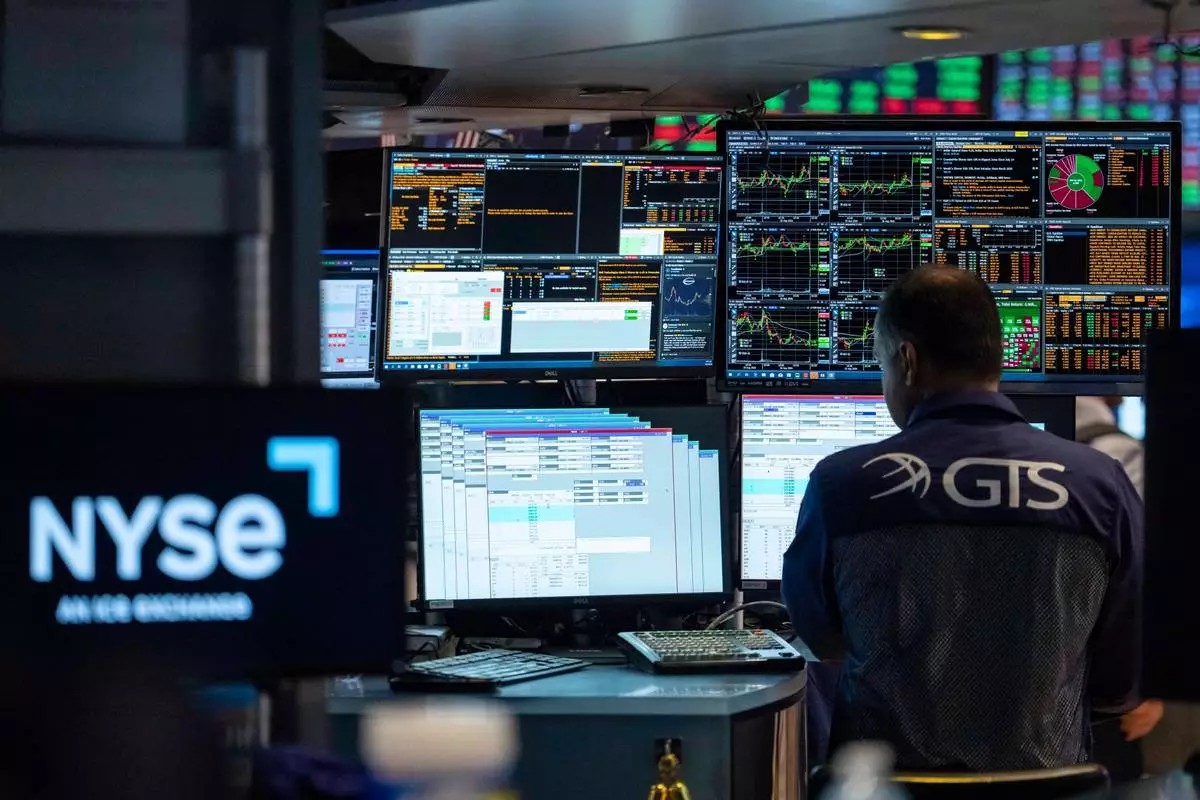
Specialists Dilip Patel works on the floor of the New York Stock Exchange, Thursday, Aug. 27, 2026, in New York. (AP Photo/Yuki Iwamura)
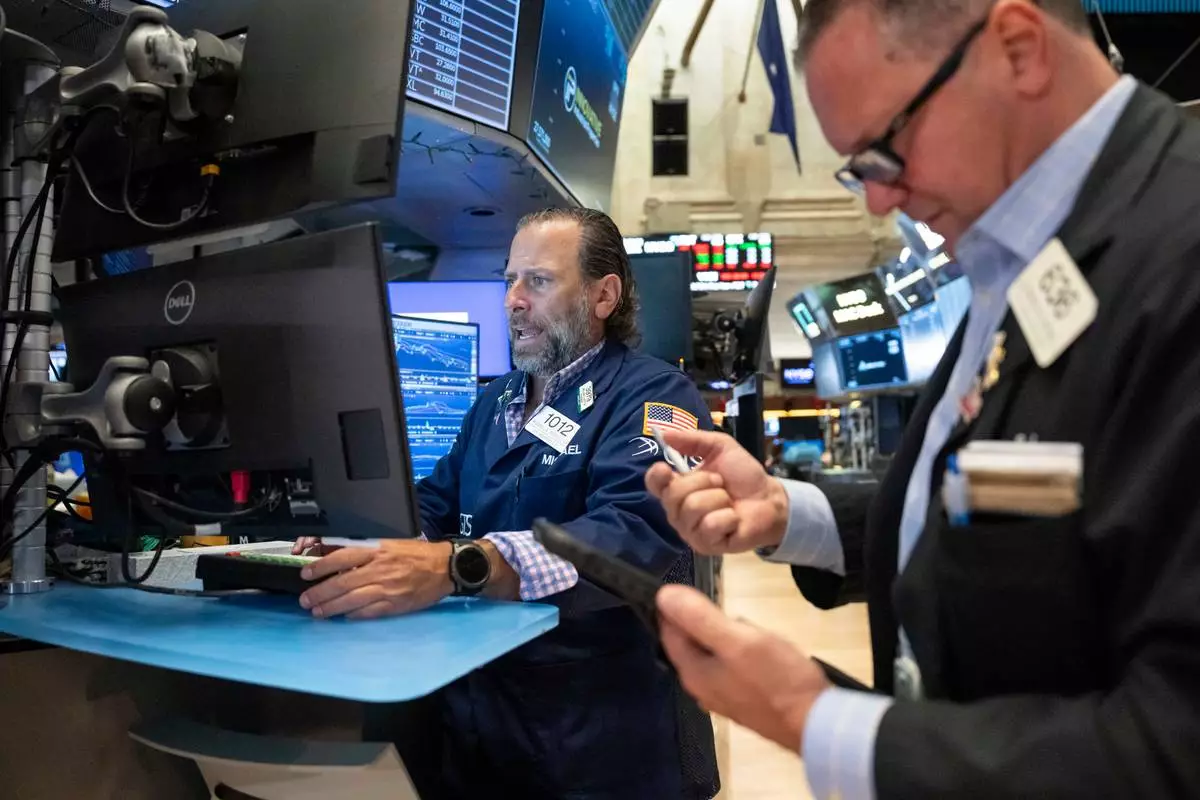
Specialist Michael Pistillo works on the floor of the New York Stock Exchange, Thursday, Aug. 27, 2026, in New York. (AP Photo/Yuki Iwamura)
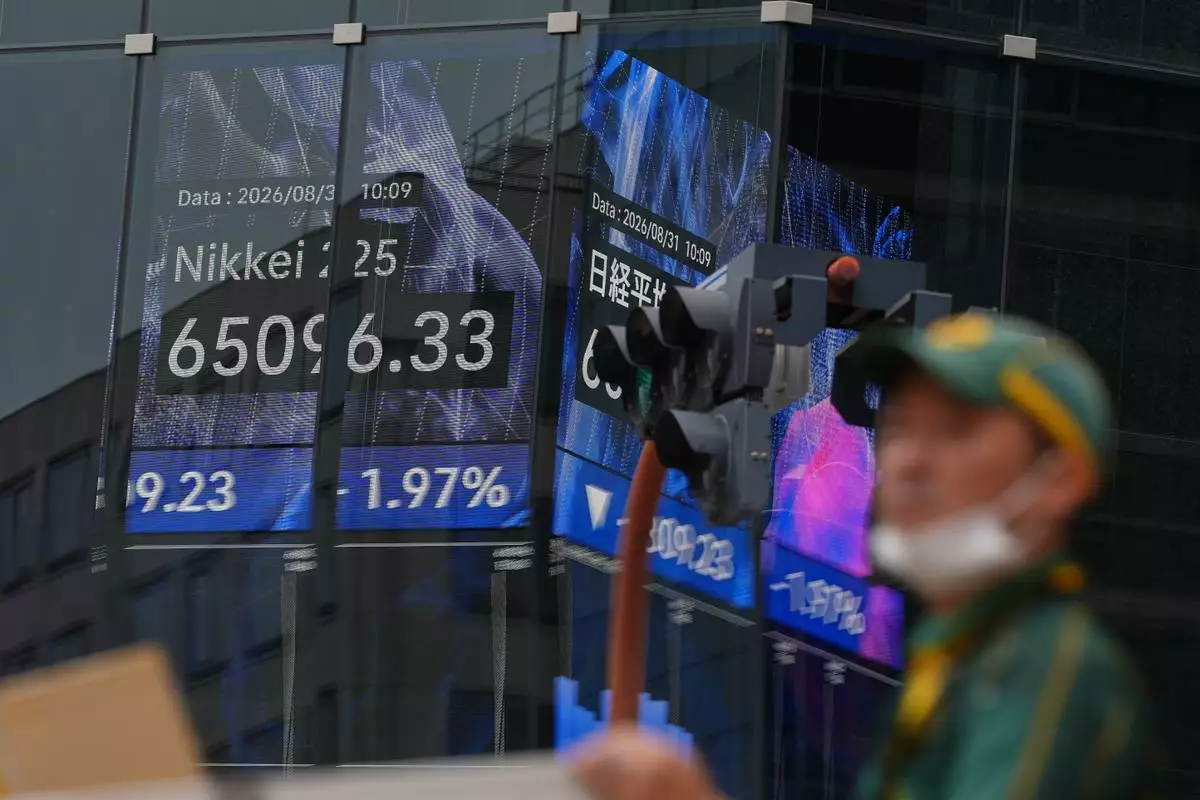
A person walks in front of an electronic stock board showing Japan's Nikkei index at a securities firm Monday, Aug. 31, 2026, in Tokyo. (AP Photo/Eugene Hoshiko)

A person walks in front of an electronic stock board showing Japan's Nikkei index at a securities firm Monday, Aug. 31, 2026, in Tokyo. (AP Photo/Eugene Hoshiko)

Currency traders work at the foreign exchange dealing room of the Hana Bank headquarters in Seoul, South Korea, Wednesday, Sept. 2, 2026. (AP Photo/Ahn Young-joon)

Currency traders work near a screen showing the Korea Composite Stock Price Index (KOSPI) and the foreign exchange rate between U.S. dollar and South Korean won at the foreign exchange dealing room of the Hana Bank headquarters in Seoul, South Korea, Wednesday, Sept. 2, 2026. (AP Photo/Ahn Young-joon)

Currency traders work at the foreign exchange dealing room of the Hana Bank headquarters in Seoul, South Korea, Wednesday, Sept. 2, 2026. (AP Photo/Ahn Young-joon)