One wearable base, interchangeable joint modules and an open platform underneath.
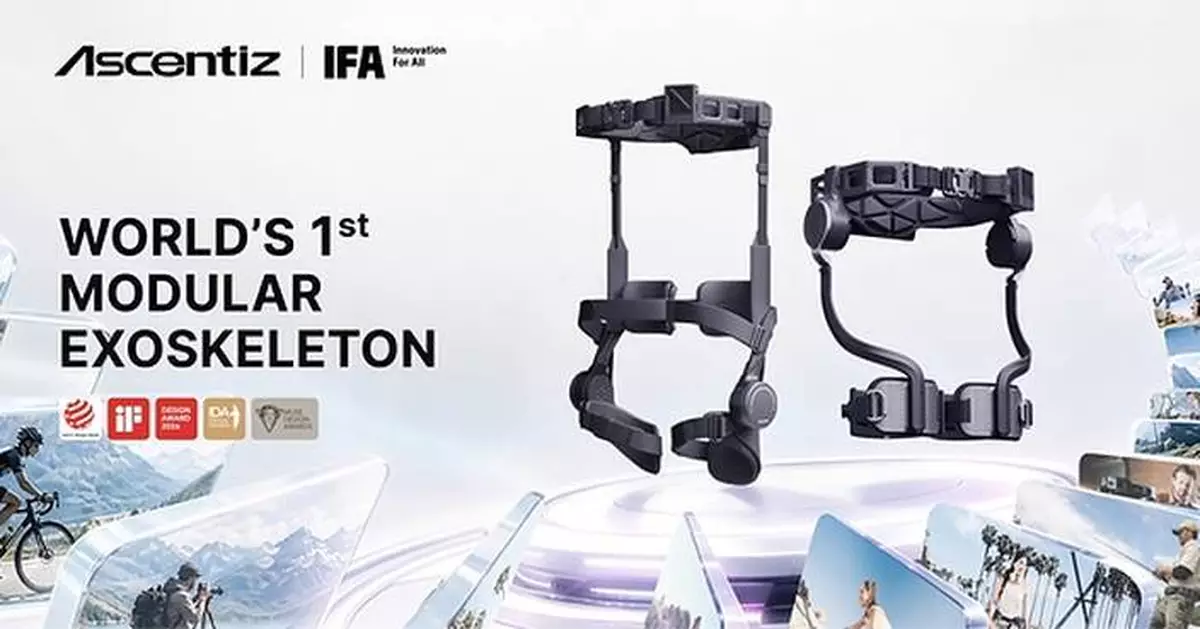
BERLIN, Sept. 3, 2026 /PRNewswire/ -- Ascentiz is bringing its H and K modules to IFA 2026, showcasing the world's first modular exoskeleton platform: one shared Exo-Belt, interchangeable joint modules and an open software platform designed to expand over time.
Ascentiz-H focuses on hip propulsion for walking, climbing, running and faster-paced movement. Ascentiz-K brings Adaptive Knee Augmentation, combining dynamic knee assistance with sustained active support and load management across flat ground, stairs, climbs and descents. Both use Adaptive Motion Intelligence to recognize changing movement conditions and adjust assistance in real time within the user-selected mode.
Why modular
As consumer exoskeletons move toward multi-joint assistance, the category faces an architectural choice: integrate every capability into one fixed full-leg device, or build a shared platform that can be configured around different movement needs.
"We chose modularity because people do not move in one way or need the same assistance all the time," said Cody Kou, Vice President of Ascentiz. "Different activities place different demands on the hips and knees. We believe wearable robotics should evolve with those needs, rather than lock every capability into one fixed device. Our goal is to build a platform that can keep gaining new capabilities over time, rather than asking users to start over with each new generation."
At the center is the Exo-Belt, which carries the battery, controller and algorithms. It can host H, K or both together, with modules swapped by hand in seconds through the MOLLE quick-release structure. H drives the wearer forward and upward, while K adds adaptive knee assistance, support and controlled braking where knee load and impact increase.
BodyOS: the foundation for what comes next
Running beneath the hardware is BodyOS, Ascentiz's common software and control foundation for modular wearable robotics. Together with AZ-Lock at the mechanical layer and CAN-FD at the electrical and communication layer, it provides a shared framework for H, K and future modules to operate on the same platform.
Open-sourced in 2026, BodyOS is designed to let the system keep growing through software updates, new Ascentiz modules and hardware developed by the wider research and developer community.
Ascentiz will showcase H and K at IFA Berlin, September 4–8, Hall 12, Booth 109.
Pricing and Availability
Ascentiz-H is available now through Ascentiz's store, priced at €1,599 for H Pro and €2,299 for H Ultra.
Ascentiz-K is priced at €2,399 for K Pro and €2,999 for K Ultra, while H+K configurations are €3,599 for Pro Combo and €3,999 for Ultra Combo.
K and H+K availability will be announced soon.
About Ascentiz
Founded in 2023, Ascentiz is dedicated to transforming advanced robotics into accessible, user-centric exoskeleton technology. Our mission is to empower individuals to climb higher, go further, and unlock new physical potential in their everyday lives and adventures. We believe in augmentation without complexity, creating lightweight, intuitive interfaces that seamlessly integrate into any lifestyle.
Learn more at ascentizexo.com.
** This press release is distributed by PR Newswire through automated distribution system, for which the client assumes full responsibility. **
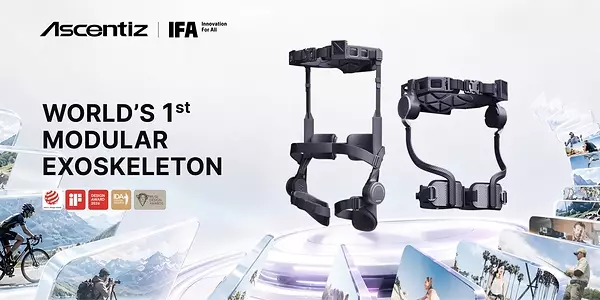
Ascentiz Brings H + K to IFA 2026, Showcasing the World's First Modular Exoskeleton Platform
New optical/electrical solution aggregates two simultaneous MIPI-DPHY camera streams, at up to 10 Gbps each, over two serialized links while consuming less than 100 mW per link, eliminating bulky cable bundles with optical fiber or differential copper connectivity. Discover more: https://silicon-line.com/msdl
MUNICH, Sept. 3, 2026 /PRNewswire/ -- EverProX Technologies Munich GmbH, under its Silicon Line® brand—a pioneer in ultra-low-power optical and electrical interconnect technology—today announced the launch of "MSDL™ 20G" which is the first product in the new MSDL™ family, an end-to-end interconnect chipset comprising the SL8582x serializer and SL8581x de-serializer. Engineered to overcome the bandwidth, EMI, and reach limitations of traditional MIPI D-PHY signals, the dual-port chipset delivers up to two simultaneous 10 Gbps serialized links for next-generation vision systems.
Breaking Physical Cabling Bottlenecks
As high-resolution multi-camera systems and high-frame-rate displays drive rapidly increasing bandwidth requirements, traditional copper cabling is increasingly constrained by limited reach and susceptibility to electromagnetic interference (EMI). The "MSDL™ 20G" chipset, comprising SL8582x serializer and SL8581x de-serializer resolves this by aggregating multi-stream video over optical fibers or differential copper pairs, extending link distances to tens of meters while eliminating bulky, shielded cable bundles. The highly integrated architecture delivers ultra-low-power consumption in both optical and electrical modes, with total SerDes power well below 100 mW per 10 Gbps link.
Executive Perspective
"Physical AI is changing the way electronic systems are built. We are seeing more and faster cameras, more sensors, and greater intelligence distributed across devices," said Yifeng Liann, CEO and Managing Director of EverProX Technologies Munich GmbH. "As systems get smarter, moving high-bandwidth data between devices reliably and in real time becomes increasingly challenging. Engineers must balance the flexibility to connect across different subsystems, the reliability that mission-critical applications cannot always get from wireless, and the ultra-low power needed to make it all practical. That's the problem the Silicon Line® team set out to solve: making high-bandwidth connectivity more energy-efficient, more reliable, and easier to integrate into the next generation of intelligent systems."
Key Technical Highlights
- Dual-Port Multi-Camera Aggregation: Supports up to two simultaneous transmissions of single- or stereo-camera streams over one or two serialized links, with one transmission per link
- Optical or Copper Connectivity: Integrated VCSEL drivers and TIA enable optical links over tens of meters, while supporting differential copper links up to 2 meters
- Ultra-Low Power: Consumes just 71 mW per optical link and 87 mW per electrical link, excluding the integrated Sideband SerDes:
- Optical Mode: Serializer 17 mW, De-serializer 54 mW (Typical)
- Electrical Mode: Serializer 27 mW, De-serializer 60 mW (Typical)
- Integrated Bidirectional Sideband SerDes: Transports I²C, GPIO, digital audio, SPI/control signals and sensor clocks alongside MIPI data, reducing cable count, connector complexity, and system components.
- Target Applications:
- AR/VR: Enables lighter, more flexible tethering and greater mobility
- Medical Endoscopy: Supports 4K/8K imaging, ultra-low heat generation, and thin optical connectivity
- Industrial Robotics and Machine Vision: Delivers reliable, EMI-immune high-speed vision connectivity in electrically noisy environments
- Defense and UAVs: Provides lightweight, low-power multi-camera connectivity that reduces cable weight and increases battery life
- Optical Mode: Serializer 17 mW, De-serializer 54 mW (Typical)
- Electrical Mode: Serializer 27 mW, De-serializer 60 mW (Typical)
- AR/VR: Enables lighter, more flexible tethering and greater mobility
- Medical Endoscopy: Supports 4K/8K imaging, ultra-low heat generation, and thin optical connectivity
- Industrial Robotics and Machine Vision: Delivers reliable, EMI-immune high-speed vision connectivity in electrically noisy environments
- Defense and UAVs: Provides lightweight, low-power multi-camera connectivity that reduces cable weight and increases battery life
Availability & Ecosystem Support
The MSDL™ 20G (SL8582x&SL8581x) are sampling now with early-access customers in bare die or compact 4×4 mm µBGA-78 packages. Evaluation Kits (EVKs) are available now for link validation. Backed by EverProX's turnkey assembly, customers can transition seamlessly from IC design to mass production. For more information, visit https://www.silicon-line.com/ or contact sales@silicon-line.com.
About EverProX Technologies Munich GmbH and Silicon Line®
Silicon Line® — a brand of EverProX Technologies Munich GmbH — is a leading IC developer of ultra-low-power optical and electrical interconnect solutions for high-speed video and data transmission. Based in Munich, Germany, the Silicon Line® portfolio includes ultra low power MIPI SerDes ICs (from MSDL™ 2G up to MSDL™ 20G), TIA&VCSEL drivers that enable ultra-thin, lightweight, and EMI-immune active optical cables (AOCs) and embedded optical links for VR/AR, medical, industrial, robotics, defense and consumer markets.
Media Contact:
Emre Oralli
Product Marketing Manager
EverProX Technologies Munich GmbH / Silicon Line®
Email: emre.Oralli@silicon-line.com
Phone: +49 151 20620735
** This press release is distributed by PR Newswire through automated distribution system, for which the client assumes full responsibility. **
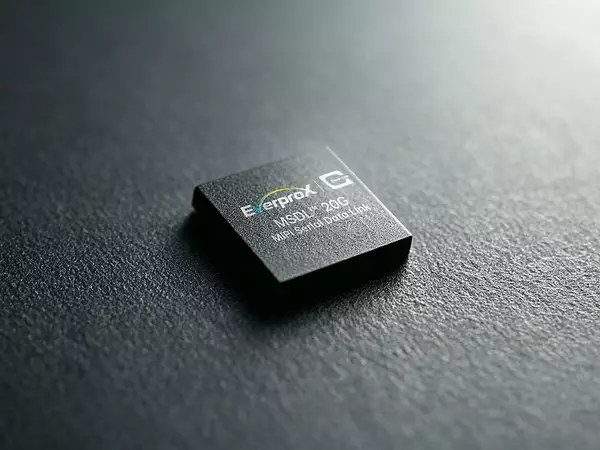
Silicon Line®, an EverProX® brand, Launches new Ultra-Low-Power SerDes Chipset MSDL™ (MIPI Serial Data Link), Extending 20 Gbps MIPI D-PHY Connectivity to Tens of Meters